"There are two kinds of Malibu. There is the beach Malibu. And there
is the rocks and cactus and coyote-ate-the-cat kind of Malibu."
–Malibu mayor Jeff Jennings
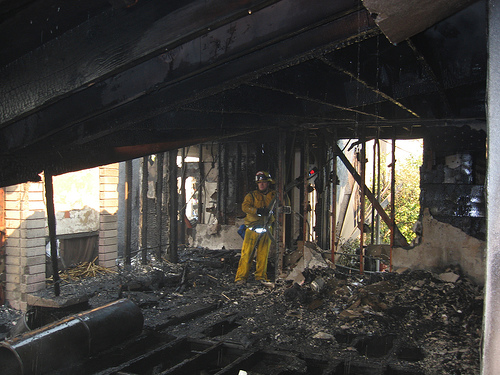
Guess which one burned?
Picture from firefighter Nancy Jackson’s Flickr set:
A Change in the Wind
W. S. Di Piero, a favorite poet, published in Poetry (10/06) a wonderful selection of his notebooks, written during a moody stay in San Francisco. It’s not available on-line, unfortunately, but a key segment deserves recapitulation here nonetheless. What I wish to bring to your attention is his discussion of how our inner weather determines what we make of the landscape we see outside. It’s finely wrought.
To wit:
The mind freights weather with its own confabulations and anxieties. Serial rainstorms here in San Francisco, intermittent blue mist — the Asian mist of screen-paintings of hillsides — infiltrating trees in Golden Gate Park. The lull between storms softens things. Then the rain starts up again like cat-o’-nine-tails thrashing my windows. A certain kind of depression, my kind — a Motown-ish lyrics: "My kind, my kind, my kind" — brings episodes that beat against the coastline of the sane or balanced self, baffled just so by meds and the talking cure. It’s not curable because it’s the nature of that particular self. (Or, in my mental menagerie: the dragon of chaos must be fed, else he rip apart every order he sees; he never goes away, he sleeps in the gate.) Late one night, writing, I start to break up (who knows why? unknowability is pain’s core; sobbing is the stupefied noise pain makes) and so lie on the floor waiting for the waves, the dragon-ish sea, the un-nameable hurt, to pass over…
Clinical melancholia doesn’t color one’s feeling for reality, it determines it.
Or, as a friend of mine — one who doesn’t believe in global warming — put it more crudely: "Global warming is an issue for liberals, but that’s because liberals have issues."
Would that we all could wave it off so easily! But he’s not entirely wrong, either. How do we distinguish between the fate we fear and fear itself? Science, I say, but scientists too have moods sometimes…
While visiting the great Edward Weston at the Getty, saw another astonishing photo exhibit by the daringly amoral photographer Luc Delahaye. As this fascinating story in Artnet about a gallery show four years ago reveals, he worked as a war photographer in Bosnia, but after a few years there had to give up the traditional photojournalist belief that taking pictures of horrors would help anything. With this abdication of hope, he found his voice — a disturbing one. For me his most memorable picture in the exhibit was the one below, of a dead Taliban Soldier, lying in a ditch, completely at ease.
Coincidentally, a report in the Washington Post yesterday said that according to intelligence and military sources, we are winning the battles in Afghanistan, but losing the war.
U.S. troops number more than 25,000 and make up the largest contingent
of the 41,000-member NATO force in Afghanistan. NATO officers say they
have eliminated Taliban leaders and fighters in higher numbers than in
any previous year. But such claims of success reflect "a very tactical
outlook in a game that is strategic," said a former U.S. senior
commander in Afghanistan who shares many of the intelligence
community’s concerns. "I have a lot of respect for [Taliban] strategy,"
he said. "These guys are not cowardly by any stretch of the
imagination."
Looks that way, doesn’t it?

John Howard lost not only his position as prime minister of Australia last week, but even his long-held seat in parliament — a defeat widely described as "humiliating." His support for the war in Iraq and against action to reduce the risks of climate change had a lot to do with that humiliation. For those of us living far away from Australia, John Quiggin succinctly defines Howard’s blase attitude towards the climate crisis neatly in a pre-election newspaper column. Quiggin concludes:
Nothing sums up the government’s position better than Howard’s response
to the IPCC report. After noting the serious of the challenge, Howard
observed that ‘the world is not coming to an end tomorrow’. Indeed not,
but Australian voters might prefer a leader who can look a little way
beyond tomorrow.
One thing we know for sure: the world is not coming to an end today, but John Howard’s world pretty much is. And isn’t that the nature of life for all of us? It’s not the world at large that matters, but the little world we live in.
In this new century, those who will not face change will have to suffer the consequences.
That’s what Texas photographer Kelli Connell depicts in a compelling series of photographs, some of which can be found in an interesting exhibit at the Nathan Larramendy Gallery in Ojai. As I mention in the story for the Ventura County Reporter:
One of the most striking displays in Larramendy’s small but
appealing gallery is a trio of large digital photographs by Kelli
Connell. Each of the photographs shows the same two women; in one, they
appear to be a mother and daughter, and are snuggled together, looking
directly at the camera.
In another photograph, they are together in a bathroom, looking as
relaxed in each other’s company as lovers, and one of the two women is
in the tub. In a third, titled “Kitchen Tension,” they are trading
edgy, over-the-shoulder glances.
But look closer at these photographs, and it slowly becomes apparent
that something is wrong — in fact, these two women are one and the
same, digitally manipulated to share the same space.
To Larramendy, the photographs document a relationship that an individual has with himself (or in this case, with herself).
“It’s about that person who is always two steps behind you,” he said.
But who is that person two steps behind us? Our conscience? Our
memory of a favorite lover? Our anxiety? The question has no single
answer, but that is part of the reason these photographs lodge so
firmly in the memory. Using one model, a digital camera and Photoshop, Connell has found a way to make vivid our inner rush of thoughts — no small feat.
Here’s the one where I first realized that something was going on. Guess it took the nudity to make me slow down and really look at the photograph. Okay, so I’m a little shallow. So shoot me.

Novelist Kim Stanley Robinson explains in an essay available for forty-nine cents on Amazon how he came to write a science fiction trilogy about global warming:
Somehow my job has made me think about climate change
for years now. I spent most of the 1990s writing a trilogy about the
human inhabitation of Mars; my characters in those books were part of a
huge multi-generational effort to change the climate on Mars, by
melting its ice and pumping its frozen atmosphere back into the skies.
All this was part of the science fictional enterprise that Jack
Williamson named "terraforming" in a story he wrote in the 1930s.
Terraforming is climate change with a vengeance, and pretty early in
the process of writing my Mars books, while reading about the various
environmental problems that were going to be caused by global warming,
it occurred to me that we were already terraforming Earth, in the here
and now, but by accident, and in ignorance of how it worked or what
might happen. All the aspects of terraforming were already present in
one form or another: we alter the Earth’s surface faster than any
natural process, we’re altering the chemical composition of the
atmosphere, making it more of a greenhouse than it was before, and this
change in turn is altering the chemical composition of the ocean, which
is rapidly becoming more acidic. Most of these processes are
destructive to the biological communities already in place, on land and
in the seas; and so the first result of our inadvertent terraforming
seems likely to be a mass extinction event, an extinction to rival the
huge mass extinctions that ended the Cretaceous and the Permian.
The human species itself is not likely to escape such an event
unscathed; we live on the top of a food chain that might be damaged or
might even crash in such an extinction event. This was a dark thought,
and as I wrote my Mars novels it was always present in my mind that
what I was describing as happening on Mars—the conscious and successful
management of an entire planet’s biosphere—might serve as a model for
what we will have to do on Earth too. In that sense as well as others
they were utopian novels, and I believe part of their popularity is due
to this fairly obvious analogy to our current situation.
Then
also, as I went for my runs on the ultra-flat floor of the Central
Valley of California, I would occasionally glimpse the Sierra Nevada to
the east, white with snow even in summer. One time during these years I
read a scientific study that suggested that global warming would impact
California more severely than most places, because only a slight rise
in average temperatures would change most of the snow falling on the
Sierra to rain, so the precipitation would quickly run off, and the
mountains would no longer serve as an immense reservoir through the dry
summers, and California would become even more of a desert than it
already is. People would have to leave—I didn’t care about that,
because too many people have moved to California anyway and it needs an
exodus—but the high Sierra meadows would likely die in the summer
droughts. I love those high meadows, and the thought that I might be
part of the last generation to see them, that the beautiful high Sierra
might become like the blasted wastelands of Nevada, filled me with rage
and grief.
"Rage and grief" because he cares, natch. Poet Gary Snyder, who lives in those Sierras, seems more sanguine about their fate. I wish I shared his optimism…and need to read Robinson’s trilogy.
From rcribbett’s photostream, the fire yesterday in Malibu, as seen from about 10-15 miles south in Playa Del Ray:

Visited the world famous La Brea tar pits of LA today (which are still bubbling methane quite merrily) and learned that indeed California did once have an indigenous turkey, but that it has gone extinct. After WWII the more familiar wild turkey from the East was introduced in various parts of the state, and naturalized readily — to the dismay of many in upscale Marin County. "Libidinous to a fault," "defiantly pecking," and "frightening" were words used in a story from the San Francisco Chronicle five years ago.
But birder Don Roberson makes the interesting argument that the turkey brought to California might be the same species that once roamed pre-human Los Angeles, about 10,000 years ago, and therefore the bird was actually reintroduced to one of its many ancestral homes, before being isolated from its eastern cousins.
Guess I’ll let the experts decide that one. But for a chuckle, check out one of the top ten bizarre experiments of all time, in which two researchers at Penn State set out to find out scientifically how picky male turkeys were about female turkeys. Would they mate with a female turkey without a tail?
Um, yes. Without wings? Yep. Without feet? Uhuh. Would they make love to a turkey head stuck on a stick? You betcha. How about with a withered male head on a stick? They would try. How about with a female head two years old, withered, discolored, and hard? Sure thing. How about with a balsa wood copy of a turkey head on a stick. No doubt about it.
Comments New Scientist:
Before we humans snicker at the sexual predilections of turkeys, we
should remember that our species stands at the summit of the bestial
pyramid of the perverse. Humans will attempt to mate with almost
anything. A case in point is Thomas Granger, the teenage boy who in
1642 became one of the first people to be executed in Puritan New
England. His crime? He had sex with a turkey.
(h/t: SciGuy)
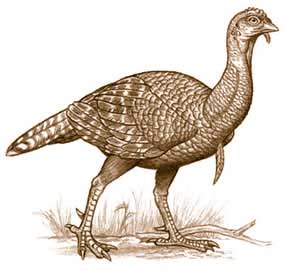
Here’s a picture of the sexy California Turkey from 10,000 years ago — which may be pretty much the same bird who today can be found fouling cars on Mt. Tam. Don’t get crazy, now.
The best coverage I’ve seen on the humiliating defeat of right-wing Australian PM John Howard comes from the Wall Street Journal, which forthrightly highlights the global warming side of the picture:
Unlike his rival [Howard], Mr. Rudd promised to ratify the
Kyoto Protocol, the 1997 international accord aimed at reducing
greenhouse gas emissions. Doing so will deprive the U.S. of one of its
key supporters on climate change issues and put new pressure on the
Bush administration ahead of an important meeting next month (DEC 3-14)
in Bali, Indonesia, where world leaders will discuss what to do when
the Kyoto Protocol expires in 2012. The Bush administration has so far
refused to ratify the Kyoto plan.
[In his acceptance speech] Mr. Rudd vowed to be a prime minister for "all Australians" and
highlighted some of his policy priorities, including a promise to act
with "great urgency on the challenge of climate change."
More on this and other intriguing topics as soon as the Thanksgiving family tumult passes.
Truly original thinkers come up with lots of ideas and inevitably, some of them are pretty wacky. This site features lots of Tom Toles: here he’s so far outside the box one has to wonder a little…but it stuck with me, this morning when the stock market headed negative for the year, so it’s worth a mull or two.


 Kit Stolz