The Dangerous Allure of the World Trade Center

No better way to gauge the worth of a book has ever been found than the test of time, and John McPhee’s work stands up spectacularly well, I think it’s fair to say, in this passage from a book he published back in l973. It’s called The Curve of Binding Energy, and it’s about the danger of small nuclear weapons constructed by the likes of terrorists, but below is the passage that most stands out, late in the book, about McPhee and physicist Ted Taylor driving into Manhattan, and seeing the World Trade Center:

The book works on several levels: as a factual warning, as a character study, and as pure writing in the non-fiction genre. Because the passage is long, I’m going to put most of it below the fold, but I guarantee, you will not regret the time spent reading it:

Driving down from Peekskill…we found ourselves on Manhattan’s West Side Highway just at sunset and the beginning of dusk. There ahead of us several miles, and seeming to rise right out of the road, were the two towers of the World Trade Center, windows blazing with interior light and with red reflected streaks from the sunset over New Jersey. We had been heading for midtown but impulsively kept going, drawn irresistibly toward two of the tallest buildings in the world. We went down the Chambers Street ramp and parked, in a devastation of rubble, beside the Hudson River. [The buildings were still under construction at the time.] Across the water, in New Jersey, the Colgate sign, a huge neon clock as red as the sky, said 6:15. We looked up the west wall of the nearest tower. From so close, so narrow an angle, there was nothing at the top to arrest the eye, and the building seemed to be some sort of probe touching the earth from the darkness of space. "What an artifact that is!" Taylor said, and he walked to the base and paced it off.

We went inside, into a wide, uncolumned lobby. The building was standing on its glass-and-steel walls and its elevator core. Neither of us had been there before. We got into an elevator. He pressed, at random, 40. We rode upward in a silence broken only by the muffled whoosh of air and machinery and by Taylor’s described where the most effective place for a nuclear bomb would be. The car stopped, the door sprang back, and we stepped out into the reception lounge of Toyomenka America, Inc., a Japanese conglomerate of industries. No one was behind the reception desk. The area was furnished with inviting white couches and glass coffee tables. On the walls hung Japanese watercolors. We sat down on one of the couches. "The rule of thumb for a nuclear explosion is that it can vaporize its yield in mass," he said. "This building is about thirteen hundred feet high by two hundred by two hundred. Its average density is probably two pounds per cubic foot. That’s a hundred million pounds, or fifty kilotons — give or take a factor of two. Any explosion inside with a yield of, let’s say, a kiloton would vaporize everything for a few tens of feet. Everyting would be destroyed out to and including the wall. If the building were solid rock and the bomb were buried in it, the crater radius would be a hundred and fifty feet. The building’s radius is a hundred feet, and it is only a core and a shell. It would fall, I guess, in the direction in which the bomb was off-centered. It’s a little bit like cutting into a big tree…An explosion in this building would not be completely effective unless placed in the core. Something exploded out here in the office area would be just like a giant shrapnel bomb. You’d have half a fireball, and it would crater down…

We went back to the elevator, and when the car stopped for us it was half filled with Japanese, who apparently quit work later than anyone else in world trade. Thirty-eight floors we feel toward the earth in a cloud of Japanese chatter, words come off the Otis walls like neutrons off a reflector. In the middle of it all, I distinctly heard one man say a single short sentence in English. He said, "So what happened then?"


Why Radiohead Is Giving Away Their Record

Somebody–the ever-thoughtful Ann Powers at the Los Angeles Times–finally gets to the heart of the reason why Radiohead is selling their new record for whatever price you’re willing to pay.

It’s about the album. They want you to appreciate the record as a whole. They think rock music is about art and exploration, not just machine-assembling catchy jingles, er, songs. 

"In Rainbows" is different because it’s that most old-fashioned of
commodities — a new studio album. A fetish object of the classic-rock
era, the studio album allows artists to firmly mark career high points
while offering listeners a sustained experience, much like a novel or
film.

For about the millionth time, a debate focuses on questions of money, industry, and novelty, ignoring art and truth. Thank God for the idealism of Yorke and his brainy co-conspirators.  I look forward to finding out what they mean by the title "In Rainbows." Sounds like beauty, doesn’t it?

Inrainbows

The Return of the Wild

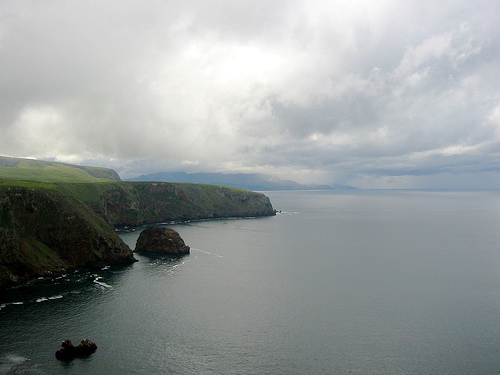
The Channel Islands, off the coast of Southern California, turn out to be shockingly big and wild and, with the exception of Catalina, undeveloped. Nonetheless some of the best lands, such as Santa Cruz Island, have been ravaged by decades of ranching — 100,000 sheep at one point. But in the last twenty years, under the careful stewardship of The Nature Conservancy and the National Parks Service, the wild foxes and oaks and other native species have begun to return, as shown in a nice long piece by Jon Krist of the Ventura County Star. He spent two days exploring the island with the land manager: I’m jealous!

Here’s a picture of a fragmant of the Santa Cruz island coastline from boompomdoink. It’s not the most spectacular choice, but it will give some concept, I hope, of the enormity of the place.

Santacruzisland

Largest Fire Ever on North Slope of Alaska

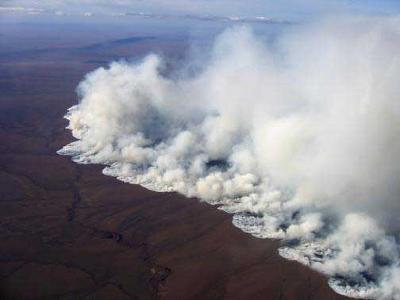
According to the AP, the largest tundra fire ever recorded in Alaska is currently burning on the North Slope, and will likely continue to burn for several weeks.

Just last week, a forestry professor from Juneau testified before Congress on global warming and the changes it is bringing to Alaska, in a story reported in the Anchorage Daily News:

"The bottom line is, it is warmer, and it is
warmer a whole lot more," said Glen Juday, a professor of forest
ecology at the University of Alaska Fairbanks. "The warming is very
substantial, in temperature terms, and has reached, the last few years,
the highest values in the record."

The higher temperatures mean that permafrost
will melt, Juday said, simply because the sustained cold temperatures
needed to keep it frozen will no longer exist.

His most recent studies show that higher
temperatures have led to an increase in tundra fires; when tundra
burns, it also releases a tremendous amount of stored carbon dioxide.
This year alone, 100,000 acres of tundra burned, Juday said.

"The tundra is starting to burn and that
means, potentially, a very large amount of carbon could be released in
the atmosphere," further concentrating greenhouse gases in the
atmosphere, and further contributing to global warming, he said.

Here’s a photo of the fire from the Bureau of Land Management:

Tundrafire

Sunday on the Planet: The Twilight Wedge

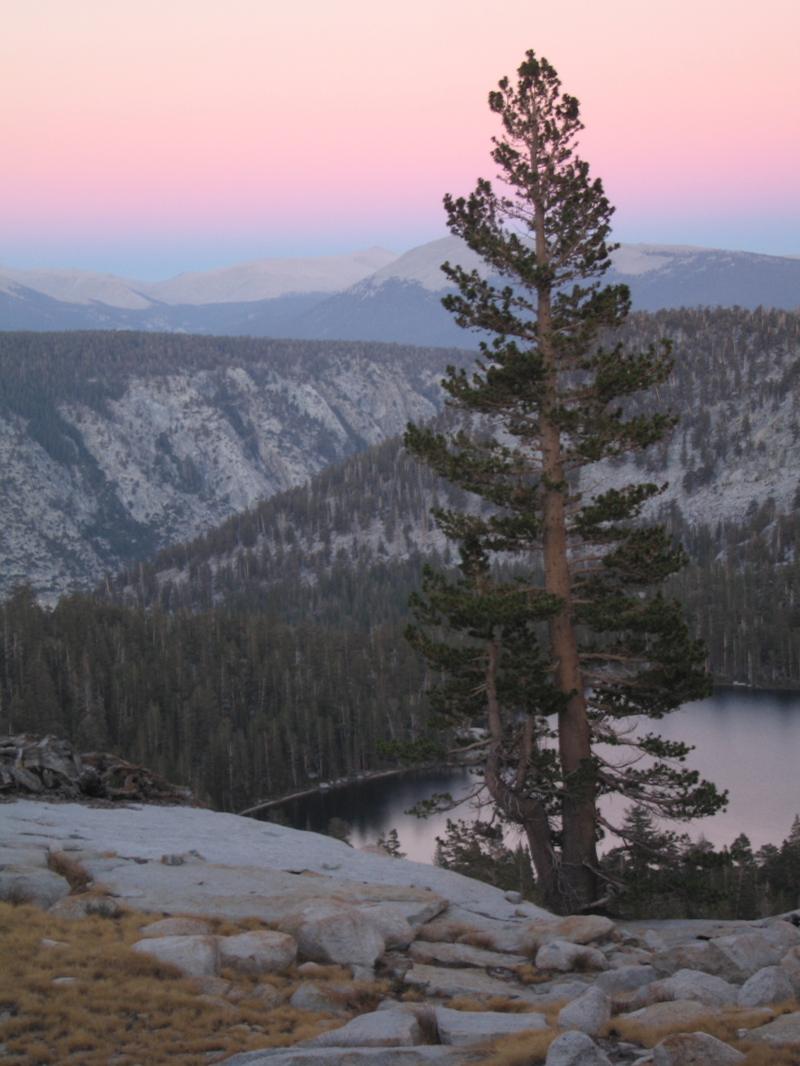
Below is a phenomena I  have seen only in my so-called "Secret Camp," which I learned this week, can be attributed to the fact that only in this location am I likely to be looking many miles east during a sunset.

I thought that the sky was blue at the horizon, and pink above, because the scattering of the long rays of the setting sun simply didn’t reach the horizon. But no! A meterologist explains it this way:

Looking WEST you see the effects of scattering with blue skies above the reddening (pink) sunset sky near the horizon as only the longer wavelengths (red) reach our eyes through the denser air near the surface. Looking EAST, the sunlight is also scattered, changing from blue to the longer wavelength (reddish or pink). Then below that is the rising shadow of the earth against the sky called the twilight wedge, again bluish.

Got that? Let me put it this way: it’s easier to remember than to explain:

Img_2841

Limbaugh Calls Climate Science “Phony”

Earlier this week, right-wing talk radio host Rush Limbaugh got in trouble for calling soldiers in Iraq opposed to the war "phony."

Yesterday he called the science of ozone depletion to be "phony" and the science of climate change to be "fraudulent." Limbaugh went on to accuse Dr. James Hansen, America’s top climatologist, of being "dishonest," compared him to a "CIA double agent," and said he should be "drummed out of NASA."

Does anyone take Limbaugh seriously anymore? Apparently, the answer is yes. For the open-minded interested in the facts, please see the rest of the post on Gristmill: