How To Avoid Becoming a Victim of Global Warming

Extreme heat is the prediction for the weather in the Ojai Valley this July 4th and for the next few days, according to the National Weather Service. Cooling is expected on the weekend, but not before.

On Friday… the forecast calls for a few degrees of cooling in most
areas… but it will still be hot… with temperatures between 105 and
110 degrees in the Antelope Valley… and between 100 and 105 degrees
at lower elevations in the mountains. Even the warmest locations
in the valleys will likely have temperatures around 100 degrees
on Friday. More significant and widespread cooling is expected
across the area Saturday and Sunday.

Scientists studying global warming, such as Gerald Meehl, of the National Center for Atmospheric Research, who testified before Congress this spring, and Bill Patzert, of Pasadena’s Jet Propulsion Lab,  predict (pdf) that global warming will bring us substantially longer and more intense heat waves.

Already, according to Patzert’s research, the "heat island effect" means that urbanized Souther California temperatures have risen substantially more than most of the nation’s — nearly two and a half degrees in our area since l950.

Some who see "The Bright Side of Global Warming" have argued that its risks are overstated, and point to a couple of scientific papers arguing that "Statistically and historically in the West…winters have posed a greater threat to humans than summers have."

This point of view was has been challenged by a huge study published (pdf) last fall by Mercedes Medina-Ramon of the Harvard School of Public Health. Medina-Ramon and her coauthors correlated weather data and mortality statistics for fifty U.S. cities from l989-2000, totaling nearly 7.8 million deaths. She focused on days of extreme heat and extreme cold, the 1% days at the far edges of the probability spectrum, and balanced the statistics for local conditions. (In Phoenix, for example, extremely hot days don’t even begin until well into the upper 90’s.)

As NPR’s ScienceFriday summarized:

Using eleven years of mortality and weather data from fifty U.S.
cities, [the study] found that in the past, mortality increased by 1.59
percent after two days of extreme cold; whereas in extreme hot weather,
mortality increased by 5.74 percent.

The study also found that a few particular groups are especially at risk, such as the elderly, the diabetic, black people, and the poorly-educated. (It should be noted that the authors suspect the last two risk factors point to poorer housing conditions, poorer health, and poorer access to health care, rather than any sort of biological vulnerability.)

The take-home message? In extreme heat conditions, pay closer attention to your body, and if you show symptoms of heat exhaustion or stroke (see this from the Centers for Disease Control) go to a cooling center or a hospital. (In the Ojai Valley, they are one and the same: the Community Hospital.)

Pay especially close attention to out-of-towners unaccustomed to our heat, and if you notice that you are having more trouble with heat than you did in the past, don’t dismiss that: you may be developing diabetes (as I did) or you may be getting older.  Medina-Ramon’s study found that the  strongest predictor of a likelihood of death could be found among the vulnerable who did not go to the hospital.

Take a hint: Don’t let yourself become a global warming victim!

(Photo from Venice Beach by Aqui-Ali, via Flickr licence: cross-posted at the Ojai Post.)

The_sun

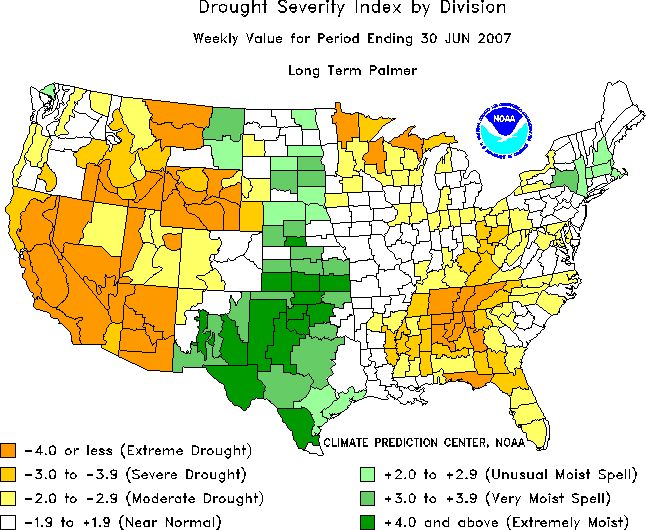
The Denier Answer to Drought: Prayer

That’s the answer for Australia and the Southeast, apparently.

Enviros might point out that Australia has long considered to be especially susceptible to drought as the globe heats up, but that would be bad form. Forget the fact that the drought there is now the worst it has been in a 1,000 years. Drought is also expected to worsen in the subtropics in places like Alabama and the Southwest, but of course, deniers like John Christy, state climatologist of Alabama, assure us that the worst drought in Alabama in fifty years is sheer coincidence.

"Rainfall patterns by their nature are variable. This is just where (the drought) happens to be this time," Christy said.

Neither Christy nor John Howard, prime minister of Australia, want to act to reduce carbon emissions. That would be a radical step. Might cause some economic dislocation. Can’t have that.

Drought_severity_for_june_2007

Culture of Corruption Becomes Official

It’s okay to lie for the White House: the Prez says so. My favorite comment to date comes from "crunchy conservative" Rod Dreher. His remarkably bitter post, titled "The Soft on Crime Republicans," is worth reading in whole, but here’s the bottom line:

Think about it: Paris Hilton did more time in the slammer than Scooter Libby. What a legacy George W. Bush has left us…

Get_out_of_jail_free

Fire Over: Arguing Begins

The Lake Tahoe fires have died down, but the discussion has just begun.

In The Los Angeles Times, the focus has been on the forest and the population issues. Moderate political columnist George Skelton drew this lesson:

There’s no economy in numbers because of an exploding population — no
growth discount for taxpayers funding the services they need.

[edit]

Just packing people into densely populated areas causes problems.

I
call this the chicken coop syndrome, observed as a boy while growing up
on a small citrus ranch in Ojai. The more chickens we’d cram into the
coop, the more they’d act up, compete, fight. That’s nature. And it’s
human nature.

The San Francisco Chronicle led with forest mismanagement, but concluded with the declining snowpack:

The Forest Service’s Safford noted that even the climate has come under
human influence, as evidenced by global warming and increased forest fires in a
dryer, warmer West.

A study being prepared documents what Safford described as a significant
increase in Sierra fires during the past 21 years, which clearly goes beyond
any naturally occurring cycle.


Worst Northern California fires

Most damaging wildland fires
in Northern California history by number of structures burned:

1. East Bay hills fire, October 1991, Alameda County: 2,900 structures

2. Jones fire, October 1999, Shasta County: 954 structures

3. Fountain fire, August 1992, Shasta County: 636 structures

4. City of Berkeley fire, September 1923, Alameda County: 584 structures

5. 49er fire, September 1988, Nevada County: 312 structures

6. Angora fire, June 2007, El Dorado County: 240 structures so far

7. Canyon fire, September 1999, Shasta County: 230 structures

8. Old Gulch fire, August 1992, Calaveras County: 170 structures

Source: California Department of Forestry and Fire Protection

[Guess which of these fires occurred in early summer?]

The Wall Street Journal focused on the drought picture for Lake Tahoe and the West:

In the Lake Tahoe area straddling the California-Nevada border, a blaze believed caused by human activity Sunday afternoon quickly spread through tinder-dry pine forests a few miles south of the lake, destroying more than 200 homes and other structures. Winds that fanned the fire subsided yesterday, but some 1,000 homes are still threatened. The fire threat in the heavily developed area is unusually severe because drought left the Sierra Nevada snow pack at 29% of normal this spring.

Meanwhile, spring in four states — Alabama, Georgia, Mississippi and Tennessee — was the driest in 113 years of record-keeping. In Florida and Georgia, the situation has been deemed an emergency by state and federal officials.

The West is experiencing its sixth-driest spring on record, while recent government reports show the drought might be creeping into the Midwest, where farmers hoping to profit from the ethanol boom have planted more acres of corn than at any time since the end of World War II.

Already, economic losses are mounting. In Georgia, peach crops are smaller than normal, peanuts were unable to germinate in the bone-dry soil, and wildfires have devoured valuable timber. The water level in Florida’s Lake Okeechobee, the second-largest freshwater lake in the continental U.S., hit an all-time low on June 1, forcing lawn-and-garden enthusiasts, golf courses and farmers to conserve water.

In Alabama, lack of hay is causing cattle farmers to liquidate entire herds.

Drought has been a persistent problem for much of the U.S. in recent years. This year, some areas are parched while others are being hit by heavy rains and flooding. Some parts of Texas have been declared states of emergency because of flash flooding.

Indeed, early in the spring, many farmers in the Corn Belt worried that too much rain was going to prevent them from planting their corn on time.

The drastic weather can be explained partly by a summer-weather pattern called the Bermuda High that is sucking moisture from the Gulf of Mexico and dumping it on places like Texas and the High Plains.

The problem for drought-affected areas in the Southeast is that the Bermuda High has pushed too far to the west. So the typical widespread afternoon thunderstorms and rain haven’t fallen there, meaning little drought relief.

Many scientists worry global warming may be playing a role, too. The kind of severe droughts punctuated by torrential rain now hitting many parts of North America have long been predicted as consequences of rising world temperatures.

Dick Cheney: He’s Not Exactly John Muir

The incandescent Joel Achenbach sums up the final installment of the potent-but-depressing Washington Post series on "the Dark Lord" of D.C., Dick Cheney:

That Dick Cheney: He’s not exactly John Muir. Not exactly Henry David Thoreau. The final installment of the Gellman/Becker series shows us a man who loves the smell of rotting salmon in the morning.

When he sees a photo of dead fish roasting in the sun, he thinks, "Quick, get me some wasabi."

His Secret Service code name is Angler, because he likes nothing better than to put on his waders and stand in a crystal clear mountain stream with a rod and reel and a few sticks of dynamite.

Gnawin’ on a little home-made spotted owl jerky.

Dreamin’ of that retirement home with the lovely view of the strip mine.

He’ll be there pretty soon: Putterin’ around the yard, setting leg traps for coyotes and the neighbor’s cats. Always with the canister of DDT in the hip-holster. Clearing brush with the flamethrower and the napalm.

Planning those RV trips to Yucca Mountain.

"Because of Cheney’s intervention, the government reversed itself and let the water flow in time to save the 2002 growing season, declaring that there was no threat to the fish. What followed was the largest fish kill the West had ever seen, with tens of thousands of salmon rotting on the banks of the Klamath River."

Cheney read that passage this morning and thought, "They make it sound like that’s bad."

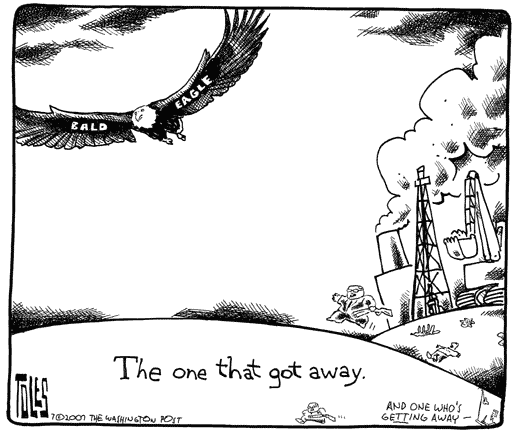
And fellow Washington Post-er Tom Toles today on one wild creature who got away…

Bald_eager_the_one_that_got_away

Opps (Housekeeping note)

Opps. Just came across eight comments that were not published because (I just found out) I am now supposed to approve every comment first. Apparently this is a change of policy, or perhaps this goes with allowing people to publish links, a change I made recently. My apologies to all of you who took the trouble to comment, but didn’t get the opportunity. Sometimes I’m a little thick.

Lake Tahoe Fires and James Hansen

James Hansen is everywhere. Kind of like Cassandra. Speaking of the West and fire, Hansen and forty-six co-authors warn in a paper last month for Atmospheric Chemistry and Physics:

An expansion
and intensification of subtropical dry conditions occurs consistently
with global warming in our climate simulations
(Hansen et al., 2005a, 2007a). Held and Soden (2006) and
Lu et al. (2007) find agreement among a large number of
models in intensification of the pattern of precipitation minus
evaporation and its temporal variance, with poleward expansion
of subtropical conditions accompanying global warming.
Practical impacts may include increased drought and
fires in regions such as the Western United States, Mediterranean,
Australia and parts of Africa. Paleoclimate data
(Cook et al., 2004) provide evidence of strong drought in the
western United States accompanying global warming, and
the GISS model is able to reproduce this tendency for subtropical
drying in past warm climates as well as in modern
ones (Shindell et al, 2006). We cannot specify a threshold for
these effects, and there is already evidence of such tendencies
in the past decade. However, the simulated effects are proportional
to global warming (Held and Soden, 2006; Lu et
al., 2007), so end-of-century effects under BAU warming are
about three times greater than in the alternative scenario.

Let me repeat that last line: The simulated effects are proportional to global warming, so end-of-century effects under Business-As-Usual warming are about three times greater than the alternative scenario (in which the growth of carbon emissions is moderated). Three times! Holy cow.

This is why scientists and environmentalists alike are determined to bring down carbon emissions numbers. We’re going to crash, but will we survive the collision with the future? If we make no effort to change — probably not.

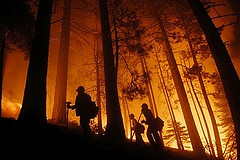
[Flickr photo of firefighters working the Lake Tahoe fire on Monday from Lorelei_29: all rights reserved]

Lake_tahoe_fire

Arnold vs. the EPA

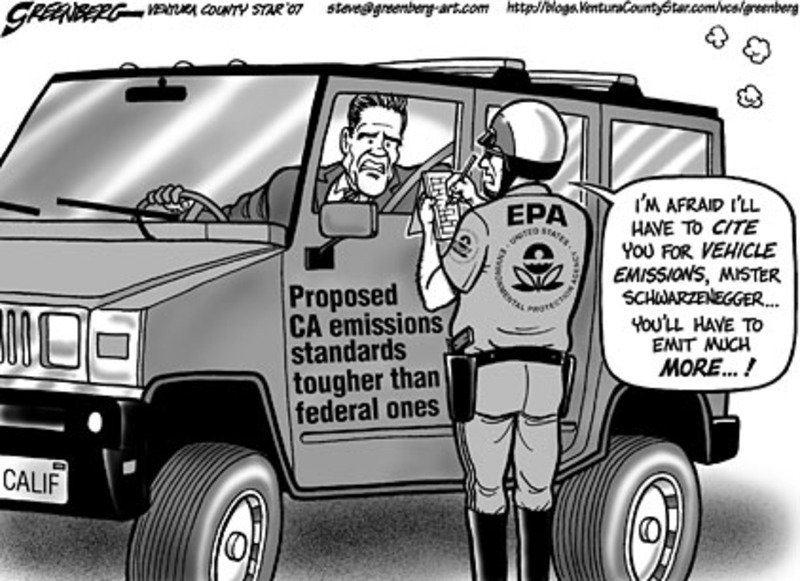
A nice editorial cartoon by Steve Greenberg of the Ventura County Star. Posted here with permission.

Who would ever have thought that Arnold, the man who (more than any other individual) helped popularize the Hummer, is also the man who most directly confronted the Bush administration on global warming?

After 9/11, respected writers said the age of irony was over. They were wrong…irony will never die. We humans need it much too much.

Arnold_vs_the_epa


Robert Heinlein on Logic

Crushed under work today, but here’s a quote that deserves remembering, from an obscure but often charming book by Robert Heinlein called Glory Road:

Logic is a way of saying that anything that didn’t happen yesterday won’t happen tomorrow.

Could this be part of the reason that self-styled conservatives have so much trouble with the concept of global warming? That it strikes them as illogical, regardless of what the science says?

Just a thought. 

[The quote comes from early in the book, Chapter Five, shortly after Heinlein’s narrator/hero wakes to find himself on another planet.]