Field Guide to NYC Birds

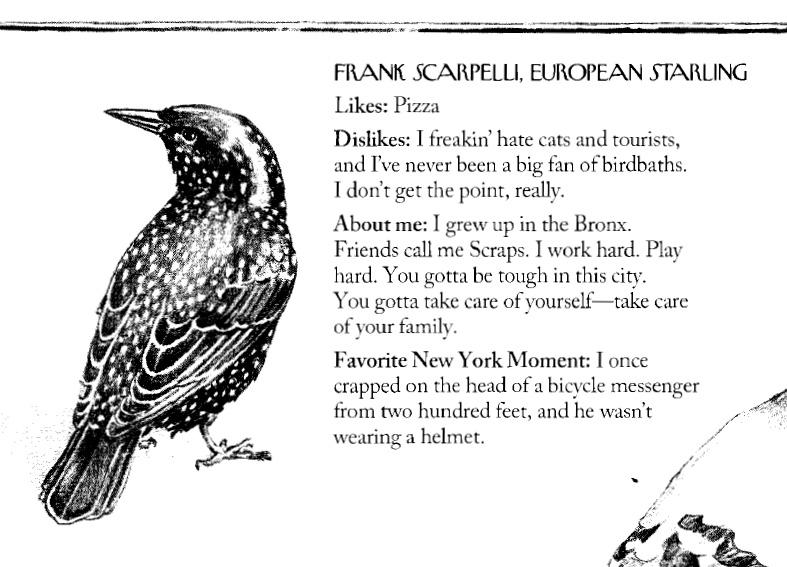
Last week The New Yorker in its "Cartoon Issue" ran a two-page spread called "Guide to City Birds." It’s not linkable, unfortunately, because it’s beyond wonderful and into some realm of gloriousness.

Okay, okay, I exaggerate. A little. But it was great, honest, and I’m going to bend the rules a little by giving you an example, and so perhaps in some tiny way encourage the artist Matthew Diffee to make a genuine field guide to NYC Birds, which I’m sure would be utterly delightful.

New_yorker_field_guide_to_nyc_birds

Climate Change Hits Insurance Industry

Yesterday the Washington Post ran a story on climate change and insurance companies. This is not a new subject, but the story by Joel Garreau was unusually well-written and thorough, and does have some genuinely fresh news…such as the fact that Allstate has stopped writing new homeowner policies in the New York area, fearing it could be swamped if a hurricane should hit the city. This should have been the lede, if you ask yours truly. You can’t miss this:

Insurance companies approach climate change bracingly free of theory. They take only an academic interest in whether the wind blows because of increases in carbon dioxide in the atmosphere, or cyclical fluctuations in the Atlantic, or the huffing and puffing of the Big Bad Wolf.

They just want to calculate the odds. They want to know how many chips to put on the table.

And where.

"Two effects are going on," says Nakada, of the risk modeling firm RMS. "Hurricane activity rates have gone up." But also, "Hurricanes are perceived to be longer-lived. These longer-lived hurricanes have a better chance of sneaking up the coast. The view of vulnerability has changed."

The specter looms of the big hurricanes of 1938 and 1954. Those Category 3 hurricanes devastated New England. Storm surges of 13 and 12 feet, respectively, swept through Providence, R.I. Historic markers demonstrate how high the water rose downtown. They are over your head. Photos show seas crashing over the top of a harbor lighthouse. It is 70 feet tall. Beach homes were swept out to sea.

"Our view is that there are some events that have the potential to be so large as to exceed the capabilities of the insurance industry, as well as the funding and financing capability of individual states," says Michael Trevino, the spokesman for Allstate, one of the nation’s largest home insurance companies. "Those are events that have the potential to be $100 billion. These events are so enormous, no entity has the ability to manage it."

Some require little imagination, such as a Category 4 hitting Miami or a Category 4 coming up the Houston Ship Channel aimed at the center of the U.S. oil industry, and America’s fourth-largest city.

But the one Allstate is focused on is a Category 3 funneling straight north up New York Harbor. Pushing a wall of water perhaps 15 feet tall up Broadway toward the second-story windows of Wall Street.

This is why Allstate has decided not to write new homeowners insurance in the five boroughs of New York City — Manhattan, Brooklyn, the Bronx, Queens and Staten Island — plus Westchester County, just north of the city, and the counties that make up Long Island — Nassau and Suffolk.

It’s this kind of change in corporate culture that is making climate change deniers irrelevant. I feel almost a little nostalgic for those days when I would bat emails back and forth for hours or days with deniers over the "hockey stick" or other alleged scientific overstatements.

Obviously, when huge corporations are turning down billions of dollars in business, fearing an unprecedented disaster, those kind of arcane "it’s not happening!" arguments become meaningless. As the story points out, once the insurance industry starts calculating a new risk–be it for cigarette smoking, or unsafe cars–the nature of the question changes. It’s no longer: Is this real? It’s suddenly: How much will this cost? And the industry says climate change is going to cost…a lot.

(Here’s a picture from the story of a Michigan lighthouse facing near-hurricane winds…in l998.)

South_haven_mich

The Absurdity of Ethanol, Explained

Admit it: everytime someone begins to talk about ethanol, you feel an overpowering desire to lie down. Perhaps take a nice little nap.

Well, finally someone–James Surowiecki, of the New Yorker–has found a non snore-inducing way to explain why ethanol is not the answer to American’s fuel needs. It’s actually not that complicated. Two words: Washington, D.C. (Or is that three words?) Anyhow: here’s the can’t miss quote:

Our current policy is absurd even by Washington standards: Congress is paying billions in subsidies to get us to use more ethanol, while keeping in place tariffs and quotas that guarantee that we’ll use less. And while most of the time tariffs just mean higher prices and reduced competition, in the case of ethanol the negative effects are considerably greater, leaving us saddled with an inferior and less energy-efficient technology and as dependent as ever on oil-producing countries. Because of the ethanol tariffs, we’re imposing taxes on fuel from countries that are friendly to the U.S., but no tax at all on fuel from countries that are among our most vehement opponents.

Our sweet tooth also has something to do with it. The whole piece, only about a thousand words, is highly recommended.

Good News for the West

This is the headline we’ve been waiting for. From a story by Blaine Harden in the Washington Post:

In West, Conservatives Emphasize the "Conserve"

The can’t miss graph:

Democratic and Republican politicians from New Mexico to Montana have found common ground with hunters and anglers in opposing widespread energy development on wild public lands, halting drilling in several areas where the public felt that wildlife and scenic values trumped economic consideration. In the past year, bipartisan grass-roots opposition has also killed off a number of proposals to sell federal land and use the revenue to pay for governmental operations.

In the mood for a little good news? Read the whole darn story.

LA Times Hints Supremes Will Split Difference on CO2 as Pollutant Ruling

The LA TImes is under tremendous pressure this fall. Circulation fell nearly 9% in the last quarter alone, the publisher and the editor were fired, and its owner, the Tribune Company, itself is on the market and likely to be sold off (in parts or as a whole) before the end of the year.

For those interested in reporting in the Western U.S., this is troubling news, because no other publication on the West Coast has the resources or the history of this newspaper, for all its flaws, and because despite its challenges, it has done a superb job reporting on political and environmental news the last couple of years.

Lately front-page stories have taken a different tack. In an effort–I think–to distinguish itself from the wire services that lesser papers rely on, and to compete with aggressive Internet speculation and rumor-mongering, the paper has begun featuring stories that hint at where events are trending.

This is tricky, because it requires inside knowledge but doesn’t fall back on sourcing, which would take the story into a this spokesman-said-but-then-this-other-spokesman-said direction, which becomes long and dull. This tack also asks readers to recognize and reward subtlety, which is a perilous business indeed in today’s media culture.

Nonetheless, the paper accurately hinted that Pombo (R-Tracy), would not survive his battle for re-election, for one, and also accurately suggested that the spinach contamination by the 0157 e. coli bacterium would be linked to cattle farming not far from the spinach growing. (An easy guess? Perhaps, but not to those of us who didn’t know.)

Now in a front-page story by David Savage, the newspaper suggests that the Supreme Court will split the difference on the crucial question of regulation of carbon dioxide and other greenhouse gas emissions. Of course, it’s possible that the court will follow the language of the Clean Air Act, which does call for the EPA to regulate "any physical, chemical (or) biological … substance or matter which is emitted … into the ambient air." After all, the law of the land does define "the public’s welfare to include effects on "climate" and "weather."

This right-wing court likely will not dare defy go that far. But because it includes some liberals and at least one moderate with a well-established interest in enviro matters, David Souter, it will instead, Savage hints, "rule that carbon dioxide is an air pollutant under the Clean Air Act, but that the EPA’s administrator is free to decide whether to issue new emissions standards for it. In the past, the court has been very reluctant to require an agency to issue new regulations.

A split decision would not force the federal agency to regulate greenhouse gases, but it could clear the way for California and the states to do so on their own."

Last week I reported that esteemed oceanographer Tim Barnett said that to stablize the atmosphere and prevent global heating beyond what is already "in the pipeline," we need to cut greenhouse gas emissions by 60%. That’s not going to happen under this court, obviously. But a split decision would allow states to begin to act where the Federal goverment has failed. It’s an imperial gesture, infuriating in its arrogance (we’re not going to do anything, but if you peons feel you must, we won’t stop you).

But it’s a start.
“Eco-Thug” Loses to Idealist, Helped by President Bush

A charming story yesterday in the LA Times by Faye Fiore looks at how an idealist named Jerry McNerney, unwanted by the Democratic Party, living off his savings, backed by over a thousand volunteers, defeated the "eco-thug" Richard Pombo, the notoriously anti-enviro Congressman from the Tracy area in CA, despite millions of dollars spent in his district by Republicans.

How did he do it? Well, he had the backing of the Sierra Club, the National Wildlife Fund, and numerous other enviro organizations…and over a thousand volunteers.

Plus, the President came to the district. With Bush’s poll ratings in California well below the one-third approval mark, that probably was a bad idea…but of course, the Current Occupant seems to think that he can overturn bad ideas with the sheer force of his personality.

We all know what happened. But we didn’t know until this story what McInerney said to Bush and Laura when he shook hands with them at the White House after his victory.

Not intimidated by authority, [McNerney] shook Bush’s hand at the White House soiree and thanked the president and the first lady for visiting his district, which he believes helped him more than it helped Pombo.

That had to sting.

Betweeness

"The clearest way into the Universe is through a forest wilderness," wrote John Muir (in a posthumous collection of his notes called John of the Mountains).

For years I’ve heard that saying of Muir’s echo in my mind. Only occasionally would the question creep in–yes, but why? Why does a wild forest take us into the universe more surely than the open sea? Or even more than a vast metropolis teaming with all sorts and types of people?

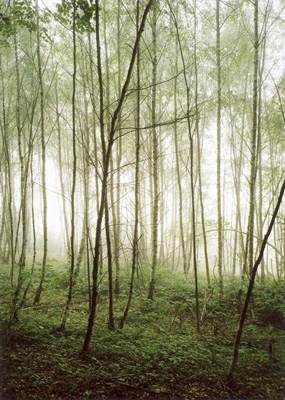
This month in Orion the critic and novelist John Berger takes a crack at that implicit question in an essay called Between Forests. His essay, which takes the forest photographs of Czech photographer Jitka Hanzlová as a point of departure, is unfortunately not posted, but just a glance at one of Hanzlová’s mysterious photographs from her Forest series gets across Berger’s essential point, which is that they have been taken "from the inside" of the forest. He writes:

[Audience, by Jitka Hanzlová]

Audience_by_jitka_hanzlova

The 06-07 El Nino: A Wuss?

A couple of days ago, the National Weather Service’s Climate Prediction Center predicted a warmer-than-usual winter, with El Nino conditions bringing a likelihood of increased rainfall to California and the West Coast. But an excellent follow-up story from Rob Krier at the San-Diego Union-Tribune points out that November in San Diego for the last forty years has been completely dry, unlike previous decades, and he went on to raise questions about not just the predicted rainfall  this winter, but the El Nino itself.

Krier quotes two experts, Nathan Mantua, at the University of Washington Climate Impacts Group,
and my helpful climatological friend Bill Patzert, at JPL. Mantua said:

“The El Niño in the tropics is doing its thing, and the jet stream in the Northern Pacific is doing its thing. My suspicion is that sometime this winter, the El Niño pattern will develop. It might not happen until January, February and March.”

But Patzert was more skeptical, suspecting that the Sea Surface Temperatures in the tropics will decline, and doubting that this El Nino will lead to a wet winter at all:

“This is definitely not a clear-cut, unambiguous El Niño. It looks like it’s holding, but certainly not intensifying. In 1997-98 [the last major El Niño year], the SST anomalies were the most positive in November. Then they started to weaken and break up.  Whatever happens this year [to the SSTs] will not be enough to give us a wet January, February and March."

Hmmm. Here’s the latest set of SST anomalies from NOAA. It’s a bit difficult to read, but as you can see, some of the projections tail off sharply in the months to come.

El_ninosst_anomalies_from_october