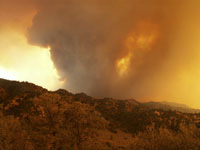
Turning the Page on the Day Fire

After burning through a month’s time, 259 square miles and over seventy million dollars, the Day Fire is history. Crews are heading home, scientists are assessing the damage, and homeowners in this area are heaving a big sigh of relief.

What put the fire out? Not the thousands of firefighters, the countless helicopters, engines, and water trucks, the air tankers, or even the DC-10. It was a change in the weather. A tenth of an inch of rain, to be precise.

But interestingly, this fire at this time–although human-caused–might possibly have been a good thing. Better now than during a full-blown Santa Ana, when it could have become uncontrollable. Plus, according to the above Ventura County Star report, few wildlife deaths have been reported.

My favorite story on the piece came from NPR’s Mandalit del Barco, who found not only color that other reporters didn’t (pictures of exotic cats being relocated) but humor (the firefighters’ name for the blaze, which was the Day After Day After Day Fire).

I plan to go into the Sespe wilderness this December, through which the fire burned, to get a picture of what the aftermath looks like.

For now, one last picture from InciWeb, of the fire in all its glory:

West_alamo_mountain_during_day_fire

Global Warming, Super El Ninos and Ultra La Ninas: An Expert Explains

Note: Over the last two weeks, I’ve conducted an interview with a mentor of mine, Bill Patzert, a meterologist and oceanographer with JPL. I’ve never met Bill, and only talked to him a few times on the phone, and I don’t even remember why exactly I first contacted him years ago, but he’s been hugely helpful and has become a real friend nonetheless.

I was thrilled when he agreed to be interviewed at length by me for Grist. Please check it out. If you have any interest in the climate of the Pacific Coast and the Southwest, I think you’ll be glad you did. Here we go…

    To a layperson, the world of climatology can be an intimidatingly foreign land. Denizens of this world, known as scientists, speak a daunting, often-impenetrable blend of acronyms (AGW, IPCC, WPAC, ENSO), Latinisms (anomalies, coterminous, precipitation deficits) and math (confidence limits, regression-based, boundary knots).

Besides the sheer complexity of global climate systems, the dreariness of this jargon may be one of the big reasons the general public has been slow to awaken to the seriousness of the threat of global warming. In fact, a conference on climate change organized by Yale last year called for "training scientists to
speak in language that is understandable to different
audiences."

One scientist who needs no such training is Bill Patzert, an oceanographer and meteorologist at the Jet Propulsion Laboratory in Pasadena, California, an institution closely linked to NASA. In the world of science, Patzert is known for his work matching TOPEX satellite weather data to the actual behavior of the Pacific Ocean and its weather systems, especially El Nino and its less-well-known counterpart La Nina. In the media world he is a go-to guy for comments on weather patterns for the LA Times, the San Diego Union-Tribune, and CBS News, among many others.

Patzert, who has briskly guided my reporting on climate questions for years, generously agreed to an extended email interview for Grist. Since he has become  known for his work with the media, and even won medals for his outreach efforts, I thought I’d begin with a question about why the rhetoric of climatology is so turgid and difficult. His answer was more than I bargained for:   

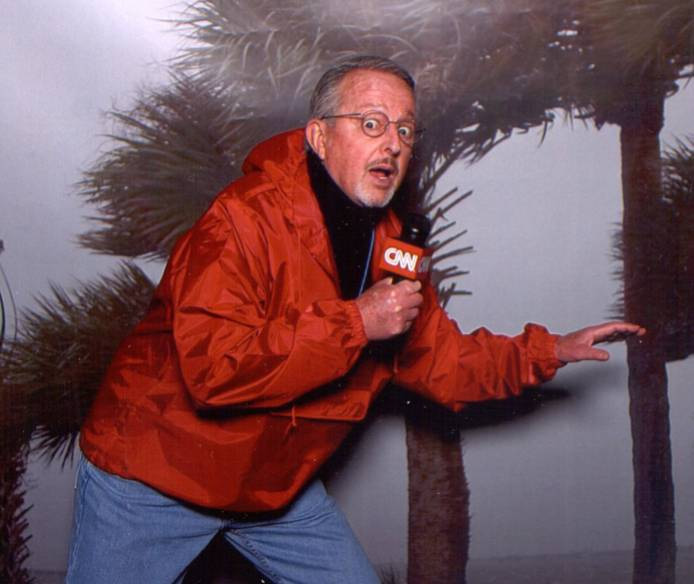
Bill_patzert_as_cnn_newsman

Fire as War in SoCal

An efriend named Judith Lewis, an enviro reporter for the LAWeekly, has a good story out this week on the Day Fire. She too interviewed fire ecologist Richard Minnich, but had the advantage of interviewing him after the fire broke out. He made an important point, quoting a TV forecaster:

"‘It’s better that it got burned off in the weather we’ve got right now instead of waiting for the Santa Anas to come along over the weekend.’ He actually suggested that the forest might need to burn."

It’s absolutely true. Twice during the three-plus weeks the fire has been burning, a Santa Ana condition developed, causing havoc and near-panic in both cases, but both times the winds were relatively mild (about 25 mph) and brief. Later in the fall, we will get Santa Anas blowing 50 mph or more, for days at a time. Much better than the fire burn now.

Lewis also noted Minnich’s point on controlling fire is always likened to war: 

Firefighters battle blazes on their frontlines and, as they contain them, mop up their smoldering remnants.

This is true, and most war metaphors (war on cancer, war on poverty) are ludicrous, but in this case I think the word fits. The Ventura County Fire Department is well-aware of the benefits of controlled burns, and has a full-time fire planner working on how to best burn down fuel beds at the right times. But they also know that air campaigns, ground campaigns, evacuations, and countless other massive, war-like, technology-dependent measures are necessary to avoid disaster in SoCal when the flames begin to rise. Fire suppression is not sufficient in and of itself, but it is sometimes necessary, and when it is necessary, war is what it feels like.

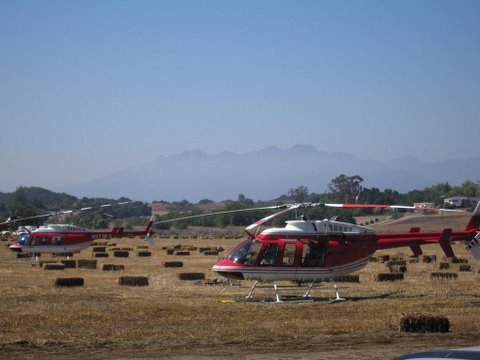
Here’s a picture of a couple of the smaller helicopters based at the fire helicamp not far from us in Upper Ojai:

Fire_copters

And here’s a picture from the LATimes of the fire in the Lockwood Valley. It’s not over…
Fire_in_lockwood_valley

Fire in Southern California: How Close Are We to the Edge?

My report from the Ventura County Reporter. This was filed literally the morning the Day Fire broke out, so my timing couldn’t be beat, and, I’m proud to say, the story stands up to the reality of what ensued quite well. In an attempt to entice you to read it, I’m going to copy over the opening and a picture. Here goes:

    On my office desk sits a small blue and white cup. I use it to hold paper clips.

    Once glossy and smooth, now it’s badly damaged — cracked, charred, chipped and smoked — but I will never give it up, because it’s the only thing left from the fire in the Oakland and Berkeley hills that fully consumed my father’s home in October of l991.

    Everything else — family photos and paintings, silverware, glassware, a dishwasher, even a heavy cast iron stove — was incinerated.

My father was away, perhaps fortunately, perhaps not. In fact, he was visiting me and my family. We had moved to the Ojai area a few months before. When he heard the news about the fire, he was on the way to LAX, but he was not able to get home in time to help.

    Even after he returned to the East Bay, he was not able to get close enough to see the charred foundation that remained for two full days.

That fire, which burned about 1,600 acres, and killed 25 people, was so hot some houses exploded in flames even before the fire reached them, set off by temperatures that reached at least 2,800 degrees, when cast iron will catch fire and burn.

    The Ranch Fire, was a similarly wind-driven fire that burned through a corner of my back yard here in Ventura County in l999. It went on to consume 4,400 acres in Upper Ojai and Ojai, costing over $4 million to fight. Though mild by comparison, it had flames as high as 20 feet. Folks around here still talk about it.

    We all know these kind of wind-driven fires could happen again. In the infamous “fire siege” of 2003, the Santa Ana-fueled Piru and Simi fires burned through 170,000 acres of Ventura County in just a few days. Statewide that week in October, wildfire blazes seriously wounded 216 people, and killed 22. Since l970, 12 of the nation’s 15 most deadly and destructive wildfires in history have hit California, and every single one of those infernos was powered by the hot dry winds of late fall and early winter commonly called the Santa Anas.

    This is “the weather of catastrophe, of apocalypse,” wrote Joan Didion in a memorable essay on the Santa Anas. “The violence and unpredictability of the Santa Anas affect the entire quality of life in Los Angeles, accentuate its impermanence, its unreliability. The winds show us how close to the edge we are.”

    She was talking about Los Angeles, but the history of our region offers plenty of examples to prove Didion’s point. Although the Cedar Fire in San Diego three years ago is the single largest on state record, newspaper accounts from 1889 detailed a drought-fueled fire in what is today Orange County that was probably three times as large, and Native American legends from several tribes in the San Diego area recall a mass migration hundreds of years ago driven by what may have been an even bigger fire.

    So when, in July, I saw several stories in the newspapers suggesting that climate change could lead to a greater risk of fire in the West, an alarm bell went off in my mind. The time had come to look at the dangers we face. It’s scary enough already. Could it get worse?

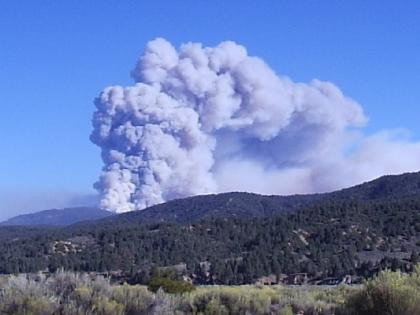
Mug_from_my_fathers_house

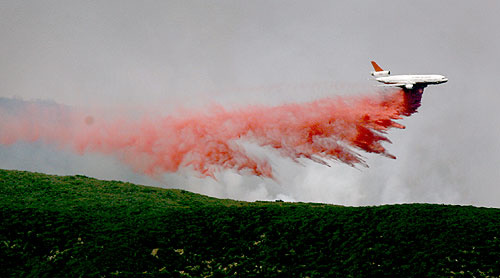
A DC-10 Takes on the Day Fire

This morning we can sniff smoke in the air, and it’s going to be very hot today, but the atmospheric
low off the coast has dissipated and the winds gone. The worst of the Day Fire may be over.

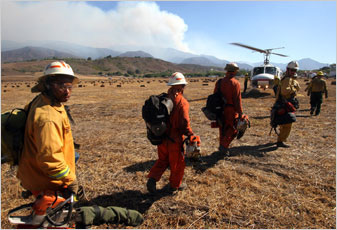
Much credit goes to the Ventura County Fire Department, the "Hotshots" teams, the prison hand crews, and many many others…but also to the technology (including a jumbo jet!) that has been dousing the fire with water and fire retardants for the last three weeks. From the LATimes:

Dc10_takes_on_the_day_fire_1

Day Fire Burns On

The Day Fire is now advancing slowly but surely towards our home in Upper Ojai on two fronts.

From the north, over the Topa Topas (6600 feet high) and from the east, up Santa Paula canyon. The eastern firefront is much more likely to cause us harm, because it’s more likely to be driven by Santa Ana winds. The fire began three weeks ago, and we’ve been threatened now for two weeks. This takes a toll emotionally; frankly, we’re all sick of it. Again area residents have been advised to evacuate, although few have, because the slow-moving fire isn’t likely to kill, and because literally thousands of firefighters, with engines, hand-crews, and air support have moved in and occupied the area. Here’s a picture of what it looked like yesterday evening, courtesy of the Ventura County Fire Department. It looks less threatening now.

Day_fire_on_topa_topas