Right-Wing Shocker: Conservative Endorses Regulation to Reduce Emissions

Genuine conservatives (as opposed to the Bush administration) have been pointing to the need for conservation of fossil fuel supplies and innovation to reduce greenhouse gas emissions for some time now, but this is really a shocker. The prominent conservative Niall Ferguson calls not just for the usual measures of reducing emissions, but for flat across-the-board regulation.

He makes some good points (although most observers I’ve read think that Europe’s cap-and-trade program has not been given enough time or support to work properly).

Regardless, enviros must welcome this call for emissions regulation from the right. It’s a little surrealistic, like seeing Dick Cheney limp out of his bunker and endorse the Geneva Conventions, but heck, I’ll take it.

The Secret History of the Gold Rush

One of the most interesting ecological writers today has to be Rebecca Solnit, an explorer in prose whose work is so original it’s difficult to categorize. History? Essay? Polemic? The reader has to decide for himself, or herself.

Her latest journey in thought comes to us from Orion, and reads to me much like a secret history of the gold rush, revealing how little it was about gold, and how much it was about mercury. Here’s a sample:

Just as one of those useful commentators from another culture or galaxy might perceive the purpose of drinking heavily to be achievement of a splitting headache and furry tongue in the morning, so she might perceive mining as a way of ravaging great swaths of the land, water, and air about as thoroughly as it is possible to do. For from an ecological point of view, mining produces large-scale, long-term poverty of many kinds while producing short-term wealth for a small minority.

The_secret_history_of_the_gold_rush

California Leads the Way on Air Pollution…Again

Yesterday the California legislature reached agreement on a deal to reduce emissions of greenhouse gases. Here’s how the Washington Post introduced the story:

In stark contrast to the Bush administration’s consistent opposition to mandatory caps on greenhouse gas emissions linked to climate change, California’s bill requires its industrial sectors to cut the state’s carbon dioxide pollution by 25 percent in order to bring it back to 1990 levels by the year 2020. Other states may soon follow suit, which could put pressure on federal officials to create a national system capping emissions and allowing companies to trade pollution credits.

"It really does point out the country needs to solve this problem in a uniform way," said William Reilly, who headed the Environmental Protection Agency under President George H.W. Bush and now co-chairs the bipartisan National Commission on Energy Policy. "It will rebound in Washington. The country’s largest state is setting a new standard for the climate issue."

The Post also noted that part of the deal is a provision to require out-of-state energy producers to reduce emissions if they wish to send energy to California, to prevent the exporting of pollution. This is an important part of the story that has not gotten much attention; more soon, I hope, especially if I can do anything about it.

The  Wall St. Journal [$] made an interesting point about the deal between the Republican governor and the Democratic legislature:

One reason Gov. Schwarzenegger ended up agreeing to the bill was that some of California’s business community supported it. He began tipping his support toward the bill after a delegation of executives from Silicon Valley last week told him many businesses wanted the bill as a way to provide them regulatory certainty and for other reasons, say lobbyists in the statehouse.

"This bill provides a new opportunity here in California," said Bob Epstein, cofounder of Sybase Inc., a software maker in Dublin, Calif., and a leader of a group that represents businesses that support environmental action.

The deal is a big step forward. Predictably, fossil fuel groups are not happy, but California has a long and honorable history of leading the nation on air pollution regulation. California now has more than twice as many vehicles registered in the state than it did in l970, but overall ozone levels are less than one-fourth of what they were back in the days before catalytic converters were required and inspections were mandated, and gee, you don’t see any tumbleweeds blowing down Wilshire Boulevard.

As Kevin Drum points out, the cap-and-trade market-based system this regulation implies hasn’t yet been codified, but still deserves support on the left.

Reaction on the right has been gloomy: Dan Walters of the Modesto Bee claims it’s "mostly symbolic" because India and China are not part of the deal. To which the logical reaction is surely: Well, duh!

When was the last time the California legislature made policy for China? And if you believe, as most Californians do, that reducing emissions is an important goal, we need to act for our own sake and to avoid hypocrisy when asking for changes from others.

But doomiest of all is the reliably whack Iain Murray of the National Review, who declares that "what California has done today…is to decide to join the Third World."

Right. The sixth-largest economy in the world, bigger than China by most estimates, even though China has about one billion residents, and California has about thirty million, is headed for economic  chaos and disintegration because we are going to ask power plants and factories to provide data on their CO2 emissions and then find ways to reduce those levels.

Where is that famous conservative optimism now?


Cynicism and Ugliness: An American Marriage

Though Hunter S. Thompson still casts a long shadow, the best ranter alive has to be James Howard Kunstler, who in a new essay breezes past Thompson and Marx and Mencken and into a realm of his own:

The new stuff built all over America in the late 20th century was analogous to the content of the television programming to which the lower classes insidiously became addicted – a cartoon simulacrum of a real world that was systematically being obliterated.  Instead of a real countryside outside the hated cities, we now had suburbia, a cartoon of country living. Instead of towns, shopping malls. Eventually the theme park, as represented by developments of the Walt Disney corporation and their clones, became both the embodiment of the destruction wreaked across the land and paradoxically the last refuge from it. Americans would flock to Walt Disney World in Orlando to put themselves in a saccharine replica of the authentic Main Street environments that they had thoroughly trashed in their own home places.

He connects as so few can the physical ugliness of American life with the brutal cynicism of development; the thrill of destruction, the roar of greed.

In other words, our living arrangement essentially became the remaining basis of our economy, in the absence of any other purposeful creation of value or wealth, such as manufacturing things.  And because it was a racket devoted to a way of life with no future, it spawned enormous cynicism.  Just as the immersive ugliness of the suburban highway strip was economic entropy made visible, so the cynicism of the public was entropy applied to human values, a force propelling things into disorder.  When nothing was sacred, everything became profane.

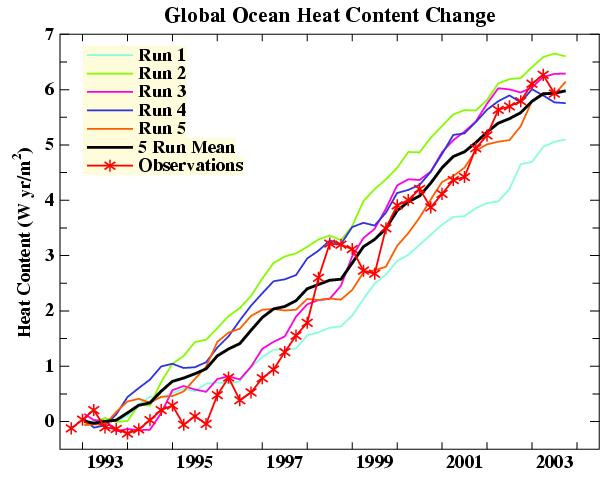
Graph of the Week: GCMs Accurately Predict Ocean Heat

A first-rate post in Real Climate by Gavin Schmidt with a great graph makes clear an important point that is, I think, little understood. Climate models are not speculative; they’re checked against observations. No one doubts the complexity of the challenge, but what is not generally understood  is how remarkably accurate the biggest and best General Circulation Models have proven to be on the big questions. (Regional climate changes are not as reliably shown, at least not yet.)

Here’s an example of the accuracy of the big picture, based on an important and almost-ignored study published last year in Science by James Hansen and his associates at GISS.

Notice how well these numerous different models track the observations of rising levels of thermal energy (heat) in oceans around the world. Note the internal consistency of the models’ results, as well as the overall match between the model and the observations.

General_circulation_models_and_ocean_hea

Maybe You Had To Be There…

From the White House transcript of today’s press conference:

"THE PRESIDENT: Right, I’ve listened to them very carefully. I’m a thoughtful guy, I listen to people. (Laughter.) I’m open-minded. I’m all the things that you know I am."

The press seems to think this was a joke. Everyone in D.C. today knows that Bush trusts his "gut" to make decisions and others to follow, and so when he makes a show of listening–to the Republican Party in Connecticut, no less–people in the press room laugh.

Maybe you had to be there. That’s the best I can say. To me it seems as if this President is a joke, and bad one.