Here Come the Right-Wing Hippies

Well, that’s the theory, anyhow, to be found in this book I reviewed for the VCReporter called Crunchy Cons.

Interestingly, I interviewed the likable author, young former National Review writer Rod Dreher, but about a third of the way through the session, he abruptly stopped answering questions (via email) and stopped responding to further contacts.

Were my questions too tough? (Among other topics, I challenged his assertion that the White House’s overseas-only $53 methane-to-markets measure was a meaningful response to global warming.)

I don’t know why he walked away (virtually). But I still give Dreher credit for saying that there is nothing conservative about industrial farming, McMansion developments, and lousy pop culture. Popular success that trashes the culture and the planet is nothing to be proud of, and will only become uglier in time. I think leftists should applaud that recognition of reality.

Crunchy_cons

The Lighter Side of the Plagues of Global Warming

From Tom Toles, of course.

The fact that a big American Elm actually fell right outside the White House during the floods of June does make one wonder if the natural fact of global warming could have possibly come up inside. Too much to hope for?

Perhaps we’ll find out in a year or two when another tell-all book is published by another disillusioned insider who once believed in the Current Occupant.

For now, we’ll have to make do with reality:

Global_warming_and_the_hardheaded_pharoa


Tribe Follows Tribe

Faithful readers may have noticed that since being asked to contribute to the worthy Gristmill site, that my posts here have entered what Tennessee Williams once called "a period of adjustment."

It’s taken me a week or two to decide on a new tack. But I remind myself that I started this blog largely to better research and delve into and write about issues of the natural world, and to collect and compile this information.

The fact that some of these posts turn out to be worthy of a national audience changes nothing, really.

So I’m going to continue to post here, I hope on a daily basis, but in that same exploratory and sometimes personal vein. If you stick with me, I promise we both will learn.

Onward.

On Sunday, one of my favorite reporters on climate change, Eugene Linden, had a piece in the LATimes op-ed page, talking about the difficulty we have facing the fact that our climate is not what it used to be, and likely never will be again. We expect disaster, but more likely, he writes:

…global warming will creep up on us as the weather gradually unmoors from its normal patterns. Single events will be explained away. But at some point, the frequency, severity and ubiquity of the unusual weather will produce a sense of foreboding, a sense that something is happening beyond our control.

What with killer heat waves, killer hurricanes and killer droughts, it’s arguable that we’ve already passed that point. Indeed, I had that feeling of foreboding in the last week of June, as Washington gradually surrendered ground and the routines of daily life to incessant rain: Cars floated down ordinarily meek Rock Creek, government buildings flooded, the Metro was disrupted and roads were closed. You may have had the same feeling last week as the power dimmed and temperatures surged in Southern California and beyond.

[cut]

Whether we are in Act 2 or Act 4 of a five-act climate drama, we are not the first to live out this play. At some point, for instance, the Moche elders, who lived in Peru 1,400 years ago, must have begun to wonder whether torrential El Niño-related rains were going to spell the doom of their civilization.

[cut]

Now it’s our turn. Like fugitives who must worry about every knock on the door, we can no longer dismiss events such as the late June rains and the July heat wave as just another instance of wacky weather. There’s a distinct difference, though, between us and the Moche and the Norse, not to mention the Mayans, the Anasazi, the Akkadians and other players in previous episodes of climate chaos.

All of them were victims of natural cycles; the evidence suggests that we wrote the script for this latest episode of climate roulette.

It’s easy to be condescending about past civilizations. They didn’t have the science and technology that have enabled us to understand how climate works or to determine the role of climate in the collapse of their cultures in South America, the American Southwest and the Middle East.

If only they knew what we now know about climate, maybe they would have adapted and survived.

Then again, maybe not. We do know what we know, and still we do nothing.

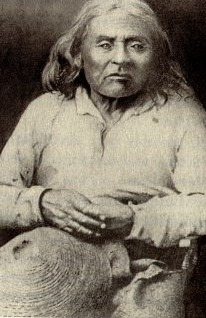
It brings to mind the famous speech of Chief Seattle.

Not the upbeat "earth is our mother" TV version, mostly made up for a long-forgotten documentary by a Hollywood screenwriter, but the version from a Dr. Smith, who heard the speech. (His version can’t be considered the "original," but it’s as close as we can get, and, after all, we don’t discount the power of the words of the Gospels, though Jesus’s words were also reconstructed from the memory and–possibly–a few notes taken by admirers at the scene.)

There is a toughness to Seattle’s words, not present in the Hollywood version, that rings true to me. At the time he spoke, in 1854, everyone assumed that the Native Americans were passing away.

Now Linden raises the same question, but about us. And Seattle’s words sound more apt than ever:

Tribe follows tribe, and nation follows nation, like the waves of the sea. It is the order of nature, and regret is useless. Your time of decay may be distant, but it will surely come. […] We may be brothers after all. We will see.

Seattle

Why They Call It “Global” Warming

In Greenland, reports the Wall Street Journal [$], temperatures have warmed 2.7  degrees Fahrenheit in the last thirty years. This has been good for Greenland’s farmers and ranchers, even though (ironically) Greenlanders support the Kyoto Protocol, and–according to the story–frequently express concern about warming elsewhere. Still,

For Mr. Magnusson and his reindeer ranch, the longer grazing seasons mean fatter animals for slaughter, since reindeer gain about half a pound per day during the spring and summer grazing season. More abundant grasslands have prompted one farmer to buy cows for a government-funded experiment in dairy farming. A longer growing season allows crop farmers to expand their home gardens into commercial enterprises. Fishermen have begun catching tons of warm-water cod, after that fish’s long absence from the region.

"We have so many cold places in Greenland, and a lot of it is covered with ice," says Mr. Magnusson. "So we are grateful for those two extra degrees we get."

Greenland_areas_of_warming

In England, it’s a different story. The warming–which is breaking heat waves records this summer–

is not welcome. Besides the heat, the still-costly Wall Street Journal says that:

England is facing its worst drought in a century, according to the government’s Environment Agency. The extreme recent heat is exacerbating a shortage of water caused by two drier-than-normal winters that left the water supply low. The underwater reservoirs, or aquifers, that supply 70% of the southeast of England are, in some places, at a quarter of where they should be, local water companies say.

Emergency water restrictions across the southeast currently ban garden hoses, and, in some places, full swimming pools and ornamental fountains. Even the Buckingham Palace lawn is brown after the royal gardener stopped watering earlier this summer.

[cut]

Some, including [gardener] Mr. Stone and Mayor Livingstone [of London], partly blame global warming for drying up England. A spokesman for the Met Office, the country’s official weather forecaster, says two dry winters and a number of warmer summers are not conclusive proof of global warming. He notes, however, that these conditions are what the office would expect from climate change.

And in Peru, an iconic glacier is in full retreat, according to the Washington Post.

QUELCCAYA GLACIER, Peru — In the thin, cold air here atop the Andes mountains, the blue ice that has claimed these peaks for thousands of years and loyally fed the streams below is now disappearing rapidly.

Mountain glaciers such as this are in retreat around the Earth, taking with them vast stores of water that grow crops, generate electricity and sustain cities and rural areas.

Farmers here say that over the past two decades they have noticed a dramatic decrease in the amount of ice and snow on their mountaintops. The steady supply of water they need to grow crops has become erratic.

"There is less water now. If there is no water, this land becomes a desert," said Benedicto Loayza, a 52-year-old farmer, standing under pear trees fed by channels dug on the mountain centuries ago to collect runoff.

But "There’s no global warming," as one friend put it dryly at a party this evening. "No, no, no global warming," everyone agreed vociferously.

I listen amused to the sarcasm and cannot help but think again in amazement and wonder back to  Peggy Noonan’s wide-eyed question from a column in the Wall Street Journal a week ago: Is global warming real or not?

Does she read the papers? Does she even read her own newspaper? How can a person step up to a pulpit that big and write to thousands upon thousands of readers in such complete ignorance?

Small Colorado Coal Burner Pays Big Bucks to Climate Change Denier

According to ABC News, a small rural electric co-operative in Colorado paid a climate change denier  $100,000 for unspecified activities without informing or asking its members.

"It’s outrageous," Ron Binz, a public utility consultant formerly with the state of Colorado, told ABC. "It’s an abuse of authority. The customers are member-owners. [General Manager] Stan Lewandowski is basically spending other people’s money."

I

Please see the full story in today’s Grist.

Mentioned in the story is a study published by the National Center for Atmospheric Research. Here’s a picture taken by FEMA from that study.

Fema_picture_of_damage_left_by_katrina

Senate Staffer Attacks NYTimes Reporter for Writing Book on North Pole

A book written to be accessible to anyone over the age of ten, The North Pole Was Here, has a staffer for a prominent denier in the US Senate up in arms.

Not for what the book says–because the staffer appears not to have read it–but the fact that it was written by a reporter.

NYTTimes reporter Andrew Revkin published a straightforward but appealing you-are-here account of visiting the top of our home planet, where the air is thin, the "ground" is ice floating on the ocean, and everything is changing.

Here’s an excerpt from the first chapter:

Unlike the planet’s South Pole, where a continent is home to permanent research stations and dozens of scientists, engineers, cooks, doctors, and other staff, at the North Pole nothing is permanent except the seabed far below. The ice that is here today will be somewhere else tomorrow. In a few years, much of what I am walking on, what our airplane landed on, will break up and slide out of the Arctic Ocean altogether through passages around Greenland, replaced by newly formed ice. A while ago, a visitor left a message in a container on the ice near this spot. It was found on a beach in Ireland a few years later.

Amazingly, this factual account has alarmed Marc Morano, a communications director for Senator James Inhofe (R-Oklahoma). Marc Morano, formerly with The Rush Limbaugh Show, and the first in the media to publicize the attacks of the Swift Boat veterans, has now attacked New York Times’ reporter Andrew Revkin.

According to a story broken by Greenwire (reg. required) on Wednesday, Morano called into doubt the twenty years of Revkin’s reporting on climate change issues, because "sales of Revkin’s book…would be enhanced by his paper’s coverage of climate."

Morano said: "We’re not just shooting arrows."

Yesterday also saw the revelation in the NYTimes that NASA has altered its credo, removing the first line–"To alter and protect the home planet"–perhaps because prominent climate researcher James Hansen pointed to that phrase when insisting on the right to speak up on the hazard to the planet and our way of life from global warming.

Given this somewhat crazy state of affairs, Gristmill asked Revkin to answer a few questions, to which he graciously responded.

Gristmill interview with Andrew Revkin.

(Please check out the above link for the actual interview. My version of the opening is slightly different in emphasis…but it’s the same information, so I hope Grist won’t object if I leave up the original version.)