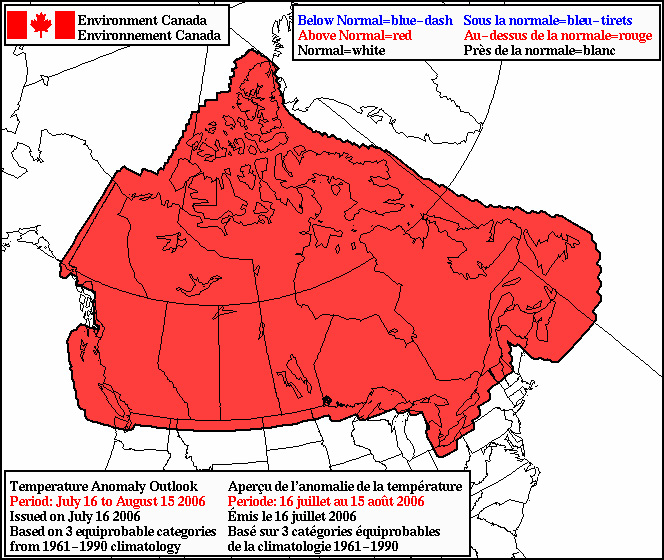
Anomaly outlook for Canada this upcoming month…
A Change in the Wind
Anomaly outlook for Canada this upcoming month…
Thom Yorke, lead singer of the world-famous band Radiohead, is not the first pop artist to find success with a song about global warming.
Andrew Bird, a superb violinist and exciting new rock musician with a long-term interest in weather systems, already has an alternative hit with his Tables and Chairs, a soaring song with a great chorus about global warming:
so don’t, don’t you worry,
about the atmosphere
or any
sudden pressure change
cause i know
that it’s starting to get warm in here
and things are starting to get strange
But Yorke is the first rock star to top the charts with a record focused on global warming, hitting number two this week with his new album The Eraser. Although usually loathe to discuss the meaning of his often-inscrutable songs with the press, he openly described what inspired the record to the LA Times:
"In the paper one day, [Friends of the Earth activist] Jonathan Porritt was basically dismissing any commitment that the working government has toward addressing global warming, saying that their gestures were like King Canute trying to stop the tide. And that just went `kaching’ in my head. It’s not political, but that’s what I feel is happening. We’re all King Canutes, holding our hands out, saying, `It’ll go away. I can make it stop.’ No, you can’t."
This became the central image in "The Eraser" — a king futilely attempting to hold back waves of disaster, drawn from a print by Yorke’s friend Stanley Donwood.
On the Radiohead site, Yorke links to a new climate change campaign, and in his usual off-hand but factual manner, talks about how the issue has hit him personally:
"THIS IS WHAT IM DOING NOW. this is big shit.this is the big ask. about climate change the stuff that wakes me up at 4am in a sweat, ….is that normal? i worry too much, apparently……THOMx"
The record, constructed on a laptop, is electronica and sounds a little strange. Yorke aptly describes it as "bits and bobs and shreds of all sorts of random chaos." But it frames Yorke’s thin but charismatic quaver–the voice voice of anxiety in our times–extremely well.
"A million engines in neutral," he sings. "The tick tock tick of a ticking timebomb."
In his lyrics, Yorke elegantly describes the central reality of global warming, the natural fact that we as a culture have the most troubling accepting, its cloudy blend of invisibility and inevitability.
He sings:
It’s relentless
Invisible
Indefatigable
Indisputable
Undeniable
As reviews have said, both of the record and of the live version with Radiohead, it’s a strong record: alluring, unsettling, oddly beautiful. (Here’s a link to a solo acoustic performance of The Clock, which begins "Time is running out…")
Will it help? Who knows? After being criticized by the Sunday Times of London for hypocrisy, because Radiohead’s last tour was far from carbon neutral, Yorke told The Observer:
No one’s going to come out of this dirt-free; I don’t come out of it dirt-free. It’s basically [about] having to make a decision whether to do nothing or try to engage with it in some way, knowing that it’s flawed. It’s convenient to project that back on to someone personally and say they’re a hypocrite. It’s a lot easier to do that than actually do anything else. And yeah, that stresses me out, because I am a hypocrite. As we all are.’
Facing facts: It’s a start.
(Cross-posted at Gristmill.)
Just another summer sunset…taken tonight on an evening walk.

A couple of months ago I remarked that the Bush administration had found an innovative strategy to avoid further investigations: scandal fatigue.
Administration screw-ups (WMDs, Abu Ghraib, Guantanamo, Valerie Plame, Medicare, the budget, and many, many more) have become so complicated and overwhelming that most people tune out less spectacular misdeeds. But while the world seems to be "blowing up," in Maureen Dowd’s words, the administration continues to stifle discussion of global warming.
A couple of recent examples from Climate Science Watch:
1) In late June, the State Department retired the portion of its website devoted to climate change, apparently so as not to have to have to report on the connection between climate change and hurricanes. It still reports on numerous other serious issues, including bird flu, HIV/AIDS, and tsunamis.
2) The EPA’s leading expert on sea rise was prevented from responding on the record to questions, according to the NYTimes.
Now the Bush administration appears to have stepped up that strategy in the Middle East, encouraging so much anarchy, chaos, and destruction today that no one has time to think about the damage tomorrow from natural disasters.
Fortunately, the irreplaceable Tom Toles hasn’t forgotten…

Check out my post on the subject at Gristmill, please. I’m happy to be one of their new contributors.
I’ll cross-post here too, as soon as I figure out the HTML quirks.
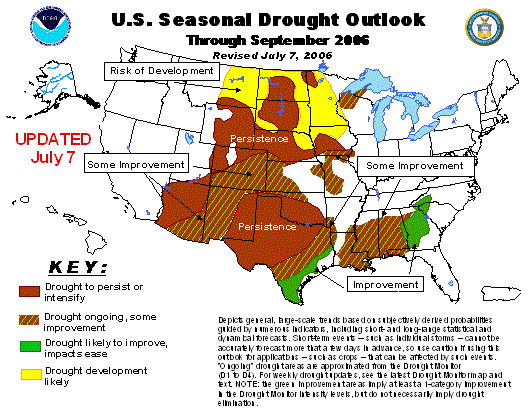
Hmmmm. My favorite meteorologist, Bill Patzert, yesterday linked the drought in the Southwest–now heading into its eighth year–to the unusually hot summer we’ve been having down here in Southern California. According to the story in the LATimes:
The cool ocean breezes and clouds that meteorologists call Southern California’s natural air conditioner broke down this year, creating record heat that is expected to continue through October.
First, May gray — the marine layer that usually blankets parts of the Southland at the end of spring — pulled a vanishing act. Then, June gloom failed to materialize with any regularity most everywhere but on the coast.
As a result, the Los Angeles region endured a blistering June — the second-hottest on record after 1981 — and the rest of the summer looks to be a scorcher, including this weekend.
"The bottom line is that we skipped spring," said William Patzert, a meteorologist at the Jet Propulsion Laboratory in La Cañada Flintridge.
[cut]
Patzert said a drought going into its eighth year in the southwestern United States bears much of the blame for this year’s heat here.
A persistent high pressure system that has been keeping that region even drier than usual has also been pumping subtropical moisture from the Gulf of California and heat from the Mexican desert into Southern California.
Overall, 2006 has been abnormally warm for the United States. The average temperature for the continental U.S. in the first half of the year was the warmest of any year going back to 1895, according to a report released Friday by the National Climatic Data Center in Asheville, N.C.
Today reached 105 degrees in Ojai. If the Pacific air conditioner has broken down, that means it’ll continue to get hotter…and hotter…and hotter in the weeks to come.
But at least we had a good rain year. Imagine what the fire season would be like with the kind of drought they’re experiencing in Arizona:
This chart, from a geophysical study published in the journal of the National Academy of Sciences last year at about this time, shows carbon emissions by each recent human generation.
Generations before us have not hugely altered the atmosphere, but we’re changing all that.
Take a look at how much bigger our contribution to the problem has been than our parents, our grand-parents, and earlier ancestors, and what it will be like for our children if we don’t stop.
The solid lines show what happens to the level of CO2 with a business as usual scenario. The dashed lines show what happens when we come to our senses and reduce emissions to zero.
Here’s the full caption for the chart from the study:
"Fig. 4. CO2-induced warming commitments linked to each human generation since 1900. Only CO2 has been considered. The range between the dotted and dashed lines for each color illustrates the large range in realized temperatures caused by the effect of CO2 emitted by each generation in the past along with the present (2000–2025) generation.
Note, for example, the very large differences in estimated warming in 2100 depending on whether constant emissions are continued through the 21st century compared to zero emissions after 2025 (black lines).
If the current (2000–2025) generation emits carbon dioxide at the same rate as the previous generation and cuts emissions abruptly to zero in 2025, the calculated atmospheric CO2 in 2025 reaches 437 ppm and only drops to 382 (approximately the current level in 2005) by 2100.
It is worth recalling that constant emissions will lead to a linear increase in atmospheric CO2, not to stabilization. Atmospheric CO2 stabilization can be reached only with an emission scenario that eventually drops to zero."

In Australia, for John Quiggin’s leading enviro blog, a special guest named Charles Young brilliantly deconstructs prominent climate change-dismisser Bjorn Lomborg.
Lomborg is a statistician who convenes conferences in Europe to argue that climate change is a trivial problem compared to hunger and AIDS in Africa. (Though, as John Quiggin points out, he wasn’t outspoken about aid to Africa until he decided climate change was getting too much attention.)
Following his let’s-emit-like-crazy advice, the Wall Street Journal in an editorial last summer declared that global warming was "a problem that’s a few centuries off."
I’d say it’s the WSJ editorial page that’s a few centuries off. They seem to be stuck in the 19th.
But never mind. Young’s is a terrific piece that takes on Lomborg point by point.
Here’s the crux:
Ought I to stop smoking? Or would it be better to donate some money to Oxfam? Certainly the immediate increase in global welfare would be much greater if I were to give some money to Oxfam. So I’ll have another cigarette.
Most of us will have no difficulty in seeing the flaw in this line of reasoning – and will recognise a type of casuistry at which addicts excel. However, if we substitute “tackle HIV/Aids” for “give money to Oxfam” and “reduce greenhouse gas emissions for “stop smoking”, and if we get a number of eminent economists to confirm that the first gives more immediate benefits, then we have the message being conveyed by Bjorn Lomborg (“Climate Change can Wait”, 2/7/06) – and most of us are too overawed by the Nobel prize-winners to spot the flaw. This message, as Lomborg states it, explicitly suggests that inaction on climate change is acceptable for the present. Moreover it implicitly suggests – to those who are severely addicted, or very stupid, or a bit of both – that it is even misguided to take action on climate change, since doing so might get in the way of the other worthy goals.
The most entertaining of all nature writers is surely Ed Abbey, a pickup truck novelist and philosopher who pointedly refused to adopt "the lofty stance, the wise man’s tone" when it came to his desire to save the planet from rape and pillage.
Orion magazine has just published a sheaf of letters from Abbey not previously seen in print, and they’re characteristically delightful; funny, sharp, brilliant. He even snaps at fellow writers like Annie Dillard and Edward Hoagland who write lovingly of the wilderness, but refuse to get out and defend it:
I despise the role of guru, or leader, or remote philosopher, earning easy money writing the right thing while the “troops,” the hundreds and thousands who actually stand before the bulldozers, spike the trees, lobby the politicos, write the tedious letters, lick stamps, staple leaflets, organize committees, attend meetings, hire lawyers and sometimes go to jail, do what they do with no fame, no public credit, certainly little or no pay (except Sierra Club bureaucrats etc), and no reward but the sense of having opposed the rich and powerful in the name of something more ancient and beautiful than human greed and human increase. The writer’s job is to write, and write the truth—but he also has the moral obligation to get down in the dust and the sweat and lend not only his name but his voice and body to the tiresome contest.
Abbey is most famous for his comic novel "The Monkey Wrench Gang," which some consider an apologist for what is now known in law enforcement circles as "eco-terrorism." In a l982 letter to the editor of the journal "Environmental Ethics," Abbey defends himself and his book:
The book does not condone terrorism in any form. Let’s have some precision in language here: terrorism means deadly violence—for a political and/or economic purpose—carried out against people and other living things, and is usually conducted by governments against their own citizens (as at Kent State, or in Vietnam, or in Poland, or in most of Latin America right now), or by corporate entities such as J. Paul Getty, Exxon, Mobil Oil, etc etc., against the land and all creatures that depend upon the land for life and livelihood. A bulldozer ripping up a hillside to strip mine for coal is committing terrorism; the damnation of a flowing river followed by the drowning of Cherokee graves, of forest and farmland, is an act of terrorism.
Sabotage, on the other hand, means the use of force against inanimate property, such as machinery, which is being used (e.g.) to deprive human beings of their rightful work (as in the case of Ned Ludd and his mates); sabotage (le sabot dropped in a spinning jenny)—for whatever purpose—has never meant and has never implied the use of violence against living creatures.
The characters in Monkey Wrench engage in industrial sabotage in order to defend a land they love against industrial terrorism.
They do this only when it appears that in certain cases and places all other means of defense of land and life have failed and that force—the final resort—becomes morally justified. Not only justified but a moral obligation, as in the defense of one’s own life, one’s own family, one’s own home, one’s own nature, against a violent assault.
It’s a strong argument, with one weakness: Sometimes environmental sabotage–such as spiking trees–can endanger not just "industry" but workers. (Abbey, in his confrontational way, probably took on this objection somewhere, but if so, I haven’t found it.)
But in Sebastopol, a new "monkey-wrenching" tactic has emerged, requiring no tool more dangerous than a flower. On the site of a huge proposed development, a former elementary school principal found an endangered species, the Sebastopol meadowfoam, flowering merrily. This brought the development to a halt. The developer accused the former principal of illegally planting the flower. The principal, leader of a local preservation group, firmly denied the charge. California state wildlife officials, according to this AP story, say the meadowfoam did appear to have been planted last year, but after digging it up and relocating it, the flower returned this year, apparently from seed. Meanwhile the development has been halted, and negotiations with town officials resumed, according to a more colorful story from Marketplace, titled "Foamgate."
Abbey would love this. It’s a delightful story, awaiting a new comic novelist to fully bring it to life…and it’s a wonderful little plant. Three cheers for the Sebastopol meadowfoam!

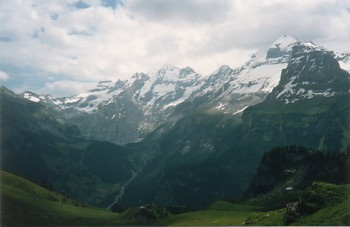
According to a story Friday in The Guardian, a huge chunk of rock–twice the size of the Empire State Building–is about to fall off the famous Eiger mountain in the Swiss Alps.
Since the alarm was sounded for the Eiger tourists have been gathering around the town of Grindelwald in the hope of seeing what promises to be the biggest rockfall in living memory.
The cause? Global warming, at least according to Dr. Hans Rudolph Keusen, a European researcher who has been surveying the mountain with "satellite based imaging radar systems."
His warning has brought in some out-of-towners, too.
Tourists are coming from all over to see the world fall apart.
Literally.
Guess I’m living in the 21st century.
Here’s a picture of the mountain, along with a first-person account over a recent visit, from Walter Cummings.

 Kit Stolz