Enviro Movie of the Year

Not Syriana. In Grist, David Roberts eloquently nominates the film , extolling its rough edges, stressing what it is not (not adolescent, not a paranoid conspiracy theory, not stupid). He admits:

When I first heard about the "oil movie," I figured it would be about oil the same way so much is about oil these days, via innuendo and implication, with conspiracy and malevolence hovering shapeless in the background. But no: This really is a movie forthrightly and directly about oil — who has it, who sells it, who buys it, and who gets caught up in its grinding gears.

But I have to side with the hardened lefty Marc Cooper, who refused to see the glass as half full:

Written and directed by Stephen Gaghan, (award-winning writer of “Traffic”), Syriana bludgeons you with the relentless message that you are watching something Terribly Important – but I couldn’t quite figure out exactly what that something was.

No question that the flick was an admirable exercise in the sort of risk-taking to which Hollywood is downright phobic. And it’s clearly an Adult Film in the very best sense of the phrase. So an “A” for effort and a courtesy, gentleman’s “C” for the final product.

All I came away with were notions I think I already knew: oil companies are greedy and ruthless; government is a pawn in the hands of such powers; and the CIA kills people it doesn’t like and is perfectly willing to eat its own when  expedient. Oh yeah, there was a whole subplot in this weave of disparate narratives about Iran and some sort of neo-connish Committee to Liberate Iran, but one of you viewers out there is going to have to explain that part to me.

(Actually, understanding the "Committee to Liberate Iran" isn’t that difficult, if you ask me. Substitute real-life Iraq for the dramatic stand-in Iran, substitute the Project for the New American Century for the "Committee" and the idea’s pretty obvious, right down to the connections between the super-rich far right conservatives (such as the John M. Olin Foundation) and well-known pro-war Washington mucky-mucks such as Dick Cheney, Paul Wolfowitz, and Donald Rumsfeld.)

To be fair, I must second Roberts’ admiration for George Clooney, who couldn’t be braver, and manages to carry the movie while looking anything like a star. Still, unlike Traffic (which Gaghan adapted, and Steven Soderburgh directed), Syriana is a movie focused on people explicitly not like us. We meet Saudi princes, Pakistani youths, Hezbollah radicals; even the Americans we encounter are far richer, more reckless, more desperate than us. These people are, in other words, "the other."

"Everything is connected" is the tagline for Syriana, but unlike Traffic–which forced us to confront the horror of illegal drugs right here at home–Syriana stays away from our kind. It actually takes torture for us to feel the pain that Clooney’s character vaguely expresses with his confused actions. Gaghan’s inability to bring home our part in the shame of oil makes Syriana an interesting experiment; not an honest-to-God movie.

In truth, the genius of Traffic–which, an English screenwriting friend reminded me, was based on an already-extraordinary mini-series–was not its complex structure, as captivating and suspenseful as that turned out to be; not the performances, though Michael Douglas has never been better; not even its masterful direction. Traffic was great because it made drug addiction, even heroin addiction, seem all too cool, all too imaginable. (Maybe the fact that Gaghan was once addicted to heroin had something to do with that.) No movie I’ve ever seen gave hard drugs their due. Syriana, by contrast, is considerably more violent, and far less affecting…an emotional desert.

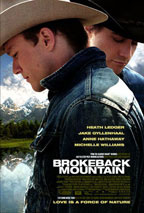
Brokeback Mountain has an axe to grind of its own, but one of a different kind. It’s about male homosexual love in unforgiving Wyoming, yet by its nature this movie ties its characters–and us–to the natural world. The beauty of the mountains that surround the two young cowboys one summer is never mentioned, but cannot be overlooked. Nobody remarks on the view; they barely see it. As in the original short story by Annie Proulx, to cowboy, the landscape is a place to work:

Ennis and Jack, the dogs, horses and mules, a thousand ewes and their lambs flowed up the trail like dirty water through the timber and out above the tree line into the great flowery Meadows and the coursing, endless wind.

It’s about as good a short story as you’ll ever read, but if you read it for lyrical descriptions, of love or the mountains, you’ll be disappointed. But that (in part) is Proulx’s point. This natural world doesn’t require her words to work on the cowboys or on us; that’s its glory. And glory is a big part of the point of the story, as she mentioned in a press conference with screenwriters Larry McMurtry and Diana Ossana, featured in New West:

This is one of the most powerful landscapes on earth and everybody who roams it knows it. There’s a visceral, unexplainable, indecipherable force that binds people to this place. I’ve known people from here who’ve gone east and they become just heartsick to be back here again.

Binding us to the planet; that is what film can do better, probably, than any other medium, and that is what "Brokeback Mountain" did better than any other movie this year. Strange that a story about homosexual love should reawaken us to the beauty of the planet, but that’s drama for you: It’s the unpredictable that makes it live within us.

"Love Is A Force of Nature," was the tagline from the movie. But the truth is, it works the other way around just as well.
Brokebackmountain_2

Quote of the Year

From Mark Lebovich of the Washington Post, via the LA Times (reg. required):

As a general rule, the most durable quotes don’t require the media to keep replaying them or a hostile opposition to keep reminding everyone of them. Rather, they stand on their own absurdity, famous last words that hang naturally from the necks of their authors. All the better if they are uttered with conviction, from a bully pulpit.

This year provided another classic in the famous-last-words category. It is the slam-dunk, read-my-lips, I-did-not-have-sexual-relations-with-that-woman 2005 doozy, a Cat 5 quote for the ages:


"Brownie, you’re doing a heckuva job."

— President Bush,

during his first visit to the Gulf Coast after Hurricane Katrina, commending then-FEMA head Michael D. Brown.

Really, it was never even close. The president’s vote of confidence had all the markings: Patently false, it came during a widely viewed event, was uttered by a prominent speaker, played to an unflattering caricature (of both people) and packed supreme irony.

Within days, Brownie was no longer doing any job, never mind a heckuva one.

It also bestowed a belittling one-word nickname that would eliminate "Michael Brown" from any future discussion of the doomed Master of Disaster.

Plus: Brownie’s white dress shirt was buttoned too high and pressed too well for a hurricane.

Plus: Brownie’s e-mails would eventually make him look worse.

"I got it at Nordstroms," Brownie wrote of his outfit while Katrina was bearing down on the Gulf Coast. Then he added: "Are you proud of me? Can I quit now? Can I go home?"

Yes, yes and yes, Brownie.

But we digress.

Back to the presidential money quote:

"I think for both concision and cluelessness, Bush wins hands down," says Ted Widmer, a history professor at Washington College in Chestertown, Md., and a White House speechwriter during the Clinton administration. "It’s very efficient," Widmer says. "It packs maximal inaccuracy into minimal expression."

An added bonus of "Brownie, you’re doing a heckuva job" is that it will live forever in the lexicon of disingenuous boss-speak. Who will ever hear the words "You’re doing a heckuva job" again without half expecting to be frog-marched out of the office a few days later?

“The Enron of Lobbying”

A couple of days ago came an amazing story by Susan Schmidt and William Grimaldi  on the rise and fall of Jack Abramoff. Of course, the real fall is just beginning for the former Beverly Hills High grad, who this weekend either will make a deal with prosecutors and turn on his former friends and close associates…or face the prospect of years in prison on a variety of bribery charges.

(And thank you Washington Post for encouraging linking to the story and blogging, even if a registration might be required.)

Abramoff is Mr. Culture of Corruption himself, a one-man wrecking crew who, it turns out, wasn’t a good guy gone bad; he was a bad guy from the start.

Abramoff was fired by his very first boss in politics, Rich Bond, a former chairman of the Republican National Committee. Bond not only fired Abramoff and two close associates, but banished them from headquarters and told Abramoff: "You can’t be trusted."

Here are some of Abramoff’s close friends and supporters: Oliver North. Jonas Savimbi. Apartheid South Africa. Dolph Lundgren. Grover Norquist. Newt Gingrich. The Pakistani military. Tom Delay.

A couple of other memorable quotes from the piece, which deserves full and careful reading.

"[When he was on a roll] Abramoff gathered his [lobbying] troops for strategy meetings that were "a great show," rollicking forums where ethical niceties were derided with locker room humor, recalled a former Preston Gates colleague. "Jack would say, ‘I gave that guy 10 grand and he voted against me!’ " the former associate recalled."

[cut]

"A Louisiana paper, the Town Talk of Alexandria, reported in September 2003 that the Coushatta tribe paid Scanlon’s public relations firm $13.7 million, a figure that amazed tribal lobbyists as well as some of Abramoff’s colleagues.

It was around that time that one colleague, Kevin Ring, learned from one of Abramoff’s assistants that his boss was secretly getting money from Scanlon, according to a source privy to the conversation."

"This could be the Enron of lobbying," Ring told the colleague."

Abramoff was getting multi-million kickbacks from Indian casinos via Michael Scanlon, in a scheme they called "Gimme Five." The government has emails in which Abramoff and Scanlon refer to their Indian clients as "morons" and "troglodytes"…but now Scanlon has "flipped" and agreed to testify against Abramoff for the prosecution.

This story by Walter Roche of the LATimes, via the Houston Chronice, speaks of "indications" that a deal between Abramoff and prosecutors is in the works, to be announced on Tuesday.

And here’s another similarity to the Enron case. Both are about to go to trial.

In the Enron case, the chief accountant, Richard Causey, has turned against the two men at the top with whom he had been, from all indications, conspiring for the last decade or so.

Why now?’

"The reality of it, the unavoidability of it, finally hit him," said one witness close to the story.

For long-suffering leftists who have been disgusted but helpless to stop the wave of anti-environmental legislation peddled by the Tom DeLay-led hard right, 2006 is shaping up to be a banner year for courtroom entertainment.

The Environment 2005: The Good, the Bad, and the Ugly

Here’s the linked version of a piece that ran in this week’s Ventura County Reporter.

2005 will be remembered as a year of natural disasters. We don’t need to recite statistics in an anchorman’s heavy voice to know the meaning of Katrina and La Conchita.

But when it comes to natural disasters, the question today is: How natural was the 2005 hurricane season? And what role, if any, did global warming play in the devastating storms that hit Ventura County in January 2005?

For years climatologists have been warning Californians that global warming will likely result in a paradoxical combination of extremes: more “droughtiness” interrupted by wetter, stronger storms. But still, those same climatologists, led by outspoken Bill Patzert of the Jet Propulsion Lab in Pasadena, doubt that this year’s catastrophic rains should be blamed on a changing climate, pointing out that, to date, California has warmed only slightly and adding that this year’s strange pattern has been observed once before, in 1889-1890.

For years, experts have thrown cold water on the idea of a connection between small increases in temperatures in ocean waters and hurricanes because very complex forces govern the creation of these storms. But a year ago, a study by Kerry Emmanuel of MIT found a 50 percent increase in wind speed in recent hurricanes. Emmanuel wrote that “the large upswing in the last decade is unprecedented, and probably reflects the effects of global warming.” Although Emmanuel and other scientists stress that no single storm, including Katrina, can be blamed on global warming, the consensus view now is that, most likely, hurricanes will become stronger and more dangerous, although not necessarily more numerous.

Nonetheless, there was good news in the environment this year, as well. The envelope please …

THE GOOD:

Solutions for CO2: Solutions to the carbon emissions crisis came from surprising places this year. The Bush administration offered a 10-year plan to build a no-emissions coal plant called Futurgen. Prominent environmentalists (such as Stewart Brand) came out in favor of nuclear power. And Princeton professor Rob Socolow offered a plan using existing technology to stabilize emissions, the Carbon Mitigation Initiative, which was backed by The Economist.

HYBRIDS SOAR: Driving a hybrid car is generally considered to be the most useful action an individual American can take to reduce carbon emissions. In 2005, high gas prices and new models more than doubled hybrid sales, to 200,000.

GOP congressmen back down: GOP Congressman Duncan Hunter, who proposed turning Santa Rosa Island (in the Channel Islands National Park) over to the military as a hunting preserve, withdrew the proposal in the face of opposition from the Parks Service, Democrats, environmentalists and the military. Similarly, Richard Pombo withdrew his plan to sell public lands for mining claims in the face of widespread opposition, especially from Republican Senators.

STORM RELENTS: On Jan. 10, 2005, the strongest storm to hit Ventura County since l969 unexpectedly relented. The tapering off that morning surprised experts; according to a presentation meteorologist Camille Sears gave in Ojai, the storm could have brought as much as 20 more inches of rain.

PURETEC CLOSES: An industrial water treatment plant operated by Puretec closed in Ventura after years of controversy, at least one toxic spill and the threat of a lawsuit from the Ventura Coastkeeper group.

NEW CAMPGROUND: Years ago, the Forest Service closed the popular Lion Campground by the Sespe, off Hwy 33, north of Ojai, so as not to threaten the Arroyo Toad, but has redesigned and renovated the trail head area, now called Piedra Blanca. The agency also plans to reopen an abandoned campground nearby, close to the Rose Valley falls.

CLIMATE CHANGE A CELEBRITY: According to Matthew Nisbet, who ranks the attention the media gives to issues, climate change was fifth on the list in 2005, behind Iraq, Social Security, abortion and the pope, but ahead of Tom DeLay, the CIA leak scandal and the Super Bowl …

THE BAD:

WASHINGTON REFUSES TO TALK: Despite pressure from many nations and international corporations (such as Chevron and Swiss Reinsurance), the Bush administration walked out of talks in Montreal aimed at reducing carbon emissions.

GENERAL MOTORS STUMBLES: In January, GM Vice Chairman Robert Lutz derided Toyota’s $800 million investment in hybrids as an “advertising expense.” By December, industry observers (such as Businessweek) were warning that GM’s financial losses might force bankruptcy, a bail-out from Washington, or might bring a buy-out offer … from Toyota.

ENDANGERED SPECIES ACT ENDANGERED: GOP Congressman Richard Pombo’s initiative to gut the Endangered Species Act passed the House and awaits action in the Senate.

THE EPA GIVES UP: The so-called Environmental Protection Agency revealed plans to gut the Toxic Release Inventory, a long-standing measure requiring industry to notify the public when toxins are released. The level for notification will be raised to 10 times what is now required; provisions regarding lead and mercury will be dropped; and reports will be issued every other year, instead of annually.

PRESERVATION A LOW PRIORITY IN NATIONAL PARKS: Paul Hoffman, a former Dick Cheney staffer, now oversees the parks service for the interior department, and is rewriting regulations to empower motorized recreation and profit over preservation of public lands. Hoffman is an intimidator and promises those who oppose him that “heads will roll.”

TWO "SMOKING GUNS": In April, James Hansen , widely considered the most reputable climatologist in the country, released a study of global ocean temperatures at various depths, 10 years in the works, that he termed a “smoking gun”—proof of human-caused global warming. In November, Nature published a study showing a 30 percent weakening of the ocean recirculation system known as the Gulf Stream, which another highly regarded expert, Michael Schlesinger, also called a “smoking gun.”

THE UGLY:

White House official rewrites science: White House lawyer Philip Cooney, caught rewriting scientific reports on global warming, was forced to resign in June. The next business day he was hired by ExxonMobil.

21st-CENTURY NERO: As Hurricane Katrina hit New Orleans, an oblivious President Bush clowned around on a stage in San Diego, pretending to play guitar with country-western crooner Mark Willis.

HUMMER SALES CRASH: Although GM claims that the new model H3 Hummer is selling well, sales of older 8,000-pound, 12-mpg vehicles are down at least 25 percent. A blogger (www.themessthatgreenspanmade.blogspot.com) who has looked at inventory records for a dealer in Thousand Oaks says sales are crashing, with a six-month supply available. But wait … is this a bad thing?

Killing the (scientific) messenger: Irritated by the Fish Passage Center, a tiny agency set up two decades ago in Portland to document salmon runs, Senator Larry Craig, R-Idaho, cut its funding out of the budget, pleasing one of his biggest contributors, the electric utility industry, which previously dubbed him “Legislator of the Year.”

Town threatened with God’s wrath: After Dover, Pa. citizens voted eight members of the school board out of office last month for requiring biology teachers to instruct high school students in “intelligent design,” Pat Robertson warned the town that “if there is a disaster in your area, don’t turn to God. You just rejected him from your city.”

The ELF: Ecoterrorists or Right-Wing Myth?

They say these are polarized times and boy, ain’t that the truth. Here’s a perfect example: the Earth Liberation Front. Is it a menace to the nation, or a right-wing boogieman?

On the right side of the political dial, notable blogger Professor Bainbridge opines that he has "no problem" with the FBI tracking "such groups," including PETA, the Catholic Workers, and a vegan group in Cincinnati, as long as they get a warrant first. After all, we’re talking about "ecoterrorists," and Bainbridge points out:

Because actual ecoterrorist cells "are very difficult to infiltrate and stop," surveillance of their "mainstream" influences seems like a logical place to start, as long as somebody checked the Constitution first to see if they needed a warrant.

On the left hand side of the dial, reporter Judith Lewis looks at FBI documents on surveillance of environmental groups, including statements from FBI agents that PETA funneled money to the Earth Liberation Front, and finds little evidence that the group actually exists. (Could that be why such their cells are so difficult to infiltrate?)

The ELF appears, in fact, to be largely the creation of a property-rights advocate named Ron Arnold, who coined the phrase "ecoterror" in a l992 book, and has been actively promoting the concept ever since.

In an interview with Fox News, Arnold gave his definition [of ecoterror]: “The first thing you look out for is, is there some protection-of-nature motive behind it? In other words, if there’s a wild area or a scenic area or something that’s not far from it, that gives you the first clue.”

Lewis goes on to track some of the most notable examples of ELF "ecoterror" acts investigated by the FBI:

In August 2003, FBI agents harassed Pomona resident Joshua Connole in connection with the vandalism of a West Covina Hummer dealership on no evidence at all, and against Justice Department orders; last month, he was awarded $100,000 in damages. The man who was later convicted of the crime, William Cottrell, denied any association with the ELF, although media roundups of “ELF attacks” still include him.

There is an ELF website, but it features as many ads as it does stories, for the likes of 0% credit cards, and it’s put up by a marketer. Lewis calls it "a blatant front for advertising."

Nice irony, isn’t it? The one real aspect of the ELF that people can point to turns out to be not a left-wing menace, nor a right-wing boogieman, but just another platform for advertising.

Is there anything in this country that’s not for sale? Sometimes I wonder…

Fifty Years From Now

It’s natural at the end of one year and the beginning of another to take stock of what has happened, and to look forward to the future. This past January, The New Yorker launched a three-part series by Elizabath Kolbert on global warming. This year, it’s the turn of Bill McKibben in The New York Review of Books. McKibben’s piece is much shorter, and pitched as a review of two new books on the subject, but I must say, he gets to the heart of the matter much more quickly than Kolbert did. Perhaps that’s becaue he doesn’t try to explain the physical processes–which by now are well-known to anyone who cares to pay attention–but simply looks at the evolution of the science of the issue. It’s stunning, memorable, and leaves the bogus far behind.

In the review, McKibben quotes Ohio State scientist Lonnie Thompson, who has spent the last twenty years of his life documenting the vanishing of glaciers around the world, but has long been reluctant to take on the issue in public. Thompson admits that the conservatism of scientists has been part of the reason the public has been slow to awake to this issue:

Scientists are by training and nature conservative and…have probably underestimated our impact. Fifty years from now—I hope I’m wrong—I think you may be living in a world where you don’t go outside between one and four in the afternoon.

The piece is short, well-written, and well worth reading.

FBI on Pombo’s Trail

This morning brings a big Christmas present for those of us who care about the health of the planet, and a big lump of coal for corrupt Republican anti-environmentalists.

As speculated here a couple of days ago, Republican anti-environmentalist Richard Pombo is officially a "close associate" of Tom Delay, the indicted Republican who once ran the House with an iron hand, and his close buddy Jack Abramoff, the lobbyist already indicted in connection with a Mob murder.

Delay is facing trial in Texas on a money-laundering charge; Abramoff is facing a long prison sentence, and has reportedly agreed to co-operate with the Federal authorities. He is known to have helped funnel money to Pombo–at least $20,000 worth. In fact, according to this story in today’s LA Times (reg. required), the FBI is already following the trail of money from an Eastern tribe hopeful of getting official Federal designation, so as to be able to open a casino…to Pombo, head of the powerful House Resources Committee. Reports the Times:

Officials do know that the flow of cash from the Mashpee to Abramoff and Pombo is a textbook example of the kind of cases of alleged influence-buying that the task force is assembling.

But what investigators want to determine is whether the Mashpee episode crossed the line into criminal behavior, as other Abramoff ventures allegedly did.

Last week on another story I talked to Andy Stahl, who leads the small-but-wonderfully active Forest Service Employees for Environmental Ethics group. He pointed out that the best window of opportunity for anti-environmentalists to pass bills was probably 2005; now legislators such as Pombo will be running again for re-election (not to mention quarreling over the Patriot Act). Pombo has won decisively in the past in his heavily Republican district, but according to this post from Judith Lewis, his corruption and anti-environmentalism have so ticked off former Representative Pete McCloskey, a Republican and one of the authors of the Endangered Species Act, that McCloskey is actively recruiting a Republican candidate to run against him, and will do it himself if he has to next year.

According to a front-page story in the Tracy Press:

Former congressman Pete McCloskey is getting closer to taking on Rep. Richard Pombo.

In what he called a “revolt of the elders,” the 78-year-old Republican said he would run in a June primary if he can’t find anyone else by the end of the year to take on Pombo, R-Tracy.

“Every professional has told us that the only way to beat Pombo is in a primary,” McCloskey said Monday in a meeting with the Tracy Press editorial board.

[snip]

McCloskey said Republicans in Congress had been corrupted by power, and he compared the existence of progressive Republicans like himself to the Ivory Billed Woodpecker.

“They’ve been extinct for 20 years, but there are rumored sightings,” he said.

Petemccloskey

Go Pete! Remind the world that the GOP once cared about the planet…

“China Puts Out Way More C02 than Competitors…”

Just came across a fascinating and busy international group site called WorldChanging; this post discusses C02 emissions not in terms of output per nations but in terms of output per $1000 GNP, and finds China to be vastly less efficient than the U.S.

In 2003, for example, the chart shows that it takes about 9500 tons of CO2 for the U.S. to produce $1000 in GNP; for the same amount of money, it takes China over 28,000 tons.

Study this post for a time and you’ll conclude that what we need to do to reduce greenhouse gas emissions worldwide is to make China a more efficient nation.

But this is an incomplete picture. It ignores the fact that increasingly China is doing the manufacturing work of the world. As the U.S. and European nations prefer to focus on various forms of service industry–some of them quite elaborate, such as the legal system, or movies–they export basic manufacturing to nations with lower labor costs.

Yet the U.S., which has less than a third of the people of China, emits about one-quarter of the world’s greenhouse gases (last I heard). So if we’re talking about solutions, doesn’t it make sense for us to look at emissions per capita as well as emissions per $1000? Wouldn’t it be easier for individuals in the U.S. to make improvements, rather than for whole industries in China to make improvements?

But it’s an interesting discussion and an interesting site.  The international group of collaborators looks for "profound positive change" and speak of "karmic rewards." They want to find new ways to cooperate and collaborate as well as new technologies. And they do build their work on a bedrock of science, and clearly know how to write as well as to graph. Worth a look.