Internet Kills Wacky Aliens, Undercuts Scientologists

Although the Internet is blamed for spreading all sorts of rumors and bad jokes, it probably doesn’t get enough credit for also dispatching with all sorts of crazy nonsense. This column on the right-wing TechCentralStation needs a grain of salt, because the writer previously spoke warmly of Harriet Miers’ mediocrity, and grandly declared without evidence that the religious ideology known as "Intelligent Design" was going to win wide acceptance in science classes.

But when it comes to aliens, he has a point.

"…the rise of the Internet in the late nineties corresponded with the fall of many famous UFO cases. Roswell? A crashed, top-secret weather balloon, misrepresented by dreamers and con men. The Mantell Incident? A pilot misidentified a balloon, with tragic consequences. Majestic-12? Phony documents with a demonstrably false signature. The Alien Autopsy movie? Please. As access to critical evidence and verifiable facts increased, the validity of prominent UFO cases melted away. Far-fetched theories and faulty evidence collapsed under the weight of their provable absurdity. What the Internet gave, the Internet took away."

Another writer on the subject of Scientology made much the same point earlier this year. I can’t find the piece, unfortunately, but his point was that the couch-jumping antics of famous Scientologist Tom Cruise concealed an underlying desperation. The cult simply can no longer recruit the credulous as readily, now that its ridiculous fantasies can be checked out on the Internet so easily.

A site by a  woman who took a few courses in Scientology back in the l980’s, called The Truth About Scientology, makes the point eloquently with a chart based on statistics drawn from a Scientology publication called "Source" magazine. The number of "Clears" has fallen to a low level and stayed there in recent years, ever since the arrival of Google in the 90’s.

Clears
It’s just not as easy to hoodwink people as it used to be.
1 Nuclear Power Plant = 93 Million Cars

Judith Lewis, the first-rate enviro reporter for the LA Weekly, spent the last six months of her life reconsidering nuclear power. Here’s the piece she wrote about it, which is as good as anything I’ve seen on the subject. Among the many stunning facts she unearthed was the fact that one nuclear power plant spares the planet the equivalent of the emissions of 93 million cars (and we’re not talking hybrids).

But it’s not the facts that I most remember from the piece. It’s the humanity. Lewis talks to all sorts, from fiery enviros like Helen Caldicott, to a public relations specialist at the nuclear power plant in San Onofre. She treats each and every one with respect, bringing out their personalities as well as their opinions. This is how we as reporters and as readers and as a society grow–by really listening.

Check it out, please.

Earth to America: Global Warming Special

Countless documentaries on climate change have aired on national television, including one last week from the newly-converted FOXNews, but last night for the first time saw a comedy special on the issue. Hosted by Tom Hanks and Leonardo DiCaprio, the special was mostly stand-up, with a few skits and plenty of advertisements, but did find its share of laughs and, perhaps most importantly, avoided predictability. No doubt they could have found some rockers to feature on the issue; instead, they called on Tim McGraw, who sang a country-rock tune about living where the green grass grows, and helpfully reminded everyone that the natural world is not just for lefties.

The special was organized by National Resources Defense Council trustee Laurie David, who’s married to Larry David, of the "Seinfeld" show. David was one of several celebrities whose appearances were as much about self-mockery as politics; clearly, the show wanted to be funny more than anything else, and mostly succeeded. As David told Amanda Griscom Little:

You need to make people aware that a problem exists, but without talking down to them. Without being preachy. I refuse to be a part of being preached to. That’s what "Earth to America!" is all about.

The most passionate celebrity voice on the issue came from Bill Maher, who earlier had told USAToday that "the environment is one of the hardest subjects to do in comedy. It doesn’t have an obvious, easy, funny target." But probably the highlight of the show was Will Ferrell’s vicious parody of George W. Bush Jr. blithering attempts to make a coherent statement about global warming from his ranch, climaxing with a discussion of how 6,000 years ago it was hot, which we know because Adam and Eve didn’t have any clothes on…"I’m not just making this stuff up, you know!"

We know better. The current placeholder in the White House has been pretty much a disaster for the country, but for satirists, he’s been golden.

Global Warming Coverage Makes Fox News Hack Hot Under the Collar

Steven Milloy is a right-wing hack who makes a good living abusing science. He has a column on the FOXNews site, but also runs two groups out of his home that have received over $90,000 from ExxonMobil. He’s upset because two well-known leftwing activists, Robert F. Kennedy, Jr., and Laurie David, have convinced his boss at FOXNews that global warming is one of the biggest stories in the world today. It turns out that John F. Kennedy Jr. likes Roger Aisles, who runs FOXNews, if not his politics, and convinced him to see a Power Point presentation put on by Al Gore on global warming. According to the story in the LATimes:

Ailes attended, and also agreed to meet several weeks later with Kennedy and David.

"I made the point to him that this should not be a political issue and that the Republican Party has a strong conservation tradition," Kennedy said.

The pitch worked. Ailes agreed the subject merited coverage, according to the activists.

This has Steven Milloy hot under the collar. He posted a piece by another right-wing hack, Patrick Murphy of the Cato Institute (also funded in part by ExxonMobil) to contest the Fox documentary that ran this past Sunday. "FOX Caves to the Global Warming Crowd!" warned an alarmed Patrick, but his was a weak effort preoccupied with obscure claims and utterly failed to challenge the well-established scientific consensus that yes, global warming is real, and it’s happening in the Arctic first, as scientists have long predicted. FOX  reporter Rick Folbaum reported from Alaska that:

After months of research and interviews with many experts, I’ve learned this simple fact: the earth is heating up. And it’s happening much faster than ever before. No one can argue with this. The vast majority of the scientific community says we’re witnessing a unique and troubling kind of climate change, one where changes that used to occur over centuries are now taking place during the course of a single lifetime.

Worse yet for Milloy, FOXNews is continuing to post the latest news on global warming, including a study published today by scientists at Princeton, warning that global warming threatens to innundate the Jersey shore with the equivalent of 100-year floods…every five years.

Yesterday FOX ran two stories on global warming. The first focused on a glacier in Greenland that is shrinking much faster than scientists expected. On his site, Milloy showed concern. "Worse, they’re running this!"  cried a frightened Milloy, speaking of a study published by scientists at the University of Delaware predicting that tens of thousands of Americans could die in global warming-caused heat waves, just as over 20,000 Europeans did in 2003.

Maybe these kind of facts changed Roger Aisles’ mind, but I wonder if he was also thinking of the future of the media company he runs. FOXNews is tightly tied in the public perception to a President and a political party whose approval ratings are plummeting. Mightn’t covering global warming be a conveniently non-political way for FOX to show its independence of the failing Bush administration? 

Listening to the Land (Is Not Easy)

In an appearance at Cal State Channel Islands last week, Terry Tempest Williams begin by talking about her new book, "The Open Space of Democracy," and her town’s struggle to keep its soul. Castle Valley, a tiny Utah town about twenty miles from Moab, was threatened with inalterable change when a real estate developer bought eighty acres directly across the river. Williams was part of a group that organized to resist; eventually, with some luck and the help of a very large check from California, they were able to buy the in-holding land themselves, and reserve it for open space. But here’s the point. Her group–which sounds as if it included most of the town–was organized around the principle of listening to the land and to each other, in equal measure.

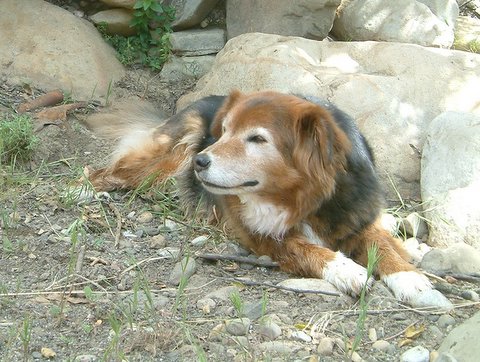
I admire this respect, but you know, it’s not easy. I wish it was. I try, but I find it’s far subtler than it sounds. Here’s a little example from my own life. A week ago late one afternoon we noticed our Djelka, the smartest dog we’ve ever known, beloved by one and all who come to our little place here in Upper Ojai, was missing. We went looking for her. We drove up the hill and around the nearby streets. We walked up the stream that runs by our house (that’s mostly dry now). We startled neighbors up the stream by dropping by unannounced late at night, because they have dogs and we know that Djelka and her pal Lucy often visit. They hadn’t seen her. They said the coyotes had been around quite a bit, howling. We called, we clapped, we yelled. We heard their dogs, but nothing else.

My wife Val went home to make dinner, and I continued to walk up the stream–in the dark–for about a mile. Stumbling over rocks. Wondering what could have happened. Djelka, who’s now twelve, doesn’t see as well as she used to. Could she have fallen in a pool and drowned? Could the coyotes have surrounded her? Lucy looked anxious, and went home. As I turned home a half-hour later, I kept calling and clapping, and heard a lot of barking from the neighbor’s house. I figured it must have been their dogs…but next morning we found Djelk trapped in a dry oil sump pit, about a yard deep, into which she had fallen the day before. She must have heard me, and barked in response, but I dismissed it, thinking it couldn’t be her, we’d already been there. If I could only have listened to her–and the land–a little better, I could have saved her from a cold night in the rain…

But the story has a happy ending. She’s fine. We’re so happy to have her back. And perhaps next time, I’ll listen a little more thoughtfully…
Dscf0178

Flip-Flopping On Intelligent Design

Facing a difficult re-election campaign against a popular, "pro-life" Democrat (and trailing by twenty points, according to one poll) hard right Republican Senator Rick Santorum of Pennsylvania is now distancing himself from Bush and Iraq, and has come out against teaching the religious ideology of "Intelligent Design" in high school classrooms.

This is a known as a flip-flop. As this story from a local newspaper points out, Santorum wrote in a Washington Times editorial a few years ago that Intelligent Design "is"a legitimate scientific theory that should be taught in the classroom."

Santorum quietly shifted his position on Intelligent Design earlier this year, after his poll numbers went south, but before Bush’s did. Maybe he sensed which was the wind was blowing.

I asked Chris Mooney, author of "The Republican War on Science," about the flip-flop during an interview in August. Mooney had noticed the shift as well, and joked that Santorum "was for Intelligent Design before he was against it."

File it under another Republican chicken coming home to roost.

The New God

LINE OF THE WEEK:     From a dazzling essay in Poetry magazine, by one of the least traditional and most interesting poets in the country, Mary Karr:

"…while I still believed in God, he had come to seem like Miles Davis, some nasty genius scowling out from under his hat, scornful of my mere being and on the verge of waving me off the stage for the crap job I was doing."

Conspiring Against Life

Tuesday evening the brilliant writer Terry Tempest Williams spoke to a crowd of students, professors, and outsiders (such as myself) at Cal State Channel Islands (in Camarillo). Wide-ranging as always, she spoke about numerous topics, but inevitably returned to her central themes; the work of sustainability, the need for community with nature.

She closed with a quote from of all people, Emily Dickinson, who wrote in a letter to a friend:

"Life is a spell so exquisite everything conspires to break it."

It’s still true today. A strong Decoder piece in Sierra this month begins:

Since shortly after Richard Nixon signed the Endangered Species Act in 1973, enemies have conspired against it. Among the most zealous is Representative Richard Pombo (R-Calif.), the chair of the House Resources Committee.

Pombo, one of the thirteen most corrupt politicians in Washington, according to a watchdog group cited in a NYTimes editorial, is on the warpath. His lies and misrepresentations have been taken apart by the NYTimes, the LATimes, and perhaps most scathingly, by the Sacramento Bee, which begins a recent editorial:

Here’s a bizarre thought: If we don’t drill in the Arctic National Wildlife Refuge, we have to sell off national parks to help balance the national budget.

That grotesque notion has slithered full-grown from the dim recesses of Rep. Richard Pombo’s brain.

That’s right: you just heard one of the best newspapers in the state call Pombo a snake. Or, as a writer named Kurt Repanshek, puts it in a great post on his wonderful National Parks Traveler blog:

What Did the National Park Service Do to the GOP?

I don’t believe these far-right wingnuts represent a desire on the part of this country’s voters, and point to the fact that (as WIlliams mentioned) moderate Republicans just voted to preserve the Arctic National Wildlife Refuge from drilling. The battle’s not over–it never is–but I suspect the anti-nature Republicans are pushing their attempts at murderous destruction as far as possible to the right precisely because they sense the pendulum swinging back towards preservation. Compared to drilling in Yellowstone, after all, junking the Endangered Species Act sounds almost moderate.

We’ll see what happens. In the meantime we can look forward to a piece  by the sharp enviro writer for the LAWeekly, Judith Lewis, who posted this yesterday on her blog:
Thespeciesyousasve

The Judge May Notice

In what has to be the most stunning electoral news of the day, all eight right-wing Republican members of the conservative Dover, Penn. school board who backed the idea of forcing high school biology teachers to instruct students in the religious ideology known as "intelligent design" were ousted by voters. According to the Washington Post, they will be replaced by Democrats.

The crucial quote:

"My kids believe in God. I believe in God. But I don’t think it belongs in the science curriculum the way the school district is presenting it," said Jill Reiter, 41, a bank teller who joined a group of high school students waving signs supporting the challengers Tuesday.

Think this kind of common sense might weigh on the mind of the Federal judge considering the case?

Bet on it.

The ruling is expected in January.

Icemelt

The Weather Where We Are: the Arctic

(from this fall’s issue of Granta, by Canadian writer Margaret Atwood, who often visits the far North)

       The Arctic is an unbelievable region of the earth: strikingly beautiful if you like gigantic skies, enormous landforms, tiny flowers, amazing colors, strange light effects. It’s also a region that allows scant margins of error. Fall into the ocean and wait a few minutes, and you’re dead. Make a mistake with a walrus or a bear, same result. Make the wrong wardrobe choice, same result again. Melt the Arctic ice, and what follows? No second chances for some time.
     You could write a science fiction novel about it, except that it wouldn’t be science fiction. You could call it Icemelt. Suddenly there are no more small organisms, thus no fish up there, thus no seals. That wouldn’t affect the average urban condo dweller much. The rising water levels from–say–the melting of the Greenland and Antarctic ice caps would get attention–no more Long Island or Florida, no more Bangladesh, and quite a few islands would disappear–but people could just migrate, couldn’t they? Still no huge cause for alarm unless you own a lot of shore-front real estate.
    But wait: there’s ice under the earth, as well as on top of the sea. It’s the permafrost, under the tundra. There’s a lot of it, and a lot of tundra as well. Once the permafrost starts to melt, the peat on the tundra–thousands of years of stockpiled organic matter– will start to break down, releasing huge quantities of methane gas. Up goes the air temperature, down goes the oxygen ratio. How long will it take before we all choke and boil to death?
    it’s hard to write fiction around such scenarios. Fiction is always about people, and to some extent the form determines the outcome of the plot. We always imagine–perhaps we’re hard-wired to imagine–a survivor of any possible catastrophe, someone who lives to tell the tale, and also someone to whom the tale can be told. What kind of story would it be with the entire human race gasping to death like beached fish?
    What kind of story, indeed? And who wants to hear it?