Wilma: “Only” a Category Two

From Dr. Jeff Masters’ Wunder Blog, posted by a hurricane watcher widely admired in the meterological community…"Including the damage done to Mexico, Wilma will probably be the second most costly hurricane of all time, next to Katrina."

After producing more hurricanes than any other year on record, the 2005 season has run through the alphabet and moved on to Greek letters…but still has five weeks to go.

The Weather Where We Are: Spain

Javier Reverte, a Spanish writer, notes how the weather has changed in Madrid in his lifetime (excerpted from  Granta, translated by Amanda Hopkinson):

Throughout my childhood, adults would repeat ancient verses–all about the seasons–which, with remarkable frequency, would coincide with the actual forecasts made. "In January, a dog seeks out the shade" (frequent sunny spells even in midwinter); "February the crazy" (the unpredictable nature of the February climate); "When March may, May marches" (if the weather is fine at the end of winter, spring will be cold); "In April, waters mill" (a reference to the Spring rains); "Water in May makes your hair and the grass grow" (Spring rains were particularly good for new growth); "In August, with cold in your face" (the North wind got colder at the end of Summer); "The air of Madrid never snuffed out either a candle or a man" (a reference, dating from the sixteeth century, to the iciness of the air in the sierra surrounding Madrid).

In Madrid today, the four seasons exist only on a calendar. It hardly ever snows, the lakes and the river never freeze over and we eat fruit that tastes of nothing all year round. If March may, May calls up siroccos from the deserts of Africa. In April, it scarcely ever rains, and the ground cracks open. The birds have fled the asphalt, no caterpillars tumble from their cocoons in the trees, the crickets no longer thrum, the flowers barely smell and storms grow rare. The cold, happily, remains nestling only in the corners of my childhood memories. But a hard heat rolls in on weary, sticky waves, right into our brains where it lodges for months on end. It is a new kind of heat, wearisome and defeating, which still seems somehow unbelievable to those of us who happened to be born sixty years ago.

No Wonder They’re Angry

Leftists such as Robert Scheer have been wondering out loud why the Republican Right is so upset with the Harriet Miers nomination. Miers may not be ""the brightest of buttons" (as Paul McCartney recently remarked about Yoko Ono–guess the reconciliation is off). But she adores the President, and has but taken a secret oath to overturn Roe vs. Wade…so what’s the problem?

Jonathan Chait at The New Republic has a good idea. Social conservatives have been taken for a long ride by the business interests that fund the dominant party these days, and there’s no sign that they will ever get back to the issues that seem to matter most to the Religious Right: abortion, flag burning, gay rights, and small government. Instead they’ve been Shanghaied into supporting tax breaks for the rich and for big business, along with numerous anti-enviro measures that do no good for ordinary churchgoers:

Bush is far from the first Republican president to enjoy unrequited support from the Christian right. Presidents Reagan and George H.W. Bush appointed moderate Supreme Court justices and declined to press hard for constitutional amendments on issues like abortion and school prayer. Instead, those presidents, like the current one, give social conservatives symbolism and imagery but little in the way of actual policy change. Affluent conservative investors, on the other hand, get massive policy changes that they like.

Why do social conservatives keep accepting this rotten deal? It’s not because there are fewer of them than there are economic conservatives. A detailed Pew survey last spring found that "enterprisers," who favor smaller government, comprise slightly less than a third of the GOP voting base. The other two groups, "pro-government conservatives" and "social conservatives," tilt right on cultural values but have moderate or even liberal economic views and outnumber the enterprisers by more than two to one.

Surely the answer has something to do with the fact that the religious right’s political vanguard is complicit in its own subordination. For years, economic conservatives have learned that they can enlist social conservative groups to back their agenda on the flimsiest of pretexts. When business groups were fighting fuel economy standards, GOP activist Grover Norquist convinced Phyllis Schlafly’s Eagle Forum to oppose them as well, according to a 1995 Washington Post story, "because the mileage goals could be portrayed as threatening such mainstays of the family as the station wagon and the mini-van." According to its website, the top two legislative items on the Christian Coalition’s legislative agenda are "Passing President Bush’s Social Security reform" and "Making permanent President Bush’s 2001 federal tax cuts."

Where does it say in the Bible that Christians should accept being duped?


Sending a Message via the Polls

Yesterday I mentioned that the environment (love this planet, hate that word) is far more popular than so-called conservatives would have you believe. Only belatedly did I realize I hadn’t given any evidence for that claim. But there’s no doubt about it; in fact, it’s even more popular than I knew.

On the local front, ten years ago last week, Ventura County approved a supposedly controversial initiative called S.O.A.R. (for Save Our Agricultural Resources) designed to preserve open space and farmland, and, not coincidentally, prevent our county from turning into another L.A. or (more likely) Orange County. A high school teacher put together an ad hoc group to lead the effort, described in this LATimes article; the initiative passed despite being outspent ten-to-one by opponents, and despite alarmist claims it would lead to a crime wave.

On the national front, last week The Harris Poll released a national telephone survey of well over a thousand Americans on the health of our land, air, and water and wilds. Three-quarters of them agreed with this statement: "Environmental standards cannot be too high and improvements must be made regardless of cost." That vast majority includes sixty-nine percent of self-identified conservatives, and sixty percent of self-identified Republicans.

Further, nearly half (47%) agreed that "not enough" is being done to regulate those who would abuse the health of our world, and only four percent declared themselves unsympathetic to the environmental movement. Four percent!

How much clearer does the message have to be?

Maybe it’s not clarity that’s the problem. Somehow those of us who care about this planet have to find a way to turn up the volume…

Contrarian Round-Up

Though this writer comes to you from the left side of the dial, faithful readers will have noted an abiding interest in voices who defy the party line. Although politicized types on both sides sneer at independents and moderates, it is the undecided–or those who insist on being persuaded–who typically end up casting the decisive vote on controversial issues. Or, to be precise, they probably would cast the deciding vote, if their voice was decently represented in our national discourse.

Arguably, a great deal of the effectiveness of the Republican party and their right-wing supporters comes from their ability to suppress what Graham Greene called "the virtue of disloyalty" and hold to the party line. On environmental issues, for example, polls say that the nation as a whole is nowhere near as interested in looting the planet as are the corporate interests backing the Republican party.

As Kevin Drum wrote in a recent post, "Conservatives have also done a masterful job of demonizing, for example, "feminist," "environmentalist," "trial lawyer," and "labor union," despite the fact that sizable majorities of Americans support equal rights for women and stronger environmental rules, and equally sizable majorities are helped far more than harmed by trial lawyers and labor unions."

So for those of us who want to see a truly open debate on issues in this country–and in the House–it’s exciting to see the monolithic Right cracking up. And it’s not just the Right; this edition of a new feature called Contrarian Round-Up includes a hot button issue beloved by leftists–the allegation that the Bush administration stole the most recent national election.

From John Fund, a reliably right-wing writer for the editorial page of the Wall Street Journal:

President Bush has now gone further in internalizing the lessons of the Bork debacle. Harriet Miers is a "superstealth" nominee–a close friend of the president with no available paper trail who keeps her cards so close to her chest they might as well be plastered on it. If Ms. Miers is confirmed, it will reinforce the popular belief that the Supreme Court is more about political outcomes than the rule of law.

Andrew Sullivan, the most prominent libertarian voice on the right, vents his disgust with another partisan who as much as anyone sets the party line for the Right, Rush Limbaugh:

Maybe the memo never made it to Rush, so let’s see if we can get this through to him: it was the "held-in-contempt" Bill Clinton who reduced the size of government; it is your president and the conservative movement that has expanded it at a faster clip than at any time since FDR. That’s not an opinion. It’s what is called a fact. Deal with it. Or you too will never haul yourself out of the past.

And the cheerfully caustic Timothy Noah at Slate brings up a rather stunning criticism of the President’s decision-making abilities from a figure revered on the Right, Margaret Thatcher, (although it’s hearsay, from an ally who lunched with her recently):

The former chairman of the Arts Council of Great Britain, Lord Palumbo, who lunched with Mrs. T six months ago, told me recently what she said when he asked her if, given the intelligence at the time, she would have made the decision to invade Iraq. "I was a scientist before I was a politician, Peter," she told him carefully. "And as a scientist I know you need facts, evidence and proof—and then you check, recheck and check again. The fact was that there were no facts, there was no evidence, and there was no proof. As a politician the most serious decision you can take is to commit your armed services to war from which they may not return."

And finally, left-leaning Mother Jones assigns an experienced investigative reporter and a fact-checker to look at three books alleging that the 2004 Presidential election was stolen. Although applauding skeptics for raising the issue, and doubting that Bush won Ohio by all of 118,000 votes, Mark Hertsgaard nonetheless concludes:

Yet it remains far from clear that Bush stole the election, and I say that as someone who has written that Bush did steal Florida and the White House in 2000 (and who—full disclosure—is friendly with skeptics Miller and Wasserman). First, some of the most far-reaching acts of potential disenfranchisement, such as the purging of voter rolls, were legal—which is why one lesson of Ohio 2004 is that voting systems throughout the nation need fundamental reform. Second, even if Kerry had won Ohio, the national vote went to Bush by 3 million votes. Ohio would have given Kerry the presidency by the same unholy route that Bush traveled in 2000 and that led so many Democrats to urge, rightly, the abolishment of the Electoral College. Third, the skeptics’ position is weakened by the one-sidedness of their arguments and their know-it-all tone. They have a plausible case to make, but they act like it’s a slam dunk and imply that anyone who doesn’t agree with them is either stupid, bought, or on the other side—not the best way to win people over.

Speaking of winning people over, the farsighted Ronald Brownstein of the LATimes–whom many contrarians, notably Mickey Kaus of Slate, consider to be the best political analyst in the country–suggests today that the Karl Rove electoral strategy of relying on evangelicals and ditto-heads on the Right appears doomed in 2006, precisely because of a loss of support among independents.

In recent national surveys, Bush’s standing among independents has dropped to its lowest point during his White House tenure. In a CNN/USA Today/Gallup survey released Monday, 32% of independents said they approved of his performance as president, whereas twice as many — 64% — said they disapproved. Attitudes toward Congress are even more negative. In the new poll, 1 in 4 independents said they approved of Congress’ performance, whereas about 7 in 10 said they disapproved. Among all Americans, the approval rating for Congress in the survey was 29% — its lowest level since 1994, the year Democrats lost their majorities in both chambers.

Now maybe we can have a real debate in this country. Wouldn’t that be interesting?
Scientician of the Month

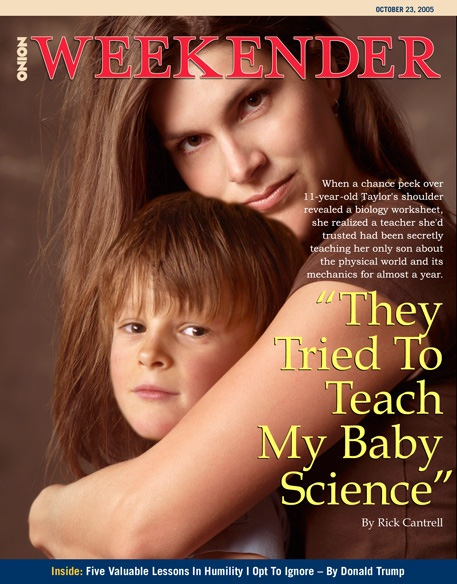
According to The Simpsons, a "scientician" is "a scientist with questionable credentials who publicly supports spurious hypotheses."

It’s a wonderful word, but almost too mild for criminals like Dr. Gilbert Ross, who has testified that arsenic in pressure treated wood is harmless, that PCBs in fish are not a health risk, and who has doubted the proven link between second-hand cigarette smoke and health problems for those who are exposed to it.

In the most recent issue, Mother Jones points out that this science abuser, the lead liar for an industry-funded group misleadingly called the American Council on Science and Health (ACSH) spent forty-six months in federal prison for his participation in a scheme to defaud New York’s Mericaid program of about $8 million. Ross worked as a doctor for the obviously fraudulent operation but claimed to know nothing about the fraud itself, which inspired the judge to tack on a perjury conviction and substantial fine. Ross subsequently lost his medical license, and was deemed "a highly untrustworthy individual" by the U.S. Department of Health and Human Serivces…but was nonetheless promoted to "medical/executive director" in l999 by the ACHS. 

The Useful Thing about Global Warming

Bill McKibben, who broke on to the national scene about ten years ago with his devastating account of "The End of Nature" (featured in The New Yorker) remains one of most incisive writers on enviro issues in this country today. Part of his skill is his ability to face hard facts, but still find alternatives to utter despair. His eloquent Changing the Climate piece in The American Prospect, in response to a much-discussed essay called "The Death of Environmentalism," is model of thoughtfulness that continues to reverberate in my mind.

On the one hand, McKibben argues that the enviro movement pretty much ground to a halt in the early 90’s with the wide-spread realization that if we did not stop emitting carbon dioxice we faced  global warming and the prospect of being forced to change our entire way of life. Nobody knows how to deal with that, and it’s crippling us with guilt and indecision.

On the other hand, McKibben goes on to say:

The useful thing about global warming is that its causes are so large and deeply rooted that it almost forces us to begin thinking on a similar scale. It’s not “environmentalism” that will solve this issue; it has its hands full trying to keep the administration from clear-cutting the national forests and ransacking the Arctic in search of yet more carbon.

No, the political force that finally manages to take this issue on is the political force that also understands and helps to nurture the deep-rooted and unsatisfied American desire for real community, for real connection between people. The force that dares to actually say out loud that “more” is no longer making us happier, that the need for security and for connection is now more important. Such a challenge might conceivably come from unexpected quarters. Christians, including evangelical conservatives, have begun to speak about global warming as a real issue for anyone concerned about the integrity of creation. The anti–SUV “What Would Jesus Drive?” movement actually scared Detroit, something the green groups have never managed.

The invaluable site "Gristmill" brought up a good example of this convergence–a story in Newsweek about how it turns out that traditional cities (which demand walking and talking, not driving and calling) are far healthier for us humans than the suburbs.

Other risk factors aside, people in densely populated places graced with sidewalks and shops had the lowest rates of diabetes, hypertension, heart disease and stroke. And the rates rose steadily as communities became more spread-out and less walkable. Statistically, a person living in Boston or San Francisco was healthier than an identical person in Atlanta or San Bernardino.

Can we get a clue? How long will it take? These are the questions that come to mind…

Is Human Kindness Surprising?

In Harper’s in September, Rebecca Solnit wrote that rare animal–a truly surprising essay. Published on the eve of Katrina’s landfall, and excerpted on the web, Solnit made at least three really thought-provoking points:

First, that people who live through disasters often look back on them fondly. New Yorkers remember the blackouts that way. Solnit, who lives in the Bay Area, recalls "the gregariousness in the hours and days after the l989 Loma Prieta earthquake, which killed sixty-three pople and interrupted life for millions…the quake shook us out of our everyday grudges and create a rare sense of fellowship in an increasingly atomized region." From this and a few other examples she concludes, following William James, that because we share the experience of a disaster, "the solidarity may eclipse the suffering, and thus rather than adding to the isolation of individual misfortune such events may undo the loneliness of everyday life."

Second, that what transpires in the aftermath of a disaster rarely resembles a horror movie. Even after the l906 earthquake, witnesses recalled "no running around the streets, or shrieking, or anything like that," but rather people walking calmly about, talking, even joking. "Instead [of panicking], the people generally classified as victims generally do what can be done to save themselves and one another. In doing so, they discover not only the potential power of civil society but also the fragility of existing structures of authority. And perhaps this, too, is grounds for joy."

And third, most radically, that disasters can allow us to rediscover the community that our government and our way of life are conspiring to eradicate, in much the same way that the festival of carnival was a joyous respite from the heavy structures of church and tradition. Solnit sees our recent history of privatization as moving us away from each other. "…we are encouraged by our great media and advertising id to fear one another and regard public life as a danger and a nuisance, to live in secured spaces, and communicate by electronic means…but disaster makes it clear that our interdependence is not only an inescapable fact but a fact worth celebrating…"

I’ve never lived through a disaster comparable to Katrina, but I have seen numerous fires and floods and an earthquake in fifteen or so years in the somewhat melodramatic landscape of Southern California where we live, and it’s absolutely true that people around here cherish their disasters. They mark their lives by them, and take pride in their willingness to help neighbors, and exhibit no signs of panic or desperation in the midst of the calamity, and a great eagerness to talk and share their experiences in the aftermath.

Once I thought it was simply that people liked the drama, but Solnit has got me thinking. Perhaps, in our heart of hearts, the disaster we fear the most is the one we know the best: Loneliness.

Toles vs. Toles

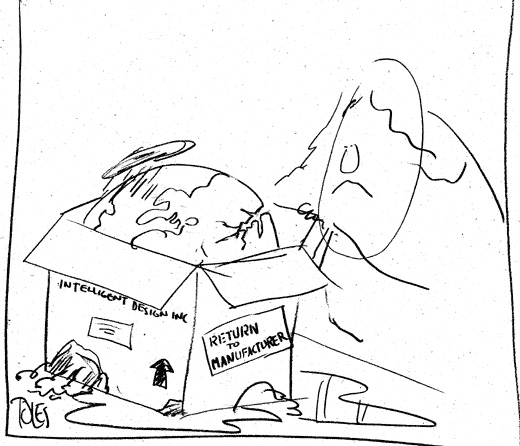
Tom Toles, an editorial cartoonist for the Washington Post, has a fascinating feature in which he publishes sketches of work he doesn’t finish and put into syndication. Given Toles’ brilliance, and the fact that he is the editorial cartoonist most interested in science and environmental issues, these sketches sometimes turn out to be quite wonderful in their own unfinished way…

Intelligent_design