Who is Harlan Talking To?

According to a story in USAToday, Harlan L. Watson, the U.S. envoy to negotiations on climate change, finds no connection between climate change and the strength of hurricanes.

"Our scientists are telling us right now that there’s not a linkage," he said in Geneva. "I’ll rely on their information."

None. Zero. Nada. Zip.

This is depressing. As discussed below at length, to blame Hurricane Katrina and its devastation entirely on global warming, as a couple of prominent speakers have, is simplistic and, for liberals, all too convenient. But at the same time, theoretical math and observational science have found solid links between global warming and stronger, wetter storms, and a highly-regarded M.I.T. researcher named Kerry Emanuel has specified that connection to hurricanes, finding a 50% increase in wind speed in hurricanes in recent years in an important paper published this year in  Nature. His paper, which is linked below, has opened a new line of research that quite possibly will be validated by other scientists. As Emanuel mentions in his opening line, a great deal of evidence suggests that global warming should bring us wetter, longer-lived hurricanes, it just hasn’t been shown yet.

A reporter in Geneva needs to ask Watson if he’s ever heard of Emanuel or the alarming evidence he’s found. If Watson says he hasn’t, a reporter needs to ask him who is briefing him, and why he hasn’t even heard of the debate in the field on this um, important, topic.

The basic lack of curiousity on the part of the placeholders in the White House towards scientific questions has been thoroughly shown. If they won’t ask the questions, it’s time for those who make their living asking questions to start putting them on the spot, on this and many other issues. 

Proving the Point…Again

In response to the escalating disaster in New Orleans, the White House proves unable even to co-ordinate its own spokespeople. 

The Bush administration, struggling to master the chaos of New Orleans, seems to have a logistical problem closer to home: getting the White House on the same page with the Homeland Security Department.

But really, we shouldn’t be surprised. P.J. O’Rouke, nobody’s idea of a liberal, warned us:

The Republicans are the party that says government doesn’t work and then gets elected and proves it.

[from Holidays in Hell. l989, London (Picador), 270-271]

Something Gave

Today the Chicago Tribune develops the story about the disastrous Republican underfunding of the flood-control system designed to prevent New Orleans from catastrophe. The lede:

Despite continuous warnings that a catastrophic hurricane could hit New Orleans, the Bush administration and Congress in recent years have repeatedly denied full funding for hurricane preparation and flood control.

The warning:

In July 2004, for instance, federal, state and local officials staged a simulation in which a "Hurricane Pam" slammed into New Orleans with 120 m.p.h. winds and created havoc that was eerily similar to that of Hurricane Katrina, including widespread building damage and death.

A Republican official speaks out:

"I’m not saying it wouldn’t still be flooded, but I do feel that if it had been totally funded, there would be less flooding than you have," said Michael Parker, a former Republican Mississippi congressman who headed the U.S. Army Corps of Engineers from October 2001 until March 2002, when he was ousted after publicly criticizing a Bush administration proposal to cut the corps’ budget.

The local expert speaks:

Joseph Suhayda, an emeritus engineering professor at Louisiana State University who has worked for the Army Corps of Engineers, said the corps simply didn’t have enough money to build the levees as high as the designs called for.

"The fact that they weren’t that high was a result of lack of funding," he said, noting that part of the levee at the 17th Street Canal–where one of the breaches occurred–was 4 feet lower than the rest. "I think they could have significantly reduced the impact if they had those projects funded. If you need to spend $20 million and you spend $4 or $5 million, something’s got to give."

The President answers, on "Good Morning America."

"I don’t think anyone anticipated the breach of the levees."

Sorry, Mr. Sullivan. Sorry, Mr. Kennedy.

Andrew Sullivan, a prominent right-wing blogger, looks at the possibility of a link between global warming and the devastating hurricane that just hit New Orleans and scoffs: "As if any serious expert believes this is in any way connected."

Sorry, Mr. Sullivan, but on August 4th of this year a prominent atmospheric scientist at M.I.T., Kerry Emanuel, published a deadly serious paper in Nature called "Increasing Destructiveness of Tropical Cyclones over the Past Thirty Years," arguing that in fact it is quite possible, even likely, that global warming is contributing both to the life and ferocity of hurricanes. Emanuel writes in his introduction:

Theory and modelling predict that hurricane intensity should
increase with increasing global mean temperatures, but work on
the detection of trends in hurricane activity has focused mostly on
their frequency and shows no trend. Here I define an index of the
potential destructiveness of hurricanes based on the total dissipation
of power, integrated over the lifetime of the cyclone, and show
that this index has increased markedly since the mid-1970s. This
trend is due to both longer storm lifetimes and greater storm
intensities. I find that the record of net hurricane power dissipation
is highly correlated with tropical sea surface temperature,
reflecting well-documented climate signals, including multidecadal
oscillations in the North Atlantic and North Pacific, and
global warming. My results suggest that future warming may
lead to an upward trend in tropical cyclone destructive potential,
and—taking into account an increasing coastal population—
a substantial increase in hurricane-related losses in the twenty-
first century.

To put it in context, stories in both Salon and the LATimes point out that Emanuel’s paper charts a new position in the field of hurricane studies, inspired by climatological computer modeling, and that many skeptics remain.

"I was one of those skeptics myself — a year ago," Emanuel told Michael Bustillo of the LATimes.

Only after noticing a fifty-percent jump in wind speeds in hurricanes in recent years, which he said "startled" him, did he begin to rethink his position.

People are beginning to seriously wonder whether there is a [global warming] signal there. I think you are going to see a lot more of a focus on this in coming years.

On the other side of the political dial, Robert F. Kennedy, Jr., a prominent environmentalist allied with the NRDC, declares in The Huffington Post that "…the science is clear" and cites Emanuel’s study as showing a cause-and-effect link between global warming and "the increasing prevalence of destructive hurricanes." He goes on to blame prominent Republican Haley Barbour for bringing global warming to his home state of MIssissippi in the form of Katrina.

Sorry, Mr. Kennedy, but the science on this subject is not nearly that clear. The leading expert on hurricane prediction in this country, Bill Gray of Colorado State University, adamantly denies not only that global warming strengthens hurricanes, but even that it exists. In an unusual readable Q&A with Gray published in September in Discover magazine, Gray declares:

Nearly all of my colleagues who have been around 40 or 50 years are skeptical as hell about this whole global-warming thing. But no one asks us. If you don’t know anything about how the atmosphere functions, you will of course say, “Look, greenhouse gases are going up, the globe is warming, they must be related.” Well, just because there are two associations, changing with the same sign, doesn’t mean that one is causing the other.

But by implying that only reckless young researchers, perhaps motivated by a desire for funding, believe in global warming, Gray over-reaches. Not all global warming believers are young, for one. Charles Keeling, the man who first discovered the cause of global warming, and tracked CO2 emissions with his Keeling Curve, and who received the National Medal of Science just three years ago, died at this year at age eighty-seven. Keeling and his team at Scripps Oceanographic Institute had no doubt about the peril of spewing what he called a "half-billion years of carbon" into the atmosphere, and neither does the man usually considered the most prominent of climatologists today, James Hansen at NASA’s Goddard Institute of Space Studies, who is Gray’s age. Not to mention that when the skeptical Bush Administration asked the National Academy of Sciences, this country’s most respected scientific body, for an opinion on global warming, the NAS resoundingly seconded the supposedly controversial UN/IPCC report linking a rise in greenhouse gases with global warming in its 2001 Climate Change Science: An Analysis of Some Key Questions . The report opened with the declaration:

Greenhouse gases are accumulating in Earth’s atmosphere as a result of human activities, causing surface air temperatures and subsurface ocean temperatures to rise. Temperatures are, in fact, rising.

But before Gray begins railing at the concept of global warming, he makes a simpler point that is well-accepted in the field, which is that Florida in particular has been very lucky in recent years:

The last major storm to come through Florida, before hurricane Andrew hit in 1992, was hurricane Betsy in 1965, which went through the Keys. Eight of the last 10 years have been very active—in fact, we’ve never had as much activity on the records, going back to about 1870 or so, as in the past 10 years—and yet we went from 1992 until last year with no hurricanes coming through Florida. If we look back earlier, from 1931 through 1965, Florida was hit 11 times with major storms. The major storms, the category 3, 4, and 5 hurricanes, only account for about 25 percent of the number of named storms, but they cause about 80 to 85 percent of the damage.

Emanuel echoed this assessment in a conversation with Katharine Mieszkowski of Salon:

When we looked at the historical record, we found that the frequency of storms globally hasn’t really changed at all.  It’s about 90 per year, plus or minus 10. The frequency globally appears to be steady."

Gray was the first researcher to link hurricanes coming out of the Gulf of Mexico to global climatological phenomena, such as El Nino, and his work is still followed closely. The recent hurricanes, Emanuel explained, represent a natural fluctuation. Every 20 to 30 years, since records started being kept in the 19th century, there have been big shifts in the frequency of hurricanes in the Atlantic. Emanuel pointed that that:

For example, in the 1940s and ’50s, there were very busy years, whereas the 1970s and ’80s were very quiet years. And we’ve had a big upswing in the Atlantic beginning in about 1995. That’s all natural.

The real problem, according to Emanuel and Gray and another well-known expert in the field, Roger Pielke, Jr., is that in the "quiet years" thousands and thousands of people have moved in and built in Florida and along the Gulf Coast. Emanuel told Salon:

A lot of people in my business had been, even in the 1980s, warning anybody who would listen — which was very few, it turned out — that there was going to be this upswing in hurricanes. It’s not rocket science. We’ve been building all this stuff in Florida during this lull that lasted 20 years. We built all this stuff, and it’s waiting to get creamed. There’s been a fantastic amount of construction. A lot of people have built homes on the water. And nobody really listened. And now all of those predictions are exactly coming true. But it doesn’t have much to do with global warming.

Or, as Pielke put it in a paper just published at the American Meteorological Society:

There is overwhelming evidence that the most significant factor
underlying trends and projections associated with hurricane impacts on society is societal
vulnerability to those impacts, and not the trends or variation in the storms themselves
(Pielke and Landsea 1998). Growing population and wealth in exposed coastal locations
guarantee increased economic damage in coming years, regardless of the details of future
patterns of intensity or frequency (Pielke et al. 2000).

Which brings us back to the situation on the ground (and underwater) in New Orleans. In a sense, as the NYTimes pointed out yesterday in an editorial called Nature’s Revenge unusual for its lack of wishy-washiness, this disaster was entirely predictable.

The damage caused by a hurricane like Katrina is almost always called a natural disaster. But it is also unnatural, in the sense that much of it is self-inflicted. New Orleans is no exception, and while the city has been spared a direct hit from the storm, its politicians and planners must rethink the bad policies that contributed to the city’s vulnerability.

But it’s also true that protecting a city threatened by a hurricane, surrounded by levees, and–after evacuation orders–populated mostly by people too poor to flee, is a city that desperately needs all the help it can get from the National Guard. To prevent this sort of civic crisis was the original purpose of the Guard. But when the Bush Administration decided to fight a war overseas with reservists, that meant, according to a story published in the Army Times, that at least six thousand  National Guard troops were not on hand in Louisiana and Mississippi that could have been there to help avert the disaster or quell looting.

It gets worse. According to Will Bunch, a senior writer with the Philadelphia Daily News, in a furiously eloquent post on his blog Attytood and at Editor&Publisher, the Bush administration not only diverted the National Guard from the New Orleans area, it also stiffed levee maintenance and building for the sake of the war in Iraq.

"…after 2003, the flow of federal dollars toward SELA [levee rebuilding and flood control] dropped to a trickle. The [Army Corps of Engineers] never tried to hide the fact that the spending pressures of the war in Iraq, as well as homeland security — coming at the same time as federal tax cuts — was the reason for the strain. At least nine articles in the Times-Picayune from 2004 and 2005 specifically cite the cost of Iraq as a reason for the lack of hurricane- and flood-control dollars.

Read the whole post. It’s quite stunning how reckless and irresponsible the White House has been with the people and property of the city of New Orleans.
It’s Not Over

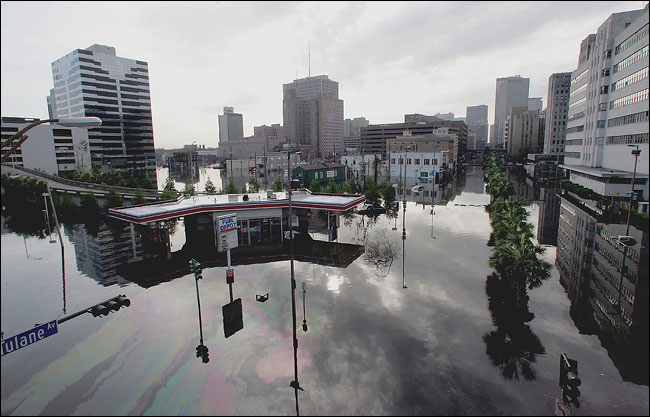
Yesterday we thought New Orleans was spared the worst of the disaster. Today we learn that two  levees protecting the below-sea level city have collapsed and Lake Pontchartrain is in full flood. Parts of New Orleans are twenty feet under water, remaining residents have just been ordered to evacuate by the governor, and the loss of life in Biloxi and Gulfport is expected to be even worse than in New Orleans. It’s overwhelming, but this writer from The Left Coaster, who is familiar with this sort of disaster from a much-smaller levee break in California, has some worthy thoughts:

The humanitarian disaster of New Orleans is something Americans are accustomed to hearing about only from Bangladesh or some other land far from our experience. What countless thousands of residents of New Orleans face now is the inability to go home for months, and the prospect of finding very little when they return. After the media grows bored and moves on other things, the people of New Orleans will have a long and difficult road to follow. Until now, the city had to do everything within its power to maintain an unsustainable status quo. Out of disaster, the opportunity arises to rebuild a new city more in tune with its environment. You are in our thoughts and prayers, New Orleans. May you have the strength to overcome and create a bright future for your city.

New_orleans_flooded

“Don’t Commute–Communicate!”

That’s a slogan Arthur C. Clarke coined back in the late 60’s, when his interest turned to our fossil fuel addiction, and ways to cut down on our cravings. Here’s a fascinating site (put up by Swiss Re, among other corporate sponsors) and includes a page–and a superb photograph–on the remarkable efforts Japan is making to reduce fuel consumption.

Catastrophe Avoided

Hurricane Katrina turned out not to be a Category 5 tropical storm, and as the storm moved a little to the east of the city, the storm waters did not top the levee system. The worst was avoided, blessedly. But civic engineers, FEMA officials, and meterologists remain concerned about the prospect for a major disaster, and some have even talked about building a "haven" in the central city around the French Quarter, with high walls, where residents could flee in case of a catastrophe.

An excellent story from American Radioworks (available in both print and audio versions) on preparations in New Orleans and the surrounding parish for a hurricane, concludes with the following thought from emergency operations chief Walter Maestri:

"One of the things that’s frustrating now for all of us in my business," explains Maestri, "is that if that Category Five Hurricane comes to New Orleans, 50,000 people could lose their lives. Now that is significantly larger than any estimates that we would have of individuals who might lose their lives from a terrorist attack. When you start to do that kind of calculus – and it’s horrendous that you have to do that kind of calculus – it appears to those of us in emergency management, that the risk is much more real and much more significant, when you talk about hurricanes. I don’t know that anybody, though, psychologically, has come to grip with that: that the French Quarter of New Orleans could be gone."

Katrina Heads Towards The Gulf Coast

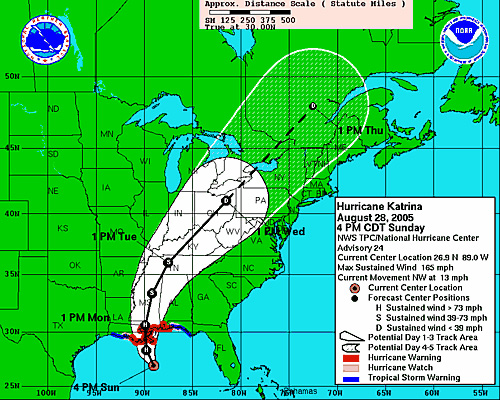
Hurricane_2Hurricane Katrina is now heading towards the northern Gulf Coast, and if it hits New Orleans, we all will likely suffer the consequences. Most of the city lies below sea level, protected on three sides by  twenty-five foot levees. If the heavy rains, strong winds, and storm surge of the hurricane overcomes the levees, experts in city government and at the National Hurricane Center predict a catastrophe. Mayor Ray Nagin, who has already ordered the evacuation of millions of people, told CNN:

"The real issue – that I don’t think the nation is paying attention to – is that through the city of New Orleans, through the Gulf of Mexico, we probably deal with almost a third of the nation’s domestic oil that is produced. And that will most likely be shut down," Mr. Nagin said.  "So, this can have a significant impact on oil prices going forward."

The path of hurricanes cannot be predicted and it’s possible New Orleans will be spared. We can pray with millions of residents for such a hopeful prospect. But as Chris Mooney, who grew up in New Orleans, documented this May in the American Prospect, experts have long been warning of the potential for a major disaster in New Orleans–possibly topping $100 billion worth of damage. We could have done much more to prepare New Orleans against the invasion of the sea. As Mooney points out on his website:

If that happens, the scientists and engineers I interviewed in my piece–who have been talking for years about the vulnerability of New Orleans–are going to come off looking very prescient. And then the only question will be, why did it require a catastrophe before we actually listened to them?

Surprisingly, even though hurricanes are fed by warm Gulf of Mexico waters, for years most climatologists have doubted that global warming would have a significant effect on the creation of these colossal storms. A decadal hurricane-creation pattern has long been believed to be much more significant. But in recent months, that consensus has been challenged–now some experts believe that in fact global warming will bump up more hurricanes to the catastrophic Category Four and Five status. Discussion to come…

A Writer Foresees A Map

Some writers are prescient; they can sense a change in the wind and put down on paper something yet to happen, or yet to be documented. In an obscure play from l972, Small Craft Warnings, Tennessee Williams described a contagious wasting disease afflicting homosexuals that sounds very much like AIDS. And in l925, in an utterly charming travel book called Along the Road: Notes and Essays of a Tourist, Aldous Huxley tossed off the following observation:

One of the great charms of mechanical progress is that it allows us to do everything quickly, easily, and comfortably. This is very agreeable; but I doubt where it is, morally speaking, very healthy. It is not even very healthy for the body. It is in the civilized countries, where human beings eat most and take least exercise, that cancer is most prevalent. The disease spreads with every fresh expansion of Henry Ford’s factories.

Now we have proof:

Cancermap