Hansen sees sea level rise of ten feet this century

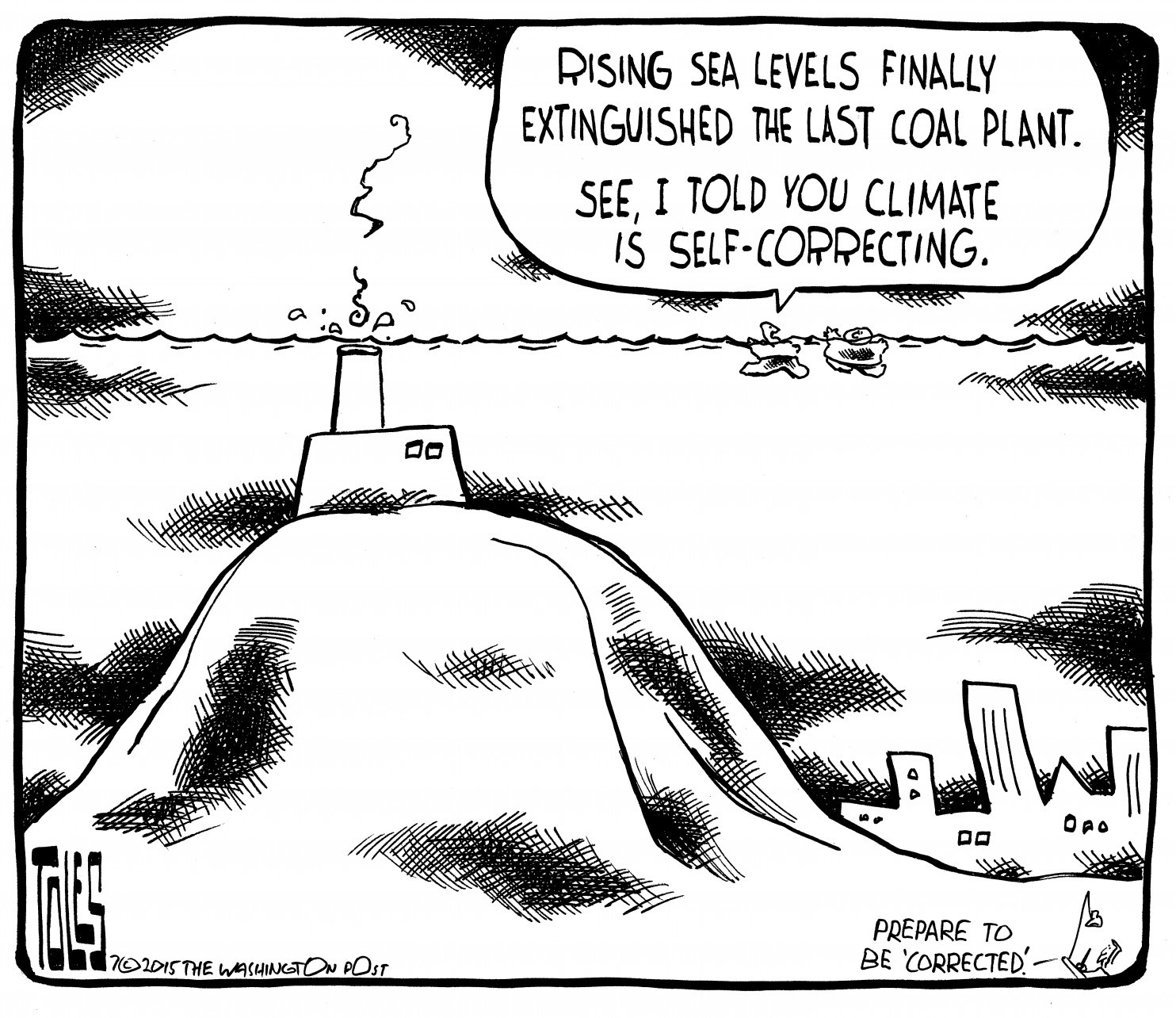
James Hansen and a team of researchers have published a paper that foresees huge sea level rises changes this century, of ten feet in fifty years, which would doom much of developed south Florida and lower Manhattan, just to cite a couple of obvious examples.

But the paper has not been peer reviewed, and researchers such as Kevin Trenberth, who have been warning of the risks of climate change for years, have been critical.

Look forward to having a chance to read the paper, which can be found here (pdf), and to hear the back and forth. Hansen, of course, has a long history of being on the mark when it comes to climate predictions.

Toles clearly thinks he has a point.

climateselfcorrectingToles


Cliff-jumpers vs. condors in SoCal

This past week, as part of its annual outdoor recreation issue, High Country News published my story on the conflict between thrill-seeking cliff-jumpers in Southern California invading the ancestral home of the endangered California Condor. Let me open up the package for you to entice you to take a look;

Before he heads out to patrol Tar Creek, a steep California canyon, Russ Tuttle, a law enforcement officer for the Forest Service, carefully gears up. Despite the summer heat, he pulls on a heavy bulletproof vest, then checks in with “dispatch” and holsters his weapon. His work involves protecting an endangered species, the California condor. But any trespassers he encounters this weekend are more likely to see him as a killjoy.

His beat looks like most of Southern California’s chaparral backcountry, only steeper. Less than two miles from the dirt road, the trail meets a hidden canyon that plunges steeply for miles, following a watercourse through a series of pools and over waterfalls, some of them well over a hundred feet high. Only 60 miles from downtown Los Angeles, the twisting, watery path down Tar Creek feels a bit like a Southwestern slot canyon: high cliffs, huge boulders and ochre-colored stone slopes smoothed by eons of water. It’s a landscape that cliff jumpers and thrill seekers find irresistible. And that’s why Tuttle is here: The area is supposed to be off-limits to protect the California condor.

The “closure” signs, set at eye level, are impossible to miss. Yet just beyond them, Tuttle spots three people coming over the ridge. Tuttle is a tall, confident man with an appealingly crooked smile, but he moves with a military bearing as he intercepts the trespassers.

“How was the water?” he asks casually.

For the rest, please see:

Cliff-jumpers versus condors in SoCal

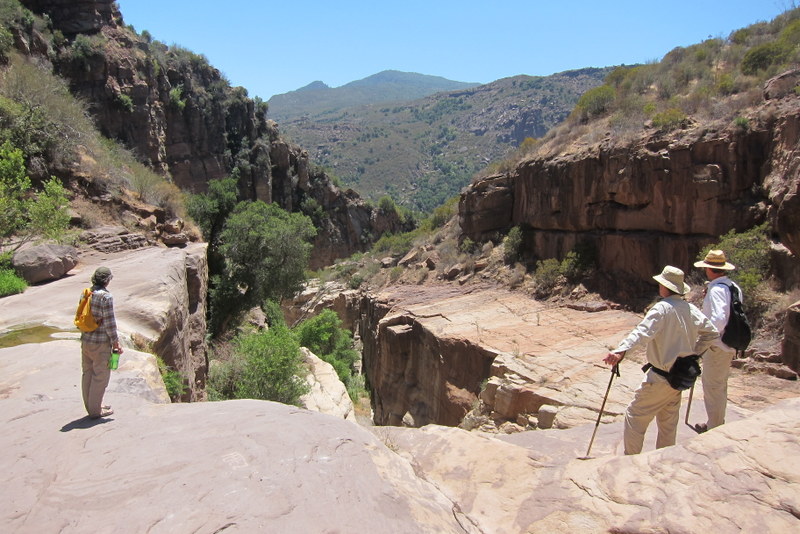
And here’s a fave pic of the area, which can look like some other world entirely — almost Martian sometimes.

heading down Tar Creek

The beauty of Dolores — and a wet El Niño?

The El Niño excitement begins early, as the LA Times explains in blunt newspaper prose:

A washed-out bridge on Interstate 10 that cut off a vital shipping route with Arizona, mudslides in Moreno Valley and snarled Southern California freeway traffic from heavy weekend rain is only a preview of problems that could come with a strong El Niño this winter, forecasters say.

The weekend storm that washed over the region Saturday and Sunday was not only remarkable for its timing — July rain storms are rare events in Southern California — but for its strength, the National Weather Service said.

The El Niño phenomenon that has warmed Pacific waters has apparently laid out a welcome mat for tropical storms to creep north, closer to the California coast than during normal years, allowing for systems such as Tropical Storm Dolores to bring muggy, rainy weather to the West’s parched landscape, said Stuart Seto, an National Weather Service specialist.

“Even though Dolores is a pretty good wake-up call for us, we should start preparing for late August or early September,” Seto said, saying that’s when the region could see more sustained rains.

Here’s a loop showing its backwards spin, courtesy of the National Weather Service.

And Jason Samenow, a great lover of weather and a tremendous news and science writer, digs into the data and the graphs indicating that this one could be “the strongest in history” for the Washington Post.

Spectacular images of the warmth of the ocean:

//platform.twitter.com/widgets.js

NYTimes to Trump: You’re a dead man walking

Margaret Sullvan, the public editor of the NYTimes, wrote today that the paper wants to do more than ‘just the facts, ma’am’ stories. That you can find on any news site, she says. What you can’t find is the analysis.

An example?

Today the NYTimes drove a stake through Donald Trump:

Donald Trump’s surge in the polls has followed the classic pattern of a media-driven surge. Now it will likely follow the classic pattern of a party-backed decline.

Mr. Trump’s candidacy probably reached an inflection point on Saturday after he essentially criticized John McCain for being captured during the Vietnam War. Republican campaigns and elites quickly moved to condemn his comments — a shift that will probably mark the moment when Trump’s candidacy went from boom to bust.

His support will erode…

This piece was by Nate Cohn for The Upshot, the paper’s snappy comeback to Vox. Sullivan explains the logic behind that knowing attitude towards the news.

I often hear from readers that they would prefer a straight, neutral treatment — just the facts. But The Times has moved away from that, reflecting editors’ reasonable belief that the basics can be found in many news outlets, every minute of the day. They want to provide “value-added” coverage.

Think it’s a change for the better, but I don’t think the public is fully aware of what’s happening. No longer does the NYTimes just report on what happened. Today it also reports on what it believes will happen.

As does Barry Blitt for The New Yorker, in his way:

Cover-Story-Blitt-Bellyflop1-879-1200-17083545

“big droughts end in big floods”: NOAA expert

From NOAA scientist Jake Crouch in his "reflections on a really big drought" today in climate.gov:

The Southern Plains drought lasted more than four years before coming to an end very quickly in the spring of 2015. There is an old adage that big droughts end in big floods, and that was the case in Oklahoma and Texas, when a slow-moving climate disaster was washed away by a fast-moving catastrophe.

Here's a NOAA chart showing the Southern Plains Drought as of 2011:

DroughtTexasNOAAgraph

Scary to contemplate a flood as extreme as our drought today.

Further reminds of what oceanographer and forecaster Bill Patzert has been known to say, which is that El Niños come in all shapes and sizes — small, medium, and Godzilla.

Blogging the Pope’s “Praise Be”: on Nature as a book

In Chapter 12 of Pope Francis' encyclical, "Praise Be," in our language, just before he launches into an appeal to all people to come together to save the world, the pontiff brings up the idea of nature as a book.

He writes (in a passage that is, may I say, too rich to be truncated):

12. What is more, Saint Francis, faithful to Scripture, invites us to see nature as a magnificent book in which God speaks to us and grants us a glimpse of his infinite beauty and goodness. “Through the greatness and the beauty of creatures one comes to know by analogy their maker” (Wis 13:5); indeed, “his eternal power and divinity have been made known through his works since the creation of the world” (Rom 1:20). For this reason, Francis asked that part of the friary garden always be left untouched, so that wild flowers and herbs could grow there, and those who saw them could raise their minds to God, the Creator of such beauty.[21] Rather than a problem to be solved, the world is a joyful mystery to be contemplated with gladness and praise.

The metaphor of nature as a volume of writings has been with us long before the paperback – since the Greeks. The Book of Nature, the idea was called, and (as usual) Aristotle has a lot to do with whipping it into a shape we can recognize. The metaphor/idea was inculcated in many of the Christian faith growing up over the centuries. To give an example John Muir grew up with the concept and in his youth likened Nature to a book, with Scripture to be revealed. He talked of glaciers writing their stories on the walls of Yosemite.

But as Muir grew older, and as he grew as a writer, he moved away from that metaphor. (As discussed in Frederick Turner's biography "Rediscovering America.") Nature was too fluid, too alive, to be likened to dead things, even if they were words on paper.

The pontiff doesn't directly confront this weakness in the thinking, but he has an answer for it. Because Saint Francis so loved wild things, and connected wild things with God, he reserved a part of the friary garden for that divine purpose. So the Pope sanctifies wilderness.

Here's Albrecht Durer's simply unbelievable watercolor of much the same idea, called, in our language "Great Piece of Turf." It's said to be painting's discovery of ecology:

Durerweeds


Jefferson and the problem of inequality in a democracy

Earlier this month, the Ojai Chautauqua held a panel discussion on income inequality, with a brilliant and politically diverse group of panelists, phenomenally well-moderated by Dan Schnur of USC. I'll put in a link, but may I say (even as someone associated with the "Ojai Chat") that it really went well, and honestly may be worth your time to watch, if you worry about the imbalance of power between the rich and the not-so-rich in this country.

Speaking of American government, we often hear Thomas Jefferson mentioned as someone who believed in small government, who advocated for the bucolic country life, and worried about tyranny of government. Well, Nelson Lichtenstein, of UC Santa Barbara, had a fresh take on that question (that deserves to be searchable here on the interwebs).

According to Lichtenstein, a MacArthur Foundation scholar, the problem of inequality in a democracy was something that Thomas Jefferson thought about a lot. Lichtenstein taught at the University of Virginia, he said, so he had first hand exposure to Jefferson's thought. Here's what Lichtenstein said:

"What Jefferson was worried about in the late 18th century was the problem of democracy. How do you have democracy in a world of inequality? What do you do when you have a society of people who own lots of land, and Jefferson happened to be one of them, and other people are either enslaved, or are working for someone, or are women, who are disenfranchised?


So what Jefferson said was that the problem is that those people who do not have an independent income, who didn’t own their own land, if they voted, if they had a voice, it would be inherently corrupt, because they were dependent on those with power and money and land. So his solution, Jefferson’s solution, was let’s have a world of independent farmers. Let’s not have big cities. And those people who aren’t independent farmers, i.e., slaves, or women, or even landless people, they shouldn’t vote, because they’ll be corrupt.


Now, in 1936, Franklin Roosevelt, when gave his acceptance speech on being renominated, he had a solution to that question. What he said was, what are doing with the New Deal? We are ending a new form of tyranny. Jefferson and the founders ended a political tyranny, when they threw out  King George. We are ending an economic tyranny. We have a new class of economic royalists, he said, and he used that phrase to evoke King George, and he said what we have to do is democratize the society.


How do we do that? We create institutions that can counter the power and land and money, and can give the powerless a voice, as in trade unions, as well as the power of the government to regulate, with the SEC. To tame, to regulate, to control this new form of economic tyranny.


The solution, to fulfill Jefferson’s ideal, is not to go back and only give the vote to those people who have an independent income, but to do something else, which is to give everyone a sense of independence. Let me give you an example of this right here on the South Coast.

We did a survey in Santa Barbara two months ago. We asked lots of questions, and among those questions we asked, of people earning low wages, was the question: Can you take time off if you get sick? Some companies make provision for sick leave, and others don’t. A huge proportion of those people we asked said, no, I’m not taking time off if I get sick, because I don’t have enough money and I need to work, or because I’m afraid I’ll be fired or penalized if I take time off. So what they represented when they said that was what Jefferson was afraid of, which was the fear and dependence of people without their own voice, or without institutions that could defend them. What these [low wage] people need is not an inspector in every workplace, but institutions [such as trade unions] that will defend people without a voice, to give them the equivalent of a farm, the equivalent of independence."

Jefferson as a defender of the independence of the working poor! That's original – and hearteningly American.