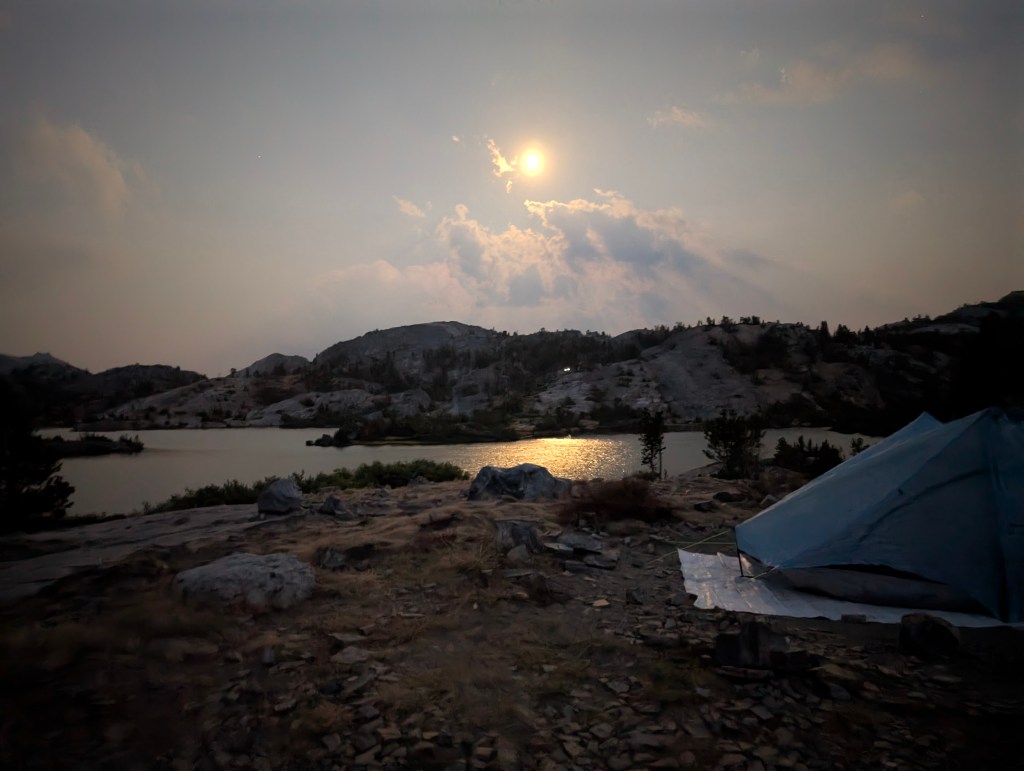
We had a luminous full moon night at a well-known campsite overlooking the famed Thousand Island Lake, this early September night. Though the ground was a flat planteau made mostly of granite, the tentsites were impressively well laid out and groomed completely clear of sharp little rocks or stones by thousands of ‘packers, perhaps). We pitched tents under the soaring majesty of the Ritter-Banner Mountains, half expecting to be joined by others hikers. We were on a small plain of sorts no more than twenty-five feet or so above the trail, but still not much visible from below, with numerous tentsites to spare — perhaps a half dozen.
Once while getting water a pair of young men asked me if there were sites up where we were, and I said yes and said they were welcome to stay, which was true. (I knew Chris would agree.) But they nodded and moved on.
The trail winds its rocky way over ridges and past a couple of little lakes, Emerald and Ruby, before going up and over a ridge and then descending rapidly to sizeable Garnet Lake. It’s worth mentioning that the trail here was as crowded as any Sierra trail for thru hiker types that I’ve ever seen, and a lot of the hikers passing me by (no complaint) didn’t seem to know the rudiments of hiker etiquette. Oh well. I didn’t either, when I started, and who knows what gaffes I may have committed.
I find that the John Muir Trail is frequently used as a means to an end: a sort of self-initiation, a preparation for an entirely new life. For example, when I first walked the trail, in July-August 1995, I fell in with a quietly determined young Asian-American man who was preparing himself to go to law school that fall. We went over Glen Pass in deep snow together as I recall (wish I could remember his name).
My doctor Andrew Mace told me that he walked the trail the summer before he went to med school. In my experience you encounter a lot of people who are testing themselves against it, and with cause: it’s a real effing challenge, some of those passes. I saw a couple of trail runners go up Glen Pass, dancing lightly up the path past me, lithe, a couple in track gear, carrying almost nothing but a little water. Still, Glen Pass is 11,926 feet in elevation above sea level. It’s more manageable than some other passes, because it does employ switchbacks, but a lot of those switchbacks are tight and steep, with big granite steps to negotiate, and even the trail runners slowed to a walk as they maneuvered around and through the stones and boulders of this winding trail, which keeps its summit hidden from view.
In this case the pass over which the intrepid ‘packer must climb, is nowhere near 12,000 feet, but nonetheless a challenging uphill trudge, as can be seen below when the black line of the JMT turns angular and twisty,, such as climbing up out of the Garnet Lake basin, an elevation gain of 400 feet in a half or quarter of a mile. (This is the area just above and to the right of the “No camping within –” warning.)

But our reward for going over that pass and continuing on a little later in the day than would be my preference was the discovery of a platonic ideal of a campsite; just off the trail at Gladys Lake, towards the lower end of the JMT in the map above.
A perfect campsite: properly sited more than 100 feet from the friendly circle of Gladys Lake, but not too far — one could fetch water easily. The camp was well off the trail and not visible to passers-by, but still obviously a well-known and well-used camp. Just over the crest of a ridge was a vast canyon, through which Shadow Creek runs. This is the one section where the JMT has split from the PCT. It’s spectacular and at the same time homey as you could want, with a kitchen area all set up, a firepit with some wood left by previous campers, two or three perfectly groomed tentsites. A big ol’ log to rest your back on. Lovely.
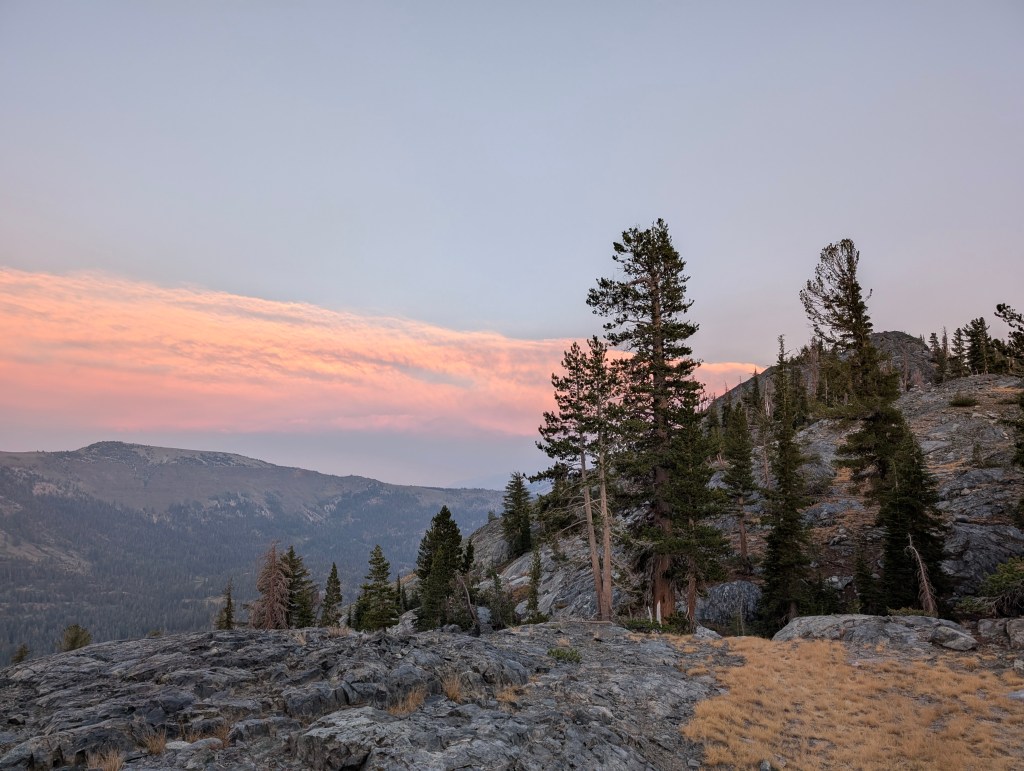
I experienced many a gorgeous campsite on this trip, but it’s hard to compete with a “grand show” such as this. The extraordinary cloud formation I believe is the edge of a vast swirling monsoonal system, one that more than once during the course of this journey turned stormy and sometimes even threatening.
 Kit Stolz