Here’s a story I wrote for the Ojai Quarterly’s summer issue about the peril that we — meaning our somewhat democratic form of government — face from a “would-be” dictator. The warning comes with authority: W. Michael Blumenthal as a child lived in Nazi Germany — the family barely escaping annihiliation in 1939 — and as an adult he grew up to negotiate with top Chinese officials in the cult of Mao.
The subject: Are We Sliding Towards Autocracy?
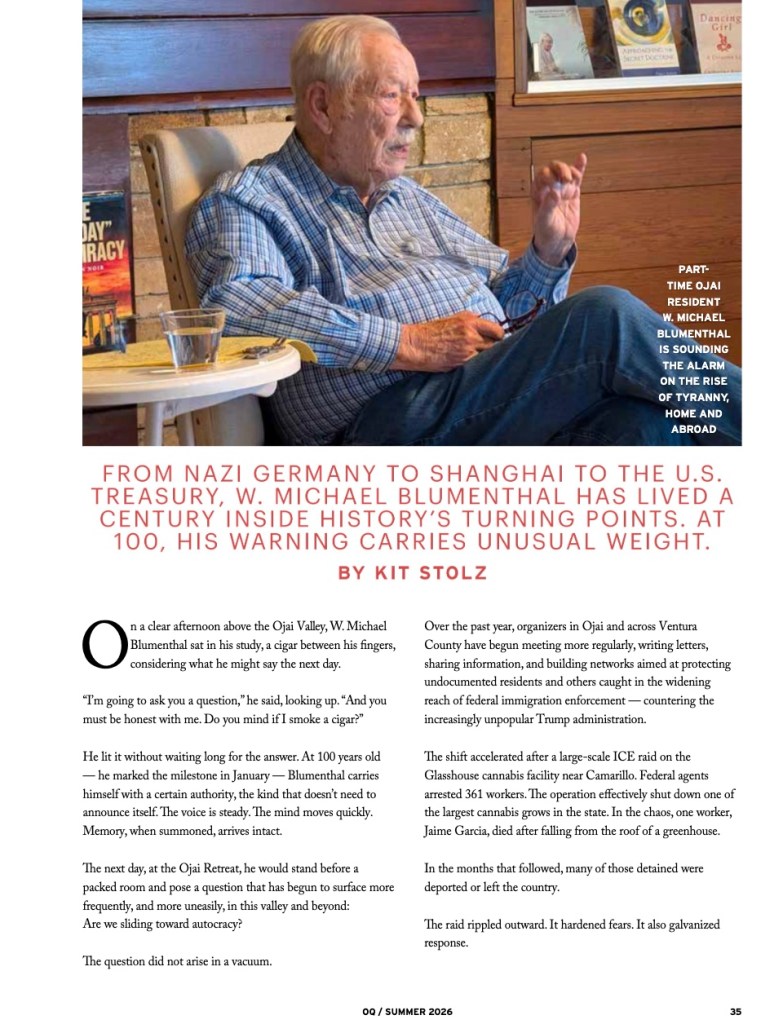
Before a packed house at the Ojai Retreat he spoke without pause for an hour.
“So are we, at the moment, moving towards an autocratic system?” he asked rhetorically, sitting in a chair and staring intently at the audience.
“Is our democracy under attack? The answer is yes, definitely, and I say that with a certain historical perspective that goes back, by definition, further than all of you, unless there’s another centenarian in the room,” he said. “I spent my boyhood in Nazi Germany, and I spent the war years under another autocratic regime, the Japanese.”
Of his youth under Nazism, he recalls how the infamous totalitarian set out to personally dominate the nation.
“What I most remember about my time in Germany was the photograph of Hitler,” he said. ”It was everywhere. There wasn’t an official room or place or anywhere where he wasn’t and the picture of him was bigger than necessary. There wasn’t a town or city that didn’t have a street or a square or a school that wasn’t called the Adolf Hitler School, or the Adolf Hitler Street, or the Adolf Hitler Square. So when I read in the paper that this president is anxious to have his name on things, I say to myself一that sounds familiar.”
His past as a teenager in the International City of Shanghai, one of the very few places that Jewish families escaping Nazi Germany could flee to during World War II, turned out for Blumenthal to be almost as desperate, if not as deadly, an experience as life as a Jew in Nazi Germany. Blumenthal today has thrown himself into writing the extraordinary lawlessness and overt, state-sanctioned corruption of that era into a work of historical fiction, to be called “City of Masks,” but the desperation he felt coming of age in that heartless amoral world still pours out of him to this day.
“There was a time when I was in my teens and early 20’s, before I left China, when I bemoaned my ill fate,” he said. “The pain in Germany, barely escaping with my life, not having enough to eat, a pair of shoes to wear, being a nobody, not having a passport, and being a displaced person in a crazy world. But with the benefit of hindsight it was the best thing that could have happened to me.”
His need drove him relentlessly, but exposure to some of the worst humanity had to offer also gave him an understanding of the power of a principled group of people working together.
“My ambition has to do with my background and has to do with the fact that I started out life as a nobody, a stateless person,” he said. “Nobody paid attention to me. I wanted to prove myself. That gave me an enormous drive.”
In his 2013 memoir一“From Exile to Washington”一Blumenthal adds that he came out of that harrowing experience in Shanghai as a kind of “optimistic cynic, which sounds like a contradiction, but really isn’t.”
Today Blumenthal is at work on his second novel, a partly autobiographical thriller set in the International city of Shanghai in that era called “City of Masks,” which he read from and talked about earlier this year at a house party for his many friends in Ojai.
He has taken up writing as a challenge to himself, and in describing the torments of those times he seems to be speaking from memory.
“Shanghai at that time was the most open and pleasure-ridden city in the world, but also the most decadent,” he said. “Corrupt and squalid. Foreign tycoons and a few rich Chinese lived in large mansions, waited on by hordes of servants. Legions of poor Chinese huddled in the streets and died there of hunger and disease. There were no visa requirements and no extradition law. Anyone could come, and no questions were asked. Tourists came to play, to sample the wide open nightlife, for the gambling, drugs, and women.”
Having seen all this and survived two of the most authoritarian and lethal regimes in the history of the 20th century has given Blumenthal an eye for dictatorial fashion. As a leader on the American diplomat corps negotiating normalization of relations — and business — with China, Blumenthal saw how the regime created a cult around the late Chairman Mao, and put up grandiose monuments to him and his deadly Cultural Revolution.
“I’ll give you another example, which is gigantism, the buildings that autocrats build,” Blumenthal said to the audience at the Ojai Retreat. “They want to build big, which is an image to themselves. It makes them feel they have the power.”
In Washington today, the Trump administration has torn down the East Wing of the White House, without Congressional approval and despite lawsuits, and plans to build an enormous ballroom in its stead, as well as a 250-foot-tall “Triumphal Arch,” and a “Garden of Heroes” near the National Mall expected to cost at least $40 million.
Blumenthal scoffed.
“When I see that the President wants to tear down one wing of the White House一which I know very well, having been in and out of there every day for almost three years一to build a giant ballroom, I think of Hitler’s office,” Blumenthal said. ”It was so large, that when you were ushered in, you had to walk thirty steps to approach his desk. So this tells me that this is somebody who has a sense of self-importance, of wanting the power, and wanting to change the way our government functions so that his enormous, enormous need to show his power is satisfied.”
Although usually Blumenthal speaks with a historian’s calm certainty, when he talks of corruption — what he saw in the International City of Shanghai during the war, and what he sees with Trump and his regime in the White House today, his tone sharpens.
“When I first came to this country, I thought it was clean and honest,” he said. “Coming from Shanghai, where corruption was in everything, when everybody could be bought and sold, this country seemed clean, even if it wasn’t quite as clean as it seemed to be. But today, the President and his family will leave office as multi-billionaires. Just like the oligarchs in Russia, the billionaires here have created a transactional society. They back Trump. He backs them. They can enrich themselves. He can enrich himself. And the people get scraps once in a while.”
But despite the corruption of the current administration, Blumenthal sees the 250-year-old tradition of democratic governance in the U.S. as a foundation on which resistance can stand and push back. He outlined the two principal ways in which democracies have been overthrown; one, by revolution, and the other, by a hollowing out of the institutions which support democratic governance.
Revolution he rules out as simply impossible in this country today. He sees the hollowing out of institutions as a process that has begun but can be fought off.
“Will we continue down this road [to autocracy]?” he asked the rapt audience at the Ojai Retreat. “No, no, relax. There is a lot of evidence that people are standing up and fighting against this, and we have a lot of evidence that to hollow out democracy here is very, very difficult. It would require enormous discipline, a very smart group, highly motivated people around a very clever chief of state and years of clever effort and propaganda for that to happen in the United States.”
Blumenthal added that he sees no sign of such cleverness and discipline in the current White House.
“Frankly, looked at objectively, this administration does not strike me as a highly disciplined, highly focused, very careful, planning years ahead kind of organization with highly competent people advising and surrounding it,” he said. “In fact, as someone who’s been in and out of the government several times over the years, I am amazed at the degree of incompetence and unnecessary stupidity that they are constantly perpetrating and which undermine the very actions that they are trying to further.”
And along the same lines, Blumenthal continues to see the embracing friendliness of the people of the United States and Ojai as a great boon, one that perhaps too many of us take for granted. He lived in Berlin for many years, and cannot help but note the contrast.
“We have an apartment in Berlin, and there’s a couple of other people who live on the same floor, and they barely say hello, even to their neighbors. I know nothing about them. Over here, someone moves in, a neighbor comes over with a pie or flowers. In the morning, when I go out to get the paper, people wave,” he said. “This is a friendly place. I’m proud to be an American.”
At the same time, although Blumenthal did not see certain doom for American democracy, he does see real threats from what he described as the “would-be dictator” in the White House.
“I worry about two things,” he said in conclusion to the audience at the Ojai Retreat. “I worry about attacks on the voting system, and I worry about what’s happening in Iran, because it shows me that the more frustrated our leader becomes, the more he is unable to do what he wants to do, the more he may be tempted to be reckless internationally, where he does not have control. You can start wars, but it’s much easier to start them than to finish them.”
Prophetic words. In the interview, thinking about Ojai as well as the nation, he called for resistance to the oncoming autocracy, and said he was proud of his daughter Jill Borgeson and the local organizing against federal police forces, including ICE, and authoritarianism.
“This is a nice place,” he said. “You want to keep it that way. The kind of brawling, cruelty and brutality, the language of violence — you can’t stand for that. People better understand that. They better pay attention.”


A dish of severe anxiety topped with a bit of hope.Thanks,Imagine Rotary,KevinKev
LikeLike