Blogging the Stern Review: The Science of Climate Change (chapter one)

The 692-page Stern Review begins with a look at the science of climate change, for good reason, but this material will not be new to any frequent visitor to this site, so I will highlight only striking statements.

The first of these comes early in the "key messages" prologue to chapter one:

A warming of 5C on a global scale would be far outside the experience of human civilization and comparable to the different between temperatures in the last ice age and today. Several new studies suggest up to a 20% chance that warming could be greater than 5C. (pp3)

An interesting footnote about the well-known skeptic (and Exxonian) Richard Lindzen: It has been suggested that water vapor could act as a negative feedback on warming, on the basis that the upper atmosphere would dryout as it warms (Lindzen 2005). Re-analysis of satellite measurements published last year indicated that in fact the opposite is happening (Soden et al 2005). Over the past two decades, the air in the upper troposphere has become wetter, not drier, countering Lindzen’s theory and confirming that water vapor is having a positive feedback effect on global warming. This positive feedback is a major driver of the indirect warming effects of greenhouse gases. (pp9)

The risk of heat waves is expected to increase. For example, new modeling work by the Hadley Center shows that he summer of 2003 was Europe’s hottest for 500 years and that human-induced climate change has already more than doubled the chance of a summer as hot as 2003 in Europe occurring (Stott et al 2004). By 2050 under a relatively high emissions scenario, the temperatures experienced during the heatwave of 2003 could be an average summer. The rise in heatwave frequency will be felt most severely in cities, where temperatures are further amplified by the urban heat island effect. (pp17)

That last statement–that the heatwave of 2050 could be routine in my children’s lifetime–shocks. If that is routine, what then would be a heatwave? 120 degrees? 130?

Blogging the Stern Review: Introduction

As it becomes ever more apparent that consensus has formed on climate change, both scientific and popular, the next question is what action(s) the international community should take and, of course, how much will they cost?

The book on this question was written by Nicholas Stern, former Chief Economist at the World Bank, and a former cabinet officer and Treasury chief for Tony Blair. It’s a long, detailed book, written by a very distinguished man, published in October 2006.

Some of the concepts of the book have begun to make their way into the international conversation about climate change; to further that conversation, and to educate myself, I intend to blog my way through it, chapter by chapter. This should make it as painless as possible for others, as well as myself.

Please follow along! Here we go…

THE INTRODUCTION:

Nicholas Stern first states that global climate change is a serious threat, and after looking at a wide array of estimates of costs and risks, reaches "a simple conclusion: the benefits of strong and early action far outweigh the economic costs of not acting." He adds:

Using the results from formal economic models, the Review estimates that if we don’t act, the overall costs and risks of climate change will be equivalent to losing at least 5% of global GDP each year, now and forever. If a wider range of risks and impacts is taken into account, the estimates of damage could risk to 20% or more. (ppxv)

This concept has made it into the conversation (although I must say, that later estimate sounds a little fuzzy — we’ll see how well Stern and his cohorts nail it down later in the book). Continuing:

If no action is taken to reduce emissions, the concentration of greenhouse gases in the atmosphere could reach double its pre-industrial levels as early as 2035, virtually committing us to a global average temperature rise of 2C. In the longer term, there would be more than a 50% chance that the temperature rise would exceed 5C. This rise would be very dangerous indeed; it is equivalent to the change in average temperatures from the last ice age to today. (ppxvi)

Stern also says that we need not choose between economic growth and averting climate change, and that we must not choose either adaptation or mitigation — both ideas well familiar to those in the conversation. But the single most interesting statement in the introduction is this one, I think:

Climate change is the greatest market failure the world has ever seen. (ppxviii)

Could this explain some the the knee-jerk opposition to the concept on the libertarian right?

Famous Blowhard Falls for Global Warming Hoax

This is rich: a clever Englishman recently faked a paper in the heretofore unknown Journal of Geoclimactic Studies, supposedly by a team of brave researchers. "They" claimed to have found proof that global warming was caused by an obscure oceanic bacteria, and were publishing the truth at great risk to their scientific careers.

Our data demonstrate that those who subscribe to the consensus
theory have overlooked  the primary source of carbon dioxide emissions.
While a small part of the rise in emissions is attributable to
industrial activity, it is greatly outweighed (by >300 times) by
rising volumes of CO2 produced by saprotrophic eubacteria
living in the sediments of the continental shelves fringing the
Atlantic and Pacific oceans. Moreover, the bacterial emissions, unlike
industrial CO2, precisely match the fluctuations in global temperature over the past 140 years. 

This paper also posits a mechanism for the increase in bacterial CO2 emissions. A series of natural algal blooms, beginning in the late 19th Century, have caused mass mortality among the bacteria’s major predators: brachiopod molluscs of the genus Tetrarhynchia.
These periods of algal bloom, as the palaeontological record shows,
have been occurring for over three million years, and are always
accompanied by a major increase in carbon dioxide emissions, as a
result of the multiplication of bacteria when predator pressure is
reduced. They generally last for 150-200 years. If the current episode
is consistent with this record, we should expect carbon dioxide
emissions to peak between now and mid-century, then return to
background levels. Our data suggest that current concerns about manmade
global warming are unfounded.

The hoax actually didn’t fool many familiar with the Web and its ways, but it did hook the biggest self-proclaimed skeptic of all — Rush Limbaugh, who pitched it to his followers as yet another proof of the "hoax" of global warming!

What do you call a man who hoaxes himself?

Into the Wild: Looking Beyond the Obvious

When the news broke fifteen years ago about an idealistic young man who starved to death in Alaska, I reacted badly.

Plenty of folks, myself included, go alone into the wild and emerge unscathed; in fact, restored to Muirean health and sanity.

The national fascination with Chris McCandless’s sad end seemed morbid to me — a morality tale told by the comfortable to justify their easy, unexamined lives.

I still think a sick fascination is part of what made Jon Krakauer’s book Into the Wild a bestseller. But I confess I have read only the excerpt from it published over a decade ago in Outside magazine, which may not do the book justice. it was somewhat misleadingly subtitled "How Christopher McCandless Lost His Way in the Wilds," and mostly focused on the mistakes he made, the tragic death.

Many people who heard of this story didn’t want to give themselves over to a reckless youth. I was one of them, but then I saw the movie, and I saw the young actor playing Chris McCandless become the man he wanted to be — "Alexander Supertramp."

He had an extraordinary life; giving away his money, burning his cash, walking off into the desert. He wanted meaning, more than anything. You could question his sanity, but not his sincerity. And nearly everyone he met fell in love with him, or way or another.

The movie overwhelms, and for both me and a wilderness friend far outstripped the written version of the story.

But to be fair, when I went back and read the excerpt again, I realized I had forgotten the most important part — Krakauer’s connection with McCandless.

In 1977, [Krakauer wrote] when I was 23–a year younger
than McCandless at the time of his death–I hitched a ride to Alaska on
a fishing boat and set off alone into the backcountry to attempt an
ascent of a malevolent stone digit called the Devils Thumb, a towering
prong of vertical rock and avalanching ice, ignoring pleas from
friends, family, and utter strangers to come to my senses. Simply
reaching the foot of the mountain entailed traveling 30 miles up a
badly crevassed, storm-wracked glacier that hadn’t seen a human
footprint in many years. By choice I had no radio, no way of summoning
help, no safety net of any kind. I had several harrowing shaves, but
eventually I reached the summit of the Thumb. 

When
I decided to go to Alaska that April, I was an angst-ridden youth who
read too much Nietzsche, mistook passion for insight, and functioned
according to an obscure gap-ridden logic. I thought climbing the Devils
Thumb would fix all that was wrong with my life. In the end it changed
almost nothing, of course. I came to appreciate, however, that
mountains make poor receptacles for dreams. And I lived to tell my tale.

The director Sean Penn talked about his version of that experience to Joe Donnelly at the LAWeekly:

…definitely the most life-changing things were the times when I put my
life on the edge. I don’t think it’s because of the life on the edge,
literally. I think it’s because of the humility that comes with dancing
with something that shows itself to be clearly bigger than you are.”

To Time, he put it more grandly:

You’ve gotta feel your own life to have a quality of life, and our own
inauthenticity, our corruptions, get in the way of that. The wilderness
is relentlessly authentic.

And so too is the movie. Penn has always had an ability to chip his edgy characters into our lives, be they Spicoli spilling stoned out of the van in "Fast Times at Ridgemont High," or too proud killer in "Dead Man Walking." Now he’s done the same thing with another actor, another character, and with skills many of us haven’t seen before — as a writer and a director.

After this movie, he may become a Clint Eastwood of indie filmmaking, a completely free spirit and a free talent. Watch out world.

It’s best to go into most movies, this one included, knowing as little as possible, so I’m not going to spoil it by saying too much, because I want you to see it, and experience it for yourselves.

But I can point you to the music, by Eddie Vedder, from what is essentially his first solo record ever, and, as you might expect, a durn good one. On the iTunes edition, it includes a shockingly strong anti-war song ("No More") and a campfire song — "Society" — as wryly touching as anything he has ever written.

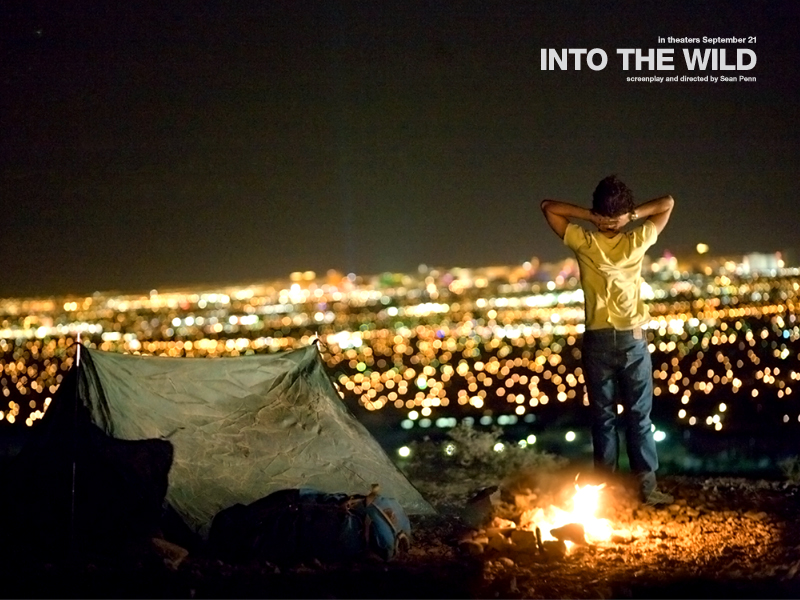
And I can give you just an instant from Mccandless’s life, and ask you if you’ve ever felt like this…

Intothewildwallpaper

CA to White House: Lead, Follow, or Get Out of the Way

Yesterday California sued the federal government, demanding the right to regulate greenhouse gas emissions.

You will recall that this was the issue before the Supreme Court this spring, in which the court decisively ruled that the EPA does have the right — and the responsibility — to regulate CO2 emissions.

Predictably, the Bush administration has done nothing. (Probably in a few months we’ll hear about how attempts by a few brave souls within the EPA to in some way reduce CO2 emissions were quashed by the White House. This is what happened with the moderate Republican Christine Whitman, former head of the EPA, who left after her attempts to regulate air pollution were overruled by Dick Cheney.)

California is not the only state tired of waiting for Washington to act: 14 other states will join the suit today.

"They are running out the clock in hopes somebody else will deal with this problem," said Mary Nichols, head of California’s Air Resources Board, to the Los Angeles Times.

Guess it must be up to us…

White House Claims Executive Priviledge to Avoid Global Warming Inquiry

Last month Julie Gerberding, the director of the highly-respected Centers for Disease Control, testified on global warming before the Senate, but her  was sharply cut by the White House. Subsequently she told the New York Times that she said everything she needed to say, but if you look at the testimony, I promise you, you will find that hard to believe.

More than half (1604/3086) her words were cut, and truly, the core of her statement was cut out. Take a look at the full/redacted testimony at Science Progress, if you doubt me. Her testimony on heat, extreme weather, allergies such as asthma, water-borne diseases, and numerous other topics were "eviscerated," according to officials within the CDC. (They wouldn’t allowed themselves to be named, for fear of being fired.)

Senator Barbara Boxer of California wrote to the White House to ask why the testimony was cut, and the White House responded with an executive privilege claim. The White House counsel said:

…the request by its very nature seeks
communications involving pre-decisional deliberative materials relating
to an inter-agency review process…it is clear that the request
implicates core Executive Branch interests and raises separation of powers concerns.”

In this case, "core Executive Branch interests" seems to be code for: We don’t want to talk about it. Kind of like a tight-lipped parent afraid to talk about sex with the kids. Who knows where the conversation might lead? Can’t have that.

Once Jack Nicholson played a military character who uttered a now-famous line: "The truth? You can’t handle the truth."

This White House is even wimpier: they can’t handle being asked about the truth. 

Bad News Thursday: CO2 Emissions Expected to Soar

Remember Good News Friday? Well, there is good enviro news to be found, for those who care to look, but the amount of bad/alarming news is downright overwhelming at times, and deserves its own category. No matter how you or I feel about it. Hence: Bad News Thursday.

In today’s "holy bleep" category:

14.6 billion tons of carbon, equivalent to an entire year of global CO2 emissions, will be released from the world’s greatest concentration of peat bogs in Sumatra by development for palm oil production by major food corporations such as Nestle, Cargill, and Kraft, according to Greenpeace/Australia.

The Paris-based International Energy Agency (IEA) sees CO2 emissions rising 57% by 2030, peaking no sooner than 2020, and leading to substantial temperatures rises of 5 degrees or more by that date. Worse, if China and India continue to develop and grow, powered by coal, temperatures could rise ten degrees by that time.

I can’t joke about that in any way; I don’t even want to think about it.

John Edwards on Why Global Warming is a Crisis

Anyone else prefer print to YouTube? Here’s John Edwards on why we need to act to reduce the huge risks of global warming, for reasons both moral and practical:

It’s not just what we do over there [in Iraq}. We are four percent of the world’s population, emitting 25% of the world’s greenhouse gases. We’re not an example for good, we’re an example for bad. We can’t go to China and India and the rest of the world and say help us develop a solution for this crisis.And global warming is a crisis, by any conceivable measure. You look at what the Pentagon says about what will happen to the world? If the temperature on the face of the earth goes up 4-8 degrees over the next 75 years you’re going to see migrations of hundreds of millions of people. Not enough food, not enough water. It’s going to make world war look mild.

(h/t: Gristmill)