Christianity: The Murderer of Creation

From an overwhelmingly powerful sermon by Wendell Berry:

Despite its protests to the contrary, modern Christianity has become willy-nilly the
    religion of the state and the economic status quo. Because it has been so exclusively
    dedicated to incanting anemic souls into heaven, it has, by a kind of ignorance, been made the tool of much earthly villainy. It has, for the most part, stood silently by, while a
    predatory economy has ravaged the world, destroyed its natural beauty and health, divided  and plundered its human communities and households. It has flown the flag and chanted the slogans of empire. It has assumed with the economists that "economic forces"
automatically work for good, and has assumed with the industrialists and militarists that
   technology determines history. It has assumed with almost everybody that "progress" is good, that it is good to be modern and up with the times. It has admired Caesar and comforted him in his depredations and defaults. But in its de facto alliance with Caesar, Christianity connives directly in the murder of Creation. For, in these days, Caesar is no longer a mere destroyer of armies, cities, and nations. He is a contradictor of the fundamental miracle of life. A part of the normal practice of his power is his willingness to destroy the world. He prays, he says, and churches everywhere compliantly pray with him. But he is praying to a God whose works he is prepared at any moment to destroy. What could be more wicked than that, or more mad?

(h/t: Rod Dreher)

Djelka: 1991-2007

So much global warming news this week I hardly know where to start, but can’t stop thinking about the passing of our beloved Djelka, the smartest, gentlest, and wisest dog I have ever known, who abruptly died while I was gone this past week. "It’s so hard to understand," as our friend Jane Carroll said. She’s been by our side, literally, for much of our lives: How could she be so gone so quickly?

Djelk_on_walk

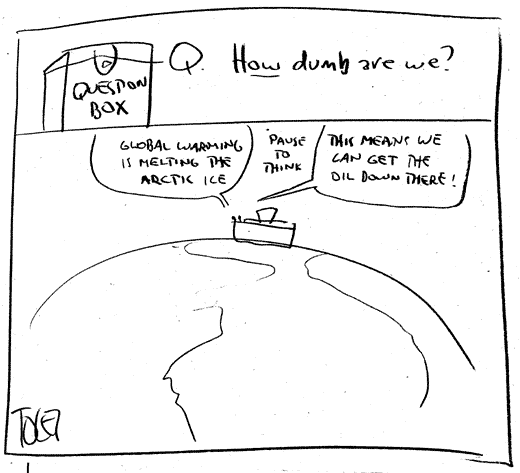
How Dumb Are We? (Do You Need to Ask?)

Some commentators on the human species and the idea of peak oil have been known to compare us to bacteria such as yeast, which will efficiently turn the sugar in a container of grape juice into alcohol…wiping out their own chances at survival. Not too smart!

Being a crazy idealist, I think humans will do better on this planet. But when you look at our behavior in the Arctic, you have to wonder. Harpers magazine had a nice piece on the upcoming war over oil in the Arctic (which Canada claims, and the US expects to get) but I can’t link, because it’s subscriber’s only. But Tom Toles in a brief sketch made essentially the same point today, in about 2500 fewer words.

Tomtolesonhowdumbarewe

Local Eating, Manhattan Style

The New Yorker‘s Adam Gopnik experiments, charmingly, with local eating in the five boroughs. His children star in the piece, which can be cloying, but they’re funny. Some of my compatriots at Grist complained bitterly about this piece, but I enjoyed it thoroughly.

Here’s the core of his argument:

There are powerful arguments against localism:
apart from the inevitable statistical tussles about exactly how much
fuel is used for how much food, the one word that never occurs in the
evocation of the lost world of small cities and nearby farms is
“famine.” Our peasant ancestors, who lived locally and ate seasonally
from the fruit of their own vines and the meat of their own lambs, were
hungry all the time. The localist vision of the tiny polis and its
surrounding gardens has historically led to bitter conflict, not
Arcadian harmony.

It is even perilously easy to construct a
Veblenian explanation for the vogue for localism. Where a century ago
all upwardly mobile people knew enough, and had enough resources, to
get their hands on the most unseasonable foods from the most distant
places, in order to distinguish themselves from the peasant past and
the laboring masses, their descendants now distinguish themselves by
hustling after a peasant diet.

This may be so; but the fact that one can explain everything in
social life as a series of status exchanges does not mean that social
life is
only a series of status exchanges. It was cool to be a
liberal in 1963, but that did not make liberal attitudes to race
foolish. All human values get expressed as social rituals; we place
bets on which of the rituals are worth serving.

Plus, a wonderful picture of a beekeeper named David Graves, who keeps hives on rooftops around the city:

Davidgravesbyjosefastgor

Conspiracy Theorists: How Will They be Remembered?

As one of the three or four Americans who actually believes that Lee Harvey Oswald shot JFK, it’s irksome in the extreme to me that I can’t get more people, even friends, to seriously consider the possibility.

In that light, it’s encouraging to read an interview with a novelist named Thomas Mallon in The Atlantic, under the title "A Single Bullet," who takes a long look at the "CTs" (conspiracy theorists) and the "Lone Nutters" (people like myself) and concludes that the nutters really aren’t so nutty.

What then do you think will be the ultimate fate or legacy
of the conspiracy theorists? Will their theories persist and outlive
them? What does a fourth- and fifth-generation CT look like?

I think that they will fade. There are certainly younger conspiracy
theorists, but I would say that the community of buffs, or
“researchers” as they like to be called, is by and large an aging
community. I think that most of them are people who have living
memories of the assassination. And I think that 100 years from now, if
you ask an American citizen who killed John Kennedy, the person will
answer, “Lee Harvey Oswald.”

I’m not saying this so much because I have this Frank Capra-like
belief that the truth will out as because one of the things the
conspiracists have never accomplished is to attach any other face, or
group of faces, to the crime, in the public mind. Oswald is the one
face that people have. One of the ironies of history is that the
average person, the average American forgets, if he ever knew at all,
that there was a conspiracy in the Lincoln assassination. Booth did
have this little band of plotters, who were quite active on that night.
But the average, reasonably informed American, when asked about
Lincoln, will say, “John Wilkes Booth killed Lincoln.” I think that
that will happen a hundred years from now with Kennedy and Oswald. And
as Henry Kissinger would say, it will have the additional advantage of
being true.

Quote of the Day

From the surprisingly readable report by the GAO on climate change, released this month, Regarding Glacier National Park, the Congressional research agency writes:

A USGS scientist informed us that, since 1850, the number of glaciers within the park has dropped from 150 to 26, and that current trends in the rate of glacial melting in the park suggest the remaining glaciers will be gone in the next 25 to 30 years. According to scientists with whom we spoke, the loss of glaciers is symbolic of the overall changes to the natural systems in the park, including the water cycle and water temperatures.

Symbolic, indeed.

Why Addicts Make the Best Rock Stars

Seriously, think about it: Why is it that hard drug addicts (including Jerry Garcia, Keith Richards, Eric Clapton, Ray Charles, and countless, countless others) seem to make the best rock stars?

I once talked to a brain scientist who actually had an answer to this question. She probably wouldn’t want to be named, but argued forcefully that the endogenous brain chemicals produced in the presence of vast fame (huge crowds cheering, blinding sex appeal, etc) were so powerful that only the most potent of external substances, such as heroin, could possibly match that high. She speculated that people who are driven to become famous need these chemicals — hence the logic of heroin.

I believe that’s true. But it’s also true, as this hilarious graphic from the Onion shows, that sometimes these same addicts make really good music. Amy Winehouse is the latest, for good or ill. She has reinvented Motown with a wit no one has managed in three decades. Hope she can stay on top of it:

Infographic

September 5, 2007 | Issue 43•36

The Troubled Life of Amy Winehouse

Friends and family have been in the news recently urging British pop singer Amy Winehouse to
quit using drugs, saying that she has a problem. What have the warning signs been?

Follow-up single to "Rehab" was "Big Fat Lid of Black Tar Heroin"

Beehive hairdo occasionally drops baggies, spoons, poppy plantations

Always in good mood or bad mood

Keith Richards seen leaving her flat looking defeated

Constantly screams "God, I love taking drugs!"

Before a show at the Hammersmith Apollo in London, Winehouse refused to go on until the stage had been cleared of all the four-headed snakes and ghosts of her ancestors

Her music thus far is pretty cool

Infographicamywinehouse_2