I just love this picture from the Climate Camp protest against the expansion of Heathrow. As countless smart people are saying–Bill McKibben, Al Gore, Mike Tidwell–we need demonstrations to save our climate.
Here’s one from the UK worth remembering:

A Change in the Wind
I just love this picture from the Climate Camp protest against the expansion of Heathrow. As countless smart people are saying–Bill McKibben, Al Gore, Mike Tidwell–we need demonstrations to save our climate.
Here’s one from the UK worth remembering:
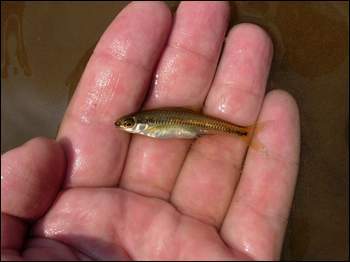
"The Cape Fear Shiner is a yellowish minnow with black stripes, pointed fins and a hard-luck past.”
So writes Taft Wireback for the News-Record of Greensboro, North Carolina. He goes on to tell how bringing down a dam helped bring back two "relict populations" of this small fish.
It’s a wonderful lede, and an inspiring story, especially for those of us hoping to bring back the signature piscine species of Southern California, the steelback, which is widely believed to be able to rebound, if only given the opportunity.
Wireback writes:
You can think of the tiny yellow-and-black minnow as a sort of
miner’s canary that swims, a bellwether for the health and restored
vigor of the water that surrounds it.
The tiny minnow was unknown
to science until 1971, when it was identified in a very limited range
that included small reaches of the Haw and Deep rivers in just five
counties — Randolph, Chatham, Lee, Moore and Harnett.
By September 1987, it already had been placed on the federal Endangered Species List because of its dwindling habitat.
The minnows need water of decent quality riffling in shallow depths over gravel, stone and boulder bottoms.
The
dam that was demolished was a small, hydroelectric operation built in
1921 and shut down in June 2004. But the site, near the line between
Chatham and Lee counties, had hosted a series of dams stretching back
into the 19th century.
So biologists couldn’t be sure how long
two separate colonies of Cape Fear Shiner had been separated by one dam
or another and its 10-mile stretch of backed-up water, too deep and
slow for the minnow’s liking.
Meanwhile, on either side of the
dam, the isolated populations of Cape Fear Shiner were dwindling.
Removing the dam produced results aimed at fixing that problem faster
than anyone had been willing to hope, [Adam] Riggsbee, [environmental scientist] said.
"If you
provide the habitat, the theory is that you should get the species back
in place," he said. "That’s exactly what has happened here in less than
two years. The river responded very quickly and so did this key
species."
(h/t: Knight Science Journalism Tracker)
A scientific panel today released a report critical of the Bush administration’s handling of global warming science, according to Andrew Revkin at the New York Times.
Of the $1.7 billion spent each year on climate research, the report
said only about $25-$30 million a year is going to studies of impacts
on human affairs.
The panel, formed by the prestigious National Academies, had other criticisms as well.
The panel also said insufficient effort has gone into translating
advances in climate science into information useful to local elected
officials, farmers, water managers and others potentially affected by
climate change, whether or not it is driven by human activities.
One
problem is a lack of interaction between government researchers and
officials, industries, or communities facing risks or opportunities in
a shifting climate, the panel’s chairman, Veerabhadran Ramanathan, said
in an interview.
This last charge I can verify. Back in 2003, the US global change research program released a massive report on California. I used this report to put together questions to ask local officials for a story about global warming, such as the doctor in charge of Ventura County’s public health system. I asked him if he had been given a copy of the report — he had never heard of it! He wasn’t happy about that…
A story I wanted to write, but poet Dana Goodyear beat me to it, for the New Yorker..
The gray-shingled house belongs to the entertainment mogul David Geffen. In 2005, after losing a long legal fight, he opened the path to the public, and last Sunday the Los Angeles Urban Rangers
convened some thirty people there for a beach tour. The rangers wore
Army-green shorts and badges decorated with a highway clover and a palm
tree, and some had binoculars around their necks. One of them, an
art-history graduate student at U.C.L.A., had been a National Parks
Service Ranger for ten years.
The safari, as the rangers called it, was an idea based on the work of Jenny Price, who writes a guide to Malibu beaches on L.A. Observed.
Public-private beaches are difficult to navigate; the private-property
and public-easement lines are invisible, and the legal boundaries of
the public lands change every hour. “It’s in the California
constitution that the public owns the tidal lands,” Price said,
explaining that this essentially means the public is allowed on the wet
sand. By this point, the group had successfully avoided trespassing on
the ten feet of private sand directly in front of Geffen’s house and
was standing on dry sand that was technically Geffen’s but was
accessible by public easement. Price recommends that day-trippers bring
a copy of the state constitution, a tape measure, and an easement map.
Finally a media outlet crunches the numbers on the two competing methods to reduce carbon emissions: a tax on carbon emissions, or a cap-and-trade proposals to compel action from business. I prefer the former because (if it included give-backs to the poor, who would suffer the most) a carbon tax would do the best job of asking for sacrifice from everyone.
But unsurprisingly, it’s not popular with politicians or, most likely, the people. Heck, back in l992, the Clinton-Gore administration proposed a carbon tax of approximately 4 cents a gallon, which was unanimously rejected by Republicans as "inflationary." Ah, the good old days.
I also like this story from the Wall Street Journal because it includes solid stats, and gets to the heart of the insincerity of John Dingell, the Democratic representative from Detroit, who has proposed a carbon tax, but mostly to drive a stake through it’s heart.
Rep. John Dingell (D., Mich.) is expected to introduce one this fall,
though he has said the bill is an attempt to show how unpopular such a
tax would be. "I sincerely doubt that the American people are willing
to pay what this is really going to cost them," he said in a
cable-television interview.
Tomorrow I’m off to the southern Sierra, out of range of the Internet, believe it or don’t. But I’ll leave some posts behind, because I’m addicted to blogging. Wish me beauty…

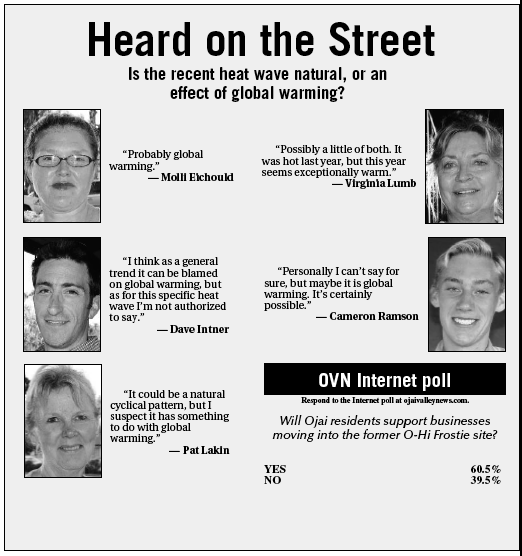
According to an informal poll taken by the Ojai Valley News, our recent heatwave is probably related to global warming. Scientists would be quick to point out that we cannot see climate patterns, which we measure in thirty-year spans, in weather, which will pass in days. But climatologists will concede that our heat waves are getting longer and more intense, as we saw in this recent eight-day episode. These folks seem to "get" that connection. What once was considered controversial is now becoming commonsense.
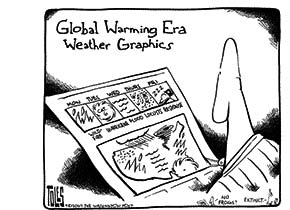
From Toles, of course…
Susan Faludi, one of the brainest of America’s leftists, brings forward a fascinating argument about the role of terror in American history. Thanks to the New York Times’ newfound willingness to blog, this op-ed from yesterday should be totally available to readers, and it’s definitely worth the five minutes.
But here’s her central contention:
Sept. 11 cracked the plaster on that master narrative of American
prowess because it so exactly duplicated the terms of the early Indian
wars, right down to the fecklessness of our leaders and the failures of
our military strategies. Like its early American antecedents, the 9/11
attack was a homeland incursion against civilian targets by
non-European, non-Christian combatants who fought under the flag of no
recognized nation. Like the “different type of war” heralded by
President Bush, the 17th and 18th century “troubles” — as one Puritan
chronicler of Metacom’s Rebellion called them, refusing to grant them
“the name of a war” — seemed to have no battlefield conventions, no
constraints and no end.
Unfortunately, by replicating the
Colonial war on terrorism, 9/11 invited us to re-enact the
post-Colonial solution, to bury our awareness of our vulnerability
under belligerent posturing and comforting fantasy.
Like the
cultural imagineers before them, our post-9/11 press, entertainers and
political spin doctors set to work to prop up our sense of virile
indomitability — “the return of the manly man” and a reconstituted
“John Wayne masculinity” were on every media lip, as the triumphs of
torture-prone Jack Bauer heroes were on every TV. The 2004 presidential
campaign was given a Western stage set — with the candidates proving
their ability to assume the mantle of Crockett in Chief by bragging
about their gun collections, hacking at brush and tree stumps and
shooting at wild animals. (John Kerry spent so much time in hunting
camouflage that he was dubbed “John the Deerslayer.”)
Also
restored was the defense of helpless femininity. Witness the Bush
administration’s much-trumpeted claims to be saving Afghan women from
their burqas and Iraqi women from Saddam Hussein’s “rape rooms.” Or the
military’s much-ballyhooed “rescue” of Pvt. Jessica Lynch (albeit from
a hospital whose caregivers had tried to return her to American forces,
but had been driven back by American gunfire). Or the invention of a
supposedly huge new voting bloc of “security moms,” trembling-lipped
homemakers desperate to re-elect the sheriff who would keep terrorists
from their suburban ranches.
For the first time in at least half a century, and likely far longer, a clear channel has opened through the Arctic ice, now visible even from space. From Eli Rabbet’s blog, with lots of amusing comments.
(Update: a new report from NOAA based on twenty climate models and CO2 already in the atmosphere sees a much faster retreat of the ice than expected — which will not surprise most of my readers.)


 Kit Stolz