Metaphor Watch: “Working Wilderness”

On the New West site, George Wuerthner makes an excellent point in a column about a phrase coined by cattle groups to create a warm sense about their use of public lands:


“Working wilderness” is a term that was coined by ranching proponents
to modify our view of the world. Most people view “wilderness” as well
as “work” as positive phrases. By using two words that have positive
responses from most people, the livestock industry seeks to evoke a
positive response to ranching. In our mind’s eye we envision a
benevolent cowboy herding his docile cattle over the land to enhance
and benefit nature. But a “working wilderness” is anything but a
wilderness. It is a place where ranchers control (at least attempt to
control) the landscape to benefit people and exotic animals. It is a
domesticated land. And the fences that are strung across the land are
more than mere artifacts used to contain cattle movements, but are
emblematic of human ownership and control. Such lands are anything but
“self willed” lands as true wilderness is. It might be well managed
from the perspective of a ranching operation—but it is not wild as
someplace where natural forces call the shots. 


For some the term working wilderness not only puts a positive spin on
old fashion human manipulation and exploitation, but it by default also
implies a negative view of wildlands. Such “self willed” lands that are
not grazed by cows are somehow vast tracts of shiftless, lazy and
presumably unemployed lands that do nothing worthwhile at all.

Love that phrasing: "shiftless, lazy, unemployed lands." In contrast, here’s some hard-working cows in action, from a recent photographic exhibition in Santa Monica by Glen Wexler, courtesy of an Los Angeles Times article called Bovine Intervention:

Shark_attack_by_glen_wexler

RFK JR Speaks at Live Earth

Here Robert F. Kennedy Jr. speaks to the New York crowd at the LIve Earth show, speaking of how the "indentured servants" of the fossil fuel interests in Washington, D.C., the "rotten politicians," are telling us that "global climate stability is a luxury that we can’t afford." It’s an inspiring speech. The video is not great, but the passion in his voice compensates. Listen:

The Point of Live Earth

"…the climate crisis offers us the chance to experience what few
generations in history have had the privilege of experiencing: a
generational mission; a compelling moral purpose; a shared cause; and
the thrill of being forced by circumstances to put aside the pettiness
and conflict of politics and to embrace a genuine moral and spiritual
challenge."

Al Gore 7/7/07

Meet the New Weather, Not the Same as the Old Weather

The Ecologist, out of the UK, publishes a good wrap-up of weather around the world, focusing on Australia’s experience as a troubling paradigm for the rest of the planet:

Until late April, Australia lay in the grip of the worst drought in its
history. River after river dried up, and in the absence of winter rain,
the government contemplated cutting off water supplies to the
Murray-Darling basin, an area of land the size of France and Spain
accommodating 72 per cent of the country’s farm and pasture land. This
was the only possible step that could have been taken to guarantee
retention of enough drinking water for the population.

Without
water, the crops would have certainly failed, resulting in a food
shortage, increase in food price and uncertain futures for the region’s
55,000 farmers. Five years of drought and evaporating incomes have
already devastated many smaller towns, with agricultural production
falling by 25 per cent in the past year. Communities in New South Wales
lie abandoned, with many of the residents forced to migrate to the
cities. Thieves even stole water from storage areas as its scarcity
increased.

The drought threatened three-quarters to a whole
one per cent of the nation’s GDP – the amount, according to the Stern
report, it would cost countries to limit greenhouse emissions and slow
climate change if action was taken now; another reminder of the
economically devastating potential of a change in climate. Still,
however, the Australian government led by Prime Minister John Howard is
denying links between climate change and the drought. Australia is the
world’s second highest emitter of carbon dioxide per capita, and has
refused to sign the Kyoto protocol, despite climate models’ predictions
that it would be one of the first areas to be seriously affected by
climate change.

In contrast with such dryness, on April 22nd
areas east of Sydney were hit with flash floods triggered by
thunderstorms. The Australian Bureau of Meteorology said that nearly
100mm of rain fell in just a few hours – around 75 per cent of what is
usually expected for the entire month.

The country’s struggle
to manage water resources is an indication of how unprepared even the
worlds most developed countries are for dealing with such environmental
crises.

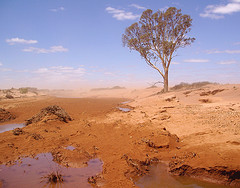
This is the climactic pattern identified by climatologist Kelly Redmond, of the Desert Research Institute, for the West years ago: "droughtiness" with increased variability. It’s the pattern we’ve seen here in Southern California. This is looking like our new weather…"drought and flooding rains," as Australian photographer Georgie Sharp puts it on her Flickr site, quoting Aussie poet Dorothea MacKellar.

We won’t know if it’s our new climate for several years, the experts agree…but in an AP story, Redmond says the current heat wave over the West isn’t going anywhere.

"The heat will hover over most of the far West through at least the
end of next week, said Kelly Redmond, a regional climatologist for the
National Weather Service. He said it could migrate further inland and
cover more of the West, including Colorado, as the week goes on."

"It looks like it is going to stay place for a good long while," he said.

Drought_and_flooding_rains

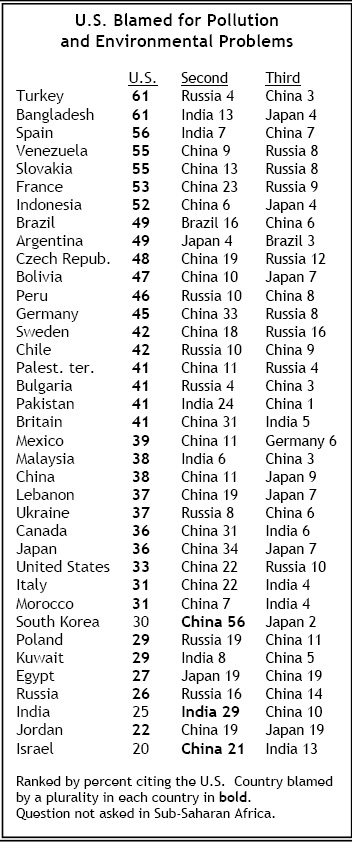
Americans, World Agree: U.S. Bad for the Environment

The results of a huge Pew Center poll (pdf) asking detailed questions of 45,000 people around the globe resulted in a wide range of opinion, as one would expect, but virtually unanimity on an important point. When it comes to the environment, the U.S. is the worst offender (the biggest contributor to global warming, etc.) 

The puzzler in this sample is India, which calls itself the worst, despite a great deal of evidence to the contrary. What’s up with the self-hatred, India?

Us_worst_for_the_environment_world_

Why You Shouldn’t Move to Phoenix

From an opinion piece by Timothy Egan in The New York Times:

What if the climate models that predict the American West heating up faster than any other part of the country prove all too accurate?

If you live here, you know what it means when the sun becomes an enemy. On Thursday, it was 110 degrees. Yesterday, same thing. Too hot to leave a dog or a child in a car without risking their lives. Your skin stings. You feel your brain swelling while waiting for the air-conditioning when you get in the oven of a parked car.

About 800 people will be hospitalized, on average, for heat-related maladies in the coming months, and some will die, mostly the very young and the very old.

As heat waves go, this week’s mercury-topper is nothing special. It’s been 121 degrees — the all-time high. But if you look at the trends and the long-term predictions by the United Nations climate panel, you wonder how our signature New City will adapt. The average temperature of Phoenix has risen five degrees since the 1960s, according to the National Weather Service. Five of the warmest years ever recorded have occurred since 2000.

A few years ago, The Arizona Republic predicted that average temperatures in Phoenix might rise by 15 to 20 degrees over a generation, due to something called the urban heat island effect. The more parking lots and Dilbert-filled buildings are slapped over the desert floor, the more heat stays trapped in the valley. On top of that is climate change.

“All of the models say in the next 50 years this place is really going to heat up,” said Robert Balling, a climatologist at Arizona State University.

Outside the city, the forests of Arizona are dying, stressed by drought and rising temperatures. A fire that burned an area the size of metro Phoenix five years ago is seen as a terrifying precursor.

What scientists have found is that there’s a threshold at which the forest ecosystem collapses. They’ve looked at droughts going back to the time of the Hohokam, who built canals here, and cannot find anything like the present crash.

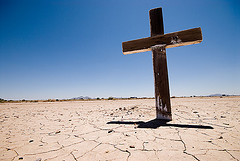
A Flickr image from Phillip Nesmith shows us what Arizona can be like…

UPDATE: Federal government warns much of the Western U.S. of dangers of "excessive heat." Maybe this should be made permanent for Phoenix?

A_dry_heat


Global Warming Makes It Tough on Gray Whales

Kenneth Weiss, a surfer/reporter who last year headed a team that won a Pulitzer for the Los Angeles Times for a series on our trashed oceans, returns to the front page today with a story about how global warming appears to be damaging the arctic feeding grounds of the Gray Whale, leading to "skinny whales" and unusual behaviors.

The whales are journeying far to the north of their usual territory looking for the sea-bed crustaceans that make up the bulk of their diet — and foraging off California and along the western coast as well.

The story tops the front page of the print edition, but for some reason is buried in the California/local edition on-line. Nonetheless, it’s worth a look, complete with graphs, maps, and photographs. Here’s the bottom line:

The loss of Bering Sea feeding grounds is responsible for another
trend: An increasing number of whales don’t bother heading that far
north. Some stop at Alaska’s Kodiak Island. Others don’t get even that
far and spend summers near British Columbia’s Vancouver Island or off
the Oregon coast. Smaller groups remain off California, feeding on
shrimp in kelp beds or anything else they can scrounge.

"These
animals are feeding on things that scientists haven’t observed in
modern times," said Bruce Mate, director of the Marine Mammal Institute
at Oregon State University. "They are beginning to become more diverse
in their diet because they have to."

But switching food could expose them to parasites that contribute to their emaciated condition, scientists say.

It’s
possible, [Steven] Swartz and other [marine] researchers said, that their scrawniness is
merely a temporary condition as the whales learn to adapt to a rapidly
changing Arctic.

"Gray whales are good at switching prey,"
Swartz said. "They need to find new places to feed, because the ocean
is changing on them. I hope we are watching a transition rather than a
serious problem."

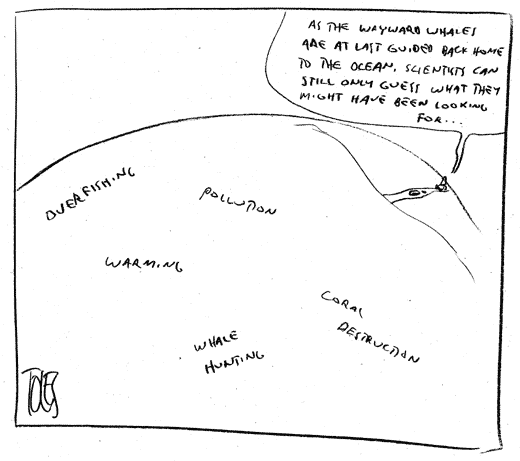
Remarkably, our most enviro of editorial cartoonists, Tom Toles, foresaw the gist of this story back in May, when he published a sketch for a possible cartoon about the two wayward humpback whales who briefly went up the Sacramento River.

Wayward_whales_by_tom_toles

“Truthiness” vs. Science

Though it will likely be self-evident to my readers that scientific truth does not always match our instincts, nonetheless Daniel Barash lays out the idea cleanly and wittily, borrowing a concept from Stephen Colbert, in an op-ed for the LATimes, entitled  "Gut Instinct Isn’t Science."

After all, the sun moves through our sky, but it is the Earth that is
going around the sun. Our planet is round, even though it sure feels
flat under our feet as we walk. The microbial theory of disease only
prevailed because Louis Pasteur, Robert Koch and other scientists
finally marshaled enough irrefutable evidence to overwhelm the
alternative perspective: that things too small to be seen with the
naked eye couldn’t possibly exist or have any effect on us.

He also includes a prescient quote from one of the great philosophers of science, Sir Francis Bacon:

"The human understanding resembles not a dry light, but admits a
tincture of the will and passions, which generate their own system
accordingly: for man always believes more readily that which he
prefers…. In short, his feelings imbue and corrupt his understanding in
innumerable and sometimes imperceptible ways."