The Beginnings of the IPCC

As you probably know, the last touches on the fourth international survey of climate change by the IPCC (Intergovernmental Panel on Climate Change) are being worked out in Paris. The amount of climate change news this week is simply overwhelming, but science historian Naomi Oreskes points out that scientific commissions have been telling the White House since l965 that we are changing the climate "through the burning of fossil fuels" and as Robert M. White, the first administrator of the National Oceanographic and Atmospheric Administration said:

We now understand that industrial wastes, such as carbon dioxide released during the burning of fossil fuels, can have consequences for climate that pose a considerable threat to future society.

That’s from l978! The story doesn’t mention in what context White said this. Was it testimony? An official report? A letter to a friend? We do need to know. Nonetheless, it’s shocking how much the experts have known and for how long, and how slow the news has been to reach the rest of us.

The latest report will say it is 90% likely that climate change is caused by human activity, according to the Wall Street Journal.
Rain and Mist in the Trees

This morning at seven I walked out to get the paper. The gentle rain of the night before had stopped; the mist hung white in the trees, for a moment the world stood still. I thought of a wonderful poem by Pattiann Rogers…

In General

This is about no rain in particular,
just any rain, rain sounding on the roof,
any roof, slate or wood, tin or clay
or thatch, any rain among any trees,
rain in soft, soundless accumulation,
gathering rather than falling on the fir
of juniper and cedar, on a lace-community
of cobwebs, rain clicking off the rigid
leaves of oaks or magnolias, any kind
of rain, cold and smelling of ice or rising
again as steam off hot pavements
or stilling dust on country roads in August.
This is about rain as rain possessing
only the attributes of any rain in general.

(con’t)

And this is about night, any night
coming in its same immeasurably graudal
way, fulfilling expectations in its old
manner, creating heavens for lovers
and thieves, taking into itself the scarlet
of the scarlet suman, the blue of the blue
vervain, no specific night, not a night
of birth or death, not the night that never
leaves the frightening side of the moon,
not the night always meeting itself
at the bottom of the sea, any sea, warm
and tropical or starless and stormy, night
meeting beneath Arctic ice.
This attends to all nights but no night.

And this is about wind by itself,
not winter wind in particular lifting
the lightest snow off the mountaintop
into the thinnest air, not wind through
city streets, pushing people sideways,
rolling ashcans banging down the block,
not a prairie wind holding hawks suspended
mid-sky, not wind as straining sails
or as curtains on a spring evening, casually
in and back over the bed, not wind
as brother or wind as bully, not a lowing
wind, not a high howling wind. This is
about wind soley as pure wind in itself,
without moment, without witness.

Therefore this night tonight–
a midnight of late autumn winds shaking
the poplars nad aspens by the fence, slamming
doors, rattling the porch swing, whipping
thundering black rains in gusts across
the hillsides, in batteries against the windows
as we lie together listening in the dark, our own
particular fingers touching–can never
be a subject  of this specific conversation.

(Georgia Review, Spring 2003)

Neilsey Survey: Those Most Vulnerable to Natural Diasters Fear Global Warming Most

As a journalist and writer-type, I think it is my job to present current issues as cleanly and fairly as possible, and not to concern myself with the "correct" way to "frame" issues.

Others see framing as a science, and argue that with proper framing, the public will waken to the issue at hand–global warming–and act on the facts.

In the above-linked post, Matt Nisbet argues that presenting global warming as a modern-day Pandora’s box will not move public opinion, partly because it leads to charges of alarmism, and besides, it’s not effective as working with evangelicals on outreach. Or as an ad campaign speaking of our responsibility to future generations.

Well, I’m no ad man. But as my editor at Grist, David Roberts, points out, any suggestion of the disastrous consequences of global warming leads criticism form some quarters. So why worry?

And a recent survey of 25,000 Internet users around the world by AC Neilsen finds that those in nations most likely to be hit by natural disasters were the most concerned about global warming.

The survey said that people living in regions vulnerable to natural disasters seemed most concerned — ranging from Latin Americans worried by damage to coffee or banana crops to people in the Czech Republic whose country was hit by 2002 floods.

In Latin America, 96 percent of respondents said they had heard of global warming and 75 percent rated it "very serious."

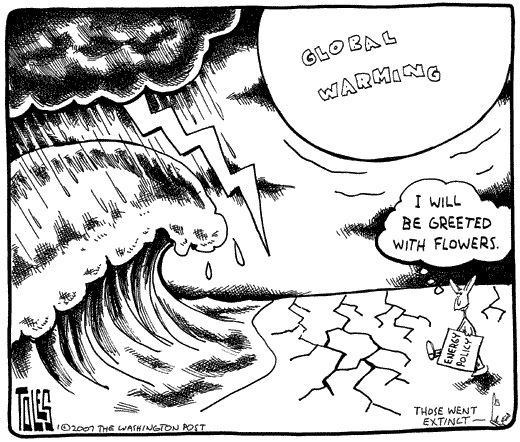
This tells me that warning of natural disasters may in fact resonate with the public.

If not now, soon. I think Tom Toles agrees…

Bush_and_global_warming

The Vanishing Glaciers

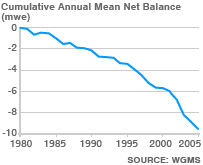
The World Glacier Monitoring Service reports that the Alps will lose three-quarters of their glaciers this century, due to climate change. Kevin Drum puts it well:

For some reason, global warming skeptics are fond of claiming that glaciers aren’t really shrinking. Usually they do this by cherry picking a single glacier somewhere that’s been gaining mass, or by suggesting that the shrinkage is due to purely local problems. But it’s not so. A broad look at glaciers throughout the world shows that not only are glaciers shrinking, but the shrinkage is accelerating.

The director of the glacier monitoring international group,  Wilfried Haeberli, puts it this way:

It is not the past that worries us, it is the future. With the scenarios predicted, we will enter conditions which we have not seen in the past 10,000 years, and perhaps conditions which mankind has never experienced.

Plus a graph!

Glaciers_vanishing

Freak January Snowstorm in Northeast, The Onion Reports

This sly story from The Onion is on the top of their "most emailed" list…even though you can find it at the bottom of this week’s front page. Just shows how much people enjoy climate change humor. The obviously Photoshopped image adds a little spice:

Northeast Stunned By Freak January Snowfall

Freak_january_snowstorn_in_northeast

“The Serious Challenge of Global Climate Change”

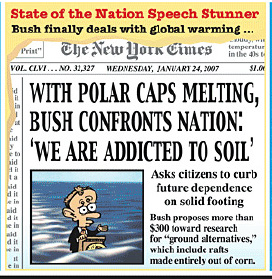
James Fallows, in an interestingly-formatted blow-by-blow reaction to the State of the Union speech in in the Atlantic, points out that when Bush for the first time glanced at the issue of global warming in the SOTU address, noting "the serious challenge of global climate change…"

Hey, what’s this? As with universal health care, Democrats are immediately up and cheering! Cheney (by my notes) remains seated. I don’t need my notes to remind me that at this point Bush and Cheney weirdly took sips of water at exactly the same time, creating an unwanted visual puppetmaster effect for Cheney.


Signs of the Apocalypse. Or, Dang It’s Cold. And Dry.

Hey, it’s not just me. Freezing in my woodstove-heated office. Trying to keep my turtle Lazarus from hibernating. It’s coyotes slinking into Los Angeles, exactly as we saw last year on the big screen, in the rather unsettling movie Collateral.

In truth, coyotes almost never attack, perhaps because they remember what happened to the last species that dared attack humans in California–the grizzly bear. Nonetheless, coyotes in the city have freaked out the easily-startled residents of Hancock Park, L.A., who casually accept 4,000 pound luxury automobiles hurtling by at high rates of speed, but are scared by 50-pound canines.

Why are these coyotes appearing? Could it be drought? In an El Nino year? That’s what the experts say. Right now most of California is either abnormally dry (yellow) in drought (beige) or severe drought (brown). We’ll be hearing more about this before long, I’m sure.

Drought_in_ca_in_january_2007

UPDATE:   The LATimes runs a hugely helpful column from Ed Boks, who runs animal control services in the city, explaining the nature of coyotes in the city. Crucial quote:

Killing coyotes has the unintended consequence of producing more coyotes, not fewer. Mother Nature provided them with a powerful survival mechanism: Smaller social group size increases the food-per-coyote ratio, and this food surplus biologically triggers larger litters and higher litter survival rates.

Even if we wanted to trap or kill all the coyotes in a designated area, history shows the vacancy won’t last. Coyotes, like the rest of nature, abhor a vacuum. Larger litters rebuild the population and, with no rivals to keep them at bay, coyotes from the surrounding areas move right in. The end result of these futile eradication efforts is always the same: The area is quickly overrun…with new coyotes.

Coyotes — once largely confined to the northwestern corner of the continental U.S. — can now be found in L.A.’s Griffith Park and New York’s Central Park, in snowy Alaska and sultry Florida.