Feeling Happy? You Should Be. You’re an Enviro.

Anna Shepherd, the "Eco-Worrier" for the Times of London, reports:

"…if you’re reading this, you are probably eco-conscious and therefore likely to be happy. So says research from Imperial College London. Far from being a moaning, finger-wagging bunch of grumps (yes, okay there are some that are like that), it suggests that greenies are cheerful. Another run to the recycling centre? Hurrah. Time to feed the worms again? Yippee. And oh good, another box of muddy organic vegetables. Mirth is rife in the homes of the planet-friendly."

It’s a web survey, so I don’t think we should take it as settled truth. But it’s good news, so I’m not going to throw it back…

(HT: Clive Davis)

O El Nino, Where Art Thou?

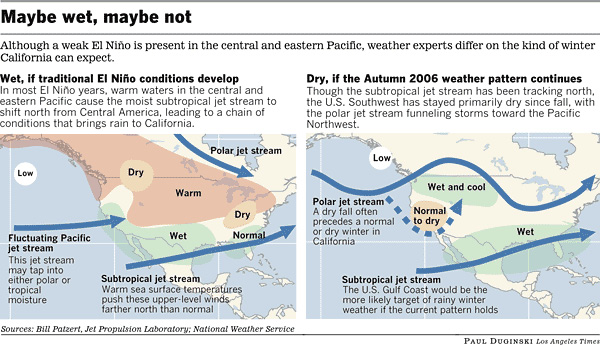
Here’s a graphic from my equaintance Bill Patzert at JPL that explains as succinctly as possible why this year’s vaunted El Nino may miss us entirely, but leave the Northwest drenched. (Click to enlarge.)

It goes with a fine story in this morning’s LATimes by Hector Becerra. I’m working another angle on this story; if it pans out, I’ll report back soon.

In the meantime, if you live in California, it’s time to pray for rain. Or dance for rain. Or sacrifice small woodland creatures…just kidding.

Maybe_no_el_nino_1

The Ecology of Peace

The new Pope, Benedict XVI, in his message for the first day of the new year, had some fascinating remarks to make about "the ecology of peace." Listen to this:

Alongside the ecology of nature, there exists what can be called a “human” ecology, which in turn demands a “social” ecology. All this means that humanity, if it truly desires peace, must be increasingly conscious of the links between natural ecology, or respect for nature, and human ecology. Experience shows that disregard for the environment always harms human coexistence, and vice versa. It becomes more and more evident that there is an inseparable link between peace with creation and peace among men.

(His Holiness’ italics.)

The closest I’ve ever come to Catholicism was an ex-girlfriend, but I like that. A lot.

the earth’s embrace

What does it mean to say that a movie, or a photograph, or a book, or any such human work, is "environmental?"

Because the word cuts both ways. If I direct a movie that looks hard at the way oil is produced in the Middle East–the deals that must be made, the deaths that must be overlooked–that could be said to be environmental, because it’s about energy, which has a huge effect on the planet.

But I would argue that is mostly an attitude towards industrial production, and a way to self-identify. Instead I borrow a definition from a quote by the great Western writer Annie Proulx:  environmental is that which that binds us to a place; or, more grandly, to the earth itself.

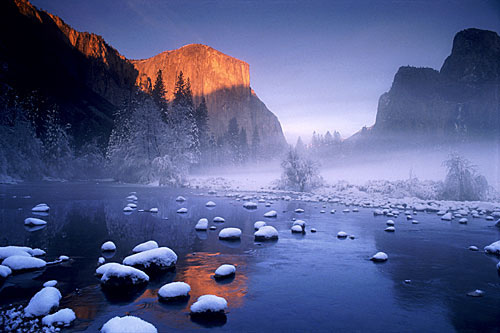
And by this definition, the beauty and the immediacy of the late Galen Rowell’s photographs makes him one of the great environmentalists of our time. He literally puts us in our place, this earth, and then with his eye for beauty draws us in, until we wish we were there to experience it ourselves.

He died in a plane crash a couple of years ago, sadly, but this fall the Sierra Club put out a wonderful retrospective of his work. Here’s the first image from the slide show on line.

Winter_sunset_gates_of_the_valley_galen_

Cut the Crap, Mr. President

Admiration and respect to Dan Froomkin of The Washington Post, who despite blogging for a major newspaper and taking a full measure of heat from right-wing partisans, continues to dog the Current Occupant’s every move, putting his every press conference, every idiotic quote, every bungling misstep on the record forever.

The column is heavily linked and written for the web, and because it covers the press covering the story, instantly provides perspective on the big story of the day in D.C.

But it has one flaw. Although Froomkin sometimes requests questions from readers to be asked to the President, he himself remains web-bound and unable to speak. 

Still he gets a lot done. Today, on my birthday, he called out the entire American press corps. He pointed out that somehow their "small-bore" questions never seemed to confront the President with the failure of his own chosen war. In contrast to their detailed-but-vague questions about "time lines," here’s a question British reporter Bill Neely put to the President on Thursday:

Q: Mr. President, the Iraq Study Group said that leaders must be candid and forthright with people. So let me test that. Are you capable of admitting your failures in the past, and perhaps much more importantly, are you capable of changing course, perhaps in the next few weeks?

In response the Current Occupant said, in many more words, not yet.

…I do know that we have not succeeded as fast as we wanted to succeed. I do understand that progress is not as rapid as I had hoped. And therefore, it makes sense to analyze the situation…

Froomkin, from his aerie in the web, points out:

Bush’s response to Neely’s question was particularly telling because it demonstrated that the president still doesn’t think he himself did anything wrong in Iraq. He recognizes that things didn’t go as planned there, but doesn’t seem to think any of it was his fault.

That indeed casts doubt on his ability to change course. As I pointed out in my October 20 column, the first step to recovery is recognizing that you have a problem.

Well, that’s a darn good point, that’s all.
Thanks Again, John

Last year Rolling Stone put up on its site a l970 interview with an embittered but very much alive John Lennon, who was brutally frank on a vast array of topics to Jann Wenner. A friend sent me the digitized recordings. (last time I looked on the RS site, I couldn’t find them, I’m sorry to report. If you want a disk copy, let me know.)

Wenner sounds a little intimidated and uncertain in his questions, but Lennon turns every vague gesture at a topic in to a full-on examination in vivid detail, rich in emotion and voice. (Someone, I think it was George Martin, said that Lennon’ was so expressive it was almost as if he was singing when he talked. )

In response to a query about what he was doing now, Lennon went on and on about about how he didn’t want to be in the recording studio with the Beatles anymore. He wanted to be at home, he said, and that’s where he was happy, and along the way happened to say, half-approvingly:

"Sometimes I felt I worked to justify my existence, but sometimes I just worked to exist."

Sounds like a blogger’s credo, doesn’t it? 

Here’s another appreciation of John today, on the anniversary of his assassination, by one of his more articulate admirers, Jon Weiner.

And here’s one reason we treasure his memory: the beauty of his idealism, which we so miss. Still.

Imagine_garden