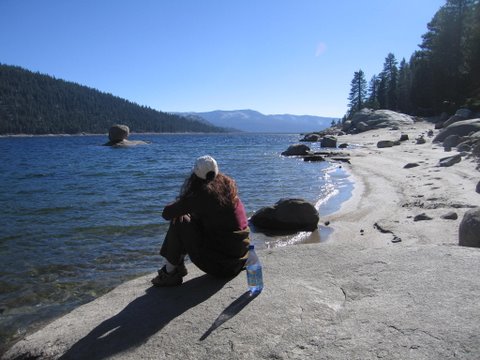
Val on a Sierra beach. Hard to believe this was just a week ago. Especially since we are facing yet another evacuation threat, here in Upper Ojai…nearly three weeks after the Day fire started.
Gather ye beauties while ye may…
A Change in the Wind
Val on a Sierra beach. Hard to believe this was just a week ago. Especially since we are facing yet another evacuation threat, here in Upper Ojai…nearly three weeks after the Day fire started.
Gather ye beauties while ye may…
The perimeter map posted on the useful-if-slow InciWeb site, which tracks big wildfires across the country. We are closest to the little nub of fire to the southwest. It’s about ten miles away and the Santa Ana winds, as forecast, are blowing, although relatively mildly at this point. We have been given a preliminary evacuation order, but bulldozers have cut a line twenty-four feet across all the way from the Topa Topa mountains northeast of Ojai to Santa Paula canyon, between us and the fire, and that line has been soaked in fire retardant.
A neighbor visited with the firemen standing watch at the top of the hill. "Yep," one said in country-tinged voice, "when that fire gets here we’ll fight it. I got a bottle of water right here."

Over a hundred people recently came down sick after eating bagged spinach contaminated by the rare but potentially deadly E. coli 0157 bacteria.
One person died, according to the FDA.
But insight into this sickening has been hard to come by until today, when three excellent stories were published on the subject, the first linked above from the opinion section of the NYTimes.
Nina Planck reveals that this particular brand of E. coli is typically associated with cows eating grain, producing a strain of the bacteria that can stand up to stomach acid, and thus overcome human defenses that can handle the usual strains of the omnipresent E. coli without serious difficulty.
The good news is that there is a well-known solution for E. coli 0157:
In 2003, The Journal of Dairy Science noted that up to 80 percent of dairy cattle carry O157. (Fortunately, food safety measures prevent contaminated fecal matter from getting into most of our food most of the time.) Happily, the journal also provided a remedy based on a simple experiment. When cows were switched from a grain diet to hay for only five days, O157 declined 1,000-fold.
The bad news is that the present situation is unsustainable, according to Marla Cone of the LATimes.
The bacterium that has sickened people across the nation and forced growers to destroy spinach crops is so pervasive in the Salinas Valley that virtually every waterway there violates national standards.
At Grist, Tom Philpott picks up the story from a different angle, looking not so much at the bacterium or its source, but at our desire for convenience, and the the scale of agriculture that feeds that desire.
I can see why pre-washed salad greens have grown into a $4 billion industry since 1986, when Earthbound Farm first sorted out the technology for keeping them fresh. It’s undeniably tempting to pluck a sealed bag of uniform greens from the supermarket counter and dump it right into the salad bowl, ready for a lashing of pre-made salad dressing.
But in doing so, you’re making huge demands on the environment. Even assuming organic production, consider that California salad greens consumed on the East Coast must be trucked across the continent and kept cool at a constant 36 degrees Fahrenheit. "At least given the fuel burned to get it to my table," Michael Pollan writes in The Omnivore’s Dilemma, "there’s little reason to think my Earthbound salad mix is any more sustainable than a conventional salad."
I’m relieved to say that on this front, a neighbor got us into a CSA, so I need not fear my spinach. Or my lettuce. Or my zucchini. Or my tomatoes. Or my squash. Or my peppers. Or my beets…
While on a brief vacation last weekend in the Sierras, the aforementioned Day Fire came charging southwest towards our neck of the woods in Upper Ojai, forcing our daughter to evacuate. Never a dull moment in Southern California!
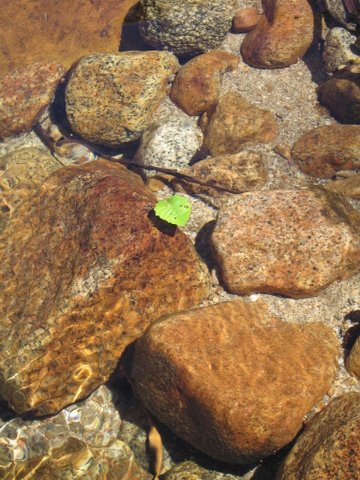
While I’m trying to put the office back together, and hoping the Santa Ana winds don’t bring the still-burning fire back our way, here’s a calming picture from Mono Creek near Edison Lake, in a lovely area in the Sierras at about 8,000 feet.
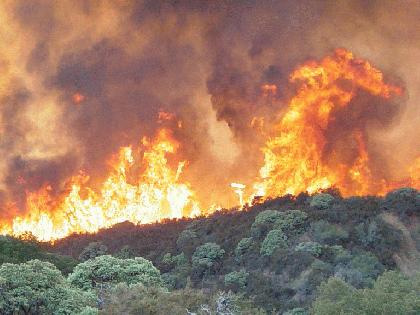
Ah, the coming of fall in Southern California. Flakes of ash fall as thickly and softly and white as snow. Clouds of smoke bigger than mountains fill the sky. Orangish sunlight and hazy gray skies last for weeks on end. Thousands of firefighters struggle to contain blazes with flames twenty and thirty feet high. Bulldozers cut lines. Planes and helicopters water-bomb all through the day. Evacuation orders arrive in the dead of night, when the skies are glowing, and the traffic wild.
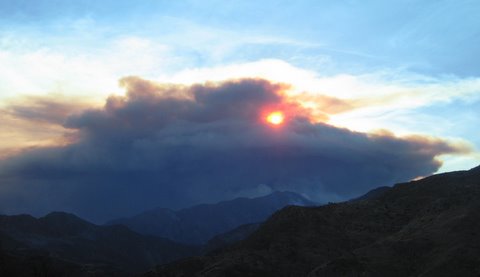
The Day Fire (so named because it began on Labor Day) continues to burn in the Los Padres National Forest northeast of Ventura County.
It so happens I spent about the last month working intensively on a fire story, to be published tomorrow, so this issue has been on my mind.
The good news is that the Santa Anas are not blowing, so that the fire–although it did close Interstate 5 for a time yesterday–is not a raging monster threatening our area. Today fire crews were able to keep it from advancing down the I-5 corridor, according to the InciWeb site, which reports on wildland fires around the country.
The bad news is that this is a large fire (over 25,000 acres) in extremely rugged terrain, very difficult to bring under control, even when wind is not a factor.
Here’s mine, with the climatologist Kelly Redmond, in Grist.
Here’s Andrew Revkin’s, with genius scientist James Lovelock, in the NYTimes.
Lovelock is predicting flat-out doom from "global heating," and within twenty years. He told the Washington Post:
"Our global furnace is out of control. By 2020, 2025, you will be able to sail a sailboat to the North Pole. The Amazon will become a desert, and the forests of Siberia will burn and release more methane and plagues will return."
That’s not what I’ve heard, but the scientists I talk to are not "big picture" thinkers comparable to Lovelock. Here’s a graphic version, from his book "The Revenge of Gaia."
Note that the most projections for global heating estimate no more than 3C by 2050. So Lovelock may be right on target, but just a little ahead of the curve. That would be characteristic, wouldn’t it?

Once, I hear, the Western desert attracted crazy dreamers; prospectors, pioneers, fanatics waving crazy religious tracts, some of whom even claimed to have seen and spoken to Jesus Christ and God the Father.
Now the Southwestern desert attracts developers, and people who dream of a house of their own, even if they can’t afford the glamour and traffic of West L.A. Buyers search for a place of their own, but end up with a million others on identical tracts in the middle of the desert. It’s a recipe for a Didion-esque madness of another sort. I think.
That’s what I see when I look at the the photos of Steve Smith. Back in the l9th century, a handful of people saw the beauty and the freedom in this land. In the 21st century people see that it’s cheap, relatively speaking, and that’s all that matters to them. They probably don’t even see the desert.
As the photographer says:
This photo series provides a portrait of the process of development that is quickly overtaking the desert peripheries of Las Vegas, Salt Lake City, Denver, and Los Angeles. Here in the suburban periphery, the landscape is scraped bare, re-sculpted, sealed, and then covered so as not to erode away. These systems of control prepare the land for habitation and also guard it against the natural forces of the desert environment. These photographs document the interactions and contrasts between this manmade environment and natural elements of the desert ecology that it resists and attempts to control.
An El Nino condition is developing, which will likely bring a good helping of clouds and rain to the West Coast this year…for the third year in a row. This is also breaking up hurricanes that could develop along the Gulf Coast.
It’s worth mentioning that the record-breaking rain Southern California lived through last year was aided by a weak El Nino as well…although a "jet stream on steroids" (as Bill Patzert described it) was a much larger influence.
Here’s a discussion from Jeff Masters’ invaluable Wunderblog:
A trend to El Niño at this time of year is unusual; May or June are the typical months that El Niño starts to develop. While the Climate Prediction Center expects that this will be a weak El Niño, the unusual timing of this event puts us in relatively uncharted territory. Since 1950, only one El Niño has started in the Fall, the El Niño of 1968. This event was an average El Niño, with a peak SST warming in the East Pacific of 1.0º C. For comparison, the warming was 2.3-2.5º C in the record El Niño events of 1997-98 and 1982-83. The unusual timing of the 2006 El Niño event comes on the heels of the unusual timing of the La Niña event that ended in May. The 2006 La Niña started very late–no La Niña of similar magnitude had ever formed in the middle of winter, as this one did. One may legitimately ask if these events might be linked to human-caused climate change. I am concerned that this might be the case, but we don’t have a long enough record of historical El Niño events to know. Up until 1975, La Niña events and El Niño events used to alternate fairly regularly with a period of 2-7 years. Between 1950 and 1976 there were seven El Niño events and seven La Niña events. Since 1976, El Niño events have been approximately twice as frequent as La Niña events, with ten El Niño events and only six La Niñas. Some researchers have speculated that this is due to the effects of global warming causing a new "resonance" in the climate system. If so, this is one way in which global warming may end up causing a decrease in Atlantic hurricane activity over the coming decades, since the increased wind shear over the Atlantic during El Niño events greatly reduces the number and intensity of these storms.

Ten years ago in December a wildlife biologist named Roy Van de Hoek was arrested, thrown face down, and handcuffed forcutting non-native shrubs out of the legendarily wild and beautiful Carrizo Plain. He faced twelve misdemeanor charges, but eventually was given three years probation.
That’s according to a Mother Jones "hellraiser" piece on Van de Hoek from l997.
Carizzo Plain is a place I hope to see next spring. It’s in Central California, but inland, and is said to be one of the wildest places along the Central Coast.
For several years before his arrest, Van de Hoek spoke out loudly against Bureau of Land Management administration that allowed fences and tree-planting in the grassy flats of Carrizo Plain. He especially disliked non-native shrubs, and ultimately was caught cutting them down himself.
Now he’s in trouble again, charged with six misdemeanors, including cutting down a ficus tree without authorization in the Ballona wetlands, not too far from LAX, which is one of the few semi-wild places left in or around the beach in Los Angeles.
"I love the wetlands and I care about the endangered species that live there, the plants and animals," van de Hoek said, his voice trailing off with emotion, according to ABC News.
The ABC story mentions a "Free Roy!" petition. I looked for it but can’t yet track it down. When I find out more, I’ll bring it up.
For now, here’s a picture of my latest hero for the day, from a Sierra Club newsletter. He ran for the board as a petition candidate last year. Wish I’d voted for him! If I’d only known…


 Kit Stolz