Category 5 Level Argument against Inaction

Yesterday the Washington Post published an op-ed on climate change that, if it were a hurricane, would have to be rated Category 5. Entitled "We’re All New Orleanians Now," Mike Tidwell argues:

Barring a rapid change in our nation’s relationship to fossil fuels, every American within shouting distance of an ocean — including all of us in the nation’s capital — will become de facto New Orleanians. Imagine a giant floodgate spanning the Potomac River just north of Mount Vernon, there to hold back the tsunami-like surge tide of the next great storm. Imagine the Mall, Reagan National Airport and much of Alexandria well below sea level, at the mercy of "trust-us-they’ll-hold" levees maintained by the Army Corps of Engineers. Imagine the rest of Washington vulnerable to the winds of major hurricanes that churn across a hot and swollen Chesapeake Bay, its surface free of the once vast and buffering wetland grasses and "speed bump" islands that slow down storms.

Because of global warming, this is our future. Oceans worldwide are projected to rise as much as three feet this century, and much higher if the Greenland ice sheet melts away. And intense storms are already becoming much more common. These two factors together will in essence export the plight of New Orleans, bringing the Big Easy "bowl" effect here to the Washington area, as well as to Charleston, S.C., Miami, New York and other coastal cities. Assuming we want to keep living in these cities, we’ll have to build dikes and learn to exist beneath the surface of surrounding tidal bays, rivers and open seas — just like New Orleans.

In Prometheus, Roger Pielke, Jr. claims that "arguments such as this make one think that the environmental community is hell-bent on its own self-destruction." Pielke says that we cannot change our fossil fuel consumption fast enough to reduce the risk, so–he argues–to claim that coastal cities in the East and along the Gulf Coast face Katrina-style disasters is irresponsible.

But what about the irresponsibility of doing nothing to prevent such disasters? That’s what concerns the enviro community. Isn’t that an argument for taking responsibility–specifically, for the responsibility of the Federal government to act to reduce the risk?

After all, the government has not acted to reduce the risk of hurricane damage, as Pielke has been proposing for years. Nor has it acted to reduce CO2 emissions.

It’s the total lack of action that brings forward this sort of apocalyptic reasoning; and, if truth be told, it’s the same lack of action that makes this sort apocalyptic argument all too credible.

Song of the Redwood Tree (Sunday Morning on the Planet)

Excerpted from Walt Whitman’s "Leaves of Grass." The poem was written in 1874: Sixty years later, the California legislature named the sequoia the state tree.

"Song of the Redwood-Tree"

The flashing and golden pageant of California,

The sudden and gorgeous drama, the sunny and ample lands,

The long and varied stretch from Puget sound to Colorado south,

Lands bathed in sweeter, rarer, healthier air, valleys and mountain cliffs,

The fields of Nature long prepared and fallow, the silent, cyclic chemistry,

The slow and steady ages plodding, the unoccupied surface ripening, the rich ores forming beneath;
At last the New arriving, assuming, taking possession,
A swarming and busy race settling and organizing everywhere,

Ships coming in from the whole round world, and going out to the whole world,

To India and China and Australia and the thousand island paradises of the Pacific,

Populous cities, the latest inventions, the steamers on the rivers, the railroads, with many a thrifty farm, with machinery,

And wool and wheat and the grape, and diggings of yellow gold. . . .

The new society at last, proportionate to Nature,

In man of you, more than your mountain peaks or stalwart trees imperial,
In woman more, far more, than all your gold or vines, or even vital air.

Fresh come, to a new world indeed, yet long prepared,
I see the genius of the modern, child of the real and ideal,

Clearing the ground for broad humanity, the true America, heir of the past so grand,

To build a grander future.

"A new society proportionate to Nature"…that’s the ideal in the 21st century, isn’t it? Whitman is still ahead of his time…

Graph of the Week: Indications of Change

Here’s a graph, from a good clear NOAA website called Artic Change. (Amazingly, this site seems to have escaped the Bush administration meddling that has marred some other gov sites on this topic.)

This graph breaks down climate not in terms of temperature but in terms of change, using principal component analysis. It’s a potent argument for the seriousness of the crisis that faces us, I think, because it points to the acceleration of change and hints at the wider swings of variability that go with what is known as global warming. 

This is a crucial and paradoxical aspect of climate change that just now is beginning to dawn on the general public.

Indications_of_a_changing_climate_2

Capitalism v. Environmentalism

Don Boudreaux, an economist, argues that to doing nothing is the best policy for global warming.

As David, biodiversivist, Deltroid, and Think Progress point out, this argument has a lot of screws loose. (Think Progress also has up a great picture of Boudroux, who looks truly insane. He is also, by sheerest chance, on the staff of the Cato Institute, which according to a book by two University of Colorado law school scholars "receives most of its financial support from entrepreneurs, securities and commodities traders, and corporations such as oil and gas companies, Federal Express, and Philip Morris that abhor government regulation.")

But just for a moment let’s ignore the whiff of prostitution, not to mention the alarming changes that global warming will work on features of life on earth (including climate, drought, floods, forest insect pests, hurricanes, species extinctions) and other aspects of life on earth.

Let’s focus on the politics of the claim.

Please read more at Gristmill. But first ask yourself: Would you buy a used car from this man? Not to mention an economic policy with potentially disastrous effects…

Don_boudreaux

The Mustache Calls Out Cheney on GOP Denial

I’ve been a bad blogger. Crushed under work, journalism, and a huge party for our good friend Deb Norton’s 40th birthday, I just haven’t been able to focus on blogging, dang it.

But I’m not giving up; just trying to find some time. Here’s a snippet from a good column by Tom Friedman (or "The Mustache," according to David Roberts, my editor at Gristmill).

Friedman, a political moderate who once was read faithfully at the White House, has dropped his support for the White House on most issues. In this column [$], headlined "G.O.P. Denial," he takes a 2×4 to the bald head of Dick Cheney, mostly on the calamitous war in Iraq, but also on energy:

Mr. Cheney, if we’re in a titanic struggle with Islamic fascists, why have you and President Bush resisted any serious effort to get Americans to conserve energy? Why do you refuse to push higher mileage standards for U.S. automakers or a gasoline tax that would curb our imports of oil?

Here we are in the biggest struggle of our lives and we are funding both sides — the U.S. military with our tax dollars and the radical Islamists and the governments and charities that support them with our gasoline purchases — and you won’t lift a finger to change that. Why? Because it might impose pain on the oil companies and auto lobbies that fund the G.O.P., or require some sacrifice by Americans.

Sunday Morning on the Planet (Dawn and Gustavo edition)

From the incandescent performance of Osvaldo Golijov’s Ayre last month in Ojai, featuring Dawn Upshaw and Gustavo Santaolalla.

(Contemporary classical music has at last shaken off the 20th-century pretention that atonality is progress. Noise-shy audiences are slow to realize this, unfortunately, but with the possible exception of some of Lou Harrison’s work, I can’t think of a better piece to bring them back than Golijov’s astonishing Sephardic/Christian/Arab/Argentinian epic. (Check out these reviews.)

I had the chance to talk briefly to one of my new musical heroes, Santaolalla, at the Ojai fest. Besides being ridiculously talented and prolific–as a writer, a producer, and a musician–he’s a complete charmer. I asked him if there was anything he couldn’t play. (Because on his superb instrumental Ronroco album, the list seems endless.)

"Anything with strings," he shrugged. Check out the lovely album, and you too will believe it.

Gustavo_and_dawn

Line of the Week

Although he’s not my favorite talk-show host, Jay Leno is undeniably a funny guy, and a very hard worker.  (Personally, I’m old school: I like David Letterman, who as the late great Neil Postman liked to point out, specializes in pulling back the curtain and revealing the trickery of TV.)

But in Hollywood it’s generally agreed that Leno has the best writing staff, and hence the best one-liners. Here’s a winner from last night:

"As you know, when President Bush is down on his ranch, he likes to spend his time clearing brush and chopping wood, because no matter how much legislation you pass to cut down trees, there’s nothing like destroying them with your own hands."

Healing the “Self-Inflicted Wound”

Never thought I’d be quoting Arnold Schwarzenegger on any topic, far less global warming, but I think he more than any other politician deserves credit for nailing the most troubling aspect of anthropogenic climate change–that it’s a "self-inflicted wound."

But as climate scientist Brenda Ekwurzel points out in a letter to USA Today, that has an upside:

Global warming is a human problem, but that means we humans can all do something about it.

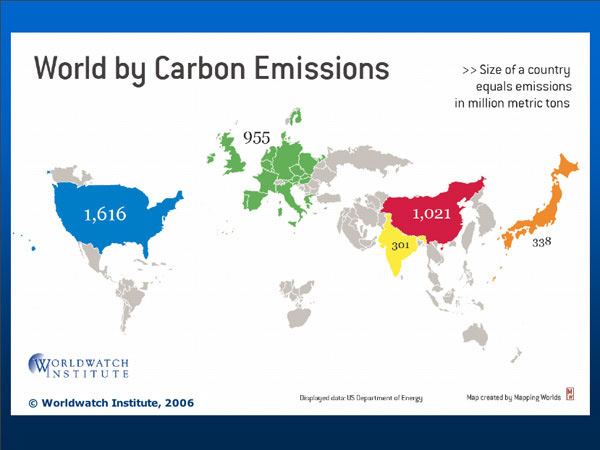
The place to start? The USA, which emits about 30% of CO2 worldwide.

World_by_carbon_emissions_1