Everybody’s Talking (’bout my Global Warming)

A year and a half-ago, we had two weeks of hard rain in Southern California where I live, totaling about twenty inches, followed by a storm burst on the morning of January 10th.

Here’s what the stream where I live looked like like the day before the storm burst.
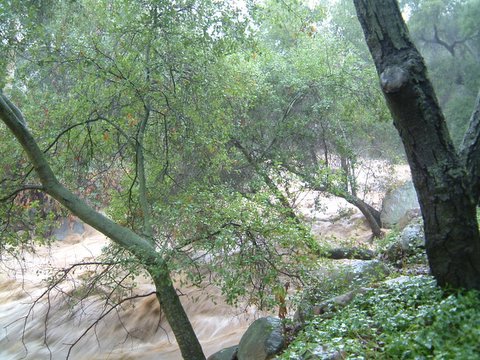
The_stream_before_the_storm

Then came the storm, with no less than six inches of rain in a little over two hours.

The flood that followed closed the little state highway I live on in one direction for nearly six months, and devastated my property. We’re still putting the pieces back together.

Naturally, I suspected global warming might have had a hand in this, what with the "intensification of the hydrological cycle" that one study from the US Global Climate Research Program for this region predicted back in 2003. Another study estimated a likelihood of stronger El Ninos, and rainstorms  5-10% wetter. (Because higher temps lead to more evaporation lead to more moisture lead to wetter storms, the effect should be quantifiable, within probable ranges.)

But interestingly, experts such as my equaintance/friend Bill Patzert at JPL/NASA, who knows a great deal about global warming, nonetheless did not name it as a cause for the January 2005 storms. Bill pointed instead to a "jetstream on steroids" with "wild fluctuations north and south."

And my neighbors too, were quiet. I think most of my neighbors accept the reality of global warming, having noticed one effect or another (fewer frosts, for example), but to my surprise, global warming was a conservation killer when I alluded to it and the storms together.   

"Just too much water," one hard-hit guy my age said. ‘We had just too much water for us to take."

Partly, I think, the reluctance to talk about it came out of seeing so many ripped-out trees, tumbled vehicles, torn-up roads, and mud-soaked houses. No one wanted to "vent" on the subject; after all, in La Conchita, ten people died in that storm. (For a sense of what that felt like, see this excellent story from T.C. Boyle called La Conchita.)

I told people that it felt Biblical. Sometimes they’d nod and sometimes they’d laugh, but nobody I can recall doubted me on that.

Back on the East Coast, the same concept came up regarding the recent storms that swamped the Capitol. (See the Tom Toles post below.)

Only one report that I know of linked these deadly storms to global warming, by Bill Blakemore of ABC News.

And just as my neighbors didn’t much want to talk about it, nor reporters, neither did the ordinary people in the Mid-Atlantic region, according to the NYTimes [$].

Right or left, the politics don’t seem to matter.

Lefties are probably more willing to speculate in disaster; righties probably more willing to accept that the universe can turn against us at any moment.

But most people I encounter, regardless of their politics, don’t really want to talk about it.

I don’t think this mutual reticence is ill-intentioned.

On the contrary, I think it comes out of a respectful wariness. As the Times Editorial said: 

There is no minimizing the deaths or the damage, but these storms have affected most people on a more mundane level. In parts of New England there is almost a grim refusal to talk about the weather, as if it has all been said already and proven useless. Anyone who works outside for a living — gardeners, painters, contractors — has more or less used up a year’s supply of stoicism already, with most of the summer still ahead of them.

But, fascinatingly, the reticence to talk about global warming in polite company has been utterly reversed in print, where all sorts of writers and thinkers are going at the subject with vigor.

I’m sorry it had to come to this, but the writing in the last couple of months from not the usual experts has been original, surprising, sometimes even dazzling. 

See below for examples from a couple of boys from Harvard, the sociologist Robert Puttnam, author of "Bowling Alone," and Daniel Gilbert, a psychologist who recently published a book called "Stumbling on Happiness."

I expect this type of item will become a regular feature; I hope all these good pieces go straight to the top of the opinion leader charts.

Robert Puttnam wrote a column for Time last week about a hugely important new study by a team of sociologists, called social_isolation_in_america.pdf, which shows that Americans are much more lonely than they were just two decades ago.

This has big environmental effects, but, as Talking Heads once said, we have no time for that now. Here’s the point from Puttnam that deserves attention:

Just as the debate about global warming began with controversial claims made by a few iconoclasts, so too were many sociologists skeptical of my findings about lonely bowlers. No complex issue is ever settled by a single study. Advancing the global warming argument has required decades of research, and it may take another decade to convince the final doubters that social connectivity in the U.S. has, in fact, disintegrated.

[cut]

As a friend said, "So what if the average American now has two close friends, not three? Two is plenty." But that’s exactly like saying, "If global temperatures rise from 65°F to 70°F, I wouldn’t even notice." That’s fine, as long as you ignore the indirect effects, like mega-hurricanes in the Gulf.

Exactly. From small acorns (slight changes in sea surface temperatures) big things (hurricanes) grow. But if we wait for all the doubters to be convinced, which will probably take another ten years, it’ll be too late, according to the scientist most respected on this question, James Hansen .

Politics vs. climate; which matters more?

But even better is the remarkably witty piece by Dan  Gilbert in the LATimes, which explains why our puny little brains are having trouble taking in the big facts about global warming.

Global warming isn’t trying to kill us, and that’s a shame. If climate change had been visited on us by a brutal dictator or an evil empire, the war on warming would be this nation’s top priority.

Now if it was all Lex Luthor’s fault; now then, we might actually do something…
 

Thinking Ahead on Climate Change Over There: Falling Behind Over Here

If you take a look at media stories and scientific blogs from the UK on the subject of climate change, you cannot help but notice how much further down the road the Brits can see than Americans.

Here in this country, for example, righties are a-tizzy over a column by Robert Samuelson calling current attempts to reduce emissions of heat-trapping gases "grandstanding." If you read the world-weary column and take a look at the comments section about it on the afore-linked Prometheus site, you’ll hear Andrew Dressler, who has written a textbook for students in atmospheric chemistry, complain:

It’s like I’ve been beamed back in time 20 years. These arguments ("it’ll destroy the economy", "production will move offshore") are exactly the same arguments made to oppose CFC phase-out. And they turned out to be completely wrong.

Over on conservative-but-not-kneejerk Professor Bainbridge’s site, the professor sounds a little worried about global warming, but resigned to it, much like Samuelson. But even that doomy stance is advanced compared to many comments on his post, where the uninformed still dispute the reality of global warming, and fling insults at people at those of us who want to act to reduce the risk.

Contrast these hackneyed debates with a story from George Monbiot in "The Guardian," in which he points out that already thousands of homes in Germany are built to a "passivhaus" standard that requires no active heating system. Yet these homes are substantially warmer than most English homes, even new ones. He’s complaining that new homes in England are behind the times because they require active heating and cooling–can you imagine?

Or take a look at a recent post from author and explorer Mark Lynas:

The UK government recently disbursed £2 million to various organizations to help them raise the profile of climate change. Very laudable, you’ll agree. But they’ve also spent £1 billion in the last year alone on their programme of building new roads across Britain. Do the maths. Considering these two figures, the UK government spends 500 times more on *causing* climate change than it does in *preventing* it.

Could the concept that the government by its actions is actually causing climate change even be discussed in this country? Judging from my recent debating experience, I have doubts…

A True Conservative

Forty years ago, when I was a little kid, my parents took me and my sisters and a friend or two up on Mt. Tamalpais (in the Bay Area) to see a music show in the outdoor theater. The show had many acts, but I’ve forgotten all of them except for one, a tall guy with a banjo who had a way of throwing his head back to let his voice soar out. He sang "If I Had a Hammer," and "Turn, Turn, Turn" and a few others, and then with his mates took a break.

Completely entranced, I became an instant Pete Seeger fan. The outdoor theater on Mt. Tam has no backstage. A friend and I found Seeger and a pal quietly eating lunch in the brush away from the crowd. I asked him, of course, for his autograph. He gave me a wry look and said "Okay–but only if you promise not to tell anyone." I promised and, in fact, burned with the secret all through the rest of the show.

It’s a small story, but so characteristic of the gentle big-heartedness of this man that I just have to share it, and post on Pete Seeger, still one of my heroes, who has once again attracted the spotlight. Mostly that’s due to the great Bruce Springsteen, who is on tour behind a new album of Seeger songs and folk classics, including Seeger’s newly-minted "Bring ‘Em Home." (Which you can hear for free.)

But Bruce would be the first to deflect the spotlight back to Seeger, who for his work with the Clearwater sloop to save the Hudson River is in the Ecology Hall of Fame, who was interviewed wonderfully on Amy Goodman’s Democracy Now!, and who was profiled spectacularly well by the New Yorker a couple of months ago. The New Yorker story is so good I want you to read it whole, but I will cherry-pick one anecdote, from Seeger’s boyhood days:

The librarian in Nyack gave Seeger novels by Ernest Thompson Seton, who helped start the Boy Scouts. "Camping and woodcraft," Seeger said. "The first one I really liked was called "Rolf in the Woods.’ Rolf was fifteen years old in 1810. He was being beaten by his uncle, and his mother dies. He runs away and finds in the woods a wigwam with an old Indian living in it, trapping animals and exchanging their skins at the hardware store for tools and nails. The boy asks if he can stay with him, and the Indian points to a corner, and the boy falls asleep. The uncle comes along later and says, "I see you’re with the Indian, I’ll go get my gun," so Rolf and the Indian run off together, and they end up in the Adirondacks. Anyway, you can see how it goes."

This is so Seeger; a fascination with the past; a sensitivity to the poor and helpless and excluded; a curiosity about how things might be completely different from the way they are. And, let me add, this unhappy-boy-finds-peace-in-the-wilderness is a theme that comes up again and again in stories about famous nature-lovers. 

David Brower, for example, growing up in Berkeley, became interested in the woods after losing two front teeth in an accident. Because his family was poor, his father couldn’t afford to cap the teeth, and Brower was teased unmercifully. He went off into the woods of Tilden Park in Berkeley (if memory serves) and liked it so much he never fully returned to what we like to call civilization.

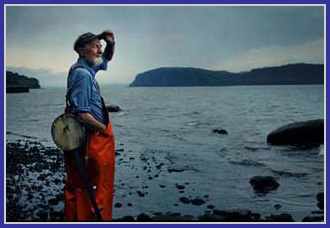
Seeger as an older man lived along the Hudson in a log cabin and sailed up and down it for decades in a sailing ship called the Clearwater, doing shows to raise money to help clean up the river. But simplicity and caring is a huge part of his appeal:

"I like to say I’m more conservative than Goldwater. He just wanted to turn the clock back to when there was no income tax. I want to turn the clock back to when people lived in small villages and took care of each other."

On July 4th, let me say that the greatness of this country is not in its imperial ambitious; its insane technology; its insecurity or its vast wealth. The greatness of this country is in the hearts of its people. No one in this land has more heart, or has touched more hearts, than Pete Seeger.

Pete_seeger_by_annie_liebowitz_2001

It’s an Ill Wind…

According to Dr. Jeff Masters’ Wunderblog, the same jet stream pattern that helped bring record-breaking storms to the East Coast will probably break up potential hurricanes along the Gulf Coast.

This jet stream pattern should act to keep wind shear high over the main breeding grounds for July tropical cyclones–the Gulf of Mexico, Bahamas, and western Caribbean. If a hurricane does manage to develop and dodge the shear, it is unlikely it will become a major hurricane, due to the relatively cool ocean waters expected this July, compared to July 2005. Thus, July 2006 will not be a repeat of July 2005, which had five named storms, three hurricanes, and two intense hurricanes.

Can we get a sign of relief? Probably not from the East Coast. More on those storms soon…

Sunday Morning on the Planet (Lex Luthor Returns edition)

The glory of movies is their grandeur, their bigness, their desire to tell a story they think the whole world should want to hear.

This grandiosity is also their failing, admittedly. The new "Superman Returns" movie turns heavy and stilted towards the end, trying to convince us that the Man of Steel could actually die.

But bringing back Superman also means bringing back his greatest antagonist, the gleeful evil-doer Lex Luthor. And, as Alfred Hitchcock always said, suspense thrillers are driven by the strength of their villain. This is especially true with comic books. The great comic book villains–Lex Luthor, the Joker, Doc Ock–think big.

They’re not just criminals. They’re civilization-enders.

Maybe this is why supervillains are so entertaining. They express our worst thoughts, which then are destroyed as spectacularly as possible by the good guy.  Which is why we leave the theatre thinking: Ah, now I feel better. Plus, the continuing success of our way of life is assured.

A highlight of the new "Superman" is Kevin Spacey as Lex Luthor. My favorite moment comes when his moll, played with jazzy petulance by Parker Posey, asks regarding his latest evil scheme:

GIRLFRIEND:    "Lex, is it true that billions of people are going to die?"
LUTHOR:          "Yes!"

Some say the latest "Superman" offers a metaphor for global warming. I’m not convinced; it’s like saying the movie makes "Superman" into a sort of secular Christ figure. (Yes, you can find that in there too, if you look.)

But the movie does effectively put innocent people on the spot as various forms of silent disaster strike. The look on their faces as the possibility of doom crosses their mind tells a story of its own.

Does Lex Luthor cause global warming? If only he did! Then we as a people might actually act!

[Correction: that’s Lex Luthor. My apologies.]

Lex_luther_returns_

Gore Moves the Needle in the Global Warming Debate

When An Inconvenient Truth first came out, I saw it and (like most who have seen it) really liked it, and talked about it with my friend Nomi Morris.

Nomi, being a long-term reporter, asked exactly the right question: Do you think it will move the debate?

Well, that it has. Here’s the evidence.

For one, the movie has greatly exceeded expectations. A couple of months ago, for example, sharp-witted box office maven David Poland, who runs a site called Movie City News, called Al Gore’s feature "boring" and estimated it would gross about 6-7 million. But the documentary has already grossed close to $10 million, according to Variety [$], and will surpass "Supersize Me," which grossed $11.5 million. Variety projects that:

Assuming "Truth" continues to play at least in major markets throughout the summer, as Paramount Vantage is hoping, it seems to be on track to end up close to the tally of "Bowling for Columbine," which cumed $21.6 million.

The paper goes on to predict that it will play even better overseas, as is usually the case with movies these days, which would put in the $40 million ballpark…a monster hit for a documentary.

But it’s not just the box office numbers. As Martin Peretz, publisher of The New Republic, points out, the paperback version of "An Inconvenient Truth," which some critics consider even better than the movie, will be number one on the major bestseller lists this Sunday. And the success of the book shows that the message is getting through.

It’s no longer a question of: Is Global Warming Happening?

The question now is: What Will Global Warming Mean?

Algorebyedsorel


Or, as Matthew Nisbet of Framing Science puts it:

Yet Gore in his media blitz is successfully re-framing global warming away from a debate over scientific uncertainty or negative economic impacts, and in the direction of moral consequences and economic innovation.

Numerous attempts to discredit the documentary by sceptics have been batted down, most recently by an AP poll of 100 top climate researchers, including skeptics. (As FOX News headlined the story: "Gore’s Global Warming Film Gets Rave Review From Climate Scientists.")

Some of these attempts to discredit the movie became downright embarrassing. The National Review attempted to poo-pooh the documentary in a cover story called Scare of the Century, but relied on a study by a scientist named Curt Davis of the University of Missouri, who immediately called the National Review cite a "misrepresentation" when contacted by Think Progress.

Richard Lindzen of MIT claimed in an op-ed in the Wall Street Journal that there was no consensus on climate change and that scientists who didn’t believe in climate change couldn’t get funding, a claim that sounded more like a whine than an argument to the scientific debaters in an unnamed Google climate change discussion group.

Tim Lambert then pointed out that Lindzen claimed that "satellite data showed no warming in the atmosphere since l979," which was flatly contradicted by a National Academy of Sciences report issued in response to a 2001 request by the Bush administration. Lindzen actually served on the panel. Lindzen has an artful way with a phrase, but his claims are as dubious as any other denier’s.

The two sentences of the NAS report read:

Greenhouse gases are accumulating in Earth’s atmosphere as a result of human activities, causing surface air temperatures and subsurface ocean temperatures to rise. Temperatures are, in fact, rising.

Ask Google today to search for"deniers" and you will get back a search rich in references to the Holocaust, but also, increasingly, a search salted with references to the deniers of today; the apologists for global warming.

And in the future, as James Hansen noted in a stunning review in New York Review of Books, Americans today could end up as hated and despised as a generation of Germans once were:

The US has heavy legal and moral responsibilities for what is now happening. Of all the CO2 emissions produced from fossil fuels so far, we are responsible for almost 30 percent, an amount much larger than that of the next-closest countries, China and Russia, each less than 8 percent. Yet our responsibility and liability may run higher than those numbers suggest. The US cannot validly claim to be ignorant of the consequences. When nations must abandon large parts of their land because of rising seas, what will our liability be? And will our children, as adults in the world, carry a burden of guilt, as Germans carried after World War II, however unfair inherited blame may be?

Few Americans want to think about that. But the very fact that the most farsighted of us are thinking about it shows that Gore has "moved the needle."

We can no longer claim, whatever our politics, that we haven’t been warned.

Heck, according to Andy Borowitz (for June 27th), even global warming doubter Dick Cheney was moved to respond, starring in a movie of his own to be released in time for the fall elections, called "A Really Convenient Truth."

“I saw the Al Gore movie, and quite frankly, the whole thing was a downer from the word go,” Mr. Cheney said at a White House press briefing. “I thought it was time to tell the American people the good news about global warming.”

“The truth is, as the entire world turns into a red-hot tropical zone, it will be possible to go on vacation wherever you are,” Mr. Cheney added. “When was the last time you wanted to take a vacation on a glacier?”

Update:    In an interview with Rolling Stone, Gore predicts that before Bush and Cheney leave  office, they will do a U-turn on global warming, "a dramatic change."

GORE:    I will make a prediction that within two years, Bush and Cheney themselves will change their position.

RS:        In two years they’ll be gone!

GORE:    Before they leave office. Unfortunately, they’ve got two and a half years left.

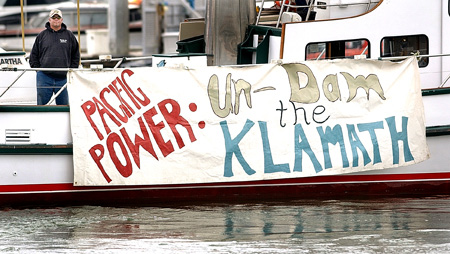
Bush Administration to Salmon, Fisherman: Drop Dead

The salmon industry on the West Coast is dying. The Bush administration–and Karl Rove in particular, as this story from the Wall Street Journal shows–helped kill it.

For more on what happened and what is happening, including pictures and audio links, see this great story from Mother Jones a couple of months ago.

But what’s especially infuriating to fishermen, Democrats, and reporters is the administration’s tactic regarding this and many other environmental issues. They simply refuse to respond to any questions.

It’s called stonewalling.

The administration won’t even consider disaster relief for suffering fishermen, despite the pleas of  many Congressman and the Republican governor of the nation’s most populous state.

"I am at a loss as to what further information you need so that our fishing-dependent communities can become eligible to receive disaster assistance," Governor Schwarzenneger said.

As The Oregonian said yesterday in an editorial:

The West Coast salmon fishing industry is nearly dead in the water, and everybody can see it’s going to hit the rocks. But so far, the Bush administration is unwilling to lift a finger to help.

Undam_the_klamath

A Test of Our Character

Maybe the most encouraging book I’ve read this year is by a young conservative columnist named Rod Dreher. It’s called Crunchy Cons and in this book he argues, to put it in a nutshell, that so-called conservatives who choose efficiency and profit over livable cities, good honest food, beauty, and the health of the planet, aren’t really conservatives at all.

I hope to write a feature on this book, which I think has a lot to say to this nation, and which I hope will be taken seriously by the right and left, but for now (while I’m trying to catch up on about nine different studies and papers) let me just quote a representative passage. In this passage he mentions about another book along the same lines, called "Dominion," by another young conservative named Matthew Scully, who has spoken scathingly of Dick Cheney’s style of hunting.

In "Dominion," Matthew wrote that when we look at an animal (and, he might have said, a forest) and see it only in terms of what practical use it can be to us, we are not seeing what’s really there, only an extension of ourselves. Conservatives see quite clearly the danger of sentimentalizing the natural world; hence our dismissive attitude toward those environmental extremists who see no essential difference between a redwood tree, a spotted owl, and a human being. But we on the right don’t see so well is the cost, moral and otherwise, of our hardheaded so-called realism.

Take factory farming. If we only think of farm animals, say, in terms of their ending up on our dinner plates, there’s no logical objection to industrialized meat production of the sort that crams thousands of animals into cramped pens, never lets them see daylight, and jacks them up with antibiotics to avoid infection from their unhealthy confinement, and hormones to boost their growth. But people recoil from films and photographs depicting the ugly reality of factory-farming methods, because there is something within us that cannot abide treating creatures this way–even creatures we plan to slaughter for food. Again, this paradox is hard to explain to vegetarians, but responsible hunters and livestock farmers know it instinctively. It’s about respect.

"Animals are more than ever a test of our character, of mankind’s capacity for empathy and for decent, honorable conduct and faithful stewardship," Matthew wrote. "We are called to treat them with kindness, not because they have rights or power or some claim to equality, but in a sense because they don’t; because they stand unequal and powerless before us."

Save the Flag, Burn the Planet

Yes, I exaggerated a little in the headline.

In fact, the nation didn’t save the flag. (I’ll leave aside the question of how threatened it was.)

Regardless, the "flag-burning" measure passed the House, has been given a head-nod by the States, and failed in the Senate by a single vote. The President said he wanted to sign it.

By contrast, a moderate measure to reduce greenhouse gas emissions failed to win even a majority in the Senate a couple of years ago, never even came up for a vote in the House, and would have been vetoed by the President, if by some miracle it reached his desk.

Logically it follows then, if we can trust the "100 top climate scientists" contacted by the AP about the science in An Inconvenient Truth, than continuing to emit greenhouse gases means we will all too soon begin Al Gore called "a slide towards destruction."

Is it an exaggeration to say our elected representatives would rather save the flag than the planet?

Please, show me the flaw in my logic. I want to see it.