Huge Storm Forces Bush To Say “Global Warming”

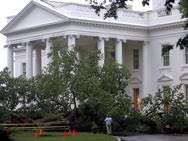
Hurricane Katrina couldn’t force President Bush to say the words "global warming," but a huge storm that has drenched the East Coast just did — thanks to an elm tree dropped in front of the White House.

Interestingly, Bush claimed in a brief statement that he has "consistently said" that global warming is a "serious problem," even though just last fall, according to a book by his adoring biographer Fred Barnes, Bush met with author Michael Crichton and declared himself "a dissenter on the theory of global warming." 

Is he readying a climb-down from stage one of the four stages of climate change denialism?

For more, take a look at this devastatingly sharp report by Bill Blakemore of ABCNews. The first three graphs read:

June 26, 2006 — A perfect storm of drenching rain, irony, political rancor, public fear and — at the last minute like a fierce stroke of lightning — word from the highest court in the land, descended on the nation’s capital today.

This storm — pulling in many parts of the global warming emergency — also broke through the White House perimeters and helped bring down a century-old elm tree, laying it across the driveway.

Even President Bush was drawn into the storm this morning, talking about climate change in a way he may find difficult to explain.

If there’s one piece of good news regarding global warming of late, it’s the increasing willingness of the national media to talk bluntly about the issue. More on this soon.

For now, let’s remember this tree for doing what it could to awaken us to the crisis.

Elm_falls_at_white_house


Happy Birthday, George

George Orwell is a great writer, period, and if you ask yours truly, his greatness comes through in "l984" not  just in the prescience of his thought, but in the passion of Winston and Julia. Surely they are the sexiest of all couples in political literature.

I do wonder why on earth he changed his name from Eric Blair to George Orwell. Yes, it’s a pen name, but the second name’s no more memorable than the first. I’ve asked a couple of English friends, assuming it must be some sort of secret apparent only to Brits, but no one seems to know.

One of Orwell’s many charms is his ability to write extraordinarily well not just as a novelist and essayist, but casually, off the cuff. Here’s a column on the common toad that I treasure, which includes, characteristically, a great big dollop of common sense:

I have always suspected that if our economic and political problems are ever really solved, life will become simpler instead of more complex, and that the sort of pleasure one gets from finding the first primrose will loom larger than the sort of pleasure one gets from eating an ice to the tune of a Wurlitzer. I think that by retaining one’s childhood love of such things as trees, fishes, butterflies and – to return to my first instance – toads, one makes a peaceful and decent future a little more probable, and that by preaching the doctrine that nothing is to be admired except steel and concrete, one merely makes it a little surer that human beings will have no outlet for their surplus energy except in hatred and leader worship.

Fire and Ice

Of all current issues, climate change dominated in the LATimes this Sunday.

Does that count as good news? (I wish.)

Fire in the Southwest worst in years…in June. "Could be a season of historic severity." Key paragraph:

That lack of precipitation created the conditions that are causing so many large fires. Meteorologists believe the West is in the grips of a severe drought cycle — the kind the region experiences only once every half a century. Some experts think climate change also may be reducing Western precipitation.

Ice melting in Greenland far faster than expected (in a very well-written story by Robert Lee Hotz). Key passage:

University of Texas physicist Ginny Catania pulled an ice-penetrating radar in a search pattern around the camp, seeking evidence of any melt holes or drainage crevices that could so quickly channel the hot water of global warming deep into the ice.

To her surprise, she detected a maze of tunnels, natural pipes and cracks beneath the unblemished surface.

"I have never seen anything like it, except in an area where people have been drilling bore holes," Catania said.

No one knows how much of the ice sheet is affected.

But, realistically, readers of the LATimes probably already mostly accept climate change.

Even more encouraging, in the national conservative pull-out Parade magazine that comes with the Sunday paper, is a story by Eugene Linden, a former Time science writer (whom I interviewed a couple of months ago) called Why You Can’t Ignore Climate Change. Key paragraph:

From the Fertile Crescent to the Yucatan peninsula, past civilizations made the fatal mistake of assuming that good weather would continue. An abrupt shift to drought in Mesopotamia 4,200 years ago probably spelled the doom of the Akkadian culture, which united city-states into the first known empire. Others see the fingerprints of climate in the collapse of the Mayans around 900 A.D., the disappearance of the Anasazi from the American Southwest a few centuries later and the end of Norse expansion into the New World in the 14th century. A recurrent pattern of history has been for civilizations to take root and flourish while the weather is good, only to fall when the weather suddenly changes.

More than any popular writer I know, Linden has brought forward the risk of global instability, or what he calls "a flickering climate." This flickering has been detected in the distant past, but in the most recent 10,000 years (with a couple of brief-but-alarming exceptions) our climate has been remarkably stable. Quite probably, that stability has contributed enormously to the success of what we call civilization. Do we really want to pull the rug out from under ourselves? Maybe better not…

Greenlandmeltextent2005_3


Art v. Bird Flu

Yesterday, the World Health Organization confirmed the first known human-to-human transmission of avian flu, a disease which some fear could become a pandemic comparable to the deadly Spanish flu of l918-l919. (Although many scientists consider that unlikely: for more, see the stunningly thorough Fluwiki.)

The good news is that this single case of avian flu transmission, from a son to a father in Indonesia, was not duplicated among over fifty others in his family, despite a month’s opportunity, so doctors are confident it doesn’t transmit easily.

But speaking of stunning! Take a look at this extensive story on "the mad scientist as artist" in Salon. (Non-subscribers will have to look at an ad to see the whole story, but it’s worth it.) Natalie Jeremijenko, a former neuroscientist and Australian rock concert promoter, has turned her phenomenal energy, command of technology, and sheer brain power towards using science to open people’s eyes to the natural world.

Birds–wild and robot–and their voices introduce visitors to her exhibit at the Whitney Museum in New York to the idea that healthy populations of wild birds are necessary to stop the spread of the disease. (When wild birds land on a perch, they activate the recorded voices.) Healthy wild birds require healthy wetlands.

Here’s what it sounds like, via Salon’s Kevin Berger:

"Tick, tick, tick. That’s the sound of genetic mutations, of the avian flu becoming a deadly human flu," says a professorial male voice. "Do you know what slows it down? Healthy sub-populations of birds. Increasing biodiversity, generally. It is in your interest that I’m healthy, happy, well fed. Hence, you could share some of your nutritional resources instead of monopolizing them. That is, share your lunch."

Next comes a female voice. "You have such a strange relationship to ownership that holds across species. I’d like to suggest that we share the land and its productive capacity — the worms, the plants, the future generations of seeds, the nesting grounds. Do you think you own this too?" The haughty voice continues. "You know those mute swans now dying all over Europe? They don’t normally migrate," she says. When it comes to bird flu and human deaths, "You’re bringing it on yourselves. But that means you can fix it. The first step is to give me a little bit of that bar."

These are some brainy birds. They’re telling us how the destruction of biological diversity is a crime against nature and increases the risk of disease. Jeremijenko explains that wild birds in Europe and Asia, fleeing ailing wetlands, are forced to roost near scummy ponds on farmlands, where they come in contact with infected chickens.

Yet rather than preserving wild lands, she laments, the international response has been the "mass slaughter of millions of birds," which only fans the flames of the flu.

"The birds are arguing that the reason we have diversity in nature is to protect us against disease," she says. "The birds are arguing that if we were to address the problem effectively, with a systems-level view, we would increase the health of domestic and wild birds, and that would be our best protection." Her birds, she says, also remind us we don’t live in plastic bubbles.

"The greatest vectors of bird flu have been freeways, airports and railways. People get on with infected birds, get off, and trade at stops along the way. It’s human migration that is transmitting this disease, not the migration of wild birds themselves."

Jeremijenko always sounds like an excitable activist. But she does do her homework. A recent report by the United Nations Environment Programme concluded, "Restoring tens of thousands of lost and degraded wetlands could go a long way towards reducing the threat of avian flu pandemics." Ecologists at the University of Georgia, as reported by New Scientist, "have shown that killing wild animals with a disease like flu could actually lead to more infected animals, not fewer."

For_the_birds

Well-Connected Conservative Predicts Bush Administration Shift to Reduce CO2 Emissions

Irwin Seltzer, despite his prominent post among as house economist and contributing editor for the far-right Weekly Standard, is a good writer and not an ideologue. (Like Eric Blair, I find these two traits often go together.)

Seltzer endorsed a carbon tax earlier this year, and told me in an email that "he felt there was enough evidence to warrant prudential activity."

For a conservative economist, that’s akin to shouting "Emergency!" and "Help! Help!" from a rooftop.

Now Seltzer, who often casually mentions inside political moves from Republican circles in his column, reports that newly-designated Treasury Secretary Henry Paulson may at long last move the Bush administration to do something to reduce greenhouse gas emissions:

Then there is the environment, a policy
area in which the Bush administration is in something of a time warp. No honest person can with certainty assert that global warming is a threat. But any responsible person can see that the evidence is sufficient to suggest that it might be, and that some action to contain emissions of greenhouse gases is an insurance policy worth having. Paulson is Wall Street’s greenest titan, chairman of the Nature Conservancy, a bird-watcher, an advocate of a greenhouse gas emissions trading system for the United States and of mandatory curbs on emissions if voluntary action proves inadequate. At Goldman, he allocated $1 billion for investment in renewable energy and energy-saving projects. He is likely to make his voice heard in an administration that is said to be ready to move from its justifiable opposition to the Kyoto treaty to more positive proposals for emissions reduction.

To the far right, of course, the slight possibility of a Bush administration acting sensibly to preserve our lovely climate is worrisome.

But although this news this gives me some hope, I still have doubts that Paulson, despite his good intentions, will get anywhere in this mulish administration.

For one, our famously faith-based president has met privately with Michael Crichton, who calls global warming a hoax, to talk about climate change. According to Bush’s worshipful biographer, Bush came out of the meeting calling himself a "dissenter" on the "theory" of global warming.

That would put him at the first stage of global warming denialism; the "it’s not happening" stage. (That position was undercut again, for what seems to be about the 500,000th time, with the long-overdue confirmation of Michael Mann’s famous "hockey stick"  graph, showing that the global average temperatures, after a thousand years of relative stability, have been rocketing upward in the last thirty years, in concert with rising levels of CO2.)

And Bush trusts energy policy to Dick Cheney, who judging from this adoring interview with Sean Hannity, is stuck on the second stage of global warming denialism (it’s happening, but it’s not our fault).

Bringing these two to reason won’t be easy. As Dorothy Parker once said: "You can’t teach an old dogma new tricks."

But we wish you luck, Henry. We’re all going to need it.

Put the Politicians Up Against the Wall and…

Ross Gelbspan, who has been reporting on global warming for years, for Boston newspapers and other publications, and who was one of the first to expose the Exxonians in The Heat Is On, has a simple but great idea: Let’s put weasely politicians on the record on climate change.

He wants local groups to bring a climate change petition to our every would-be representative and get a Yay! or a No Way! out of them before the big national elections this fall.

After all, climate change is only one of the biggest issues facing our species today. Asking our elected representatives to state their views on the matter seems only rational.

Prediction: Republicans will be loathe to respond.

Solution:    Any would-be elected official who waves off the question goes down as a "No Way!" obstructor.

It’s a start. I’m going to ask my Congressman myself and report back.

(HT:    Gristmill’s Soapbox.)

Pic of the Week

Oh, those crazy kids!

Here’s a satellite picture of Ophelia, Nate, and Maria in 2005. This from a new study issued yesterday by the National Center for Atmospheric Research, which reports that global warming "increases the risk of further enhancements in hurricane activity," in the characteristically cautious language of scientists. 

Or, as the press release puts it, a little more bluntly:

The study contradicts recent claims that natural cycles are responsible for the upturn in Atlantic hurricane activity since 1995. It also adds support to the premise that hurricane seasons will become more active as global temperatures rise. Last year produced a record 28 tropical storms and hurricanes in the Atlantic. Hurricanes Katrina, Rita, and Wilma all reached Category 5 strength.

I’ll see if I can get into the study and report further. For now:

Ophelia_nate_and_maria

West v. East Divide In Supreme Court Wetland Ruling

In a first-rate column today in the Washington Post, E.J. Dionne highlighted a legal conflict between the "humility" of conservative Supreme Court Chief Justice John Roberts, who in a recent speech called for the broadest possible agreement among justices on cases, even if on the narrowest of grounds…and Antonin Scalia, who places great faith in broad rulings based on the "original" meaning of the Constitution, which, curiously enough, always seems to align with his own far-right values.

As Dionne explained:

To propose that court decisions should achieve broad majorities is, in the current circumstance, to tell the court’s conservatives that they have an obligation to temper their own passions and reach out to the liberal minority. To get 7 to 2, or 8 to 1, or 9 to 0 decisions, the court would have to avoid far-reaching declarations congenial to conservative doctrine.

Roberts’ effort is a noble and admirable one, I think, but it ran into a rock named Scalia on  its first big test and sank without leaving a trace.

On Monday the Supreme Court announced that it could not reach agreement on a wetlands case that could have either upheld the right of the Federal government to find a "hydrological connection" between wetlands and navigable bodies of water, such as perennial streams and rivers…or could have legally severed that connection, and allowed property owners to develop wetlands properties, regardless of their downstream consequences.

The court divided between the right-wing conservatives and the quasi-liberals, with Anthony Kennedy, a Sacramento native, playing the moderate, and proposing his own new interpretation of the law. In the words of the LATimes:

[Kennedy] said he would require government regulators to show that filling a wetland would have a "significant effect" on the quality of the downstream waters.

He noted that filling a wetland with dirt or sand usually would result in silt flowing downstream.

Kennedy’s decision, combined with the opinion of the four conservative justices, meant there were five votes to send the Rapanos case back to the lower courts.

There a judge will decide whether Rapanos’ fields were indeed protected wetlands, with Kennedy’s opinion as a guide.

Or, "Here’s another fine mess you’ve gotten me into," in the immortal words of Oliver Hardy.

The newspaper noted that most streambeds and even rivers in the West, such as the L.A. River, are dry in the summer, so Scalia’s "originalist" interpretation would have had a completely different effect on the East Coast than on the lands west of the 100th meridian.

But it didn’t point out, as Kennedy did in his opinion, that ruling for the developer Rapanos would have meant choosing sides with a bully and a cheat:

In December 1988, Mr. Rapanos, hoping to construct a shopping center, asked the Michigan Department of Natural Resources to inspect the Salzburg site. A state official informed Rapanos that while the site likely included regulated wetlands, Rapanos could proceed with the project if the wetlands were delineated (that is, identified and preserved) or if a permit were obtained. Pursuing the delineation option, Rapanos hired a wetlands consultant to survey the property. The results evidently displeased Rapanos: Informed that the site included between 48 and 58 acres of wetlands, Rapanos allegedly threatened to "destroy" the consultant unless he eradicated all traces of his report. Rapanos then ordered $350,000-worth of earthmoving and landclearing work that filled in 22 of the 64 wetlands acres on the Salzburg site. He did so without a permit and despite receiving cease-and-desist orders from state officials and the EPA. At the Hines Road and Pine River sites, construction work–again conducted in violation of state and federal compliance orders–altered an additional 17 and 15 wetlands acres, respectively.

Oil Companies and Sierra Club Agree: Time for Conservation

On Meet the Press yesterday, three oil company executives came to talk about the high prices, oil exploration and development, and, believe it or not, the need for conservation.

Chevron, ConocoPhillips, and Shell aren’t in complete agreement on all issues, and may have been talking about conservation partly in hopes that people will listen to their plea for development off the coasts of California and Florida.

Nonetheless, here’s what James Mulva, CEO of ConocoPhillips, actually said:

And it’s not only that we need to add to supply, but we need to reduce demand. In the United States alone we have about 2 percent of world oil reserves, 5 percent of the population, and yet we use about 25 percent of the world’s consumption of oil.

Shocking, isn’t it? He almost sounds like an environmentalist. Mulva went on to add:

Thirty years ago we effectively over a five-year period of time reduced demand for oil for transportation fuels by two to three million barrels a day. It seems to me there’s been enough finger-pointing for a long period of time that we need to improve the efficiency of transportation fuels. And this goes a long way.

MR. RUSSERT: You mean miles per gallon?

MR. MULVA: Miles per gallon.

As Ron Brownstein pointed out in the LATimes, Mulva was talking about measures Congress passed in l975 that mandated automakers to increase the average fuel economy of their vehicles, reaching 27.5 mpg in l985.

Maybe we should think about such an idea today, in an era of high gas prices, increased reliance on foreign oil, and the threat of global warming?

But even though the President admits that we are "addicted to oil," actually taking the most obvious practical step to deal with the problem is completely beyond him, his party, or Congress.

Here’s Dan Becker of the Sierra Club, shaking his head in disbelief in the LATimes:

It’s like a tobacco executive calling for reduced smoking. The shame is that the head of Conoco is far ahead of the Congress and the president.