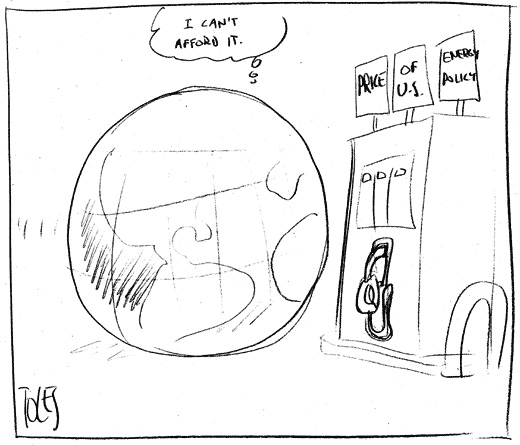
Global Warming on One Page

One of the many good ideas that came out of the Yale Project on Climate Change was simply to put together a one-page version of the consensus science on climate change, and what it means for us here on earth.

By chance, Roger Ebert as a veteran reviewer happens to have done that, and quite well, I think, and his version is posted below. I’ll continue to post more good versions as they come along, but this is actually the best I’ve seen to date.

(A personal note: For reasons mysterious to yours truly, despite the fact that he has been reviewing movies for almost forty years, is a reliable, amusing, and insightful critic, and has even won the Pulitzer Prize, it seems that people just cannot give Ebert his due. Often I hear him called "Gene Siskel," even though his former partner died seven years ago. Or they call him "the fat one." Perhaps it’s because Ebert is a better writer than he is a TV performer. Or perhaps people just don’t like critics. Or perhaps people don’t like people named Roger. Anyhow! Please look at the following as writing, and ask yourself: Is this not a good summary of the challenge of global warming?)

AN INCONVENIENT TRUTH (summary/review by Roger Ebert)

I want to write this review so every reader will begin it and finish it. I am a liberal, but I do not intend this as a review reflecting any kind of politics. It reflects the truth as I understand it, and it represents, I believe, agreement among the world’s experts.

Global warming is real.

(Roger Ebert’s review/summary of "An Inconvenient Truth," continued)

It is caused by human activity.

Mankind and its governments must begin immediate action to halt and reverse it.

If we do nothing, in about 10 years the planet may reach a "tipping point" and begin a slide toward destruction of our civilization and most of the other species on this planet.

After that point is reached, it would be too late for any action.

These facts are stated by Al Gore in the documentary "An Inconvenient Truth." Forget he ever ran for office. Consider him a concerned man speaking out on the approaching crisis. "There is no controversy about these facts," he says in the film. "Out of 925 recent articles in peer-review scientific journals about global warming, there was no disagreement. Zero."

He stands on a stage before a vast screen, in front of an audience. The documentary is based on a speech he has been developing for six years, and is supported by dramatic visuals. He shows the famous photograph "Earthrise," taken from space by the first American astronauts. Then he shows a series of later space photographs, clearly indicating that glaciers and lakes are shrinking, snows are melting, shorelines are retreating.

He provides statistics: The 10 warmest years in history were in the last 14 years. Last year South America experienced its first hurricane. Japan and the Pacific are setting records for typhoons. Hurricane Katrina passed over Florida, doubled back over the Gulf, picked up strength from unusually warm Gulf waters, and went from Category 3 to Category 5. There are changes in the Gulf Stream and the jet stream. Cores of polar ice show that carbon dioxide is much, much higher than ever before in a quarter of a million years. It was once thought that such things went in cycles. Gore stands in front of a graph showing the ups and downs of carbon dioxide over the centuries. Yes, there is a cyclical pattern. Then, in recent years, the graph turns up and keeps going up, higher and higher, off the chart.

The primary man-made cause of global warming is the burning of fossil fuels. We are taking energy stored over hundreds of millions of years in the form of coal, gas and oil, and releasing it suddenly. This causes global warming, and there is a pass-along effect. Since glaciers and snow reflect sunlight but sea water absorbs it, the more the ice melts, the more of the sun’s energy is retained by the sea.

Gore says that although there is "100 percent agreement" among scientists, a database search of newspaper and magazine articles shows that 57 percent question the fact of global warming, while 43 percent support it. These figures are the result, he says, of a disinformation campaign started in the 1990s by the energy industries to "reposition global warming as a debate." It is the same strategy used for years by the defenders of tobacco. My father was a Lucky’s smoker who died of lung cancer in 1960, and 20 years later it was still "debatable" that there was a link between smoking and lung cancer. Now we are talking about the death of the future, starting in the lives of those now living.

"The world won’t ‘end’ overnight in 10 years," Gore says. "But a point will have been passed, and there will be an irreversible slide into destruction."

In England, Sir James Lovelock, the scientist who proposed the Gaia hypothesis (that the planet functions like a living organism), has published a new book saying that in 100 years mankind will be reduced to "a few breeding couples at the Poles." Gore thinks "that’s too pessimistic. We can turn this around just as we reversed the hole in the ozone layer. But it takes action right now, and politicians in every nation must have the courage to do what is necessary. It is not a political issue. It is a moral issue."

When I said I was going to a press screening of "An Inconvenient Truth," a friend said, "Al Gore talking about the environment! Bor…ing!" This is not a boring film. The director, Davis Guggenheim, uses words, images and Gore’s concise litany of facts to build a film that is fascinating and relentless. In 39 years, I have never written these words in a movie review, but here they are: You owe it to yourself to see this film. If you do not, and you have grandchildren, you should explain to them why you decided not to.

Am I acting as an advocate in this review? Yes, I am. I believe that to be "impartial" and "balanced" on global warming means one must take a position like Gore’s. There is no other view that can be defended. Sen. James Inhofe (R-Okla.), chairman of the Senate Environment Committee, has said, "Global warming is the greatest hoax ever perpetrated on the American people." I hope he takes his job seriously enough to see this film. I think he has a responsibility to do that.

What can we do? Switch to and encourage the development of alternative energy sources: Solar, wind, tidal, and, yes, nuclear. Move quickly toward hybrid and electric cars. Pour money into public transit, and subsidize the fares. Save energy in our houses. I did a funny thing when I came home after seeing "An Inconvenient Truth." I went around the house turning off the lights.

Algoreandkatrina

Money Can’t Buy You Love; Or, in Santa Paula, Development

Not all the news from this election in California is good. Much-loathed anti-environmentalist Congressman Richard Pombo easily defeated GOP legend Pete McCloskey, and now looks to be on a glide path to re-election.

But the news from little Santa Paula is incredible. For the third time in recent years, the not-rich voters in this old-fashioned little town of roughly 25,000, said to be the Citrus Capital of the world, have rejected a massive development project backed by powerful interests intent on turning the town into another Thousand Oaks or, worse, Orange County.

Predictably, the losing developers and the City Council (which only put the measure on the ballot after a court battle) are now prophesizing that Santa Paula will face doom, taxes, and pot holes, in about that order.

Here’s why they’re bitter. For the 47% of the vote that Centex won, they spent $1.5 on the election, and, they say, nearly $13 million altogether in three years of planning. (Yet still didn’t bother to come up with a better way to handle traffic from thousands of homes than to dump it on to city streets, which is probably why the project lost.) In opposition, a local group called We CARE, led by a realtor named John Wisda, spent $8,600 on signs, and won 53% of the vote.

So, to be precise, We CARE spent 4.2 dollars for every one of its "no" votes. Centex spent $7092 dollars for every one of its "yes" votes.

As Bill Fulton, a city councilman and urban planner in Ventura, told the Ventura County Star:

"This just reinforces how difficult it is to get a housing project past the voters [in Ventura County]. All the stars have to align for it to happen."

Way to go, Santa Paula.

Another Far-Right Hack Misrepresents Another Researcher

A couple of weeks ago the National Review ran a cover story by Jason Steorts claiming that fears of melting ice at the poles were over-hyped. Following a line of argument laid out by the ExxonMobil-funded Competitive Enterprise Institute, Steorts quoted a study by a scientist named Curt Davis.

Davis, director of the Center for Geospatial Intelligence at the University of Missouri-Columbia, promptly called the CEI a bunch of liars, saying it was part of a "deliberate effort to confuse and mislead the public."

Think  Progress then went to the scientist for a comment specifically on Steorts’ story, and Davis said that Steorts "misrepresented" his work, "did his math wrong," and failed to consider "significant ice loss on the coasts of Antarctica" when calculating the mass of ice at the South Pole.

Now, another National Review writer associated with CEI and the National Review writes another story that misleadingly quotes another scientist. For the far-right TCS (which also takes money from Exxon) Iain Murray wrote a story claiming that there was some question as to whether climate change was anthropogenic and vaguely extolling local measures to adapt to climate change, as opposed to national or international efforts to reduce emissions. All through the story he implied that those advocating reducing carbon emissions for the sake of the health of the planet somehow were standing in the way of "freedom," "resilience," and "creativity," all activities apparently despised by environmentalists. He quoted exactly one scientist, named Indur Goklany:

Indur Goklany, in a study for the National Center for Policy Analysis (NCPA), examined the effects of tackling infectious diseases, hunger, water insecurity, sea level rise and threats to biodiversity now as opposed to attempting to mitigate climate change now. In all cases he found that tackling them now would have considerably more effect and be cheaper than tackling climate change.

But although it’s true that Goklany advocates adaptation over mitigation (perhaps because the National Center for Policy Analysis he works for is also funded in part by Exxon) he himself said in a comment on Monday at Prometheus that "[mitigation and adaptation] don’t have to be mutually exclusive."

Once again, the Exxon hacks are forced to mislead to make an argument against reducing carbon emissions, claiming that it’s either/or when it comes to healing the planet.

Yes, of course we need to prepare for the worst now, just as a doctor presented with a patient running a fever will do what he must to get that fever down. And yes, of course we must prevent the fever from getting much worse in months and years and decades to come. But first and foremost, we must act, which is what ExxonMobil has spent millions to stall, all for the sake of profit, over five billion in the first quarter alone.

Healing the Earth, Inch by Inch

Here’s a wonderful story by Eric Bailey in today’s LATimes about a group of true activists from around the country working to heal scars left on the California desert by trashers and motorcyclists. They labor long days in hot sun east of Barstow, putting just about all of us to shame with their cheerfulness. They’re paid a vast $160 a week by the Student Conservation Assocation, whose motto is: "The World is Calling. Answer It."

I can only tip my hat to their reply. Here’s another thousand words on the subject:

Paul_miles_desert_hero_

The Reverence Movement

Orion is a bimonthly out of New England passionately in love with our planet; show a little interest and they’ll send you a big gorgeous issue for free. Even when I disagree with one of its essayists, as I sometimes do, I can only respect the adventurousness of their writing, which takes nothing for granted.

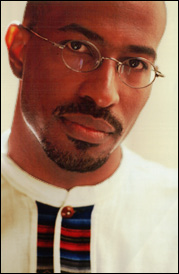
So I wish I could link to a Q&A they have in this month’s issue on an activist named Van Jones, who works with Ella Baker Center for Human Rights in Oakland. (It’s off-line.) Jones speaks about what it means to be an activist, and, specifically, what he calls "the reverence movement." (His resume gives you some idea of his worth, but not enough: Let me quote some of the Orion interview with him.) If you want to know more, ask Orion for this month’s issue.

A reverence movement is, at the end of the day, taking corrective steps to further enhance the beauty of others and the beauty of yourself.


If you ask people what their actual experience of being on the left is, lots of people say, "Oh, we’re saving the world, blah, blah, blah. I say: "No, no, no, what’s your experience–like, Thursday?" They say: "Oh, it was horrible." It’s like the difference between using diesel versus solar as your energy source. Anger is a messy fuel that eventually causes more problems than it can solve.


Van_jones

Putting a generation of kids in a prison is like clear cutting a forest. We deeply believe we have a throwaway planet–throwaway species, resources, neighborhoods, nations, continents. Young people and adults in prison have been thrown away as well. Once they’re outside the circle of people who deserve dignity and respect, then they can be preyed upon. The prisoners can be worked–Angola in Louisiana is a classic example. Or by big corporations here in California: Microsoft, for some of their packaging; Victoria’s Secret and United Airlines, for their telemarketing orders…it’s all related. The polluters, the clearcutters, the incarcerators, they’re all enacting the same story: money is more important than life, and we have the technology or the guns to protect ourselves from any consequences of our heedlessness.

One thing I know from my own experience is that demonization and deification are the same process, two sides of the same coin, and if you set yourself up to be deified, then you can’t be mad when the other side demonizes you. The idea that either you’re this egomaniac who’s only out there for yourself or you’re this pure martyr with no personal ambitions or desires–both of those are false.

I think people who want to change society have a double duty. We have to be willing to confront the warmonger within and without, the punitive incarcerator within and without, the polluter within and without, the greedy capitalist developer within and without. We have to really look at how we are–combative, punitive, self-destructive, greedy; we’re passionate about changing that in the external world, even as it we enact it in our internal world and in our relationships with each other.

We have this whole David and Goliath syndrome. If you’re an activist, that has a positive side: you want to confront unjust authority, fight against long odds, hold out the possibility of miraculous outcomes. And that’s a good thing.

But there’s a shadow side to David and Goliath, which is that there’s got to be some big mean other. You’ve got to be the small underdog all the time and there’s got to be some confrontation between absolute good (you) and absolute evil (the other). If you’re an activist then you know what I’m talking about; you know what it’s like when you try to lead a meeting and somebody’s got to challenge you on every point. You know what it’s like when you get everyone riled up to attack the mayor, and the mayor doesn’t show up, and everybody attacks you. It’s part of the toxic stuff you’re playing with.

Also, you have to have enough respect to realize that Goliath has probably figured out the slingshot thing by now. So to continue to do the same thing over and over again, which is what we’ve been doing since the 60’s, keeps us from being creative. And it’s probably going to yield worse results over time.

The  other thing is, it could be that you’re just in the wrong book of the Bible altogether. It could be that it’s not really about David and Goliath; it’s really about Noah. The kinds of really serious challenges that are coming up will feel more like what happened down in New Orleans. it’s easy to say there’s an evil Goliath called George Bush who’s letting bad things happen to good people. But even if George Bush were to leave the planet, we’ve still got major, major climate destabilization to deal with. And so it could be that we need to figure out new ways to win–to be open to the possibility that sometimes we can win Goliath over to helping us build the ark.

Using Innovation to Reduce Emissions

Back in l968, the Golden Gate Bridge eliminated tolls on northbound traffic, and doubled the toll on southbound traffic. This brilliantly simple change greatly sped up traffic through the toll booths, but had no great effect on toll collection. Since then, it’s an idea that has been copied around the world.

For me, it’s a great example of how innovation can result in change for the better, without requiring new superstructure or new procedures. Good ideas can be found out there in the world, for those who take the trouble to listen and look for them. (If memory serves, the toll idea actually was given to the Golden Gate Bridge by an ordinary citizen…though I can’t find evidence of that on-line.) 

Here’s another such potential good idea to reduce carbon emissions, courtesy of economist Dean Baker at the new Harpers blog. It’s a very simple idea:

Currently, auto insurance is viewed as a fixed expense. People pay the same amount for their insurance no matter how much they drive. This means that when someone is comparing the cost of driving to work with the cost of carpooling or public transportation, they won’t factor in the cost of insurance, because they will pay the same whether they make any particular trip or not.

This would change if drivers paid for insurance by the mile. Taking rough numbers, the average person drives her car around 10,000 miles a year and pays a bit less than $1,000 each year for insurance. This means that the cost of insurance is approximately 10 cents per mile. If for each mile they drive drivers paid 10 cents for insurance, then on average they would pay the same amount for insurance as they do now—but they would have much more incentive to cut back their driving.

So, for instance, a driver who was considering carpooling to avoid a 40-mile roundtrip commute to work could save herself $4 a day (more than $800 a year) in insurance costs by carpooling under the pay-by-the-mile system. Many trips that make sense under the current insurance payment system would not make sense with a pay-by-the-mile system. It would discourage driving in the same way that a large gas tax would discourage driving, except that—on average—no one will pay more for insurance.

The only disadvantage I can see from this idea is that it would encourage lying about odometer readings. But this could be checked against odometer inspections, Baker points out, and some insurance companies and even some states already encourage this insurance-by-the-mile policy.

Gentlemen, start your odometers!


Sunday Morning on the Planet

Well, the town is still in shock, stunned by the dynamic debut of three new superheroines.

Even this Sunday morning, these three are on our minds, since we saw them at the Theatre 150 show in Ojai known as Saving the World: One Story at a Time.

It’s a full night of original short plays, produced by my neighbor Chris Nottoli, and featuring him and writer/actor Deb Norton, with a host of other talented locals. The show features Valerie Levett, as a modern-day Snow White, with TV stars Betsy Randall and Laurie Slade, in a play called "Little Red," written by a folksinger friend named Rain Perry.  It’s a great little play, I can attest, and the acting is described as "top-notch" by reviewer Rita Moran in the Ventura County Star. (For some reason the text doesn’t load for me, but the pictures are good, and perhaps you’ll have better luck.)

But moving from world to world on stage requires stupendous feats in the wink of an eye, and at that, these superheroines perform brilliantly, all agree. From left to right, let me introduce to you:

Julia Scott, Zoe Quinn–holding up her hand–and Emily "Sweets" Levett.

They’ve come to save the day; or, in this case, the night…and for that I am grateful.

Savingusall

“Cannot Reject What It Has Not Seen”

Regarding attempts to negotiate nuclear issues with Iran, on Friday the White House’s newly-appointed Press Secretary Tony Snow declared that "Iran cannot reject [a new proposal] it has not seen."

Nice try, Mr. Snow, but your boss has already rejected Al Gore’s presentation on global warming, An Inconvenient Truth, by refusing to see it against the advice of his own senior environmental advisor.

We can only hope the religious fundamentalists in Iran are a little more open-minded than our President.

“Stupid” Thinking on Climate Change at Yale

Over at Gristmill, David Roberts has been trying to drum up interest in a new report on a conference  organized by the Yale School of Forestry and Environmental Studies focused on "closing the gap between science and action" on climate change (Download americans_and_climate_change.pdf).

It’s a big report, and along the way mentions that Americans are "time-starved," which of course is why all too few of us get around to reading big reports.

If you want to a taste but not the full meal, my suggestion is to read the foreward by James Speth and the 39 recommendations at the back.

I’ll be posting some favorite passages, great ideas, and topics for further research in the next few days, as time permits.

One of the most forceful passages, I thought, came when it came to the question of values. Here was a recommendation that came out of a working group on religion and ethics:

Preamble to Recommendations

1. The current moral imperative on climate change
articulated by many in the faith community recognizes
that:
                        a. Any action that risks the quality and viability of life
on earth and future generations is fundamentally an
act of destruction and morally unacceptable.

                        b. Changing something as fundamental as the chemistry
of the Earth’s atmosphere is morally unacceptable.
                        c. Any action that increases the risks to the most
vulnerable is morally unacceptable.

2. America as the world’s richest nation has historically
and currently contributed so much to the climate
change problem that it is morally obliged to take
leadership responsibility to address this problem.

One of the members of the conference was Rev. Richard Cizik, who as head of the National Association of Evangelicals represents 54 denominations, 45,000 churches, and a constituency of 30 million evangelicals.

Cizik opposes abortion, stem-cell research, and homosexuality, but he’s also concerned about climate change, and has been confronting right-wing Republicans such as Senator Rick Santorum in public on the issue. (You might recall this story from Amy Sullivan on "The New Evangelicals.")

This seems to have brought a counter-reaction.

A Washington lobbyist on the religious right told The Guardian:

"Rich is just being stupid on this issue. There may be a debate to be had but … people can only sustain so many moral movements in their lifetime. Is God really going to let the Earth burn up?"