Controlling the Debate vs. Facing Facts: The Weakness of the Unilateral Executive

In commemoration of Martin Luther King, former Vice-President Al Gore gave the best speech heard in this country by this reporter, a Gore doubter, in some time. While challenging the idea that the President can act on foreign policy unchecked by Congress or the judicial branch (which Gore says should be called the "unilateral theory" of the Presidency), Gore also effectively linked the Administration’s tendency to bully questioners to its blindness to politically inconvenient facts, which leads inexorably to the unhappy results we are now seeing around the nation.

Or, as the well-known blogger Josh Marshall put it:

The point Gore makes in his speech that I think is most key is the connection between authoritarianism, official secrecy and incompetence.

In the speech, Gore showed how the Administration’s desire to ram through a Medicare drug benefit, any benefit, despite doubts from Republicans and Democrats alike about how well the plan would work is part of the Administration’s mindset, which equates controlling the debate with a total unwillingness to face facts: 

...when the Administration was attempting to persuade Congress to enact the Medicare prescription drug benefit, many in the House and Senate raised concerns about the cost and design of the program. But, rather than engaging in open debate on the basis of factual data, the Administration withheld facts and prevented the Congress from hearing testimony that it sought from the principal administration expert who had compiled information showing in advance of the vote that indeed the true cost estimates were far higher than the numbers given to Congress by the President.

Deprived of that information, and believing the false numbers given to it instead, the Congress approved the program. Tragically, the entire initiative is now collapsing- all over the country- with the Administration making an appeal just this weekend to major insurance companies to volunteer to bail it out.

To take another example, scientific warnings about the catastrophic consequences of unchecked global warming were censored by a political appointee in the White House who had no scientific training. And today one of the leading scientific experts on global warming in NASA has been ordered not to talk to members of the press and to keep a careful log of everyone he meets with so that the Executive Branch can monitor and control his discussions of global warming.

Well argued, Al.

Intelligent Design: The Obvious Solution

Mark Johnson of Vista, CA., writes to LA Times with the why-didn’t-I-think-of-that answer to the intelligent design brouhaha:

I have a proposal for those religious fundamentalists who insist on promoting "intelligent design" in our public schools. We will allow courses on intelligent design (and other creation myths) to be taught in public schools if you allow courses on evolution and other sciences to be taught in churches. 

Random Positive Post

One of the stereotypical complaints about environmentalists is that they are all "gloom and doom." The fact that there is some truth to this frustrates me. I think that part of this derisive statement comes out of the fact that enviros actually do care about the planet more than a lot of folks, and so seeing the loss of its beauty and its wild creatures and its healing qualities pains us in a way that doesn’t other folks (insert your insult here).

Nonetheless, every once in a while, I feel compelled to defy the stereotype and point out some potential good news, culled from a variety of enviro sources.

Here’s a passage from a story about development along the "edges" of the forest, called Living on the Edge, from the excellent magazine Forest, by Patricia Marshall.

Randal O’Toole, an economist with the Thoreau Institute in Portland, Oregon, says that the concern over development is misplaced. O’Toole published the results of a study he did in Wallowa County in northeastern Oregon in the late 1980s, in which he described the county—which is breathtakingly beautiful, with soaring mountains and pristine lakes-—as a tragedy in the making. He predicted that the demise of the timber economy would be incentive to convert timber land to recreational or residential areas, and that people would be tempted to make the conversion for their own economic gain. The tragedy was that development itself would ruin the scenic beauty of the area, thus devaluing it. But as it turns out, though there has been some development in Wallowa County in the last decade and a half, O’Toole’s predictions did not come true. “There hasn’t been a major boom in Wallowa County,” O’Toole says. “People seem to want to be near population centers.”

O’Toole says that from an economic and resource standpoint, growth in areas near cities is not a problem. “One thing people don’t understand is that we have a huge abundance of land in this country. If every single family in this country bought an acre of land, it wouldn’t even double the amount of land we’ve dedicated to cities in this country,” he says. “Having people buy land for second homes and putting houses on them isn’t going to consume that much land.”

I’m not sure that’s the last word on the subject, but you know…it’s a perspective worth hearing.

An Inch’s Worth of Difference…to John Lennon

A month ago I posted on political change and what John Lennon would do were he still with us. In response a friend (Craig Rosen) sent me a fascinating interview between Lennon and Yoko Ono and well-known British radicals Tariq Ali and Robin Blackburn, which ran in an Trotskyist sheet called (believe it or don’t) The Red Mole back in the early 1970’s. It’s posted on the Counterpunch site.

As is so often the case with Lennon, the interview is fascinating on about seventeen different levels, and still very much worth reading, twenty-five years later. (Just to cite one example: Lennon believed that the first big step for himself and the Beatles, to break out of the societal role they were assigned, came out of their "Liverpoolness"–refusing to change their accent to go on the BBC. Not what you might expect, is it?)

But here’s the crucial item, I think, for people who care about the planet. In the midst of an interview thick with references to the saintly Workers, oppression, the capitalist game, and other such weary Marxisms, Lennon abruptly quotes writer Richard Neville, who compared Wilson (of the Labor Party) and Heath (of the Conservative Party). As Lennon put it:

Like Richard Neville said, there may be only an inch of difference between Wilson and Heath but it’s in that inch that we live….

Back in 2000, people who knew me often assumed that because the environment matters to me, that I would vote for Ralph Nader. I found the assumption insulting. I know Ralph Nader wasn’t going anywhere, and didn’t trust him for a minute; I wanted to preserve that inch’s difference, where millions of us live, between the Democrats and the Republicans.

I’m going to be blunt: Six years later, is there any doubt about the wisdom of that choice?

(But in the next breath, I must admit that if Lennon were still with us, he would not settle for the Democrats, and likely would call for us all to live in cities…or something equally challening.)

Lennoninhelmet


Another Conservative Opinion Leader Endorses Carbon Tax

Irwin Seltzer, an economist who writes the economic and forecasting column for the influential right-wing conservative publication The Weekly Standard, this week endorsed a carbon tax.

In his column, called Petropower, Seltzer implicitly warns of of the danger that our economy could be held hostage, if not by the Saudis (as in the past) then perhaps by the likes of a less-than-democratic nation such as the Russia of Vladimir Putin.

When I praised him to the publication for considering such a tax because it’s hugely helpful in the battle against global warming, Seltzer responded:

I remain uncertain as to whether there is a global warming phenomenon, but feel there is enough evidence to warrant prudential activity such as a carbon tax which, of course, has other advantages — namely encouraging the development of technological alternatives to imported oil.

Seltzer is one of a growing chorus of "opinion-leaders" on the right who have endorsed either a full-scale carbon tax, a new tax on gasoline, or other significant carbon-reducing measures, including Paul Anderson, the CEO of Duke Energy; The Economist; Thomas Friedman of the NYTimes; Jim Immelt, CEO of General Electric; the influential blogger/writer Andrew Sullivan; and Jim Woolsey, a well-known hawk and former CIA director.

This puts these business-minded conservatives about where progressives were on this issue ten years ago, as Bill McKibben pointed out in a column last month in the spectacular enviro magazine "Orion." Speaking of the concept of "peak oil," McKibben wrote:

It reminds me a little of the very early days in the fight over global warming. Appalled at the forecasts of global destruction, some of us demanded immediate and strong action–high taxes on carbon emissions, and never mind the pain. Others–more moderate or politically realistic–advocated a suite of "no regrets" policies. They suggested, say, gradual rises in gas mileage, higher efficiency standards of appliances. Even if climate change proved to be overblown hooey, they pointed out, such rational and easy measures would still save us money, reduce conventional pollution, and so on. These steps were like taking out a modest amount of insurance; whatever happened, we’d have no regrets about having adopted them.

In actual fact, of course, we took neither the urgent nor the more relaxed steps. Instead we bought Ford Explorers. Now everything that was frozen is melting and soon we will have…regrets.

But the wisdom of acting to further what some are calling the "triple bottom line"–business that pays dividends not just in cash, but also socially and environmentally–was shown this week by the release of the WorldWatch 2006 report on the state of the planet. According to a thoughtful summary provided by Todd Wilkinson of the New West Network:

…true fiscal conservatives get it, and it is in their bean counting hands that the real green revolution that brings a truce between preservationists and despoilers will be won.

He quotes the authoritative report, which points to numerous examples:

° In 2003, researchers pouring over 52 studies of businesses and regulations showed there was a positive relationship between financial performance and social and environmental performance. That’s evidence that the triple bottom line is more than a feel-good abstraction.

° In the 30 years since 3M started its 3P program (it stands for Pollution Prevention Pays), aimed at cutting waste, pollution and rewarding employees who find better ways conserve resources, 5,600 projects have prevented an estimated million pounds of pollutants and produced almost $1 billion in first year savings.

° At General Electric, CEO Jeffrey Inmelt says that as part of its “ecomagination” initiative, the world’s ninth largest corporation intended to double its investment in green technology over the next five years and cut its greenhouse gas emissions by one percent by 2012. (It should be noted that some wonks from thinktanks trying to refute global warming have said that America’s companies cannot grow to remain prosperous and cut greenhouse emissions).

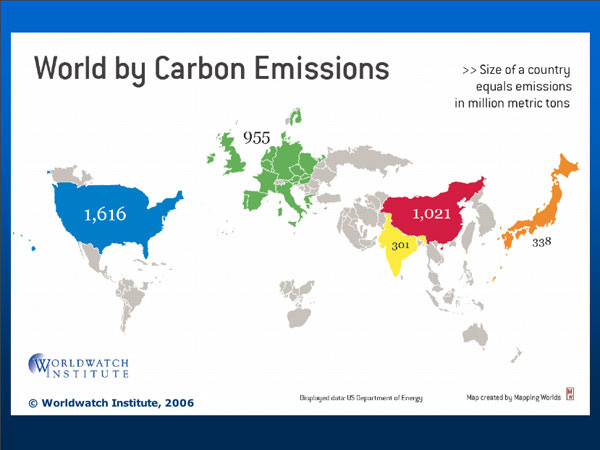
Of course, it would help if the nation’s largest employer and agenda-setter, the Federal government, would get involved. And it doesn’t help that popular demagogues like Rush Limbaugh continue to claim (as I heard a week ago on his show) that global warming doesn’t exist because we couldn’t have caused it, and besides, most of those talking about the issue are against capitalism and quasi-Communists. (No, I’m not making that up–that’s what he said–but unfortunately the Media Matters site that sometimes offers Limbaugh transcripts has bigger fish to fry this week.)

But as Limbaugh blathers on, the reality stares us in the face:

World_by_carbon_emissions

Impatient Bush Administration Stumbles Again

This week the pro-logging policies of the Bush administration took two hits, as reported on the useful Forest Service Employees for Environmental ethics (FSEEE) site.

First, an extensive study in Science of so-called "salvage" logging in the aftermath of the disastrous Biscuit fire in Oregon found that, contra logging industry and Republican claims, post-fire logging resulting in much higher fuels loads and far fewer surviving seedlings. The researchers concluded:

Therefore, the
lowest fire risk strategy may be to leave dead trees standing
as long as possible (where they are less available to surface
flames), allowing for aerial decay and slow, episodic input to
surface fuel loads over decades.

Second, a Federal judge reinstated the requirement that the Forest Service and other Federal agencies "survey and manage" forest lands before opening them up to logging, a requirement the Bush administration eliminated in 2004 without notice or discussion.

As this laconic AP story on the ruling points out, this will cost the Bush adminstration about $2.7 million dollars from lost sales…which by some strange coincidence is the same number the government would have to pay to survey the 5.5 million acres of forest, much of it old growth forest, for endangered and threatened species, according to this story in the Seattle Post-Intelligencer.

Yet another example of the fundamental incoherence of the Bush administration’s environmental policies, which so often seem to boil down to a reckless desire cut, drill, and develop…at any cost.

Two-Thirds of Mountain Frog Species in Two Decades Extinct: Global Warming Blamed

Two-thirds of 110 species of the colorful harlequin frogs of South America have vanished since the 1980’s. The article in Nature quotes the lead researcher:

"Disease is the bullet killing frogs, but climate change is pulling the trigger," says Alan Pounds, an ecologist at the Monteverde Cloud Forest Preserve and Tropical Science Center in Costa Rica.

Panamanian_golden_frog

Discussing the study, Andrew Revkin in the NY Times (reg. required) points out that the climate change/species extinction link is challenged by a few researchers, on the grounds that the mechanism–which appears to be linked paradoxically to a fungus–isn’t clearly understood.

Searching for balance, Revkin writes:

Several scientists criticized the paper yesterday, saying it glossed over significant sources of uncertainty; others said it was important evidence that warming caused by humans was already harming wildlife.

But take a look at the piece in Nature. Here’s how the explain what they found:  

The team first mapped the timing of species disappearances against changes in sea-surface and air temperature over the past few decades, and found that the frogs are disappearing almost exactly in step with climate change.

But it was not clear how the link between species loss and climate change worked: the world is generally warming, but the fungus is thought to be more deadly in cooler climes.

So the team looked at 50 sites from Costa Rica to Peru. It found that the frogs were doing worst in areas where night-time temperatures are getting warmer, but day-time temperatures are cooler – conditions that favour the fungus.

The most likely connection, say the researchers in Nature2, is that large-scale warming is accelerating the formation of clouds. This in turn makes local conditions kinder on the fungus, and spells bad news for the frogs.

To me that sounds very convincing, and–even more interestingly–unusually blunt.

Fortunately, to keep everything in perspective, we have Tom Toles.

The Unenlightened Face

The Buddhists speak of an Unenlightened
Face    the face of one who has not yet

found the light    as I walk I turn my
face toward the sun    I feel its warmth

but the light has not yet entered me
perhaps the light must come from what

was written    what was told by those
who sat beside him long ago    I read

the texts but the light does not enter
me    I know it is not given to all to

receive the light no matter how they
may long for it     perhaps I’m one of

the darkfaced the sons of attachment.

–James Laughlin, from "The Bird of Endless Time," l987