Earth A Few Thousand Years Old–Videos Say So

In Lebec, California (which is about ninety miles north of downtown Los Angeles) a suit has just been filed charging the school board with teaching so-called "Intelligent Design" under a new name: Philosophy.

According to the story by Henry Weinstein in the LA Times (reg. required):

An initial course description, which was distributed to students and their families last month, said "the class will take a close look at evolution as a theory and will discuss the scientific, biological and biblical aspects that suggest why Darwin’s philosophy is not rock solid. The class will discuss intelligent design as an alternative response to evolution. Physical and chemical evidence will be presented suggesting the earth is thousands of years old, not billions."

The course, which began Jan. 3 and is scheduled to run for one month, is being taught by Sharon Lemburg, a special education teacher with a bachelor of arts in physical education and social science, according to the lawsuit.

The suit adds that Lemburg "has no training or certification in the teaching of science, religion or philosophy," and is "the wife of the minister for the local Assembly of God Church, a Christian fundamentalist church, and a proponent of a creationist world view."

Lebec is a small town in an area known mostly for camping, fishing, hunting, and snow in the winter in Southern California. The school board approved this "philosophy" class by a 3-2 decision. The school administration did not defend the decision when a reporter called, saying the Superintendent  was out of town, and no one else could speak on the record. The suit was filed by eleven parents, one of whom is a scientist at the Jet Propulsion Lab in Pasadena and commented:

I believe this class undermines the sound scientific principles taught in Frazier Mountain High School’s biology curriculum and is structured in a way that deprives my children of the opportunity to be presented with an objective education that would aid the development of their critical thinking skills."

But most interesting to me was the suit’s contention that:

the course relies exclusively on videos that advocate religious perspectives and present religious theories as scientific ones — and because the teacher has no scientific training, students are not provided with any critical analysis of the presentation.

How convenient is that? I think it’s part of a deplorable trend. Anyone who has a kid in school knows how much "teaching" comes to students these days via videos and movies. Usually when these cause controversy, it’s related to content; for example, teachers who show R-rated movies to junior high classes. (Probably not so much because these teachers want to corrupt kids, but just because they’re lazy.) But if you want kids not to question the Biblical claim that the planet is just a few thousand years old, and to believe that life didn’t evolve from single-celled organisms, that the glaciers didn’t sculpt the mountains, that dinosaurs never trod the earth, and so on, how clever to show them videos encapsulating your point and then take no questions!

I wonder where these videos come from…


Pombo on the Defensive

About a week ago, the Los Angeles Times reported that Richard Pombo (R-Tracy) was a "close associate" of Tom DeLay under investigation by the FBI. The FBI suspects that Pombo did favors for an East Coast tribe that wanted Federal recognition in order to open a casino; Pombo, who represents a central district in California, had no constituent interest in the case…but he pocketed  over $30,000 representing the tribes’ interest.

This weekend, the LA Times reports that Pombo is also under investigation for working with fellow California Republican John Doolittle and Tom DeLay to sabotage an FDIC investigation into the financial dealings of notorious anti-environmentalist Charles Hurwitz. Hurwitz engineered the leveraged buy-out by MAXXAM of Pacific Lumber, which led to the huge logging controversy over the Headwaters redwood forest. Richard Serrano and Stephen Braun report that:

Reps. John T. Doolittle and Richard W. Pombo joined forces with former House Majority Leader Tom DeLay of Texas to oppose an investigation by federal banking regulators into the affairs of Houston millionaire Charles Hurwitz, documents recently obtained by The Times show.

The Federal Deposit Insurance Corp. was seeking $300 million from Hurwitz for his role in the collapse of a Texas savings and loan that cost taxpayers $1.6 billion.

The investigation was ultimately dropped.

The effort to help Hurwitz began in 1999 when DeLay wrote a letter to the chairman of the FDIC denouncing the investigation of Hurwitz as a "form of harassment and deceit on the part of government employees."

When the FDIC persisted, Doolittle and Pombo — both considered proteges of DeLay — used their power as members of the House Resources Committee to subpoena the agency’s confidential records on the case, including details of the evidence FDIC investigators had compiled on Hurwitz.

Then, in 2001, the two congressmen inserted many of the sensitive documents into the Congressional Record, making them public and accessible to Hurwitz’s lawyers, a move that FDIC officials said damaged the government’s ability to pursue the banker.

The FDIC’s chief spokesman characterized what Doolittle and Pombo did as "a seamy abuse of the legislative process." But soon afterward, in 2002, the FDIC dropped its case against Hurwitz, who had owned a controlling interest in the United Savings Assn. of Texas. United Savings’ failure was one of the worst of the S&L debacles in the 1980s.

Doolittle and Pombo did not respond to requests for interviews last week. They publicly defended Hurwitz at the time, saying the inquiry was unfair. Hurwitz’s lawyer said Friday that the FDIC had been overzealous. This summer, a judge in Texas agreed and awarded Hurwitz attorney fees and other costs in a civil suit he filed. "They sought to humiliate him," U.S. District Judge Lynn N. Hughes, said in the ruling. The government is appealing the decision.

In key aspects, the Hurwitz case follows the pattern of the Abramoff scandal: members of Congress using their offices to do favors for a politically well-connected individual who, in turn, supplies them with campaign funds. Although Washington politicians frequently try to help important constituents and contributors, it is unusual for members of Congress to take direct steps to stymie an ongoing investigation by an agency such as the FDIC.

It’s unclear from the story what documents the Times saw, if they came from Abramoff, and if Abramoff will testify to any of these "seamy" abuses of the legislative system. But the potential for an influence-peddling charge already looks quite plausible.

Interestingly, a Jail Hurwitz! launched by an Earth First! outfit in Garberville charged Pombo and Doolittle with that crime…back in 2001, when the Congressmen sabotaged the FDIC investigation by revealing the agency’s confidential records.

Pombo is a powerful Republican (chairman of the House Resources Committee) and has been re-elected in his Republican-dominated district seven times. A story by the first-rate on-line site Muckraker suggests that he still has an excellent chance to win re-election this year, despite the fact that the Sierra Club and other enviro groups are organizing to defeat him.

[Cathy] Duvall is currently spearheading a high-priority Sierra Club effort to publicize Pombo’s environmental record. "It is our No. 1 public outreach campaign for spring and summer," she says. "We are also researching and laying the groundwork for a potential political campaign in the fall."

Defenders of Wildlife is moving aggressively with its own education-outreach project, which includes the Pombo’s in Their Pocket website alleging that the rep has a quid-pro-quo relationship with his corporate contributors. Defenders has also been running print and TV ads in Pombo’s district over the last two months, criticizing his assault on the ESA and his proposal to sell off national parks, and the group has more ads in the pipeline.

"We will very likely lead an aggressive campaign against Pombo to put an end to his legislative assaults," [Mark] Longabaugh says [of the League of Conservation Voters].

Sierra Club and Defenders are in discussions about pulling together a coalition of at least half a dozen environmental groups that would pool resources to hire organizers and canvassers for Pombo’s district. "We are anticipating that by this spring we could have political organizers in the field," says Longabaugh, who’s been in California this week surveying the scene.

Insiders predict that the total spending on the battle for Pombo’s seat — including the rep’s own spending and money from outside groups — could exceed $5 million, with more than $1 million coming from the environmental community. As of September, Pombo had raised $713,430 for the campaign.

But that’s not all! According to this story by Nick Juliano in the Tracy Press:

[Democratic] party strategists think they have a winner in [Steve] Filson, 58, a commercial airline pilot and U.S. Navy veteran from Danville.

“For a new guy that’s come along with no track record in the public eye in a political race, I think we’re doing real well,” Filson said Friday.

His military service and moderate profile have made him the clear favorite of Democratic heavy hitters — he has received campaign contributions from groups associated with Minority Leader Nancy Pelosi, No. 2 House Democrat Steny Hoyer and Bay Area Rep. Ellen Tauscher.

But the best news for enviros of all is that it appears likely that Pete McCloskey, a co-author of the Endangered Species Act (that Pombo has devoted his legislative career to sabotaging), and a former Marine who represented the district for sixteen years, is preparing to run against Pombo.

So, to recap. Pombo faces an investigation by the FBI that is proceeding down two separate tracks, quite possibly based on testimony by pariah lobbyist Jack Abramoff; an energized Democratic party, a local poll that show that less than a third of his formerly-loyal constituents plan to vote for him in November, a massive environmental campaign against him that may well be able to outspend him, plus likely serious opposition from his own party.

Pombo told the Tracy Press that "I run every campaign the same way." But he’s not talking about his opposition, the investigations, or his association with Delay, Abramoff, Duke Cunningham, or pay-offs from the Mashpee Wampanoag tribe. Is it really any wonder his words sound a bit hollow?

Big Week in Climate Change

This blog tracks climate change, and attempts to translate the science of it into words that a layman (such as myself) can understand. It began in part because I realized that thoughtful reporting on this issue, which is as changeable and as complex as the winds that circle the globe, is just impossible on a once-in-a-while basis. But even after a year of catching up, there are some weeks so busy that it’s almost impossible to stay current.

This post will list the highlights from last week, as briefly but inclusively as I can:

Peter Gleick, a scientist’s scientist, speaks on climate change and the impossibility of converting those who will not believe–many of them because they’re funded by, or involved with, the fossil fuels industry.

Scientists love to prove each other wrong – it is how they make advances and bolster their reputations – and it usually works to the benefit of our knowledge and understanding. Climate contrarians, however, misuse this tool of the scientific process to confuse people into believing that the debate about climate change should somehow be resolved, all uncertainties laid to rest, and the “truth” discovered – before policymakers act in the public interest. The proper response is to insist that the skeptics produce a reviewable, replicable scientific theory that can provide a plausible explanation for the mass of the evidence on climate change without invoking human interference. No climate skeptic has ever been able to produce such a theory.

John Quiggan of Australia put in a post that concisely but completely discredits the dishonest skeptics and smartly points out:

First, in the course of the debate, a lot of nasty things were said about the IPCC, including some by people who should have known better. Now that it’s clear that the IPCC has been pretty much spot-on in its assessment (and conservative in terms of its caution about reaching definite conclusions), it would be nice to see some apologies.

Second, now that the scientific phase of the debate is over, attention will move to the question of the costs and benefits of mitigation options. There are legitimate issues to be debated here. But having seen the disregard for truth exhibited by anti-environmental think tanks in the first phase of the debate, we shouldn’t give them a free pass in the second. Any analysis on this issue coming out of a think tank that has engaged in global warming contrarianism must be regarded as valueless unless its results have been reproduced independently, after taking account of possible data mining and cherry picking. That disqualifies virtually all the major right-wing think tanks, both here and in the US. Their performance on this and other scientific issues has been a disgrace.

Speak of "spot-on!" This hardheaded argument was alertly seconded by Kevin Drum, of "Political Animal," and then by David Roberts, of "Gristmill," who tartly asked the follow-up question:

Once we start talking about what to do next, is there any reason to think these same people are going to stop shilling industry-friendly propaganda?

Is the Competitive Enterprise Institute still going to show up in the last few paragraphs of every single story on climate change? I would think at this point even the most credulous environmental reporter would have learned their lesson.

Speaking of pro-industry groups, Grover Norquist’s Wednesday morning meeting of right-wing politicos and think-tankers welcomed Al Gore and invited him to give his PowerPoint presentation on global warming. Already last year Gore opened the eyes of Roger Ailes and FOXNews to the reality of the issue, resulting in a documentary on the subject (to JunkScience abuser Steven Milloy’s horror). The reviews of Gore’s presentation were just as good this time around.

Wrote Steve Hayward of the right-wing National Review’s The Corner:

As Grover’s meetings are off-the-record, I won’t relay any of Gore specific remarks (beyond repeating what I think he’d want Cornerites to hear–that global warming and the potential harm it may do to the planet should be recognized as a moral challenge by everyone, especially conservatives). But I think I can stay within the rules to make a few general observations about the experience.

First, Gore was funny, relaxed, and self-effacing, and he was received by the Group with the utmost politeness and courtesy, as it should be. John Miller is right to praise the guy for seeking to meet with a group of people not one of whom likely voted for him. His Powerpoint presentation on global warming was superbly done–the best I have ever seen either on this or any topic. (He has some dazzling graphics, and uses Powerpoint as it ought to be used.)

Gore took on all comers for about 25 minutes after the speech, and I thought most of his responses were not strong. He graciously acknowledged the merits of good points and some challenges put to him (including two from me, if I can boast a bit). But most of his answers, I thought, sounded like canned bits of the rest of his speech that he left out, and he didn’t, with few exceptions, join the fundamental premises at the heart of the questions. He also is not up to date on a few aspects of the climate change debate, but this is entirely forgiveable in my mind because it is almost impossible to keep up with this fast-moving scene.

Above all, Gore the practical politician may have come to realize something the environmental movement is resolutely clueless about: there can be no serious progress on any environmental issues without the participation of conservatives, for the obvious reason that the conservative movement is a potent force that is not going away any time soon. And with most other foreign conservative parties having joined the green/global warming bandwagon to some extent, this leaves the American conservative movement as the most significant remaining holdout. Most environmentalists want to demonize conservatives; Gore says he wants to talk to us. Good for him.

Once again, this reporter feels compelled to point out that there are conservatives–such as John McCain, who polls say is the most popular politician on the national scene–who do understand the urgency of the global warming crisis. McCain has been talking about the issue and pushing Congress to act for years. (Why is that both leftists and right-wingers consistently forget his efforts? Do neither really want to see him get any credit? I guess I’m naive, but I just don’t understand.)

But otherwise Hayward makes two excellent point on which everyone can agree: This issue is evolving rapidly, and major political progress in this country is impossible without the conversion of far more centrists, right-wingers, and Republicans than have signed on to date.

Further, James Hansen–who is widely considered the most respected climatologist in the country–has stressed that it is "not too late" to act to save the planet from drastic climate change. In a commentary published in the International Herald-Tribune,he concluded:

In the long run, satisfying energy needs while decreasing CO² emissions will require developing renewable energies, sequestering CO² produced at power plants and perhaps a new generation of nuclear power. But emissions can already be reduced now with improved energy efficiency.

It is important that the United States, as a leader in technology and as the largest producer of CO² in the world, take the lead.

In general, industrial emissions of CO² are declining. The problem is emissions from power plants and vehicles. The solution in both cases depends on efficiency. We need to avoid building fossil fuel power plants unless and until sequestration is a reality.

For vehicles, efficiency is critical because of the rapidly growing global number of vehicles.

In the United States, even though the number of vehicles on the road increases every year, we could stop increasing emissions by accepting even modest improvements in efficiency of about 30 percent by 2030. This could be done with available technology, and there’s ample time to phase it in.

The accrued benefit in 35 years, even without the introduction of hydrogen-powered vehicles, is a savings of oil equal to more than seven times the estimated amount of oil in the Alaska National Wildlife Refuge.

Keeping the rise of global temperature below one degree Celsius is technically within reach. Everything depends on an informed public to bolster the political will of leaders across this warming globe.

But back on earth, far away from political considerations, there was just as much news. The American Pika, a charming little creature that lives only under snow in the Sierras and other high mountains, appears on the way to extinction due to global warming, according to two studies. University of Washington researcher Donald Grayson in a press release pointed out that the pika has moved 1700 feet higher in elevation in Yosemite, to nearly 10,000 feet, and was quoted as saying:

"We might be staring pika extinction in the Great Basin, maybe in Yosemite, too, right in the face. Today, the Great Basin pika is totally isolated on separated mountain ranges and there is no way one of these populations can get to another. They don’t have much up-slope habitat left."

But as alarming as this news is for the pika, for those of us who live on the West Coast, the news that the little-known Pacific Decadal Oscillation appears to be speeding up radically could be much bigger news. A study just published in Science finds that the Pacific is warmer than it has been at any point in the last 1400 years. Usha McFarling, a reporter for the LATimes, checked this study out:

Bill Peterson, a scientist with the National Oceanic and Atmospheric Administration, agreed with Field’s conclusions of a long-term warming trend.

Peterson also said that, for unknown reasons, the Pacific Decadal Oscillation might be speeding up from alternating 20-year cycles to three- or four-year cycles.

"It’s not behaving like it used to behave," Peterson said.

Given that the PDO is widely believed in the field to influence El Nino/La Nina, which has huge effects on our weather, this could be big news, and deserves following closely.

What the Public Wants

"It is a mistake to suppose that the public wants the environment protected or their lives saved and that they will be grateful to any idealist who will fight for such ends. What the public wants is their own individual comfort. We know that well enough from our experience in the environmental crisis of the twentieth century. Once it was well known that cigarettes increased the incidence of lung cancer, the obvious remedy was to stop smoking, but the desired remedy was a cigarette that did not encourage cancer. When it became clear that the internal-combustion engine was polluting the atmosphere dangerously, the obvious remedy was to abandon such engines, and the desired remedy was to develop non-polluting engines."

The "thin-faced, sharp-eyed, and elderly" Senator Burt in Issac Asimov’s "The Gods Themselves," l972, chapter seven.

Rooftop of the World Melting

From Japan’s largest newspaper, via Warm Planet, comes news that glaciers in the world’s highest peaks are melting. Here’s the lede and a touch of local color on this sad but unsurprising news.

MEILI SNOW MOUNTAIN, China–The "rooftop of the world" is melting.

Thanks to global warming, glaciers on the Tibetan Plateau are rapidly liquefying, possibly causing many of the region’s water woes–especially flooding–in the past decades. The huge meltdown could cause serious ecological trouble in the future, including water shortages, Chinese experts say.

[cut]

Jashi, a 43-year-old farmer who grew up in Miyon village, said: "Fifteen years ago, the tip of the glacier was about 200 meters closer to our village. The height of the ice wall at the end of the glacier was also double the current one. The melting makes it seem the glacier is running away from villagers."

GM Moves Away from Pure Gasoline

According to this post in Treehugger (1/5/06), General Motors is partnering with Chevron and the State of California and an alternative ethanol company to launch a new line of "flex-fuel" vehicles.

Treehugger wonders:

Does this mean that the automaker has finally realized that its past tactics are simply not working and that they need – for the sake of the environment and their shareholders – a new approach? Well, according to an environmental consultant that has recently begun working with GM and prefers not to be named here, the scoop is that the General has indeed decided that the best place to try to make a breakthrough is with flex-fuel vehicles. In 2006, they will introduce new models that are able to burn an 85% ethanol mix (up to this point, only big pickups and SUVs could do it, but in 2006 two cars will too – more on that below) and and may significantly increase the total number of flex fuel vehicles that they produce (GM has 1.4 million of the nearly 5 million flex fuel vehicles on the road in the US).

Fascinating. The post goes on to say that GM is fully aware that the public mistakenly equates ethanol with corn, but that the vehicles will not be limited to corn-based fuels. 

Well, it’s only a step–and not a hybrid, so it will have little effect on overall emissions–but keep in mind that at this time last year, Robert Lutz of General Motors was deriding Toyota’s investment in hybrid technology as an "advertising expense."

A journey of a thousand miles…

The Enlivening Beauty

In a Christmas day post I lauded an artist named Barbara Medaille and her landscape called For the Firefighters.

Because so many friends and readers responded to the painting, I followed up with a few questions, to which she graciously responded on the phone and in email. (The result is blended together in the continuation below the virtual fold below; as I told Barbara, if I got something wrong, she can just go to the comments and set me straight!)

"For the Firefighters" was a painting I’ve been waiting a good deal of my life to see. I encounter so many California landscapes that are pretty and representational, both of the beauty of our state and of its factual appearance, but fail to catch the underlying drama of our landscape. As Barbara says, California is far less stable and unchanging than it sometimes appears.

You can see this drama, I think, even in her landscapes which aren’t obviously threatening, such as this one, called West County:

West_county_1

Q:   How long does it typically take for you to complete a painting, from start to finish?

Medaille:   It varies so widely. I’ll start a painting and leave it until it suggests something to me about where it’s going. It’s kind of a collaboration between me and the painting, and what it evokes for me. I’ll leave it alone until I find something in it. Sometimes a painting will just arrive, but more often than not I’ll hang it on a wall for a while and wait. I don’t have a firm number. I’ve even gone back to a painting I thought I had finished three years before.

Q:    It sounds as if a lot of the work arrives in the process.

Medaille:    It all arrives in the process. I don’t think I set out with a definite idea in mind. I paint places that have moved me greatly or frightened me or inspired awe. If I try for something very often it’s dead in the water by the time it arrives.

Q:    You mentioned that you grew up in Los Angeles, and were informed by that landscape. Talk a little about where you live now, and how California has influenced you.

Medaille:    I live in Northern California now, in Healdsburg. I grew up in West L.A., but my dad had horses he kept at Will Rodgers State Park. I remember him having to load them up and take them out to the beach to get them away from a fire, I can’t remember which one.

I’m not sure when the allure of fire began for me, but God knows they were part of the landscape when I was growing up in L.A., Malibu, Bel Air. Always burning up.  And then the ensuing slides.  "Debris flow" in the San Bernardino mountains.  Everything in constant motion.  Earthquakes, too.  Nothing stable.
In a heartbeat, all that was familiar disintegrated. 

I did a whole series of paintings about the Oakland fire. I remember a couple really wanted one of those paintings, but they had kids, and it was too frightening. It’s always been that way in California, but not just in California. I was very moved when I read about the death of fourteen firefighters in Glenwood Springs, Colorado. I’ve always had a love/hate relationship with fire.

Q:    Can you talk a little about your memories of L.A.’s landscape?

Los Angeles is always dry, no matter what the "come-latelies" (in the last 50 years) might think. When I was a girl, I rode a horse along/in the dry L. A. River bed. It was wide and open and looked to me like anything could happen there. Often dad would take me into the high country, the Eastern Sierra and western Nevada where I fell in love with the land forever. And sometimes we trekked out into the desert just to look around.

Q:    Are the dangers of this dry land a fact that California painters understand especially well?

Maybe in terms of landscape, but it’s not just California. It’s true in Idaho, in Montana, in Colorado too. We Westerners are very aware of fire, but I don’t think it’s a regional thing, to be enthralled by danger. These are things over which we have no control. We pretend we do have control. We pretend it’s okay. But these forces of nature are not going to be controlled no matter what–and I like that! I don’t want to be glib. I don’t want to be in favor of living in remote and inaccessible places in the event of danger, but hell, I have lived out there…and I think it’s enlivening.

Q:    Can you talk a little about other artists who have influenced you?

Are you familiar with the photographs of Richard Misrach?  His work fascinates me because it incorporates the mess we humans have made and the residual beauty therein.

[It so happened that the LATimes (reg. required) just ran a long and thoughtful piece on epic art of the West, which concludes with a look at Misrach and his work in the desert.]

Q:   A good deal of Misrach’s work seems to be about finding beauty in the natural and the unnatural world that others may have overlooked. Does that make sense to you?

I think of another photographer, I can’t remember his name, but he too went out into the desert and Western regions and photographed old mining equipment left to rust, along with slag heaps and waste ponds, and he photographed it with such love that he found a beauty there. He even hand-colored the prints. This is what humans do! We can’t avoid it.

I once got into an awkward discussion with a photographer, who said to me: "You painters can do whatever you like; if there’s an ugly tree, you can just take it out," and I told him, you don’t have a clue about the process! Who is to say that tree is ugly? Look at Sebastian Salgado and his photographs of the miners in the diamond pits. It’s beautiful and it’s horrifying…

Q:   It sounds as if that blend of fear and beauty is central to your work.

I would say in essence that we humans tend to miss so much because of our fear. 
I want to try to look at all the scary and frightening things.  Much will remain dark.  And even remain terrifying, but I do not want to look away.
 

Department of T’was Ever Thus

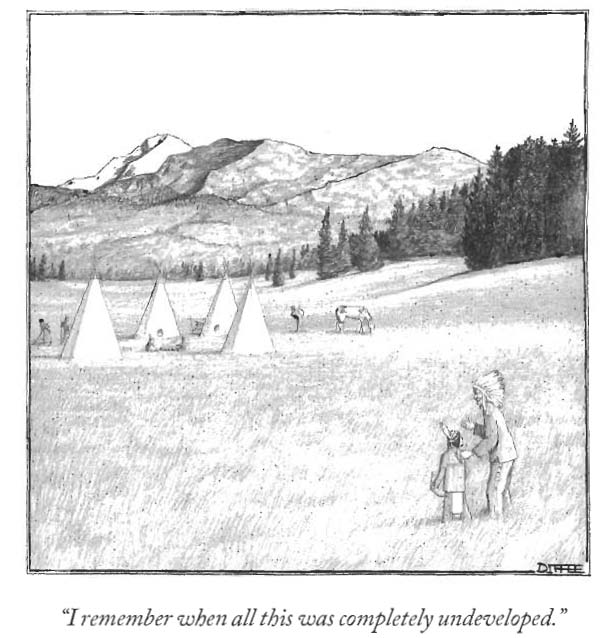
From the New Yorker, we respectfully beg permission to use the following drawing. (This site is about enlightenment on the topic of environmental change, makes no money for anyone, and gives credit under Fair Use doctrine guidelines.) And surely the artist Diffee would want people interested in environmental topics to see the sheer beauty of his wit:

Undeveloped_1

The Onion vs. Stupidity

Public Outraged As Price Of Fast-Depleting, Non-Renewable Resource Skyrockets

December 28, 2005 | Issue 41•52

ATLANTA (Oct. 12)—Americans are expressing their outrage at the soaring price of the non-renewable resource gasoline from the passenger seats of their vehicles across the country.

"America means having a right to cheap gas without having to say please," said Augusta, GA resident George Rizner, idling in his Hummer H2 in a protest near the Georgia State Capitol. "What are we supposed to do, walk?" Rizner then did doughnuts in a nearby parking ramp until his vehicle stalled.

Isn’t that wonderful? Here’s the full item , but that’s all I need. It’s a picture as it is. 

It reminds me of a quote which Issac Asimov thoughtfully adapted into one of his finest novels:

"Against stupidity, the gods themselves contend in vain."

                                                                                                    –Friedrich von Schiller

Enviro Movie of the Year

Not Syriana. In Grist, David Roberts eloquently nominates the film , extolling its rough edges, stressing what it is not (not adolescent, not a paranoid conspiracy theory, not stupid). He admits:

When I first heard about the "oil movie," I figured it would be about oil the same way so much is about oil these days, via innuendo and implication, with conspiracy and malevolence hovering shapeless in the background. But no: This really is a movie forthrightly and directly about oil — who has it, who sells it, who buys it, and who gets caught up in its grinding gears.

But I have to side with the hardened lefty Marc Cooper, who refused to see the glass as half full:

Written and directed by Stephen Gaghan, (award-winning writer of “Traffic”), Syriana bludgeons you with the relentless message that you are watching something Terribly Important – but I couldn’t quite figure out exactly what that something was.

No question that the flick was an admirable exercise in the sort of risk-taking to which Hollywood is downright phobic. And it’s clearly an Adult Film in the very best sense of the phrase. So an “A” for effort and a courtesy, gentleman’s “C” for the final product.

All I came away with were notions I think I already knew: oil companies are greedy and ruthless; government is a pawn in the hands of such powers; and the CIA kills people it doesn’t like and is perfectly willing to eat its own when  expedient. Oh yeah, there was a whole subplot in this weave of disparate narratives about Iran and some sort of neo-connish Committee to Liberate Iran, but one of you viewers out there is going to have to explain that part to me.

(Actually, understanding the "Committee to Liberate Iran" isn’t that difficult, if you ask me. Substitute real-life Iraq for the dramatic stand-in Iran, substitute the Project for the New American Century for the "Committee" and the idea’s pretty obvious, right down to the connections between the super-rich far right conservatives (such as the John M. Olin Foundation) and well-known pro-war Washington mucky-mucks such as Dick Cheney, Paul Wolfowitz, and Donald Rumsfeld.)

To be fair, I must second Roberts’ admiration for George Clooney, who couldn’t be braver, and manages to carry the movie while looking anything like a star. Still, unlike Traffic (which Gaghan adapted, and Steven Soderburgh directed), Syriana is a movie focused on people explicitly not like us. We meet Saudi princes, Pakistani youths, Hezbollah radicals; even the Americans we encounter are far richer, more reckless, more desperate than us. These people are, in other words, "the other."

"Everything is connected" is the tagline for Syriana, but unlike Traffic–which forced us to confront the horror of illegal drugs right here at home–Syriana stays away from our kind. It actually takes torture for us to feel the pain that Clooney’s character vaguely expresses with his confused actions. Gaghan’s inability to bring home our part in the shame of oil makes Syriana an interesting experiment; not an honest-to-God movie.

In truth, the genius of Traffic–which, an English screenwriting friend reminded me, was based on an already-extraordinary mini-series–was not its complex structure, as captivating and suspenseful as that turned out to be; not the performances, though Michael Douglas has never been better; not even its masterful direction. Traffic was great because it made drug addiction, even heroin addiction, seem all too cool, all too imaginable. (Maybe the fact that Gaghan was once addicted to heroin had something to do with that.) No movie I’ve ever seen gave hard drugs their due. Syriana, by contrast, is considerably more violent, and far less affecting…an emotional desert.

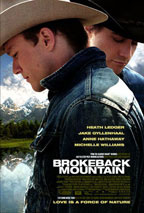
Brokeback Mountain has an axe to grind of its own, but one of a different kind. It’s about male homosexual love in unforgiving Wyoming, yet by its nature this movie ties its characters–and us–to the natural world. The beauty of the mountains that surround the two young cowboys one summer is never mentioned, but cannot be overlooked. Nobody remarks on the view; they barely see it. As in the original short story by Annie Proulx, to cowboy, the landscape is a place to work:

Ennis and Jack, the dogs, horses and mules, a thousand ewes and their lambs flowed up the trail like dirty water through the timber and out above the tree line into the great flowery Meadows and the coursing, endless wind.

It’s about as good a short story as you’ll ever read, but if you read it for lyrical descriptions, of love or the mountains, you’ll be disappointed. But that (in part) is Proulx’s point. This natural world doesn’t require her words to work on the cowboys or on us; that’s its glory. And glory is a big part of the point of the story, as she mentioned in a press conference with screenwriters Larry McMurtry and Diana Ossana, featured in New West:

This is one of the most powerful landscapes on earth and everybody who roams it knows it. There’s a visceral, unexplainable, indecipherable force that binds people to this place. I’ve known people from here who’ve gone east and they become just heartsick to be back here again.

Binding us to the planet; that is what film can do better, probably, than any other medium, and that is what "Brokeback Mountain" did better than any other movie this year. Strange that a story about homosexual love should reawaken us to the beauty of the planet, but that’s drama for you: It’s the unpredictable that makes it live within us.

"Love Is A Force of Nature," was the tagline from the movie. But the truth is, it works the other way around just as well.

Brokebackmountain_2