The Dream of Co-Existence

Last week Joseph Arrieta of The Left Coaster posted an essay about the disappearance of the steelhead in California and how, sadly, the salmon will likely be the next to vanish from our state. The post was so warmly, charmingly written that it made it possible to read about the actions of the "criminal freaks in the executive branch" who back the vast diversion of cold water (upon which the salmon depends) from the Trinity and Klamath rivers south to huge corporate farms in the desert.

Today the LATimes reports that the same "criminal freaks" propose reducing critical habitat for the red-legged frog in our region by a mind-boggling 82%, so as not to inconvenience real estate developers.

It’s just too much. You have to steel yourself just to open the paper in the morning; even skimming the headlines overwhelms, and the facts of the day–imparted by the sincerest of people, with the best of intentions–become unbearable.

Alternatively, Neil Young has a new record out, Prairie Wind, with a great song called "It’s a Dream." It begins "I try to ignore what the papers says/and I try not to read all the news" and mentions a bad dream his wife had. The song goes on to mix polyptotonically the meaning of dream and nightmare into his memories of growing up; of the Red River flowing through his home town; of a boy fishing the morning away, under a bridge, where the young birds call out to be fed…and slowly we realize that the dream that he sings about, that’s passing away, is the harmony of our lives…"it’s gone/only a dream/and it’s fading now/fading away/it’s a dream/only a dream/just a memory/without anywhere/to stay"…

Elsewhere on the album he rails against the Senator who votes to develop ANWR–"the caribou he killed/meant nothing to him/he took his money/like all the rest"–but it doesn’t have the power of the sorrow he expresses for the fading-away of the dream.

Perhaps the only way we can honor the species we as humans seem so eager to sweep away is to bring up the sorrow we feel for their passing.

Forest Service Eludes the Law

Once upon a time, the Bureau of Land Management and the Forest  Service administered public lands for citizens, taxpayers and extractive industries. This wasn’t ideal (it’s well-known that the costs of road-building, for example, outstrips the revenue the FS receives from timber sales) but at least some of us could walk freely on public lands without being charged both for maintenance and entrance.

All that changed with a fee program, supposedly a demonstration program, in the late 90’s, which was spearheaded by a coalition of industry heavyweights called the American Recreation Coalition  and included Yamaha, Disney, and REI. This attempt at privatization of public lands kicked up a lot of opposition, from the right as much as from the left. As the collection of documents at Keep the Sespe Wild shows, the program was unpopular under the Clinton administration and the Bush administration, and a coalition of Senators, led by Larry Craig of Idaho, a Republican, was moving to end or severely limit the program when a rider was attached to last year’s overall appropriations bill, authorizing the fee program, but–supposedly–limiting it.

Now it turns out that the Forest Service is evading even the langauge of the rider bill, which–according to Ralph Regula, a Republican representative from Ohio, who sponsored the it–significantly limited its scope. Regula in a press release declared:

"No fees may be charged for the following:
solely for parking, picnicking, horseback riding through, general access,
dispersed areas with low or no investments, for persons passing through an
area, camping at undeveloped sites, overlooks, public roads or highways,
private roads, hunting or fishing, and official business. Additionally, no
entrance fees will be charged for any recreational activities on BLM,
USFS, or BOR lands. This is a significant change from the original language.
The language included by the Resources Committee is much more restrictive
and specific on where fees can and cannot be charged.”

In fact the Forest Service has continued to charge fees, as a survey (with photographs) shows, around the country and in Southern California. They claim a loophole–a "High Impact Recreation Area"–status even for hundreds of thousands of acres of backcountry, in order to charge entrance fees, which are specifically not allowed. But they’re not fooling anyone, and Senator Craig is holding hearings on the matter, and you can register your frustration by sending an email by Friday to:

kristina_rolph@energy.senate.gov

and beginning with the following statement:

"Please include this in the public record for the 10/26/05, 2 pm hearing before
the Subcommittee on Public Lands and Forests on the implementation of the Federal
Lands Recreation Enhancement Act."

Because your email will go to a Senator interested in lobbying his own members to bring the Forest Service in compliance with an existing law, this may well be more effective than the usual letter to your representative. Take a moment to speak up for freedom in our national forests. I am…

Science Fiction vs. Reality

We interrupt this blog for a brief announcement: Too often, science fiction, no matter how imaginative, just plain sucks.

Here’s an example, from one of the genre’s founders, Edgar Rice Burroughs. It’s from his second book The Gods of Mars. A Martian princess named Phaidor has just been rejected by a studly Virginian from earth, who has another Martian Princess for a wife. Phaidor doesn’t like it. She yells:

Dog! Dog of a blasphemer! Think you that Phaidor, daughter of Matai Shang, supplicates! She commands. What to her is your puny outer world passion for the vile creature you chose in your other life?

Phaidor has glorified you with her love, and you have spurned her. Ten thousand unthinkably atrocious deaths could not atone for the affront that you have put upon me. The thing that you call Dejah Thoris shall die the most horrible death of them all. You have sealed the warrant for her doom.

And you! You shall be the meanest slave in the service of the goddess you have attempted to humiliate. Tortures and ignominies shall be heaped upon you until you grovel at my feet asking the boon of death.

In my gracious generosity I shall at length grant your prayer, and from the high balcony of the Golden Cliffs I shall watch the great white apes tear you asunder."

Actually, that’s a highlight. It shows some emotion, instead of yet another battle scene between the Plant Men, the black Barsoomians, the Great White Apes, and the numerous other bizarre factions on this ridiculous Mars. Believe you me, this book (and every other book I’ve ever read by Burroughs) is just about unreadable. Yet he is one of the most popular of all authors, having sold millions of copies of dozens of books in over thirty languages, most notably Tarzan.

In contrast, for those of us who think that fiction can be a useful tool for uncovering truth amidst overwhelming reality, an upcoming movie called Syriana will likely be worth a look. It stars George Clooney (and no doubt would never have gotten made without his backing). It was written by the brilliant Stephen Gaghan, of Traffic fame, and similarly uses overlapping story lines and a multitude of alarming characters to get at the truth about that most precious of earthly commodities today: oil.

In an interview with the LATimes, Gaghan makes a number of interesting points, including:

Our lifestyle is predicated on our ascendancy in the energy business over the 20th century. We’re all beneficiaries of that. I’m complicit. You’re complicit. We’re all complicit. We hide behind the fact that we don’t understand.

Uh-oh. Confronting your audience with unpleasant realities? As one media observer pointed out, a blog for a mediocre baseball team can attract 842 comments in a day; far surpassing political sites, much less enviro ones. You could be asking for trouble, Stephen…

Good Question. Bad ANWR.

From MoJo Blog, a question on the House floor asked during the debate over the Artic National Wildlife Refuge (ANWR) by Rep. Edward Markey:

So the choice comes down to this – do we raise $2.4 billion by prying open and forever destroying a national wildlife refuge, overturning forty years of established environmental policy, threatening the way of life of the Gwich’in peoples, and allowing the oil and gas industry to select any of our other 544 national wildlife refuges as their next target, or do we give the Secretary the discretion to raise by a tiny fraction the royalty rate paid by the wealthiest corporations in the world for producing oil on the public’s land? This is simply a question of whether we would rather protect public land or big oil companies.

From the LATimes today:


Oil Giant Does Well: Exxon Sales Top $1 Billion a Day

$100.7 billion in revenue is a record as profit hits $9.9 billion. Results draw outrage.

Quote of the Week

"Students are ill-served by any effort in science classrooms to blur the distinction between science and other ways of knowing, including those concerned with the supernatural."

American Association for the Advancement of Science, in a new release backing the National Academy of Sciences and the National Science Teachers Association’s refusal to force biology teachers in the State of Kansas to teach "intelligent design."

The Weather Where We Are: Holland

(from Granta this fall, by Maarten ‘t Hart)

    Here, in Holland, there is only one plant from which one can make reasonable deductions about climate change: the broad bean. The broad bean likes the cold and you have to plant it early. But not too early, because then it will rot in the damp, chilly soil. Years ago I used to plant it in the clay soil in my garden around the middle of March and harvest it in the middle of May. If I planted it a bit later to make sure it wouldn’t be defeated by cold and damp weather, it would grow well but then there was a risk that black bean-aphids would destroy it at the beginning of June. The black bean-aphid is a cruel organism. It appears suddenly in the tops of the beanstalks. Only ten or so on the first day, but an aphid becomes a grandmother overnight, so there are another hundred aphids the next day and ten thousand the day after that. Soon, large, jet-black squirming aphids completely cover the plants and transform them into cheerless phantoms.
    Planting the broad beans early prevents the aphids from striking. The beans are mature before the aphids show themselves. And if an aphid does appear, I can eliminate it by ruthlessly pinching the tops of the plants.
    What have I learned in the past seven years? That planting my broad beans in March is too late. Black bean-aphids will reliably appear at the end of May when the beans are still growing. What has also become apparent to me is that broad beans can be planted earlier, at the end of February–something that was impossible in the past. And even then I have to watch out for aphids because, since the weather in May is warmer and drier than it was, say, fifteen years ago, they show themselves much earlier and in greater numbers.
    Due to my experience with broad beans, I believe it is possible to speak of a subtle and irreversible change in the climate. By the end of February the soil has warmed up to the point that broad beans can be planted, and by the end of May it has been so much warmer in the intervening period than in the past that black bean-aphids are appearing earlier than before. Yet we must keep an open mind. The aphids may have mutated to the point that they begin to reproduce earlier. Perhaps we are planting better quality broad beans which can stand the cold and damp bettter than the kind we used to plant? Nevertheless I cling to the view that climate change is responsible for this revised strategy for the successful raising of broad beans. I’m going to buy a houseboat.

(translated by Michiel Horn)

Saving the American Soul — Or Trying To

Terry Tempest Williams is an adventurer in prose. Although she writes thoughtfully, she has an fierceness that gives her books great power. She’s revered by many readers I know for "Refuge," which explored the connection between the cancer that struck her family and the environment in which she grew up in Utah. As worthy as that book is, however, and as controversial as she is among the Mormons, in recent years she’s gone far beyond her personal story, delving into a painting in the Prado, oil industry devastation in the Rocky Mountains, and now, in an on-line column in Orion, the connection between the fallen in Iraq and the dying-out of the American Elm.

She tells of an arborist named Rufus Wanning, well-known in Maine for his devotion to the American Elm. He put his knowledge to work, checking every elm in the town of Blue Hill every week for the slightest sign of the dreaded Dutch Elm disease, and nipping it in the bud when he found it. There is no cure for the disease, and most American Elms now die before they mature, but Wanning’s vigilance has saved dozens, perhaps hundreds, of magnificent trees.

Now Wanning has given permission to a local peace group to allow his land to be used as a memorial to the fallen soldiers in Iraq. At a service, Williams writes:

Ann Ferrara spoke of three kinds of death: the one where breathing stops; the one where we are laid to rest; and the spiritual death that occurs when those we love are forgotten. She said, the first two cannot be stopped, the last one can. "We must not forget."

My eyes turned to the field of white flags and the magnificent elms that shaded them. I saw Rufus Wanning with his head bowed and his large hands clasped behind his back. In his humble stance, I thought about how his impulse to save trees is the same impulse to offer his land as a place of peace. And how the third death, the spiritual death that accompanies the act of forgetting must be extended to the remembrance of beloved lands as well as loved ones.

For me, the white flags of the fallen became the white tufts of cotton grass blowing in the Arctic National Wildlife Refuge. My eyes blurred. Boundaries blurred. What are we being asked to sacrifice in the name of greed, in the name of lies? What are we allowing to be buried if we fail to act out of our love and our outrage? There is no separation or compartmentalization when it comes to the sacred nature of life. The war in Iraq and the war on our environment are fueled by the same oil relationships.

Terry Tempest Williams will be the writer featured this year by Cal State Channel Islands in an annual reading put on for the students, the professors, and the public. She will discuss her new book, The Open Space of Democracy, on Tuesday, November 8th, at 6:30 pm at Conference Hall. Call 805-437-8994 for more details…and take it from one who usually prefers books to readings: Williams is that rare talent who can mesmerize large crowds simply by reading out loud. 

Whatever You Say, Dear Coal Industry

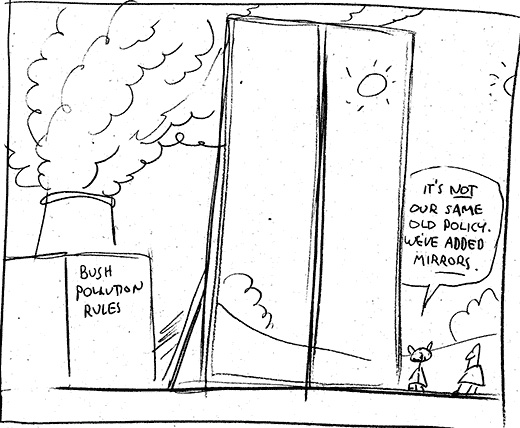
A week ago Tom Toles of the Washington Post published a sketch of a cartoon he never quite finished–quite possibly because the story it meant to illustrate never made the papers. But it’s yet another jaw-dropping example of an administration pressuring the Environmental Protection Agency to do whatever its bedmate, in this case the coal industry, wants.

Just three years ago, you might recall, the Environmental Protection Agency considered dropping the requirement that coal-fired power plants upgrade their pollution control equipment when they upgrade their producing capacity. This is a long-standing requirement known as New Source Review (NSR). After an outcry, the EPA reinstated the requirement. But after the re-election of the Bush Administration, all that has gone by the boards.

Here’s the sketch by Toles:

Bushpollutionrules

A memo from the Natural Resources Defense Council to the press reveals:

The Bush administration itself formally rejected adoption of this industry-promoted approach as recently as 2002, on grounds that it "could lead to unreviewed increases in emissions that would be detrimental to air quality and could make it difficult to implement the statutory requirements for state-of-the-art [pollution] controls."

Just two months ago, the federal appeals court in Washington, D.C., supported that contention in a decision that found the industry position would violate the Clean Air Act. The draft proposal obtained by NRDC reveals that the agency is planning to reverse course, adopting the approach that this binding court decision rejected. The resulting legal inconsistency is so extreme that the leaked draft obtained by NRDC contains a placeholder for EPA to figure out how to explain its rejection of the court’s reasoning.

There’s lots more, including a leaked memo from the chief of the Air Enforcement Division of the agency, Adam Kushner, explaining in detail why the new policy will render enforcement impossible.

What can you say? Amazing. Shameless. Disgusting. Sickening. Literally…