Making the Connection

Democrats and leftists are excited about the accelerating crack-up of the Bush administration, which–as acerbic Dana Milbank of the Washington Post noted in the aftermath of Katrina–no longer can even effectively stage a photo op. (Interesting, Fox News is now taking the position that supporting the troops means attacking those trying to shove words into their mouths–even if those people are Presidential handlers from the Bush Administration. Maybe they can tell which way the wind is blowing.)

But those of us on the left hand side of the dial concerned about enviro issues need to keep our cool. It’s a long way to the next national elections, first of all, and when it comes to global warming, the fact remains that we need to move not just the elites, but vast middle of the country, the self-identified moderates who tend to lean to the right, as Kevin Drum of the "Political Animal" site at the Washington Monthly has eloquently written about on many occasions. Drum points out that according to numerous polls, self-identified liberals are down to about twenty percent of the electorate, which is why it’s so important to reach beyond this natural audience.

One piece of very good news is that the most popular politician on the national stage, John McCain, is leading the fight on this issue in the Senate, and is said by some grumbling right-wingers to be "obsessed" with global warming. But what excites yours truly is that McCain–unlike Gore and quite a few leftists–doesn’t talk about global warming as a distant prospect that could bring total disaster to far-off places and species at some point in the alarming future–the disaster movie approach.

No, McCain travels the country to bring the issue home. In Arizona he talks about drought (which according to NOAA, is now in its sixth year in much of the Southwest). In Minnesota he talks about ducks, and how enviros and hunters are working together to save them…from global warming.

This week, we’re stopping at Buffalo Creek, Minnesota, home of the Prairie Pothole Region: the most important breeding ground for ducks in the United States. But this critical area is at risk.

With global temperatures rising by just a few degrees Fahrenheit, the future of this crucial habitat and the ducks that breed there are at stake.

As temperatures rise, ducks migrate farther north in warmer weather in the Northern Hemisphere. These ducks risk losing a place to live, eat, breed and survive. The climate changes taking place affect young ducklings’ ability to survive their first migration. Rising temperatures even lowers the rate of survival for the food that ducks eat and feed to their young. Most notably, the population of ducks could decline by about 70% in about 70 years if current projections play themselves out. This would be caused mostly by the fact that 91% of the wetlands that ducks need would have dried up.

In a rare coupling, environmentalists and hunters have joined forces to call attention to the threatened duck. Hunters spent $1.3 billion in the United States in 2001, $99 million of that was spent in Minnesota alone. Hunters and environmentalists join together to highlight the demonstrable fact that change is already occurring. The migratory and brooding cycles of many types of birds has significantly changed compared to patterns from 1960. Hunters know that their livelihood is at stake as climate change takes a toll on the duck population in the United States. Environmentalists know that wetlands are drying up as carbon dioxide in the atmosphere increases and temperature change follows suit.

Check out McCain’s travel log for more information on "virtual march" on Washington.

Writers Around the World…on the Big Heat

I admire scientists enormously but let’s face it, they’re not the most captivating of storytellers, even with their nifty color graphs. Darwin has a lot to say but when it comes to our heritage, he loses most of the country, the polls say, and no matter how many times anthropologists and National Geographic explain that no, we weren’t descended from apes, but from a common ancestor to both apes and humans; well, never mind. Too complicated and/or thorny for prime time, apparently.

So when the fall issue of the great English literary magazine Granta arrived, complete with brief letters from writers around the world on global warming, I perked up. At last a way to offer human truths on what many (including Andrew Revkin of the NYTimes) call "the biggest story in the world."

I’m sure Granta won’t mind if I quote from some of these wonderful pieces over the next few days. Note: I’m deliberately not going to quote the Canadian writer, Margaret Atwood, because her piece on the Artic is jolting, and for now I want to bring to light other–gentler, but no less memorable–visions of the change that is now sweeping the globe.

From The Weather Where We Are:

Urvashi Butali: INDIA

"…the weather has always been cruel in India, but it was at least more predictable. You knew the summer would be hot, and the winter cold. March, and the harvest festival of Holi, brought a hint of summer, and by April the heat had begun to kick in, rising until the monsoon broke in June or July. November, and the festival of Diwali brought a hint of winter and by December the warm clothes were out. Now you’re guessing much of the time: will the winter be cold, the summer hot? WIll the heat come early, the cold late? Nobody, not even the Met department, seems to be able to say for sure."

"Perhaps we can adjust to this new uncertainty–people are adapatable and so, up to a point, are the crops they grow. But if the monsoon were to become equally capricious–and its arrival and duration have never been completely dependable–then India would face a very different future. The monsoon is the most essential and cherished of our seaons. The harvest relies on a good monsoon, and therefore the economy relies on a good monsoon. It directly affects our well-being; it can influence the outcome of elections; it’s the only season that merits a whole raga to itself in Hindustani music. The story goes that in the court of the Mughal king Akbar, courtiers jealous of the poet Tansen persuaded the ruler to ask the poet to sing the raga Deepak, the music that is dedicated to fire, to a flame. They knew that once he began, he would become so absorbed in his music, that not only would everything else burn with the fire, but he would die too."

"But Tansen was cleverer. He agreed to sing, he had little choice. But he spoke to his young daughter, and warned her of what would happen, telling her that as he began to sing, she should take up the raga Malhar, the raga that welcomes the monsoon rains. He sang, and she sang. His music ignited a fire, everything began to burn, her music brought the rain, everything was blessed. A song that everyone across India will recognize is a song that asks for rain

Allah, give us clouds, give us rain, give us shade… Allah, give us clouds…."                                                                                       

The Uses of Cynicism

A couple of weeks ago newly-elected Senator Barack Obama impressed even the jaded blogosphere with the brilliance of his response to those on the left eager to punish Democratic Senators deemed to be "appeasing" right-wing Republicans by working with them on certain issues, or not opposing them bitterly enough on others.

The post on Obama’s website, which also can be found on Daily Kos, fully deserves reading from start to finish; it’s a masterpiece, not for its rhetoric, its flowery phrases or angry denunciations (what flowery phrases?)…but because it just makes so much sense. But what makes it inspiring to yours truly is its determination not to be drawn into hyperbole , but to make a virtue of the truth.

Hyperbole is especially tempting when it comes to global issues such as climate change, I think, because the fact that we are facing a whole new world, literally, opens the door to the wildest sort of speculations or fears. It’s especially important to those of us who believe in truth and science not to be drawn into the trap of exaggeration, from which no reputation can emerge unharmed. The issues we face are big enough.

Here’s what Obama said:

And I firmly believe that whenever we exaggerate or demonize, or oversimplify or overstate our case, we lose. Whenever we dumb down the political debate, we lose. A polarized electorate that is turned off of politics, and easily dismisses both parties because of the nasty, dishonest tone of the debate, works perfectly well for those who seek to chip away at the very idea of government because, in the end, a cynical electorate is a selfish electorate.

He was speaking of politics, but it’s just as true regarding the planet’s health. The temptation is to respond to cynicism about science and the environment with apocalyptic visions of doom; tempting, but that way hyperbole lies. The facts are troubling enough; leave the apocalypses to the religious fanatics.

Business As Usual in Bush Adminstration: It’s Okay for Industry Lobbyists to Write Hazardous Waste Regulations

A story in today’s Washington Post reveals yet another full-scale assault on the environment from the Bush Administration. This has become so routine that it’s a little surprising the paper even thinks it’s worth the front page. 

Back in 2001, the Bush Administration Environmental Protection Agency (which clearly needs a new title) allowed industry lobbyists from Cintas Corportation, whose chairman raised more than a quarter-million dollars for the Bush-Cheney campaign, to rewrite rules on the washing-out of hazardous waste from industrial towels. This caused some controversy, because environmentalists and landfill operators objected, and the issue landed on the desk of the Inspector-General of the EPA, Nikki Tinsley.

Her response? No problem!

"The bottom line is that’s okay," she said. "If someone gives them words that they think are appropriate, there’s nothing wrong with that. That’s legal — and common, apparently."

Certainly under this administration it’s common. Tinsley is a long-time bureaucrat enthusiastically endorsed for her office by anti-science extremist Senator James Imhofe of Oklahoma (who once famously called global warming "the greatest hoax ever perpetrated on the American people"). He expected her to be critical of the agency and its science advisors and evidently she’s filling the bill.

In the past, it was commonly considered shameful to let polluters write regulations. But those days of responsibility to public health and the future are gone.

According to a profile in the newspaper, Tinsley has in her office a pillow on which in needlepoint is emblazoned: If You Obey All the Rules, You Miss All the Fun.

That’s today’s EPA: having fun with hazardous waste.

And God Said to the Scientist…

My good friend and hiking/writing pal Cary Odes, seen below sampling the currants at Secret Camp, was inspired by the controversy around Intelligent Design, and came up with the following:

God, to “scientist” in a heavenly setting:

GOD                       Why did you not fight harder to make my glory known?

“SCIENTIST”           Oh, Lord, what more could I have done?

GOD                       Teach the word, my book, even as I have given it to you.

“SCIENTIST"       
    We have taught the Bible, in every church all over the world.

GOD                        Why only in church?

“SCIENTIST"            
We’ve tried other places. Even in the schools.

GOD                        I know about the schools.  I know everything.

“SCIENTIST"            Yes of course.  I’m just saying that the non-believers, the evil ones—

GOD                        Just say it.

“SCIENTIST”          
OK, Democrats, were fighting us, using things like the Constitution.

GOD                      
Is the Constitution above MY word?

“SCIENTIST”          
No, of course not.  But I’m just saying, for their own good, to get them the world of God, had to be more inventive.  And so we invented a little bombshell we called Intelligent Design.
GOD                  
     Does that say I created the world in six days?

“SCIENTIST”      
     Well not exactly.  We were having a little trouble selling that as science, so we repositioned ourselves with our fallback strongpoint.

GOD                  
     And that was?

“SCIENTIST”      
    Well that the world is a really complicated place and you gotta admit it’s really complicated and isn’t it obvious it’s complicated?

GOD                  
     And that pointed to my glory?

“SCIENTIST”      
     Well sure!

GOD
                       How?

“SCIENTIST"       
    Well if it’s a really complicated world, then someone would have to be really smart to make it.

GOD                        And who’s that?

“SCIENTIST”       
    You!  Of course!  We don’t say that, but it’s pretty darn obvious.  Sorry about the “Darn”.

GOD                        Oh please! I’m not a child.  So you thought that since the blasphemers and sinners wouldn’t let you teach what you really wanted, that the next best thing was good enough?

“SCIENTIST”       
    Well when you put it that way, it doesn’t sound too good.  But I really have to defend myself a little bit here.  And this is with all due respect, but we’ve been doing a pretty good job here with the big picture.  The country’s never been closer to becoming a theocracy. 

GOD                        I’m still waiting!

“SCIENTIST”            But it won’t be long.  Just let us work this our way.  I know you want to come down and wipe away the wicked.

GOD                        You have no idea.

“SCIENTIST”       
    But.. we can turn them all around.  We have your power on our side!  Soon.  Soon.
GOD                        
Okay, just don’t keep me waiting too long.

“SCIENTIST”       
    The end is near.

GOD                        
From your mouth to my ear.

"Scientist" walks away, back towards Earth.  God pulls off a mask, revealing that he is actually Satan.

GOD/SATAN            
This is the easiest job.

Img_0207

Place of a Billion Bonus Points

A commentator (Jennifer S.) points out that I failed to reveal to my vast constituency where I went on vacation a couple of weeks ago, after promising a billion bonus points to whoever could identify the spot from a photo (below).

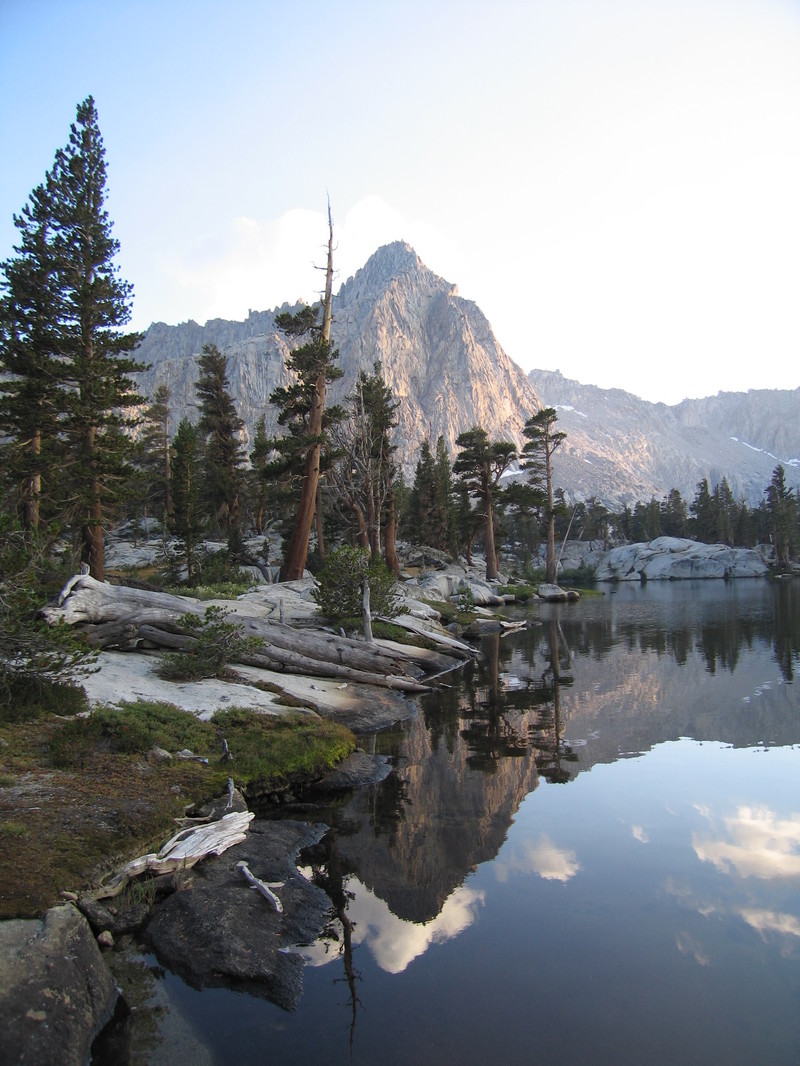
Well, no one knew, but I didn’t mean to be quite so coy about it. What I call Secret Camp is located about thirty minutes from Mineral King as the crow flies, in a little-known corner of the Southern Sierra called Big Five Lakes. I’ve camped all over the Sierras, but this is the place against which I have come to measure all other camps. More before too long, but for now, here are a couple of pics:

The first is from the sleeping porch out back, and looks eastward with the rays of the setting sun towards Mt. Whitney, which you can as a little triangle twenty-eight miles away, slightly to the left.

The second looks south towards the eye-catching Sawtooth Peak, which dominates the region.

Img_0181

Img_0248_1

Kyoto is Dead: Now What?

The Brookings Institute, Goldman Sachs, the Wharton School of Business, and quite a few other prestigious institutions allied to host a conference of economists in New York last month on the top ten risks facing the global economy.

Among those risks was global warming (although it was considered far less threatening than the rise in oil prices or deficits, according to a poll of over 300 economists taken for the conference).

The panel on global warming was hosted by Carol Browner, who headed the EPA for the Clinton Administration. On the right hand side of the political dial was David Henderson, an economist at the Naval Postgraduate School; on the left was Warwick McKibben, who directs an economic research institute in Australia.

Both agreed that the world’s climate is warming. Both agreed that the laboriously-negotiated Kyoto Protocol is not going to help.

But Henderson sees global warming as not a problem, and likely to bring more benefits than costs. "Examples [he cited] include lower transportation costs, more tourism, longer growing seasons for agriculture, and slightly decreased mortality."

(I wish the summary bothered to mention how global warming is going to lower transportation costs; on the face of it, that sounds ludicrous.)

Henderson said that the Kyoto Protocol, even if implemented, could not reduce warming, and argued for reducing tariffs to give third world nations incentives to reduce greenhouse gas emissions.

McKibben agreed that Kyoto is not likely to work, not for technical reasons, but for political reasons–because it’s too centralized.

He outlined a decentralized strategy with the following features: [that it] be
driven by national rather than global policies, especially in developing countries, where
emissions are projected to grow rapidly and where the costs of abatement are low; have long-run
objectives; and be market-based with markets in both annual and long-run emission permits. The
“McKibbin Solution”, developed with his colleague Peter Wilcoxen, is analogous to the U.S.
government bond market, where securities with short and long run maturities are actively traded.

Hmmm…sounds worth investigation.

Most noteworthy to yours truly, however, is that fact that even Prof. Henderson, who saw mostly benefits from global warming, admitted that there is likely to be "costs such as air pollution in some areas,
an increase in the sea level, and increased frequency of hurricanes."

Since Hurricane Katrina has already cost more than the 9/11 attacks, and is estimated by one reinsurance group to be "the biggest single disaster in insurance history" how much less will transporation costs have to be to compensate? A fraction? 

Carol Browner concluded along these lines, "arguing that in many cases, costs of
environmental regulation turn out to be less and the benefits greater than initially envisioned."

Amen. It’s worth recalling how in the l960’s the auto industry forecast economic gloom and doom if air pollution controls were implemented; in fact, such regulations have hugely improved the air in places like Los Angeles since those smoggy times, despite massive increases in traffic.

Why do we take such improvements for granted? We give politicians like Rudolph Giuliani credit for reducing crime, and see him as a hero, and polential presidential candidate. I can understand that. But why can’t we give environmental regulators and their supporters, almost all of whom are liberal Democrats–such as Henry Waxman and George Miller and Carol Browner–credit for clean air and clean water? Don’t they deserve some applause as well?

Why Did This Break in England?

An English newspaper, The Independent, is reporting that a Pentagon report commissioned by the Secretary of Defense found that the war in Iraq and divisions within the military brought "near catastrophic failures" to the relief efforts for Hurricane Katrina.

"The US military has long planned for war on two fronts. This is as close as we have come to [that] reality since the Second World War; the results have been disastrous."

So wrote Professor Stephen Henthrone, a professor at the US Army’s War College. I guess we shouldn’t be surprised. Nothing much has gone right with war planning in the last couple of years.

But why did this confidential report leak out in England? That’s what puzzles me.

Mr. Orwell, Meet Mr. Limbaugh. Mr. Limbaugh, meet–Oh! You’ve Already Met

People far more famous than I have called Rush Limbaugh a big fat liar, but what shocks me is not just the fact that he shades the truth, or that he blames the Clintons for everything under the sun, or even that he misleads. Everyone has a point of view, and everyone is going to frame an issue in his or her way, but few people calculate their lies as thoroughly as does Limbaugh. At least when it comes to climate, his are big lies, in the classic Orwellian sense.

An example from a couple of weeks ago, courtesy of Media Matters. Here’s what he said on his radio broadcast on September 21st:

LIMBAUGH: A story from the UK Telegraph today:

    "The Truth About Global Warming.

Global warming has finally been explained: the earth is getting hotter because the sun is burning more brightly than at any time during the past 1,000 years, according to new research.

"A study by Swiss and German scientists suggests that increasing radiation from the sun is responsible for recent global climate changes.

    "

Dr. Sami Solanki, Director of the renowned Max Planck Institute for Solar System Research in Germany, who led the research, said, ‘The sun has been at its strongest over the past 60 years and may now be affecting global temperatures.’ "


Has to be the case, because there’s global warming on Mars.

All this came from an article in the United Kingdom’s Telegraph.  Limbaugh falsely claimed it was published the morning he read the opening sentences, but otherwise quoted it accurately. But what he didn’t say was what Solanki went on to say:

He says that the increased solar brightness over the past 20 years has not been enough to cause the observed climate changes but believes that the impact of more intense sunshine on the ozone layer and on cloud cover could be affecting the climate more than the sunlight itself.

The article then quoted three other researchers who made similar points. Bill Burrows, a  climatologist and member of the Royal Metereological Society, who said the matter deserves further study; David Viner; who said that the effects of deforestation and the burning of fossil fuels had come to dominate natural factors over the last twenty years; and Gareth Jones, who criticized the study for not taking into account greenhouse gases, sulphate aerosols, and volcano activity.

Further, the Max Planck Institute, the research organization for which Solanki works, went on to specifically refute his interpretation a month later in a press release:

These scientific results therefore bring the influence of the Sun on the terrestrial climate, and in particular its contribution to the global warming of the 20th century, into the forefront of current interest. However, researchers at the MPS have shown that the Sun can be responsible for, at most, only a small part of the warming over the last 20-30 years. They took the measured and calculated variations in the solar brightness over the last 150 years and compared them to the temperature of the Earth. Although the changes in the two values tend to follow each other for roughly the first 120 years, the Earth’s temperature has risen dramatically in the last 30 years while the solar brightness has not appreciably increased in this time.

Now, it’s true that these are complex questions, and, as the above discussion indicates, attributing cause and effect when it comes to a change in the global climate is never going to be a "no-brainer." But the very fact that Limbaugh chooses to ignore all the complexity, and to attribute the change in our climate to a single cause, and to imply in fact that it is a "no-brainer"…shows that he’s not interested in the truth of the matter, only in the big lie most convenient to his position.

“It Makes No Sense”

Lots of catching up awaits me, but for now…

    "The timber program is losing money–an estimated $48 million in the last fiscal year. It makes no sense to ask the taxpayers of this country to funnel millions more to such an expensive endeavor."

–Republican Senator John Sununu of New Hampshire, on a senate amendment to the appropriations bill for the Interior Department. The amendment, which was sponsored by Sununu and Senator Jeff Bingaman of New Mexico, would have prevented up to 17.3 million in taxpayer subsidies for new road construction in the Tongass National Forest. The amendment was defeated.
[from Forest magazine, the fall 2005 edition of the excellent publication by the Forest Service Employees for Environmental Ethics]