Featured

Radioactive Rain

The Partial Nuclear Meltdown That Still Haunts Ventura County

Here’s a new story I wrote for Ojai magazine on — believe it or not — a major nuclear accident, a partial nuclear meltdown, that still contaminates part of Ventura County.

Screenshot

‘Woody Guthrie used to say that some men will rob you with a six-gun, and some with a fountain pen. The killing today at SSFL is done by burying contaminant numbers in a table that you need a magnifying glass to read. And then lying about it.’

— Dan Hirsch

Imagine a vast but unseen menace, an invisible rain of infinitesimal particles — as likely to cause cancer in people as any substance — falling on a mountain ridge in northeast Ventura County, then moving over Simi Valley, Canoga Park, the San Fernando Valley and into Los Angeles. 

Imagine companies with government contracts responsible for this rain of ghostly mutagens working with government officials to keep this mortal threat a secret from the public. 

Imagine the executives responsible for the unseen downpour not only refusing to reveal it, but when confronted with indisputable films and records of its occurrence, flatly denying it. 

This was an era — the 1950s and ’60s — before environmental review. Almost the only notice taken in the newspapers of a massive nuclear and rocketry facility in the mountains over Simi Valley called the Santa Susana Field Lab were the want ads that attracted thousands of workers. Mostly those hired were blue-collar workers paid well to work in aerospace. 

But tens of thousands of rocket tests, and decades of nuclear waste in Ventura and Los Angeles counties, left behind radioactive particles, toxic chemicals, and radioactive metal in industrial recycling centers in Ventura, and as well in the waters off Santa Cruz Island. In all these places remain some of the most toxic substances known to humankind, and in some cases, in massive quantities deposited there with little or no public notice or remediation. 

Now imagine one University of California nuclear expert, volunteering for years of organizing and investigation, uninterested in personal fame, relying on a tiny circle of fellow activists and the support they inspire from student researchers, stepping forward and breaking that story’s tomb-like silence. 

To this day, Dan Hirsch, even in retirement, while living near UC Santa Cruz, remains at the heart of the long battle between the owners of the facility — which permanently closed in 2006 — and the activists demanding a complete cleanup of its toxicity, both radiological and chemical. 

This is the story of the Santa Susana Field Lab. It has been a source of fierce contention and countless lawsuits and scientific studies for decades, but might never have come to light if UCLA nuclear policy lecturer Hirsch, working with fellow anti-nuclear activists, student investigators and the press, had not revealed the truth of the partial nuclear meltdown in 1979. 

Screenshot

THE MELTDOWN 

“This is my first opportunity to tell what happened in 35 years,” said John Pace, who was 20 when he started working as a reactor operator trainee at the console of the Sodium Reactor Experiment (SRE) at the SSFL. “I was not supposed to say a word.” 

Pace returned to Southern California from retirement in Idaho in 2014 to speak at an event hosted by Hirsch’s community SSFL Work Group in Simi Valley. After holding a decades-long silence about the accident, as ordered in 1959, Pace was overcome with emotion and apologized to the crowd while telling his story. The crowd included other former SSFL workers, some of whom — like Pace — had had health problems since their work tenure. 

Pace told reporters he was sterile for seven years after a few years of work at the SSFL, and later developed lung problems and skin cancer, which he attributed to his time working in the reactor building.

The reactor at which Pace worked in his youth — the SRE — was the largest in Southern California at the time. But at 20,200 kilowatts, it was small by modern standards and primitive in design. The SRE lacked any sort of concrete containment dome, which now is a design standard in reactors, to prevent any release of radioactivity from inside the structure to the atmosphere. 

Pace was a trainee reactor operator, but had been on the job only a few months. He admitted to being intimidated by older, more experienced officials at the plant. When he arrived for his shift on July 12, 1959, he was shocked to hear what the reactor officials said. 

“There were men all lined up around the console, and they started discussing what happened with the accident,” he said. “As I stood there and listened, they scared me to death with what they were talking about, because a ‘power excursion’ is the worst thing that can happen in a reactor.” 

For reasons the operators didn’t understand at the time, the nuclear reaction — and internal temperatures — in the uranium core escalated uncontrollably in a fraction of a second. During this “power excursion” and over the following 13 days, nearly one-third of the radioactive fuel rods melted, and dozens of fuel rods broke inside the reactor chamber. 

“I heard about how they had barely shut the reactor down after it had run away on them,” Pace said. “The reactor had an automatic shutdown, but that didn’t work and then they finally did it mechanically, powering the control rods down. All this went on for quite a while, and the storage tanks filled with radiation, and they realized they couldn’t do anything about it. I was there to listen as they said that if we don’t shut this down, it’s going to blow up. And so they had to release the radiation straight out of the reactor into the atmosphere. This has not been talked about, but the winds were blowing in the direction of the San Fernando Valley.” 

The reactor officials, puzzled by what went wrong, restarted the reactor two hours later. Some radiation monitors went “off scale,” according to Atomic Energy Commission records, and an on-site health-monitoring official later reported that radiation inside the reactor building had reached 300 times safe levels.

Pace said a fellow employee asked the company’s top executive, Marvin J. Fox, if they could tell their wives about the radiation then “over their heads” in nearby towns such as Chatsworth, Canoga Park and Simi Valley. After a moment’s consultation with aides, Fox came back with a stern warning. 

“They said no, you cannot — we don’t want anybody saying a word about it,” the director said. “We’ll report what happened to the public in our own due time.”

The reactor workers were subsequently sworn to silence. Other SSFL workers spoke of being threatened with legal action, and of having dosimeter badges (which measure employees’ work exposure to radiation) confiscated. Because of the threats, which Pace said had a military tone, for decades SSFL workers loyally stayed silent, even at the risk to their own health and their families. 

Two hours after the partial nuclear meltdown, officials restarted the badly malfunctioning reactor. 

“It was a very foolish thing,” Pace said. “It scared us to death, but for two weeks, every 24 hours, they would shut down the reactor and then restart it until they figured out for sure that the sodium pump was the cause. Every time they shut down the reactor, more radiation was released out into the atmosphere. It could have been toward Simi Valley, or Topanga Canyon. I can’t tell you which way it went.”

For Hirsch, it’s no mystery why the reactor operators ignored safety precautions. 

“Is it really hard to understand?” he asks. “No, not at all. They were up on a hill. No one could see them. It was before the days of any regulation. The EPA didn’t exist. And they were nuclear cowboys.” 

Weeks after the partial meltdown, Atomics International — on the letterhead of the Atomic Energy Commission in Washington, D.C. — released on a Saturday morning in Canoga Park a brief statement saying that a single “parted fuel element” had been observed at the reactor. 

“The fuel element damage is not an indication of unsafe reactor conditions,” according to the statement. “No release of radioactive materials to the plant or its environs occurred and operating personnel were not exposed to harmful conditions.”

No reporter followed up on the press release. Although the Santa Susana Field Lab (and supporting facilities in the San Fernando Valley) employed thousands of workers for decades in dangerous conditions, with injuries and a few deadly accidents, still nothing of the meltdown was reported for 20 years until Hirsch — working with UCLA students in the 1970s — began requesting documents from the Atomic Energy Commission under the Freedom of Information Act (FOIA).

Screenshot

OPPOSING VOICES

Today, Hirsch and his many allies in Ventura County and around the state, most prominently Melissa Bumstead and Jeni Knack, co-founders of the Parents Against SSFL activist group in Simi Valley, believe that unless legal action is soon taken against the powers that be at the site — Boeing and the state Department of Toxic Substances Control — the alleged collusion will succeed, allowing Boeing to avoid the costs of a full-scale cleanup, expected to cost hundreds of millions of dollars, leaving residents below the site in Simi Valley and West Hills at risk.

Without Hirsch’s leadership — detractors and supporters such as Bumstead agree — the fate of the Santa Susana Field Lab over the last 60 years would have played out very differently. 

Phil Rutherford, a Boeing consultant and nuclear expert who worked at the SSFL as senior manager of Radiation Safety for 25 years, overseeing 10 employees, argues (1) that no contamination has been found beyond the boundaries of the 2,850-acre site. He said that any cancer among residents in Simi Valley was not caused by the SSFL, and has questioned the need for a “cleanup to background.” Although he makes clear he does not speak now for Boeing — which limits its engagement with the press to corporate statements — in his detailed analysis, he blames Hirsch for prolonging the struggle over the cleanup.

Rutherford commented (2)) last year: “With the exception of Boeing’s successful SB 990 lawsuit against the state, all lawsuits have been initiated by Dan Hirsch and other activist organizations against the California Department of Public Health, DTSC itself, the Department of Energy, and Boeing. Since Dan Hirsch was not a party in the mediation and not a signatory to the [2022] Settlement Agreement, there is no guarantee that future lawsuits will not occur if things do not go as he wants.” 

This stance ignores the substantial evidence of elevated rates of cancer found among the people of Simi Valley, among other towns near the SSFL. In 2007, a federally funded study (3) by a University of Michigan epidemiologist found that specific cancer incidence rates were 60% higher for residents living within two miles of the site, compared to five miles away. 

Bumstead of Parents Against SSFL said that the state agency refuses to take these numbers into account. 

“The DTSC won’t recognize outside reports, even when they’re federally funded, like the 60% higher incidence rate,” Bumstead said. She speaks with a weary familiarity of cancer. Her daughter Grace’s cancer was diagnosed when Grace was 4 years old. The second diagnosis — well after her daughter’s first recovery — came when Bumstead and her husband had for a time hoped to move the family away, out of state, away from the SSFL, only to realize they could not support their sick child without their local families’ help. 

In the course of her families’ long trial by sickness, Bumstead said she has met in oncologists’ offices dozens of other local families with kids with cancer. In meetings and demonstrations, she displays a bulletin board with pictures of local children in cancer treatment. It’s one reason she speaks harshly of the DTSC and Boeing and what she calls their attempt “to kick the can down the road for a thousand years.” 

Parents Against SSFL Melissa Bumstead’s board of pictures of kids with cancer in her community

In an attempt to resolve the controversy, Gov. Gavin Newsom, Jared Blumenfeld, secretary of the California Environmental Protection Agency, and Meredith Williams, director of the DTSC, announced a new plan, based on a legal settlement reached behind closed doors between Boeing and the DTSC in May 2022, that they say will at last decontaminate the SSFL.

“Santa Susana Field Lab is one of our nation’s most high-profile and contentious toxic cleanup sites,” said Newsom in a press statement. “For decades there have been too many disputes and not enough cleanup. Today’s settlement prioritizes human health and the environment and holds Boeing to account for its cleanup.” 

But Hirsch and his long-term allies, including Parents Against SSFL, Physicians for Social Responsibility, and the Natural Resources Defense Council, believe the settlement gives Boeing license to avoid the vast majority of the cleanup — up to 94%. Although the clock is running, the advocates — possibly with the county of Ventura and other local governments — want to sue.

On Jan. 12 of this year, the Ventura County Board of Supervisors announced a “tolling agreement” between Boeing, DTSC, and nearby local governments — the cities of Los Angeles and Simi Valley, as well as Los Angeles and Ventura counties. 

The agreement removed the need for the local governments — or other entities — to file suit by Jan. 15, 2024, against Boeing and the DTSC, under the California Environmental Quality Act. 

The concern is that the agreement could narrow lawsuits over the cleanup to individual “Cleanup Plans” for smaller portions of the site, 10% or less, which advocates say will greatly limit the extent of the cleanup to measures limited numerically in the Settlement Agreement of 2022. 

“Woody Guthrie used to say that some men will rob you with a six-gun, and some with a fountain pen,” Hirsch said. “The killing today at SSFL is done by burying contaminant numbers in a table that you need a magnifying glass to read. And then lying about it.” 

Hirsch is a singular figure — a hardworking and largely unpaid Gandhi-inspired idealist. As an undergrad at Harvard in 1970, Hirsch helped lead protests against the Nixon administration’s assault on Cambodia, ultimately closing the campus to allow students to go home to organize against the war. Hirsch returned to his hometown of Los Angeles in 1972 and — after finding work as a lecturer at UCLA in nonviolence and energy policy — launched a campus Committee to Bridge the Gap (CBG) to peacefully end the war in Vietnam. 

After the war ended in 1975, Hirsch, with CBG, turned his focus to nuclear weapons and policy, discovering, to his shock, at the UCLA campus near his office a working nuclear reactor emitting radioactive gasses. This stunner motivated students on campus to volunteer to join CBG’s investigatory work. Besides the reactor on campus, they soon found records of an unlicensed and unmarked nuclear waste dump on the grounds of the nearby Veterans Administration.

These nuclear discoveries made headlines, and the CBG was ultimately able to challenge the relicensing of the campus reactor and win its removal. At his modest log cabin home in the redwood forest not far from UC Santa Cruz, where he led a nuclear policy center for decades after his time at UCLA, Hirsch keeps a part of the reactor console given to him as a sort of prize in the end by UCLA officials. It is kept in one of several storage sheds full of decades of files. 

BREAKING THE SECRET MELTDOWN STORY

In 1979, just two weeks after a partial meltdown of the Unit 2 reactor at Three Mile Island caused a near panic in Pennsylvania, and about a month after the unwittingly well-timed release of the nuclear-reactor disaster film “The China Syndrome,” Warren Olney on his popular nightly NBC Channel 4 newscast shocked Los Angeles with news of a partial nuclear-reactor meltdown above Simi Valley in 1959. 

“In 1979, when we discovered the partial meltdown, I brought the story to Warren and he did a five-part series during ‘sweeps week’ for the ratings,” Hirsch said. “They took out a half-page ad in the LA Times and really promoted the series.”

This brief summation dramatically understates the investigatory work that Hirsch and a mentee, Michael Rose, did in the AEC archives at UCLA, and with FOIA requests to pry documents, images, and even films loose from the nuclear repository in Oak Ridge, Tennessee. 

“I think he deserves a lot of credit, and he has been willing to take the heat for it,” Olney said in an interview in the fall. “It’s remarkable. The video images showing the fuel rods broken inside the reactor were just incredible. He always gives credit to a student documentarian he worked with, Michael Rose, for the images, but they were a gold mine. He and his team got these videos from the NRC (Nuclear Regulatory Commission). I’m sure you can never get anything like that anymore.”

Dan Hirsch testifies before the Senate in 1991

Olney adds that despite abundant evidence of a catastrophic meltdown at the SRE — including the fact that it took millions of dollars, the design of a new system of cameras and grappling tools to work inside the reactor chamber, and 14 months of unprecedented work to remove the broken core and repair the malfunctioning cooling system — Atomics International executives said nothing much had gone wrong. 

“It did not appear to be a hazard to the public or to our employees, and in retrospect it wasn’t a hazard to the public or our employees, and we put that plant back online,” said Atomics International Assistant General Manager Wayne Myers to Olney in the NBC series. 

That statement was as false and misleading as the original press release. This past fall, a nationally recognized expert in nuclear reactors, Arnie Gundersen, who has conducted radiological studies at the SSFL, said that the partial nuclear-reactor meltdown released many more radioactive particles than the much-better-known partial meltdown at a reactor on Three Mile Island in 1979.

“I would say the release [of radioactivity] from Santa Susana was definitely the worst meltdown up until Three Mile Island,” Gundersen said. “And there were actually more radioactive particles, such as cesium and strontium, that got out of Santa Susana than got out of Three Mile Island. Three Mile Island released a lot of noble gasses, such as xenon and krypton, at much higher rates, but the stuff that’s on the ground at Santa Susana, even now, is much worse than the stuff on the ground in and around Three Mile Island.” 

For his part — when not organizing around Diablo Canyon and other nuclear facilities in California — Hirsch has devoted 45 years of his life to cleaning up Santa Susana. It’s one of few places in the world to have suffered fallout from a partial nuclear-reactor meltdown, he points out, and it’s also a site where tens of thousands of rocket tests were performed from the 1950s to the 1980s, resulting in the dumping of hundreds of thousands of gallons of carcinogens onto the ridgetop site, including hydrazine, perchlorate, and trichlorethylene. 

“On the last day [of the NBC series], Warren got a call from a woman in Newbury Park, who was the mother of a child with childhood leukemia,” Hirsch said. “She said she had found eight other families in the neighborhood with kids with cancer. She asked Warren for help, and he said, ‘I’m a reporter — call Hirsch.’ So she called me to ask for help. And I promised to help her. I never thought it would take so long.”

Screenshot

DID THE STATE MISLEAD VENTURA COUNTY ADVOCATES AND OFFICIALS? 

Hirsch and many of his longtime allies believe they have been misled and — in Hirsch’s case — personally betrayed by California officials, including former Cal EPA Secretary Jared Blumenfeld. He’s angry about it. 

“We were played,” Hirsch says bitterly.

For decades Hirsch and allies have pushed for a “cleanup to background,” which means removing the radionuclides from the site, removing soil in massive volumes if necessary, and it means removing “Contaminants of Concern” from aquifers and keeping them out of stormwater. 

For Hirsch and his many local allies, the painful part is that, first, in 2007, and then again in 2010, they believed they had won that prize — the cleanup to background — in a pair of binding legal agreements, known as the Administrative Orders of Consent (AOC). The cleanup was expected to be complete by 2017.

“There was literally dancing in the streets when we heard that we had gotten an agreement for a full cleanup,” Hirsch said. “We really thought that by 2017, we would be home free. And I can tell you about the depression people who live near the site felt — people who’d seen their kids grow up without a cleanup, and now are seeing their grandchildren grow up without a cleanup.” 

Despite Hirsch’s unofficial position, his grasp of the complex radiological issues and the clarity of his presentations have repeatedly put him at the center of SSFL controversy. Often, he has found himself in negotiations over technical cleanup standards with state and federal officials, including more than one Cal EPA secretary, as well as DTSC Director Meredith Williams.

Hirsch said that when Blumenfeld was first appointed head of California’s EPA agency by Gov. Newsom in 2019, he searched out Hirsch regarding the SSFL, worked with him for months, even asking him to prepare “an action memoranda” regarding negotiations. Blumenfeld promised to retain the standardized risk assessment — which controls the extent of the cleanup — and said that he would defend the AOC agreements. 

“This is what Jared had promised to me, and had boasted to me,” Hirsch said. “He said he told Boeing, ‘We ain’t going to do it.’ He also told the public and Sen. Padilla and numerous mayors and supervisors that we’re not going to touch the risk assessment, we’re not going to weaken it and, well, that’s exactly what they ended up doing.”

CAL EPA OFFICIAL ALLEGEDLY MISLEADS SIMI VALLEY CLEANUP ADVOCATES

In 2020, after extensive work with Hirsch, Blumenfeld came to Simi Valley to give a talk, (5) in which he specifically thanked Hirsch and Bumstead and then-Ventura County Supervisor Linda Parks, among others, for their work attempting to hold regulators to account. 

“What we have in front of us are agreements,” he said, speaking of the 2007 and 2010 legal agreements to clean up the Santa Susana Field Lab lands and water to a pristine state before the rocket tests and nuclear reactor accidents.

 “We’re not really here to negotiate, this is not negotiation,” Blumenfeld said. “This is about implementation.”

That was in 2020, and at the time, Blumenfeld’s remarks — fulsome in their praise for Hirsch and other advocates — were warmly applauded by a receptive Simi Valley crowd. 

But in 2021, the same DTSC that Blumenfeld chided for dragging its feet on the cleanup went into closed-door negotiations with Boeing, emerging nine months later with a Settlement Agreement in 2022 that Hirsch and Ojai water-quality expert Larry Yee, among others, say means that most of the toxins at Santa Susana will remain. 

Yee, who served from 2012 to May 2022 on the Los Angeles Regional Water Quality Control Board, which regulates stormwater and toxic waste runoff from Santa Susana, expressed serious concerns at the time about the closed-door negotiations leading to the 2022 Settlement Agreement between Boeing and the DTSC. As a consequence, Yee said he believes he was forced to resign from the water board on a legal pretext created by Cal EPA officials before a crucial vote by the water board upholding the disputed Settlement Agreement. Like Hirsch, Yee feels personally wronged by Blumenfeld and the Newsom administration, but he calls for a lawsuit for the sake of the people downhill from the SSFL.

He joined with Hirsch and other advocates pressing Ventura County to file suit because, he said, “Without a complete cleanup, people continue to lie in harm’s way.”

“This is a divide-and-conquer strategy by Boeing and the DTSC,” Yee said. “Unlike the AOC agreements, which called for a full cleanup to background, the Settlement Agreement focuses on certain areas within the larger site — no more than 10% of the total.” 

Hirsch agrees. 

“Jared Blumenfeld made 1,000 pledges and broke every one of them,” Hirsch said. “And he did it on behalf of the polluter. And his actions, if not overturned, will result in a bunch of cancers. The system doesn’t work the way it’s supposed to. The agencies that are supposed to protect us are actually working with the polluters they’re supposed to be regulating.”

Today, local area governments — including Ventura and Los Angeles counties and the city of Simi Valley — are contemplating filing a lawsuit against the decades-long cleanup plan released by the Department of Toxic Substances Control in June 2023.

Ventura County Supervisor Matt LeVere, whose district includes Ojai and Ventura, said the Simi Valley City Council and Board of Supervisors for both Ventura and Los Angeles counties have agreed jointly to hire the Meyers Nave law firm and environmental assessment firm Formation Environmental LLC to look at the DTSC’s environmental review. 

“I’m still fully committed to holding Boeing and the Department of Energy accountable,” LaVere said. “If our lawyers and consultants come back and tell us this is not a good agreement, that it’s not a full cleanup, if we think there’s some kind of sweetheart deal, then we will challenge it, because I absolutely believe, and my colleagues also believe, that there needs to be a full and exhaustive cleanup of this site. And if it takes filing a lawsuit to get that, we will.” 

Hirsch for his part said he remains committed to the struggle to decontaminate Santa Susana, and is working with allies to file a lawsuit to challenge the Settlement Agreement between DTSC and Boeing, arguing that they are “begging to be sued.”

“The arc of the moral universe curves toward justice,” he said, referencing a famous saying of Martin Luther King Jr., but not accepting its passivity. 

“The arc of the moral universe doesn’t curve on its own,” he said. “The arc of the moral universe curves toward justice, but sometimes it curves away. People have to work hard to curve the arc of the moral universe toward justice.” 

FOOTNOTES:

1.

2. https://www.philrutherford.com/SSFL/Settlement_Agreement/DTSC-Boeing_Settlement_Agreement.pdf

3. https://www.ssflworkgroup.org/files/UofM-Rocketdyne-Epidemiologic-Study-Feb-2007-release.pdf

4. 

Featured

UCSB Scientists See End to “Normal” Climate

From the Independent in Santa Barbara, a story I pulled together on two young scientists exploring the data underlying the megadrought in which SoCal finds itself today:

By Kit Stolz
Mon Sep 19, 2022 | 4:49pm

In August, Governor Gavin Newsom and officials from the Department of Water Resources released a new Water Supply Strategy, saying that because of California’s “hotter, drier climate,” the state needed to find at least 10 percent more water to supply its farms, cities, and industry by 2040. 
“We are experiencing extreme, sustained drought conditions in California and across the American West caused by hotter, drier weather,” states the plan. “Our warming climate means that a greater share of the rain and snowfall we receive will be absorbed by dry soils, consumed by thirsty plants, and evaporated into the air.”

The plan says that steadily rising temperatures will overcome even a year or two of better-than-average or average rainfall in Southern California — as in 2018 and 2019 — and will not close what state officials call an “evaporative gap” that threatens California’s water supply.

This new state plan follows the climate science on “aridification.” That’s the scientific term for the “drying trend” that young climate scientist Samantha Stevenson of UCSB’s Bren School of Environmental Science and Engineering identified this year in an extensive global study of the 21st-century hydroclimate

Danielle Touma | Credit: Courtesy

Stevenson said that she wanted to provoke new thinking about what we call drought.

“Drought is already normal in much of the western United States and other parts of the world, such as western Europe,” Stevenson said. “Part of the reason I wrote the paper was to try to say that we need to think about what we mean when we say ‘drought,’ because we’ve been using these definitions based on expectations from 40 years ago. What happens if you know the drought is never going to end?”

Stevenson’s work finds that “the soil moisture changes are so large that conditions that would be considered a megadrought” in western Europe and North America will become average. Stevenson said that the team’s modeling shows that the drying trend has in fact already emerged from the data in our region. What scientists call “megadrought” has become our norm.

Peter Gleick, a prominent researcher in water and climate in California at the Pacific Institute since the 1980s, seconded Stevenson’s finding that the concept of a “normal” climate has become profoundly misleading in the West.

“In general, the science about increasing drought severity and “aridification” is strong and worrisome, and builds on concerns about climate and water that scientists have been raising for literally decades,” Gleick said. “The climate is changing. What used to be normal is no longer normal, and we’re not approaching a new, stable normal — a ‘new normal.’ Rather we’re entering a period of rapid, unstable changes, and we’re not adequately prepared.”

An example of the breakdown of climate normality leading to rapid, unstable changes in the West could be found right next door to Stevenson in the work of Danielle Touma, her post-doctoral researcher at the Bren School last year, who this year published with Stevenson and others a paper on the deadly debris flows and floods that can occur when a deluge follows a firestorm.

This happened in January 2018 in Montecito, a scene that shocked Stevenson, Touma’s mentor at the Bren School, to the core. 

“I moved to Santa Barbara in October of 2017, two months before the Thomas Fire. I’m from the East, but I’ve lived in the West a long time, and I thought I knew about fires from places like Colorado,” Stevenson said. “But then I got to California and the Thomas Fire happened. It was apocalyptic — very scary. And then the rainstorm happened and the debris flows and it was kind of a wake-up call for me. I wondered how climate change would affect these sort of ‘compound events.’ And then Danielle arrived and was actually interested in quantifying that.”

Touma said that she was unusual as a climate researcher in that she had experience with both extreme fire weather and extreme rainfall events. Despite her familiarity with the data, she herself was surprised by the findings from the climate models, which show a 100 percent increase in such “compound events” in California by the end of the century, and a 700 percent increase in the Pacific Northwest. The study finds that extreme fire weather events will be followed within five years by three extreme rainfall events in the same locations in the West 90 percent of the time.

That means that this century, extreme wildfires in the West will usually be followed in short order by extreme rain, with the potential for massive damage. Daniel Swain, a colleague of Touma’s at the National Center for Atmospheric Research, described the significance of her study.

Samantha Stevenson | Credit: Courtesy

“The risk of post-fire hydrologic hazards is not just increasing because we’re seeing more intense wildfire burning conditions, although we are and that’s part of the story,” Swain said. “The other half of the story is that the very most extreme precipitation events are likely to increase rapidly as well. And so you put these two and two together, and we’re getting more extreme wildfires on the one hand, and more extreme precipitation on the other hand.”

“These kinds of signals are emerging a lot earlier than you would think,” Touma said, speaking gently of potential disasters. Both Touma and Stevenson said that they did not intend to become climate scientists earlier in their careers, but were drawn to the field for idealistic reasons.

“I didn’t start out as a climate scientist; I was an astronomer when I first went to grad school,” Stevenson said. “I wanted to tried to understand those big questions in space, but I found that given the magnitude of the climate crisis that was already unfolding in 2006, that those questions aren’t the ones we need to be focusing on when things were literally starting to heat up. I wanted to do science that will actually help humanity in some way.”

Touma began her career as a civil engineer interested in designing water systems, but when she began to look into the design work, she discovered that engineers had not adequately integrated the climate models to understand the impact on streams and rivers since the 1970s.

“So when I went to do my PhD, I decided to focus on climate change and its impacts,” she said, adding that Stevenson was the first woman mentor she had had in her career.

“It was really important for me to have that mentorship,” she said “Not only because Sam’s a woman, but because she’s an amazing scientist.”

As for Stevenson, she said that she is the designated climate modeler at the Bren School, and she is excited to work with graduate researchers and students in the cross-disciplinary environment of the graduate school. She especially likes working with students interested in climate.

“In California, when I tell people what I do, the reaction I often hear is: ‘Save us!’” she said. “It’s hard to argue that climate change doesn’t exist when we’re seeing the hottest temperatures we’ve ever seen and the largest fires that have ever happened year after year.”

Featured

Beatrice Wood stars again

This summer I explored a new book about Ojai’s greatest artistic hero — or arguably, hero of any sort — and heard many wonderful stories from many people in Ojai who knew the spectacular artist and character in her salad years. Here’s the story in the Ojai Quarterly and here’s the opening page:

on a new book about Beatrice Wood and Marcel Duchamp in the Ojai Quartlery: read the whole thing via the link above or here.

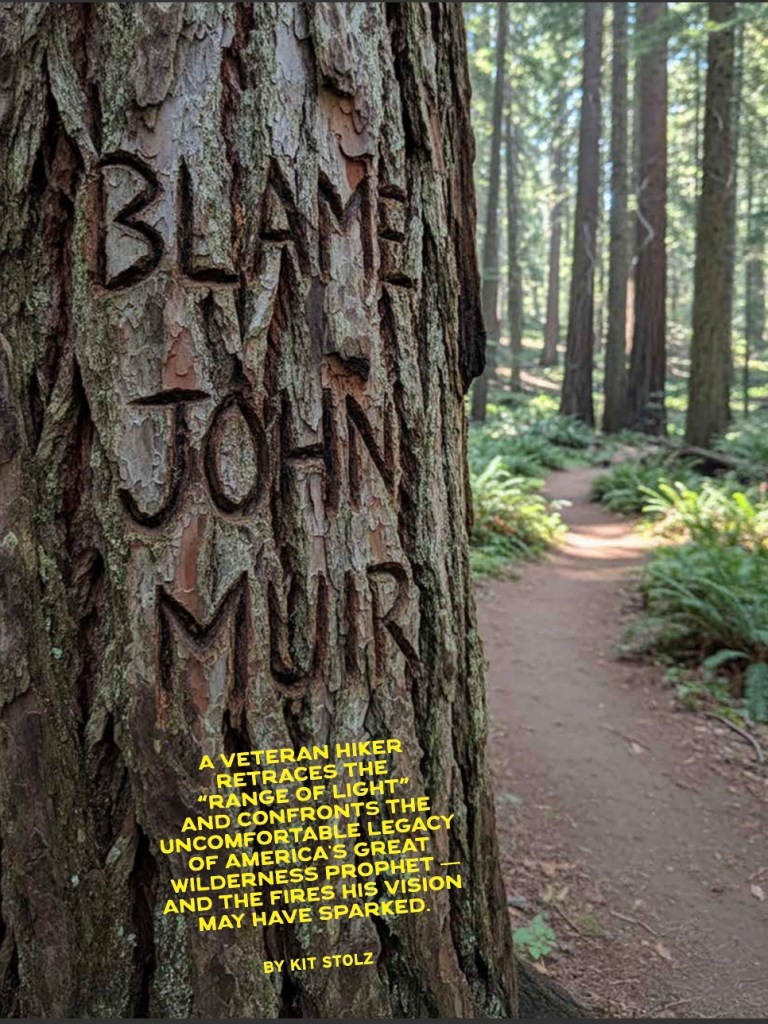
BLAME JOHN MUIR: Fire on the JMT 2025

Here’s a story in Ojai Quarterly about my struggle with the legacy of my long-time hero John Muir while walking his trail — in smoke — this past September.

[This first image comes from the story in the winter issue of the magazine, as linked above, and has a slightly different tone and fewer pictures than this blogger’s version of the same story. FYI. Bloggers need not worry about column inches.]

As I plod at first light up the legendarily difficult “Golden Staircase” towards Mather Pass, panting, pushing down on my hiking poles for a little extra oomph, with five miles and thousands of feet still to go to reach the crest, I wonder what in the world has come over me. 

What kind of spirit is this? What has possessed me to try this — at seventy? 

In my chest I feel my heart pound. A fiery ache fills my watery legs.  Every few minutes I look around for a flat-topped boulder on which to sit, rest the weight of the pack, catch my breath, let my thudding pulse slow. I stop often this way, to nod and smile perhaps a little wryly at the occasional younger backpackers who pass me by. 

I blame John Muir. Were it not for Muir; for his captivating adventures, for his inspiring and oft-quoted words about his beloved “Range of Light,” I wouldn’t be here. Trying to walk 212 utterly exhausting miles through the High Sierra — in smoke. 

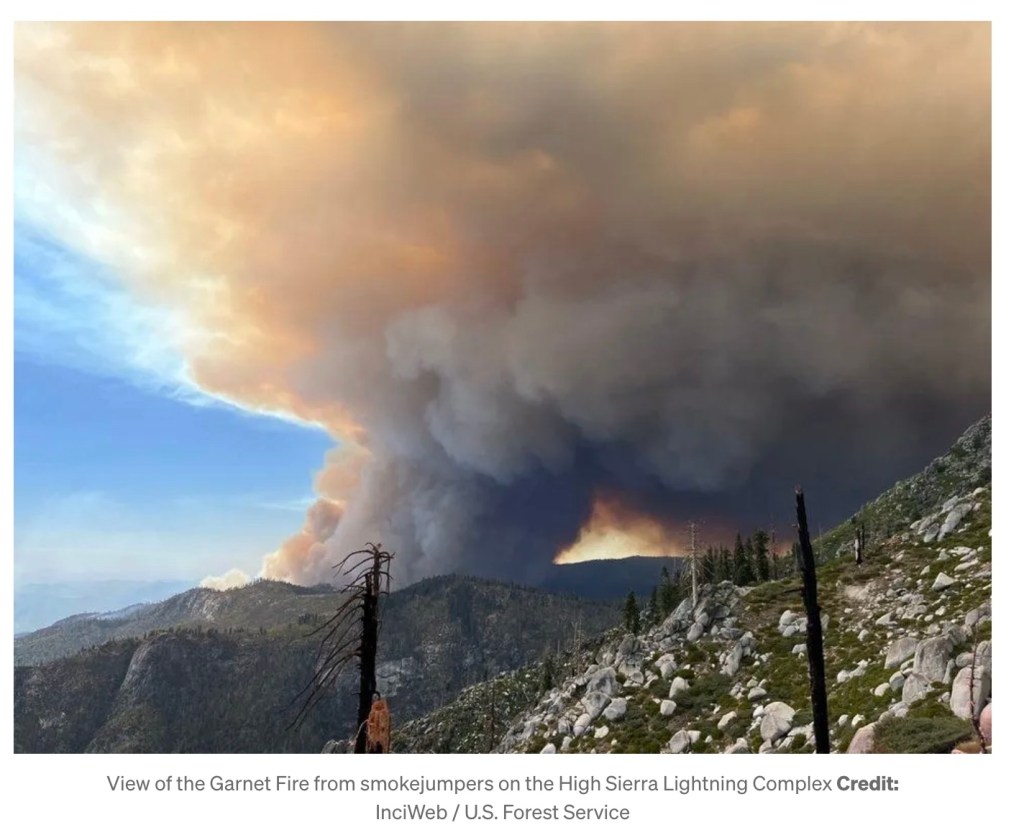
The Sierra National Forest, fifty miles to the south, was on fire. And for that too — some say — John Muir is to blame.

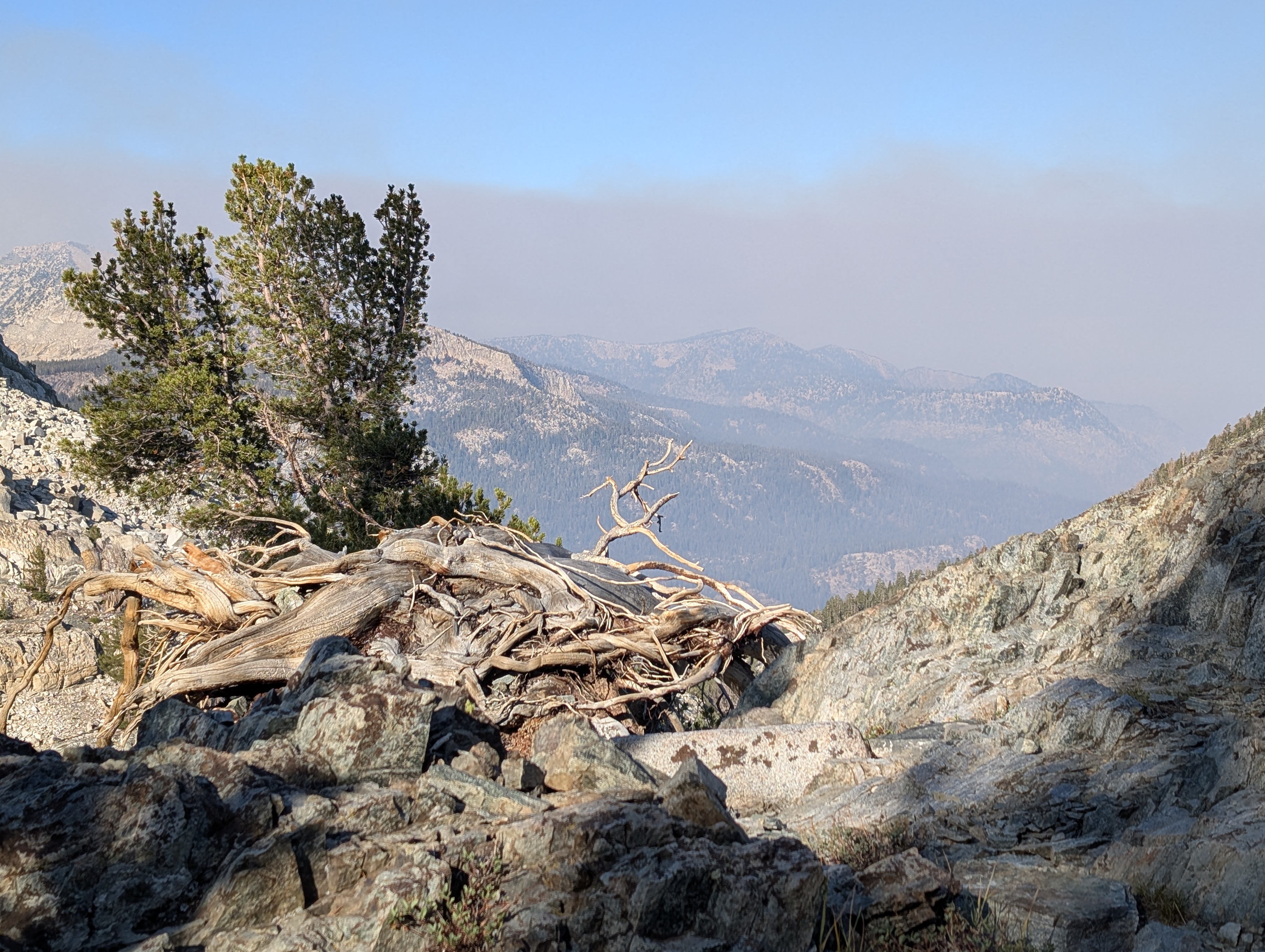
“Wall of smoke” from Garnet Fire — photo taken about sixty miles south of Yosemite

I flashback forty years. With my young family — a thirtysomething partner and a twosomething child — I visit a tiny luggage store next to the Vista Theater in Los Angeles to buy a suitcase for a trip. On a high shelf behind the sole proprietor stands a dozen or so travel books for exotic and pricey vacation locales, including one wildly out of place — “My First Summer in the Sierra,” by John Muir. I buy it on impulse, remembering a handful of blissful times in my youth in the mountains. Upon reading I find myself plunged into the raw beauty of the Sierra once again. A different,  wilder life awaits me. If I want it. I search out more of Muir’s writing and hear the mountains calling him. I hear that call too. 

“Camp out among the grass and gentians of glacier meadows, in craggy garden nooks full of Nature’s darlings. Climb the mountains and get their good tidings,” Muir wrote in 1898. “Nature’s peace will flow into you as sunshine flows into trees. The winds will blow their own freshness into you, and the storms their energy, while cares will drop off like autumn leaves.” 

Living in smoggy, chaotic, traffic-choked Los Angeles in the late 80’s and early 90’s, I needed that natural peace. Eventually I went to the mountains to look for it, even walking the JMT in a heavy snow year in 1995, thirty years ago. As countless others go to the mountains today, perhaps equally “over-civilized,” people who find they need wildness and beauty and adventure in their lives, (And as did countless others in the late 19th century, about as many women as men, who united to form the Sierra Club, which Muir launched in 1892 “to explore, enjoy, and protect wild places.”)

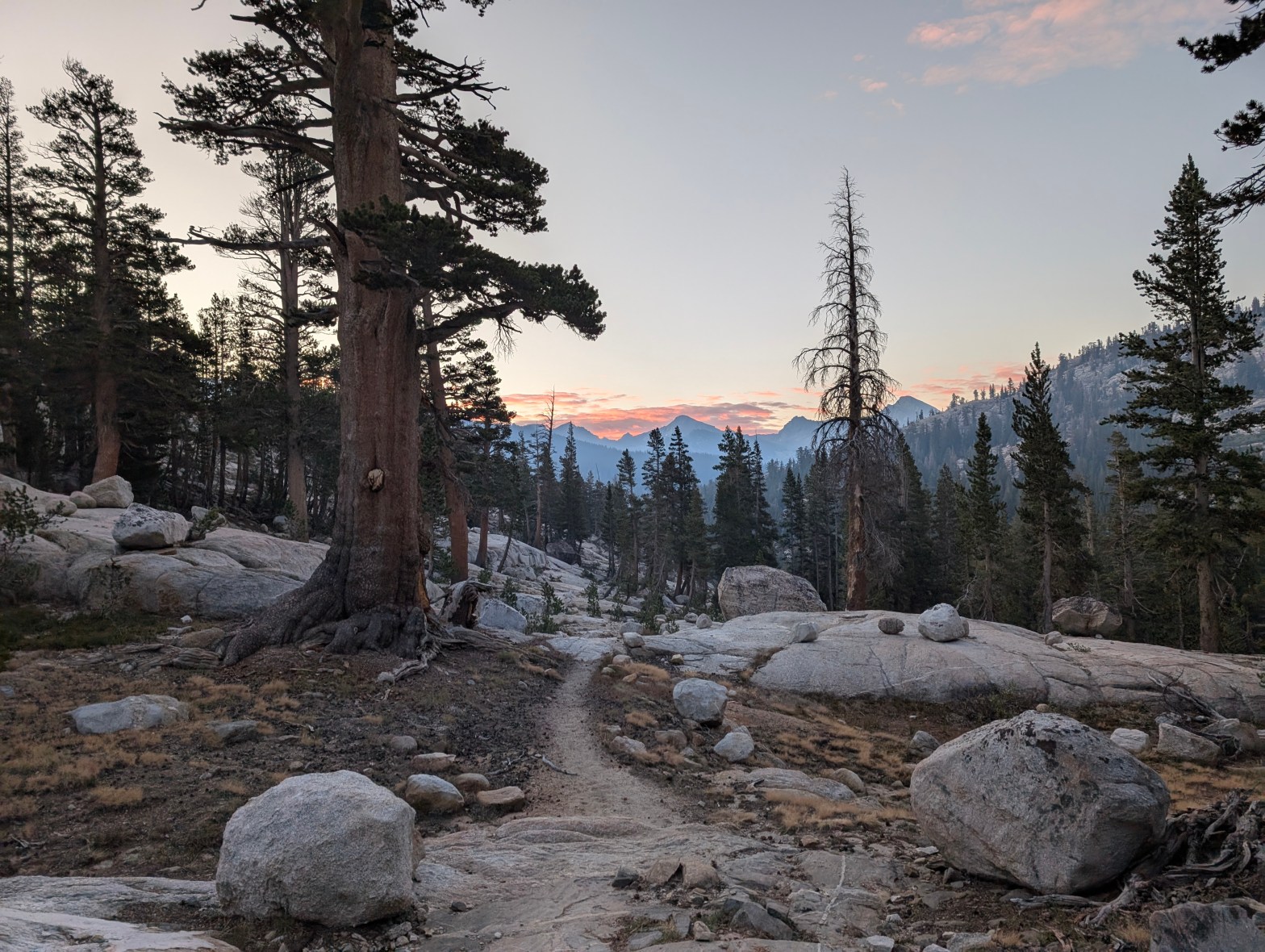
View looking westward down Palisades Creek at dawn, on trail eastward towards Mather Pass

View looking northward thru the Upper Basin towards Mather Pass

So perhaps I should credit John Muir and his allies. Had they not spent decades expanding the national parks and forests, building trails, blocking planned roads through the mountains, expanding forest protections, the John Muir Trail, or JMT, wouldn’t be here. Exhausting me. 

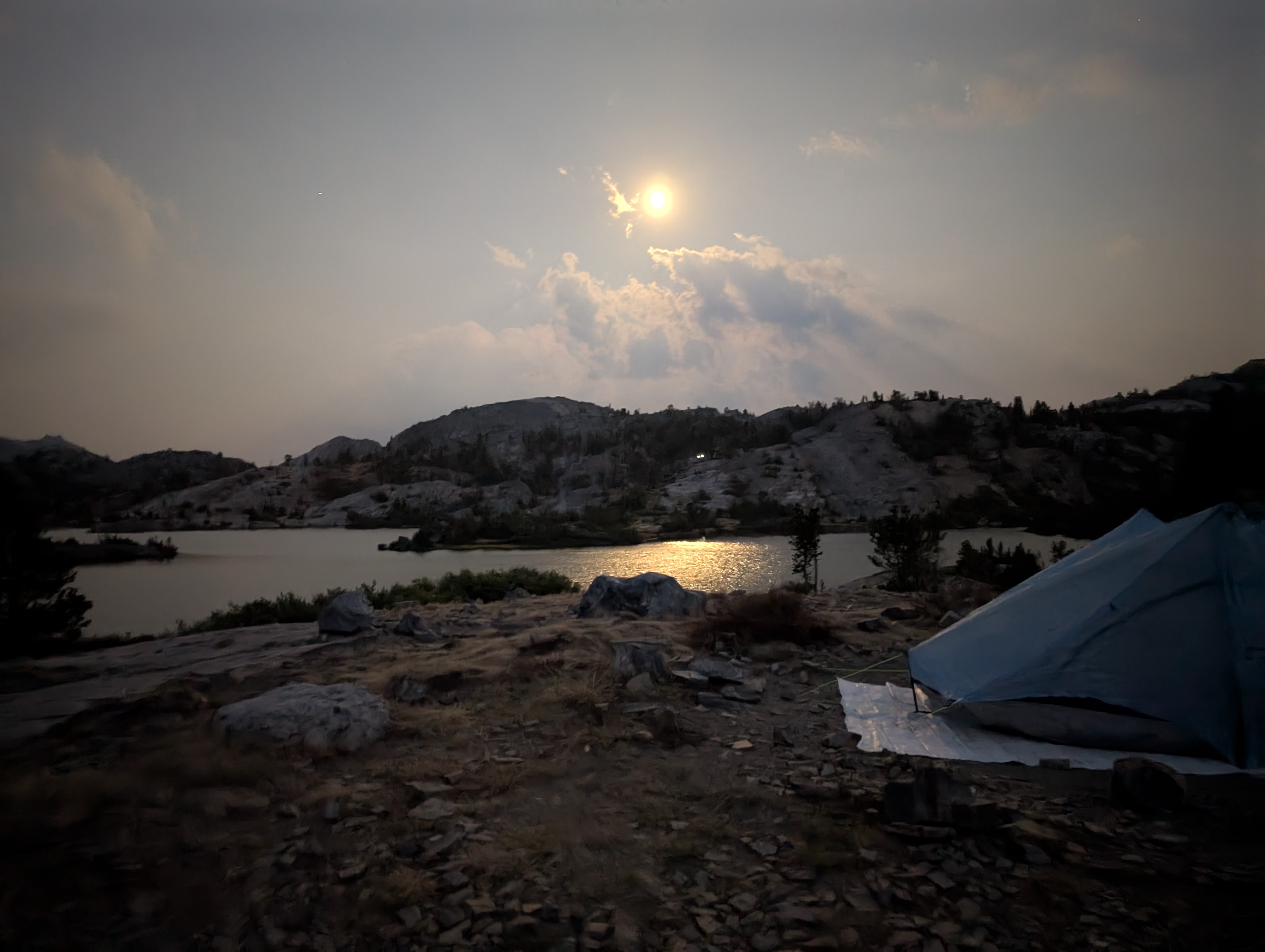
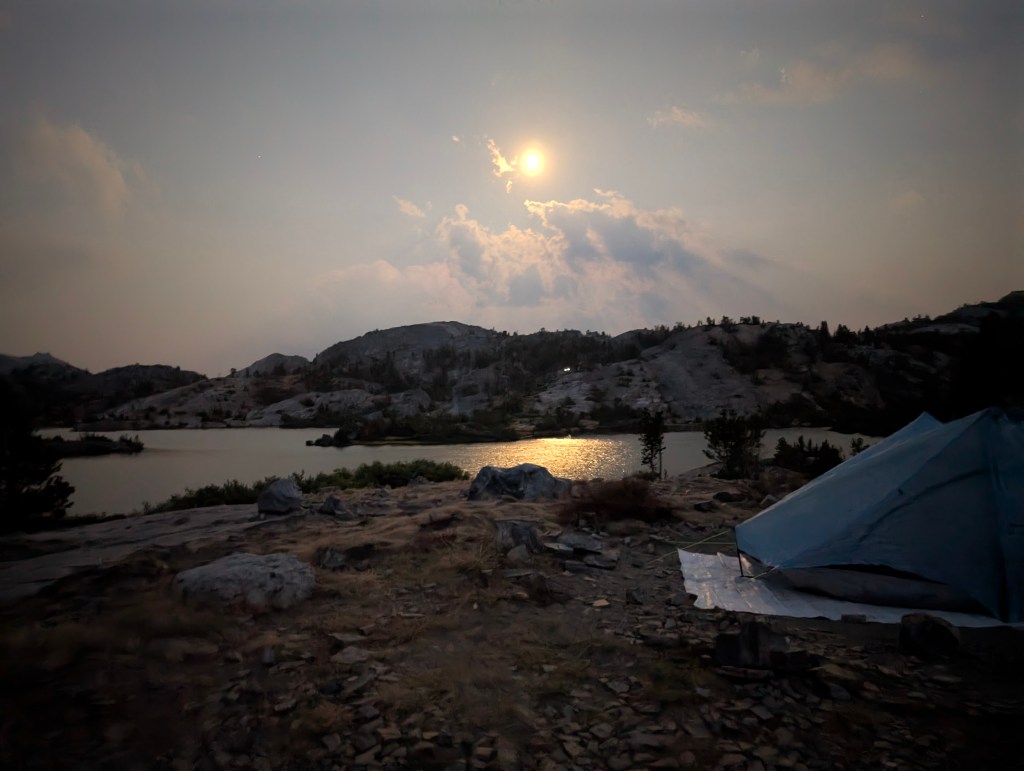
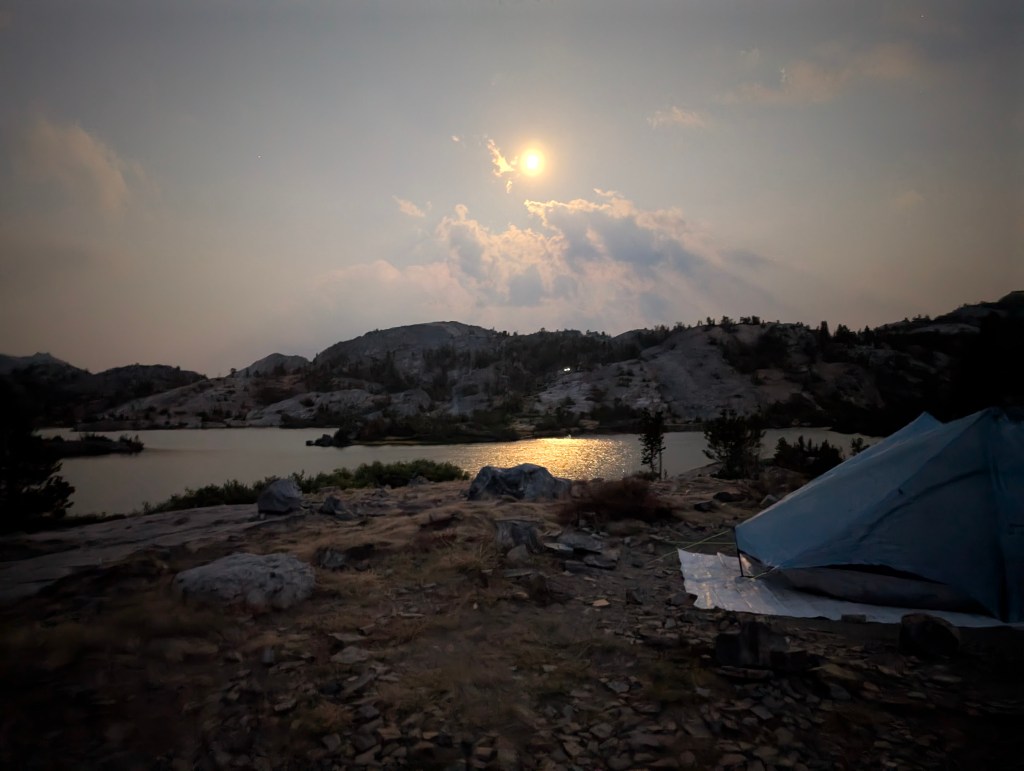
Flash back a few days, to September 3. With a friend from days spent on the Appalachian and Pacific Crest Trails, I head south from Tuolumne Meadows. We’re left gasping in the thin air on the first steep climb, but a night later recover under a full moon by Thousand-Island Lake. 

Under a full moon, camping by Thousand-Island Lake

After four days and a stay at a hiker’s cabin in funky-but-friendly Red’s Meadow — about fifty miles south of Yosemite — we turn up the JMT again, energized but troubled by reports of a major fire fifty miles to the south. Dingy blue-grey wisps of smoke hang in the trees. 

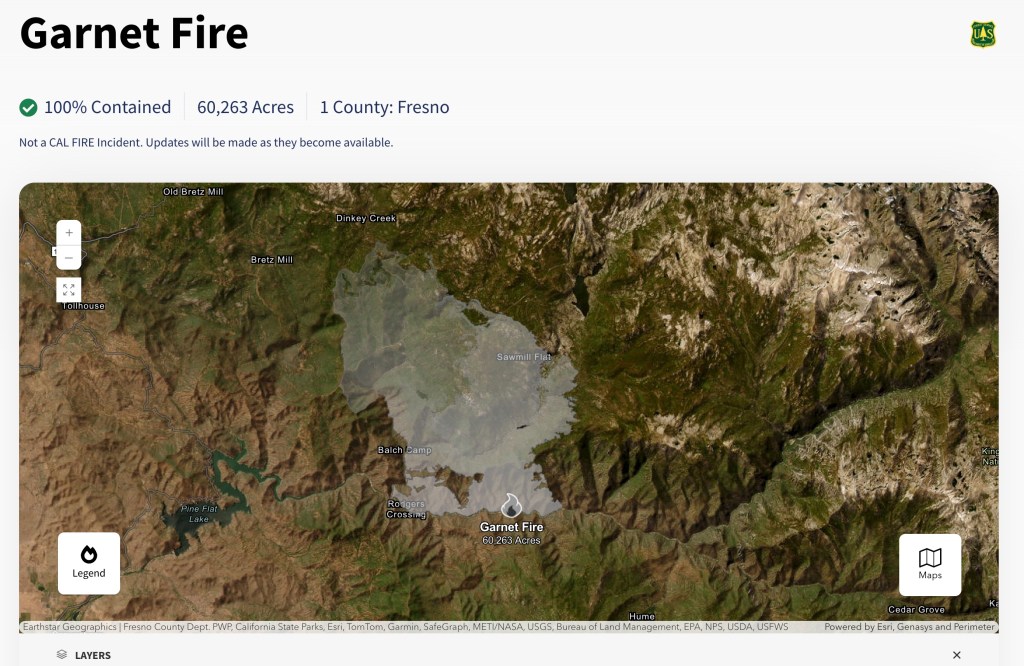
The smoke came from the Garnet Fire, which — following lightning strikes — had broken out a little over two weeks before in Sierran forests east of Fresno. The fire burned for almost a month with catastrophic intensity, consuming about 60,000 mostly uninhabited acres of old growth forest. This is the sort of forest fire which some experts blame on, yes, John Muir. 

DID MUIR”S VISION OF WILDERNESS BRING ENORMOUS FIRE TO THE SIERRA? 

https://medium.com/@alanworldview/key-things-to-watch-with-the-garnet-fire-6b58896fb8a8

To solve the wildfire crisis, we have to let the myth of “the wild” die,” was the headline on a story in August in the L.A. Times by reporter Noah Haggerty. In a story published just days before the Garnet Fire broke out, Haggerty wrote that “Muir sold the president [Teddy Roosevelt] on a uniquely American myth of the wilderness — that if we work hard enough to isolate public lands from our influence, we can preserve a landscape essentially “untouched” by man.” 

Haggerty in his news story interviewed fire ecologists and indigenous fire experts working to bring beneficial “good fire” back to Sierran forests. The idea is to reduce fuel for wildfires to prevent an all-consuming wildfire. The Garnet Fire is the sort of inferno that has destroyed millions of acres of forest in California in the last five years, in dozens of uncontrollable fires, many of them — such as the Camp Fire that killed 85 people in Paradise — lethal. 

Muir in 1903 on a famous camping trip in Yosemite with Teddy Roosevelt convinced the President to put Yosemite under federal protection. With this protection came a vision of wilderness untouched by man, implicitly (if unwittingly) excluding the first peoples who lived there. This prevented native peoples from “tending the wild” with frequent low-intensity fires, all but guaranteeing the destruction of forests, when the suppressed fires came the next time. 

“The single most important reason mentioned by Native American elders when asked why their ancestors burned the Sierra Nevada was to keep the underbrush down to prevent a large, devastating fire,” writes M. Kat Anderson, a leading researcher of indigenous land-management techniques used in the Sierra. In a report to Congress in 1996, she documents that in the 500 years before 1800, as many as 100,000 Indians lived in the Sierra, and the burning, tilling, seeding and other tools used by residents in over 2500 native villages had an enormous and beneficial impact, making forests sustainable, as they cannot be if left entirely untouched.

It’s a powerful critique of Muir’s vision of a wilderness untouched by man. It’s a fact that Muir’s desire to protect forests from man — and loggers — shaped Teddy Roosevelt’s thinking about public lands. It’s true that Muir’s idea of “the wild” as a place apart from man proved short-sighted, because it assumed that Sierran forests would not need tending.

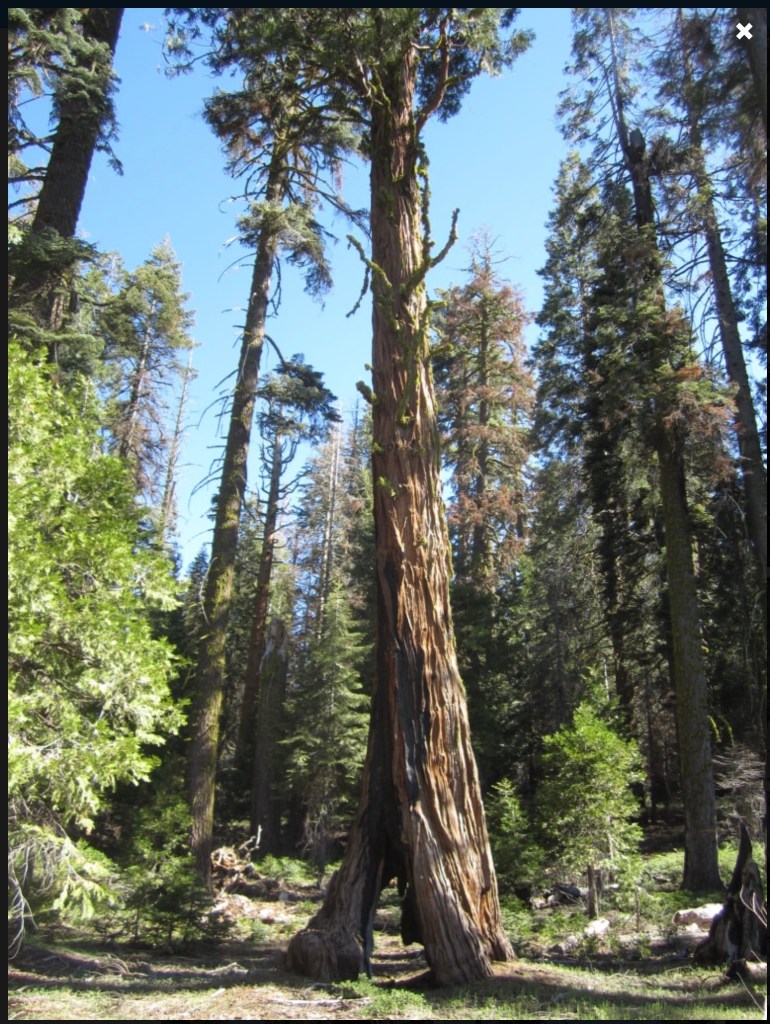
Split-trunk tree in the Teakettle Experimental Forest, before it was destroyed in August-September 2025

But it’s also true that the federal government didn’t take control of the management of Sierran forests for many decades after the Gold Rush, well into the 20th century for most such forests, and long after — tragically — the native peoples, such as the Yokuts and the Mono that “tended the wild” in Sierran forests had been decimated. 

Fire ecologists know what happened in the forests that burned in the Garnet Fire because in these Sierra National Forest lands stands the Teakettle Experimental Forest, a block of about 3000 acres used for the past century to study and test forest management techniques. A meticulous fire scar study of the Teakettle forest showed that before 1865, fires in the Teakettle were frequent, occurring in the range of every 11-17 years, presumably started by native peoples. No major fire occurred after 1865 was detected when the study was conducted — none until this year.

Muir has been blamed for many sins, including racist remarks about people of color in his early years, even if he argued forcefully and at length against the eradication of Indians (when that was California state policy — a $5 bounty for Indian scalps –in the19th-century). One can blame him for not realizing that the “gentle wilderness” he so admired in the Sierra forests was the work of the first peoples, and needed their tending. Yet when indigenous “good fire” in the Sierra National Forest came to an end, Muir was working as a young inventor in a broom factory in Ontario, Canada. He had yet to even see California. He had nothing to do with the decimation of the 90,000 first peoples who lived for centuries in Sierran forests, a great number of whom were felled by European diseases in the 1830’s. To blame John Muir for the genocide of California tribes, not to mention for forest management policy a hundred years after his death, makes little sense. 

Kim Stanley Robinson, the author of “The Sierra Nevada: A Love Letter,” has come to Muir’s defense, with several other California writers. He points out that Muir never advocated for the removal of native peoples from the land in anything he wrote, even in unpublished letters or journals. Further, exploring coastal mountains in Alaska in later years, Muir lived for a time with the Tlingit people. As a child Muir had been nearly worked to death by his father,and often beaten. For that reason he greatly admired the respect these people showed their children.  

“I have never yet seen a child ill-used even to the extent of an angry word,” Muir wrote. “Scolding, so common a curse of the degraded Christian countries, is not known here at all. But on the contrary the young are fondled and indulged without being spoiled.”

Regarding the Garnet Fire, Matthew Hurteau, a fire ecologist, published in early September an impassioned piece called Eulogy for the Teakettle, in which he mourned the loss of the grand old growth forest to which he had devoted two decades worth of his work and life. The tragedy for Hurteau — and the Sierra National Forest — is that he and his colleagues over several years put together a treatment plan to reduce the risk of a catastrophic fire in a large and ancient forest.

Despite bureaucratic opposition, a government shutdown, and management changes, in 2018 they won a $896.000 CalFire grant for prescribed burns for most of the 3,000-acre old growth Teakettle forest. These treatments were meant to save the forest. After countless delays, they were scheduled to begin in the fall. 

CalFire summary of the Garnet Fire: https://www.fire.ca.gov/incidents/2025/8/24/garnet-fire

“I cried on September 1,” wrote Hurteau. “I am sad and angry. I am sad because this old-growth forest is no more. I am angry because this outcome was a choice. The choice was inaction by forest “leadership.” They chose doing nothing instead of working to prepare these incredible trees that are hundreds of years old and some as much as 9 feet in diameter.” 

[Matthew Hurteau or colleague cataloguing trees in the Teakettle Experimental Forest before its destruction]

I had read reporter Haggerty’s accusatory piece in the L.A. Times before I started on the JMT. Although most analysts don’t blame Muir for the “Smokey Bear” policy of fire suppression — which became official Forest Service policy after WWII —  it’s widely accepted among foresters that this policy has failed. In 2007, two researchers with the USDA (which oversees the Forest Service) published a white paper called “Be Careful What You WIsh For: the Legacy of Smokey Bear,” pointing out that “the long-standing policy of aggressive wildfire suppression has contributed to a decline in forest health, an increase in fuel loads in some forests, and wildfires that are more difficult and expensive to control.”

Still, the possibility that my hero — the man whose signature I had tattooed into the inside of my forearm — could have even inadvertently caused such ruin unsettled me. Would these fires spoil the Sierra? Would I come to dread this trail?

The crest of Silver Pass in early September 2025

Lose faith in Muir?

I walked southbound, a little more hesitantly, towards Evolution Valley, I had in mind what a Hawaiian-shirted backpacker told me when we encountered him and a friend on the trail. They were heading out, cutting their trip short, and he told me why. 

“I don’t want to have to see Evolution Valley in smoke,” he said. “I don’t want to remember it that way.”

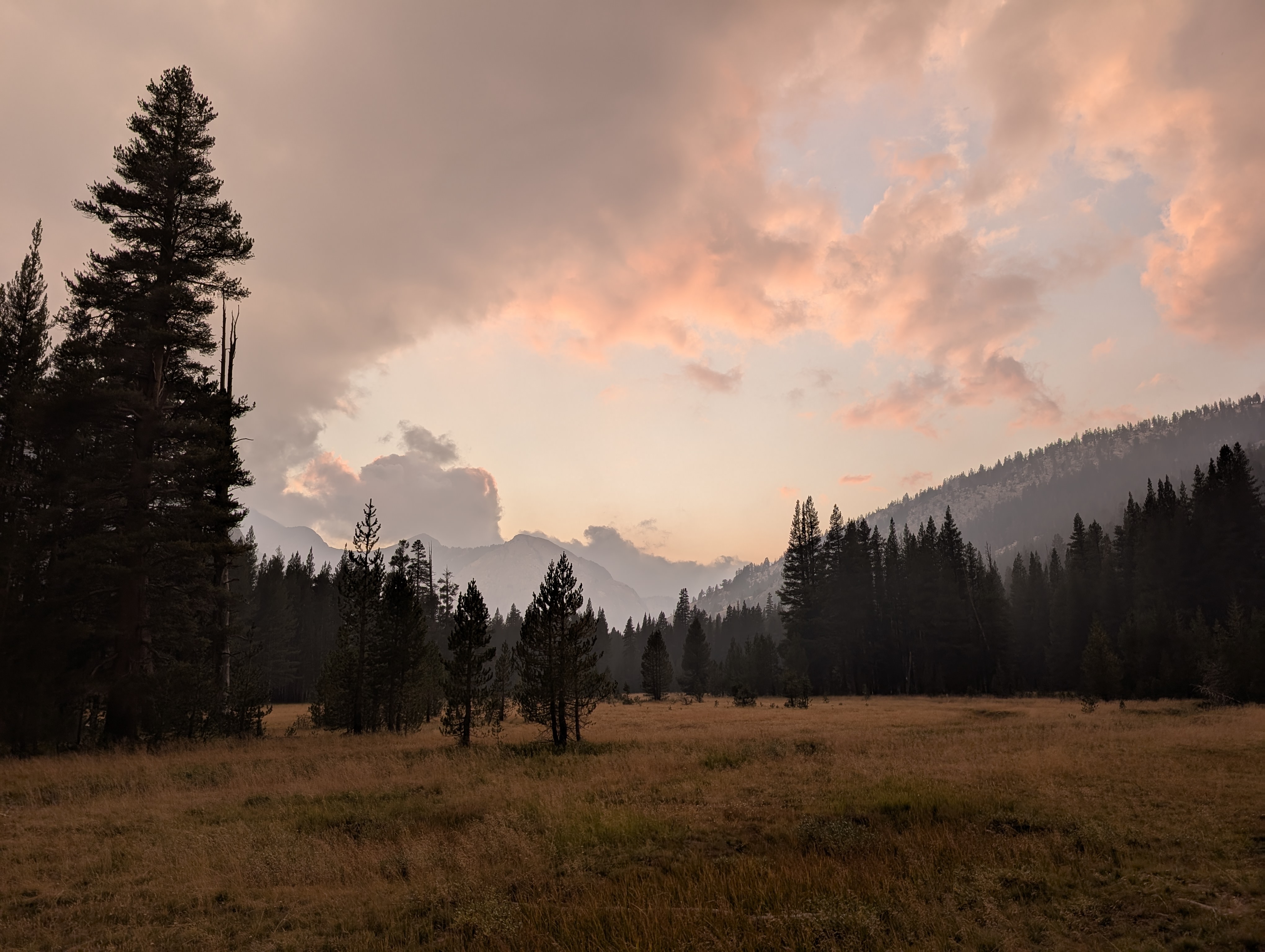
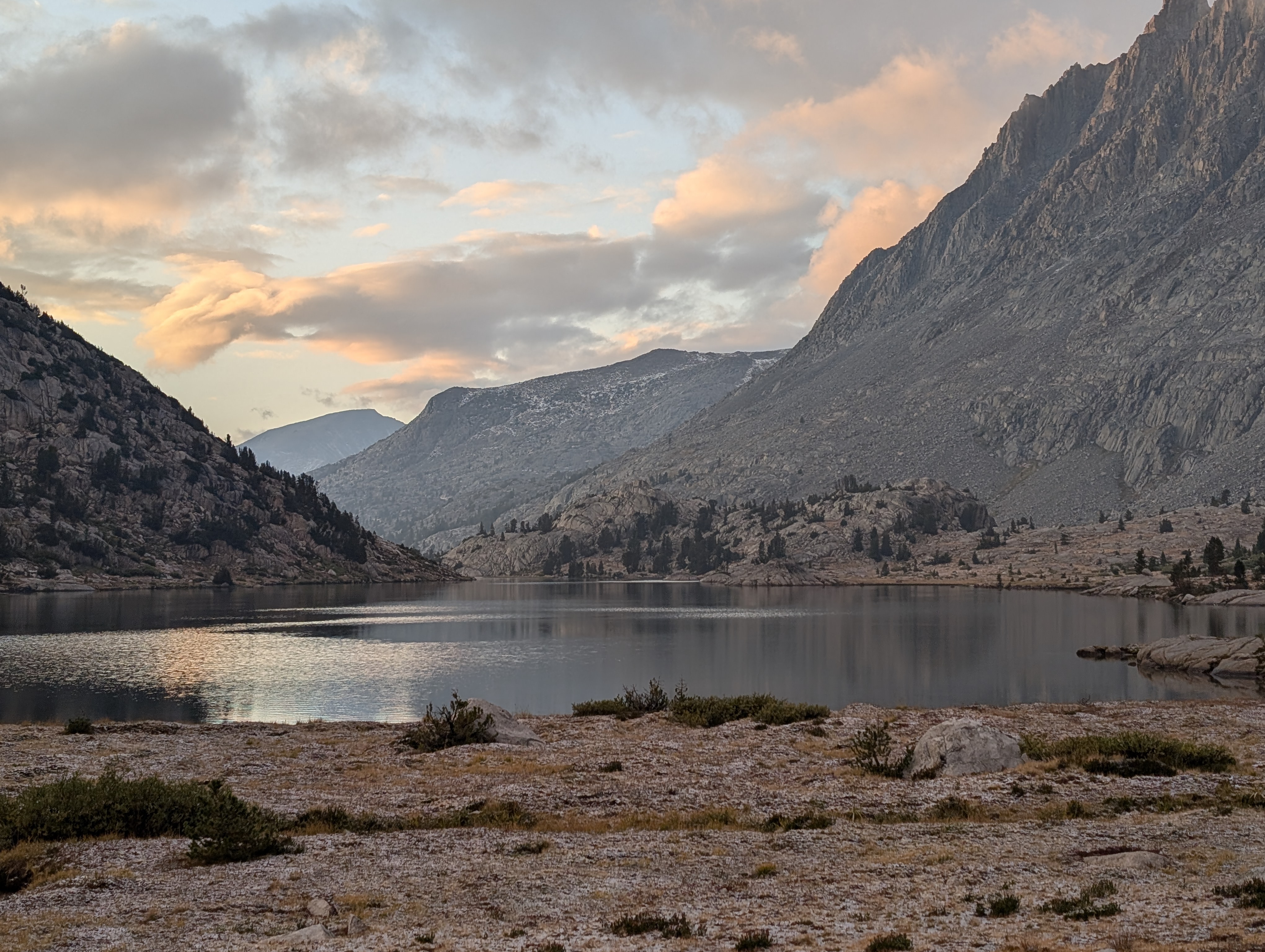
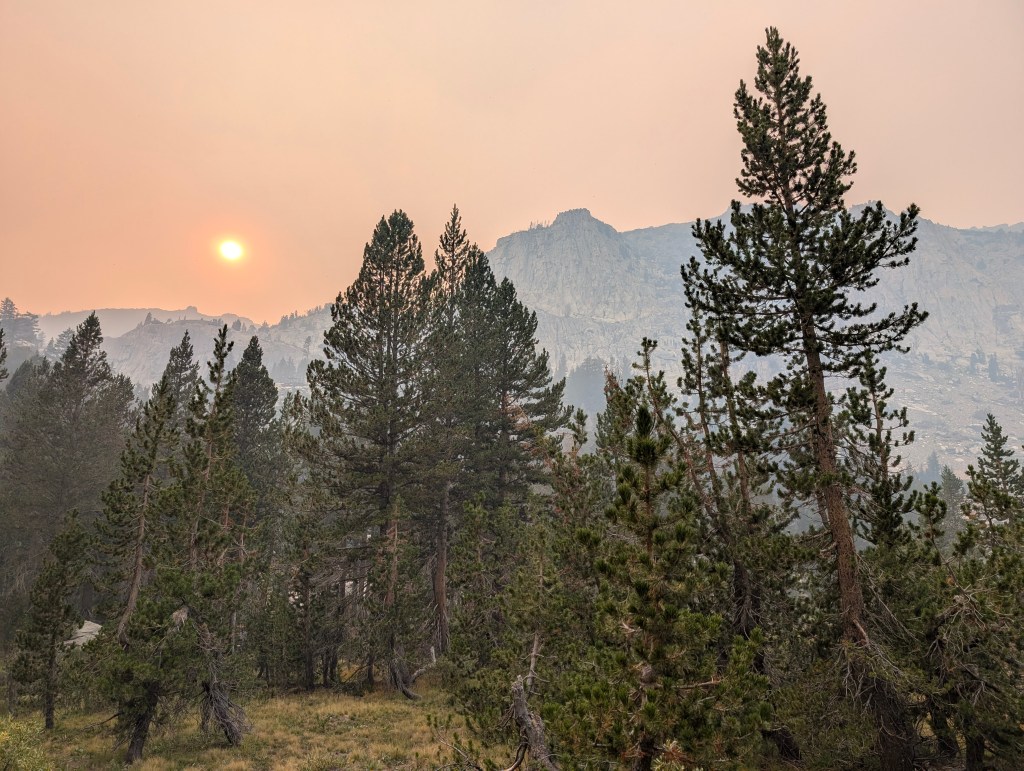
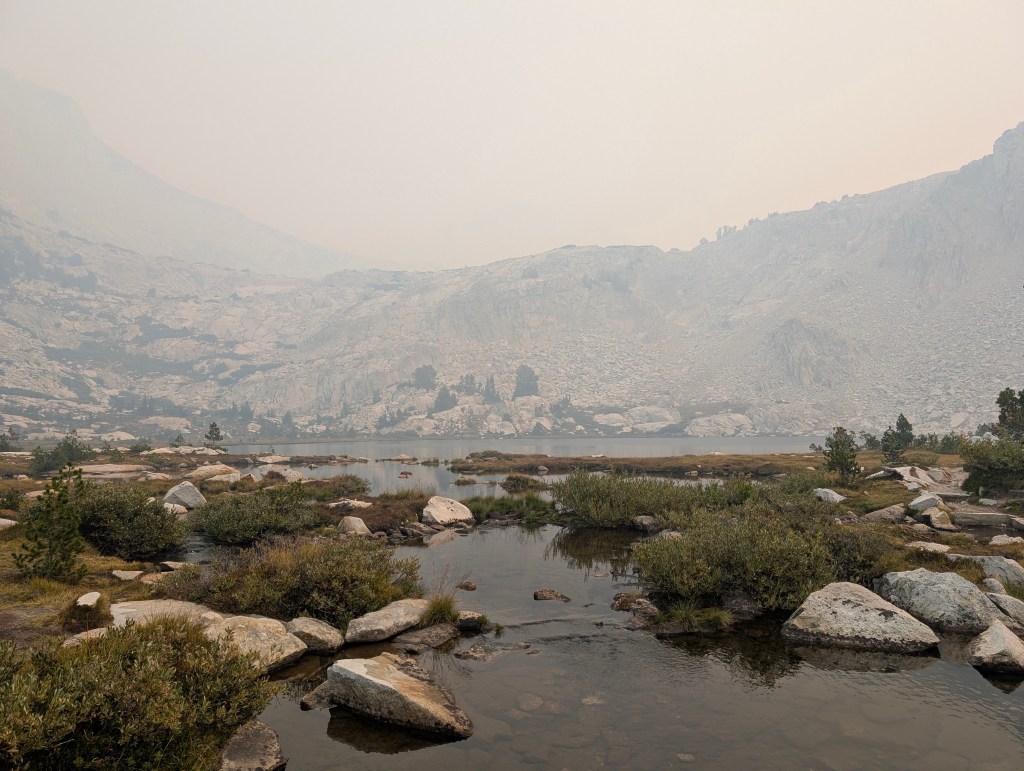
Evolution Valley on a smoky evening in September 2025

Days later I reached the famously beautiful Evolution Valley. The valley, as paradisical as any in the Sierra, was shadowed by orangeish clouds flowing into the valley and building up against the peaks. Blessedly, these same clouds that night brought rain, washing the air.

The precipitation resumed late the next day, as I panted my way up out of Evolution Valley to Evolution Basin, a thousand feet higher, but this time it came as hail and hardened snow. I hastily put up the tent. After a freezing night, the air at dawn could not have been cleaner. The grand views went on and on and into memory.

After a brief but intense snow storm, I made camp by Evolution Lake. View looking south, towards Muir Pass.

The renovated Muir Hut atop Muir Pass serves as a portal to the higher and much more challenging JMT in the Southern Sierra. Each of the next five 12,000-foot passes on the southern JMT took me a half day or more to climb, and as I made my way slowly up the switchbacks, I forgot my worries about smoke. In their long history, these rocky mounts have seen far worse — ice ages, avalanches, monumental floods — and recovered every time.

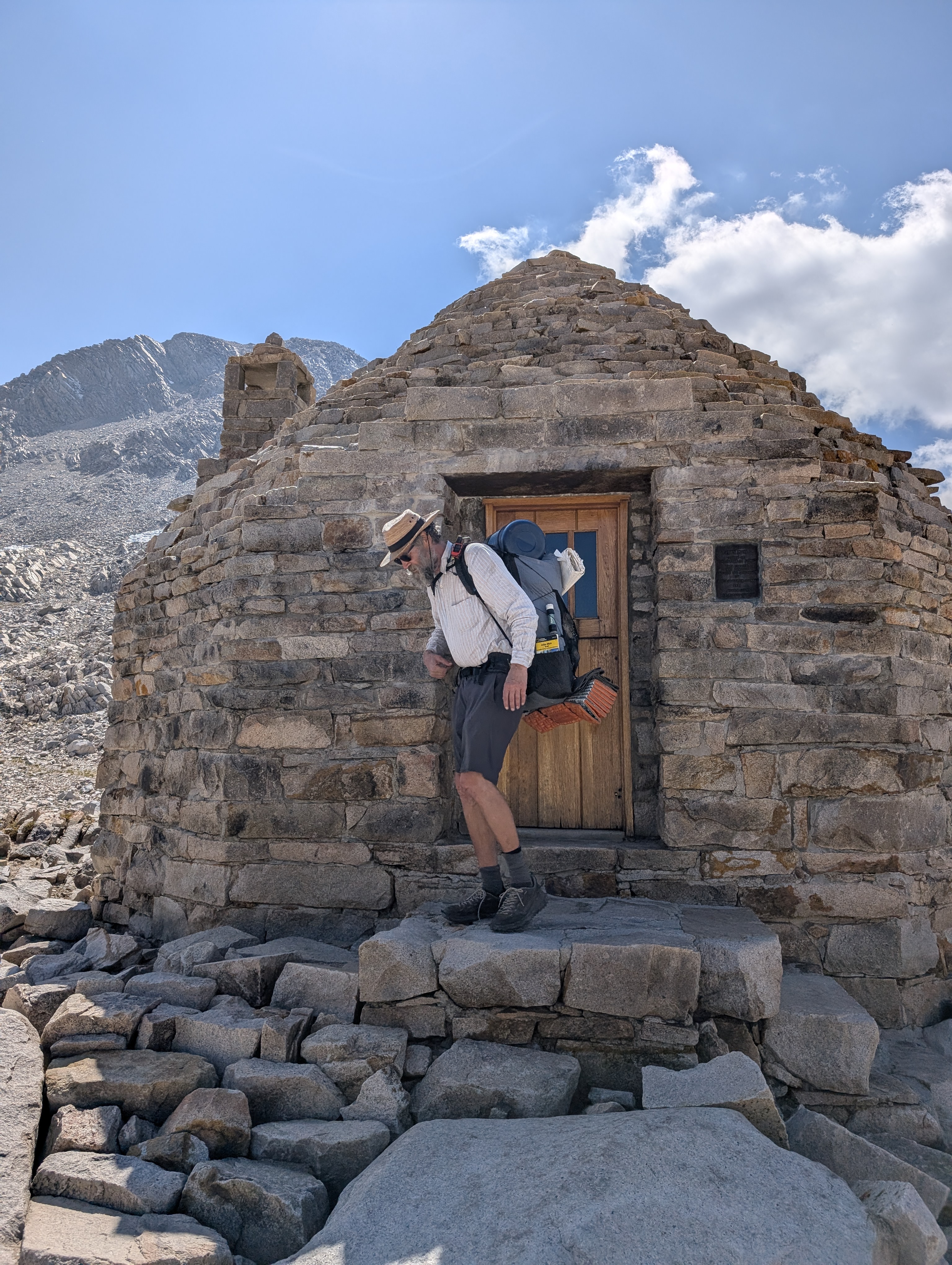
Stolz at storm center called Muir Hut at the top of Muir Pass

“By forces seemingly antagonistic and destructive Nature accomplishes her beneficent designs — now a flood of fire, now a flood of water; and again in the fullness of time an outburst of organic life,” wrote Muir, about Mt Shasta.

He could easily have been describing the timelessness of the Sierra. A few days of smoke cannot ruin these mountains, any more than a few crashing waves can ruin a beach. 

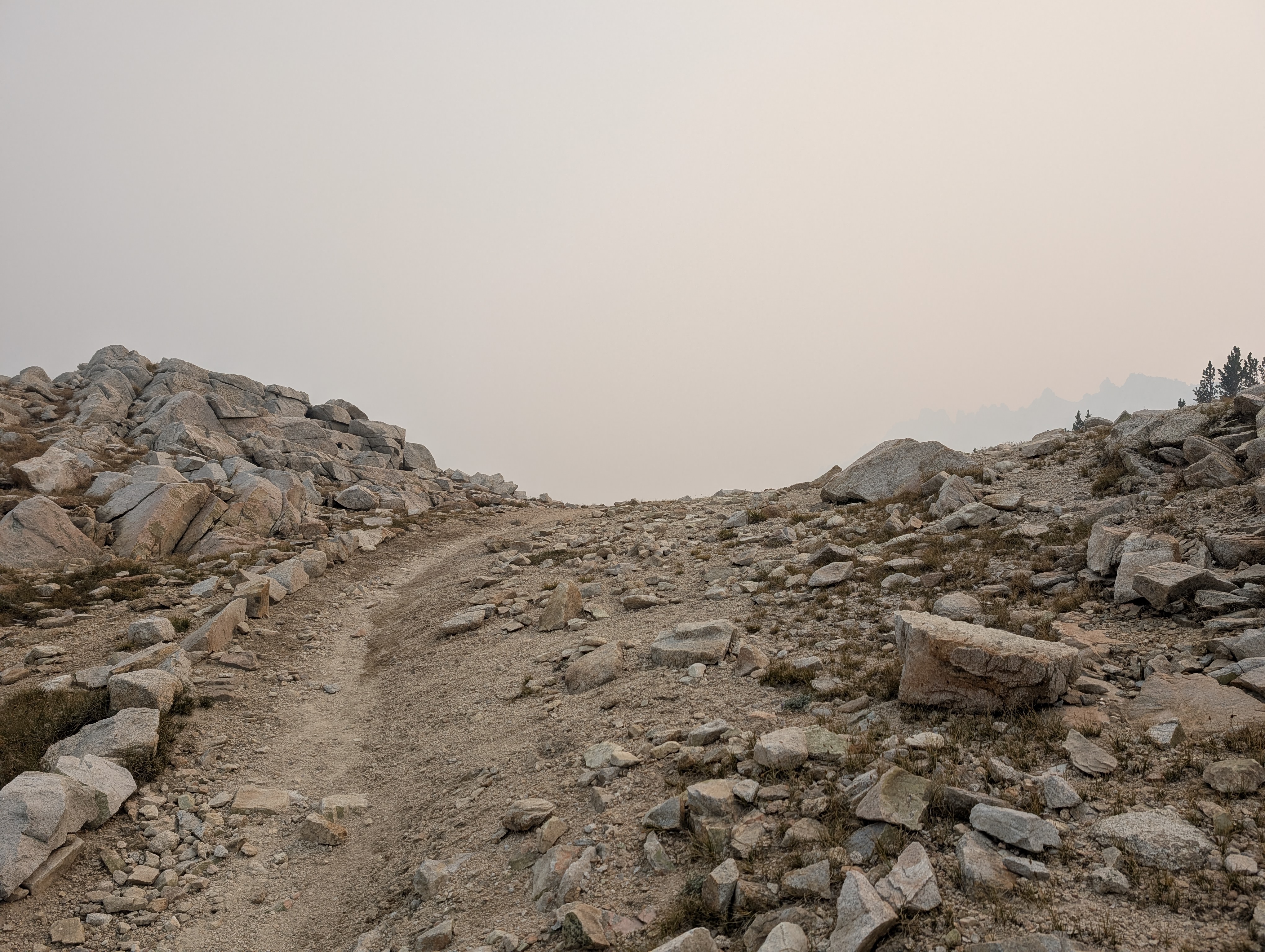
I headed up the all-but-endless climb up the Golden Staircase, a path that steepens pitilessly towards the top of the glacial canyon and Mather Pass. After seven hours or so I at last crested the final rise and collapsed at the top, on a tiny beach near an outlet stream. Rethinking my allegiance to this trail. 

Stolz after crossing over Mather Pass

Robinson too, as much as he adored the Sierra and admired John Muir, had no such affection for the JMT.  

“Have I mentioned that I don’t like the John Muir Trail?” writes Robinson snarkily in his “The Sierra Nevada: A Love Story.”

“The Interstate 5 of the Sierra, the crowd scene, the foot killer, the permit sucker? The 212 miles of nonstop human busyness?” 

Four days later, when on my way out I crossed over the Sierra crest on Kearsarge Pass in Onion Valley, the last of the high passes on my route, I decided in my weariness that he had a point.

Sign atop Kearsarge Pass reads: Entering John Muir Wilderness

One can experience the Sierra in all its glory without spending weeks on the Muir Trail. Muir himself often wrote of a day chasing a butterfly, or hours spent counting the tiny flowers in a yard-square of mountain meadow, or of simply strolling along in the sunshine. 

“Hiking — I don’t like either the word or the thing,” he wrote in 1911. “People ought to saunter in the mountains, not hike.” 

From Silver Creek to Bear Creek: SOBO on the JMT

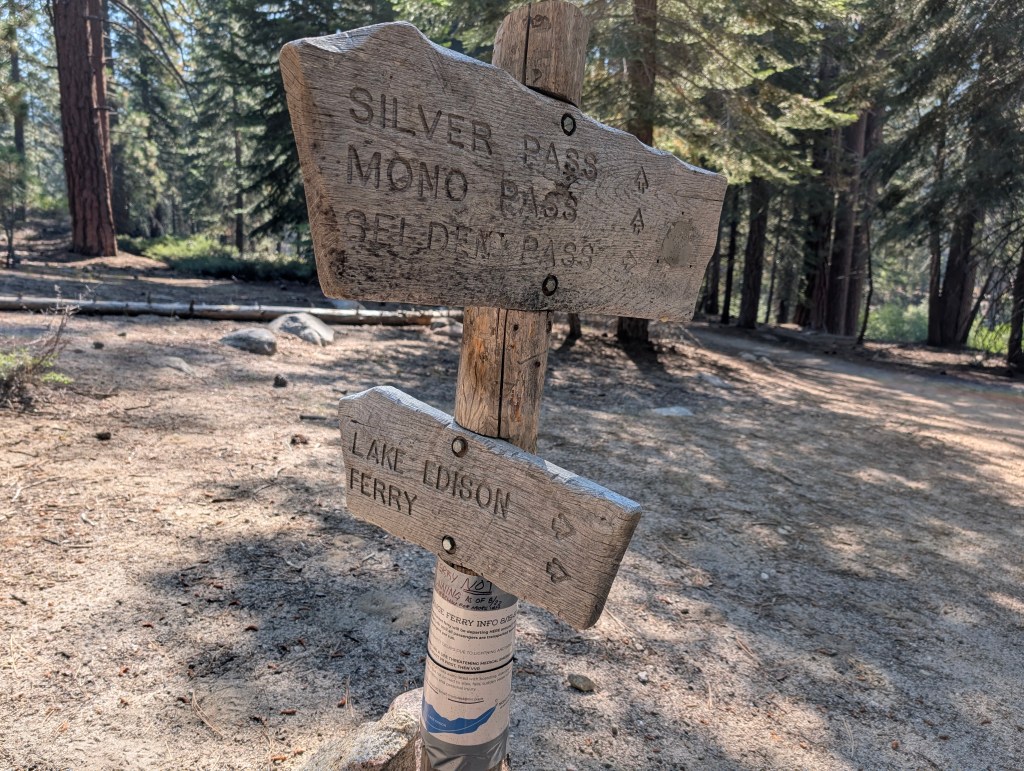
Here’s a junction sign at a crossroads: one arrow points towards Lake Edison and the Ferry, and another arrow points up the long forested hill to the Bear Creek Meadows area. It’s a relentless but soft under foot climb of about five miles and 2,000 feet.

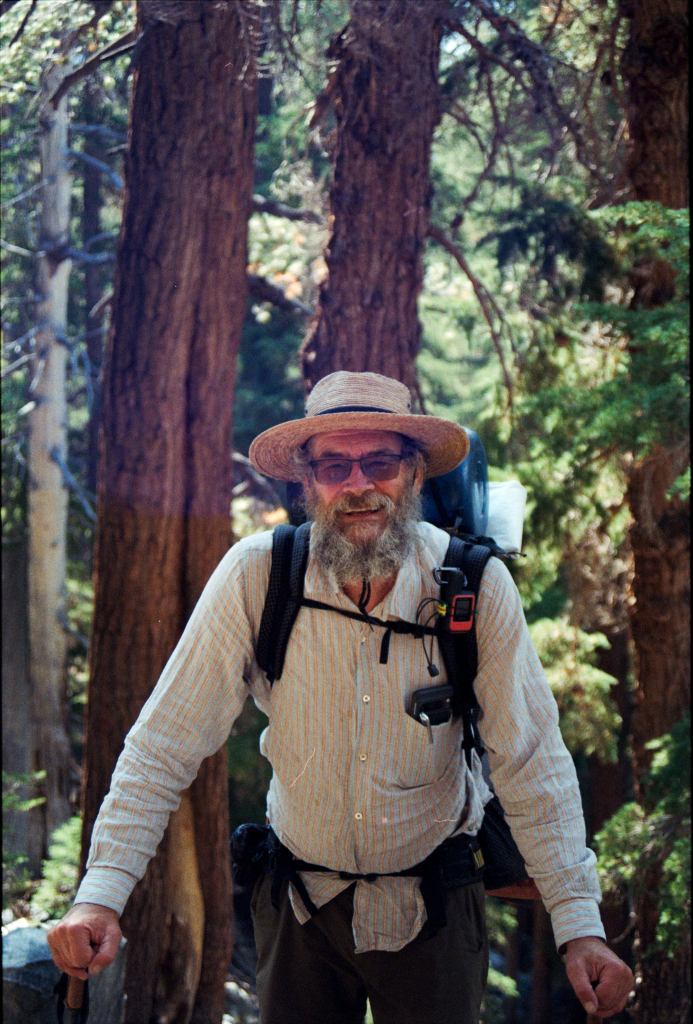
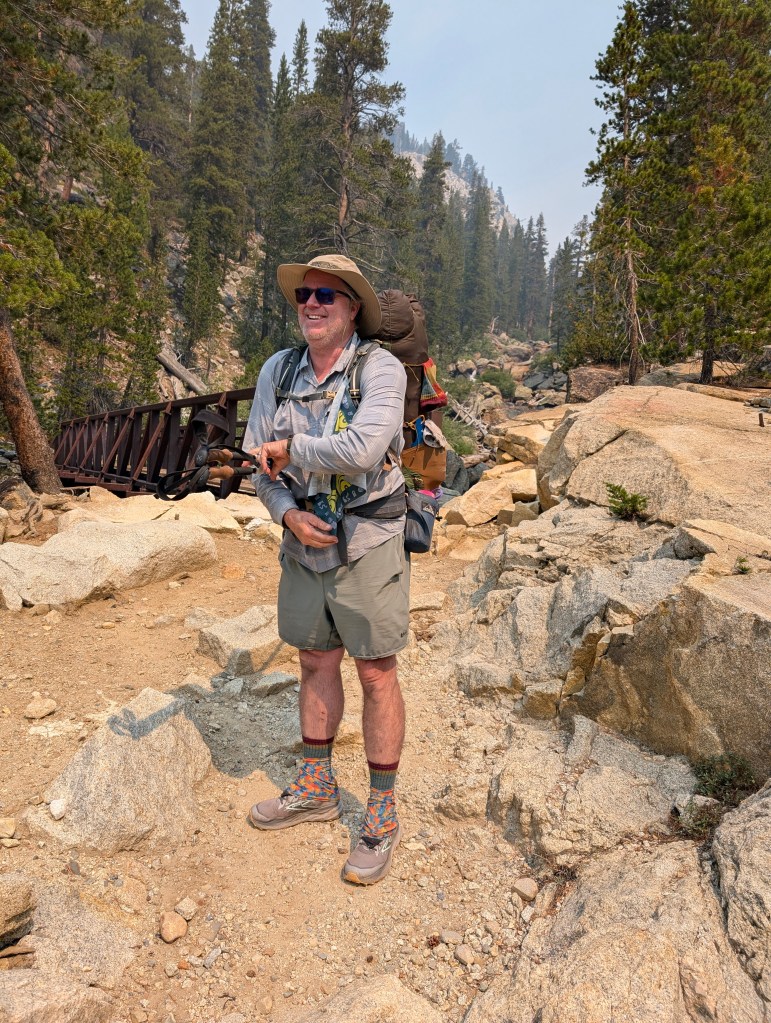
On that all-afternoon uphill stretch, I ran into a nice young man, Kelly Song, with a buddy, and a camera. He asked if he could take my picture, as he was experimenting with 35mm photography again. He said he worked in the movies. I said sure. So that’s what I look like on the trail, I guess.

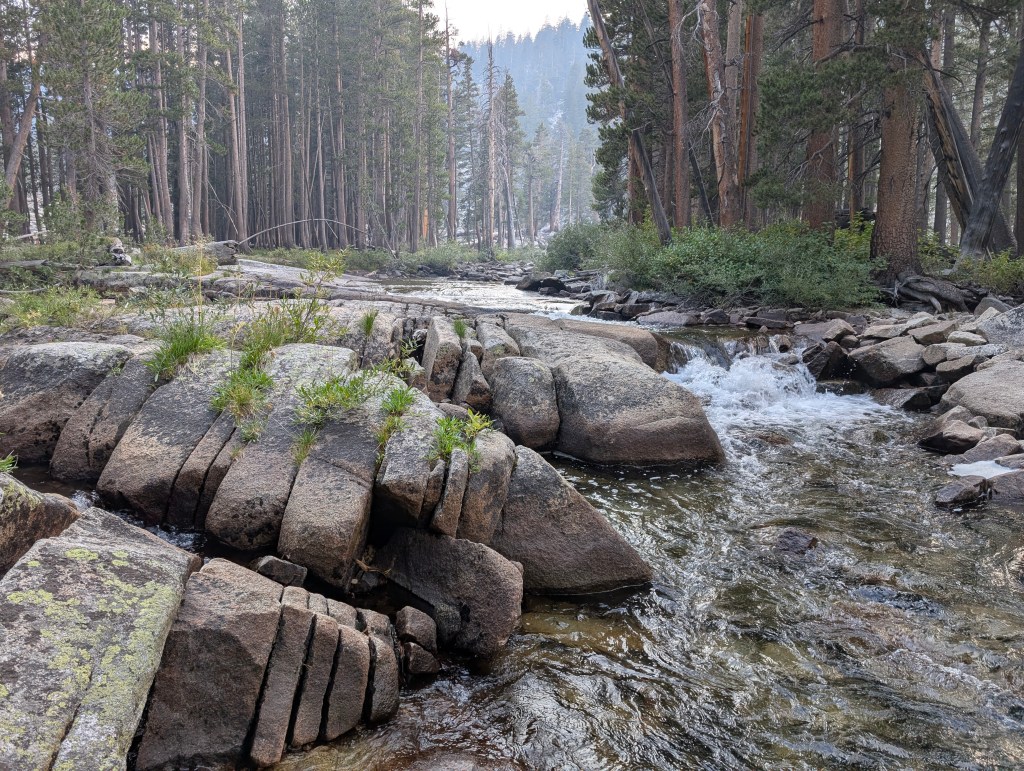
Ah well — though the trail can be demanding, and embarrassing, also it will surprise you with unheralded spots of surpassing beauty. At this stop on Bear Creek, shortly before the trail turned away from the water, I couldn’t stop photographing the Zen-like features of the water, the tall trees, the mosses and plants growing between the straight-line time-smoothed fissures in the granite.

I had nothing in particular to do at this campsite, and left promptly the next morning, as had become my custom, but nonetheless I could not get over the beauty. Clambered all over the water-smoothed surfaces. Loved it. Never forget it.

Smoky Afternoons on the JMT: SOBO Sept 2025

From Tully Hole and the Fish Creek Trail junction at 9,091 feet, the trail ascends almost seventeen hundred feet in 3.3 miles, so it’s a fairly hard climb to Silver Pass.

On the other hand, it’s a good trail and footpath too, and this time going over the nearly 11k pass I didn’t bonk or have to nap. I had adjusted to the altitude I guess.

On the southern side of Silver Pass (above) the trail fell moderately but persistently — as often happens on the JMT heading south, over a tough pass you find yourself sauntering down a broad valley — despite the lousy air, a lovely landscape. Everything was great except for the tainting of the smoke.

Now — away from Yosemite — I was meeting a different kind of hiker; experienced, athletic, often testing themselves against the famously difficult High Sierra trail.

I ran into this charming fellow named Chris, who spoke with an Australian accent. He was planning to finish the trail and then head home. He said he had been hiking from Horseshoe Meadows (and had covered most of the trail in six days) with a friend but his “mate” had injured his knee badly at Bubbs Creek and had already been evacuated and then flown home to Australia.

A few short miles over the pass I found a flat place not far from the trail, and not far from a little creek — ideal camping, obscure, pleasant, safe from prying eyes, even sheltered. I went to bed early, resolved to get up early, to wake at 5:00 to pack up, gulp down a cold-soaked oatmeal and protein powder concoction left to me by Chris and hit the trail at first light. At 6:15. These are cheesy old guy tricks, maybe.

I don’t care. I packed carefully.

Because sometimes these cheesy old tricks work — in fact the dawn air was clear as clear could be, if a little extra colorful in the far distances.

Trouble at the Fish Creek Footbridge: SOBO on the JMT, September 2025

The trail crosses the Purple Lake outlet at 10,078 feet: Chris consulted with passing hikers who said they were heading for an exit a couple of hours north on the Duck Pass Trail. More than one party we met had resolved to get off the trail, away from the smoke.

You couldn’t blame them, but the trail ascended gradually to pleasantly scenic Lake Virginia, and the haze in the air in the early morning wasn’t terrible.

Heading south the trail dives nearly 1000 feet in less than a mile or so into a little-known stream and valley paradise called Tully Hole. The trail’s not dangerous, but it’s consistently steep. Behind this veteran European thru hiker named Laurent, you can see the trail zig-zagging down the hill. Didn’t seem to both him or his party.

After a long hour of descent with a pack that wasn’t quite right, and clothes that were a little too warm, and socks that had some grit in them, I stopped to reoutfit, repack, get some water, etc — even though I know Chris was ahead of me and would get a lot further ahead of me because I stopped. But I felt like I had no choice. I couldn’t turn this into a race — not even against smoke.

And when I got to Tully Hole, I wished I was going yet slower, and that I could simply stop because it was so darn paradisiacal.

Eventually I caught Chris just past the Fish Creek Footbridge. He was frustrated because he had been there for an hour, even as the air began to worsen, and he couldn’t even move because he had to wait for me. We had a good talk: when he fully explained the obstacles, I understood why he had to turn around now — he couldn’t stand 200 miles of smoke, so it only made sense really to go back. Even though it was a big ol’ climb back to Purple Lake and past it to Duck Pass.

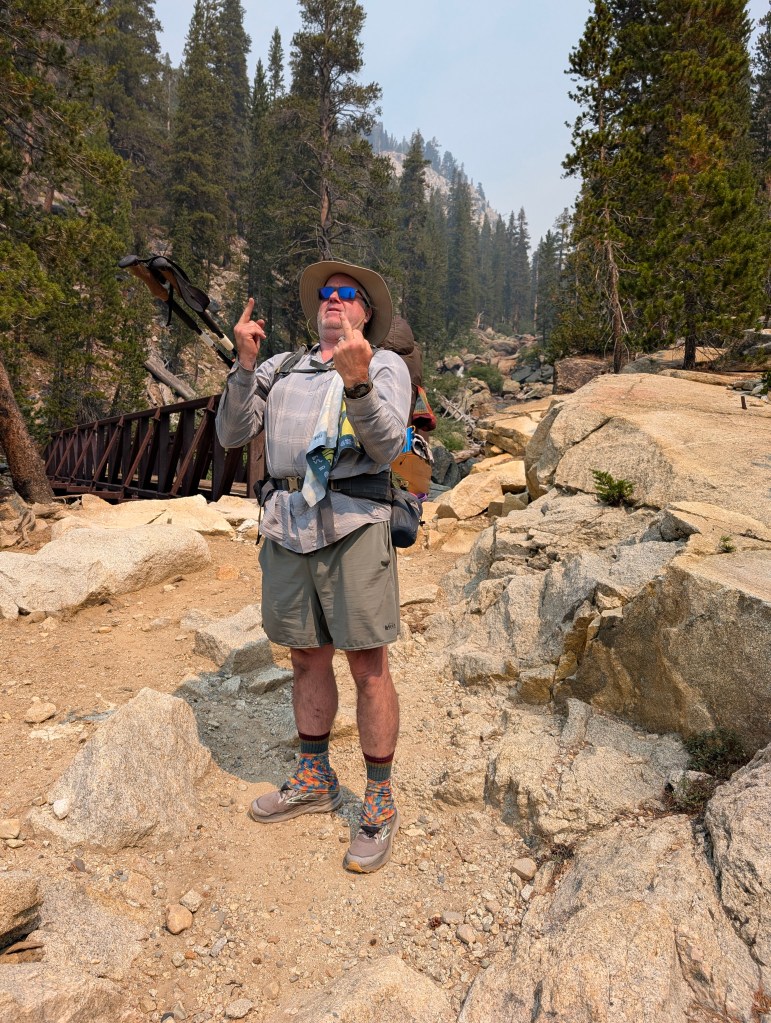
To the smoke that spoiled the trip for him he gave a hearty salute:

But he couldn’t stay mad for long:

We parted: Tugboat headed back to Mammoth by way of Duck Pass: I headed south for Horseshoe Meadows, first by way of Silver Pass.

When the smoke hit the throat: from Red’s Meadow to Purple Lake

Everything changed the morning that Tugboat and I left Red’s Meadow, headed south and uphill, aiming for the popular and memorably beautiful Purple Lake.

Red’s Meadow is at a low spot on the JMT — 7,630 feet — and heading south the trail climbs mostly gradually but steadily to 10,300 feet and Duck Pass.* Not a bad trail at all, except the air was the stuff of a horror movie, or an apocalypse.

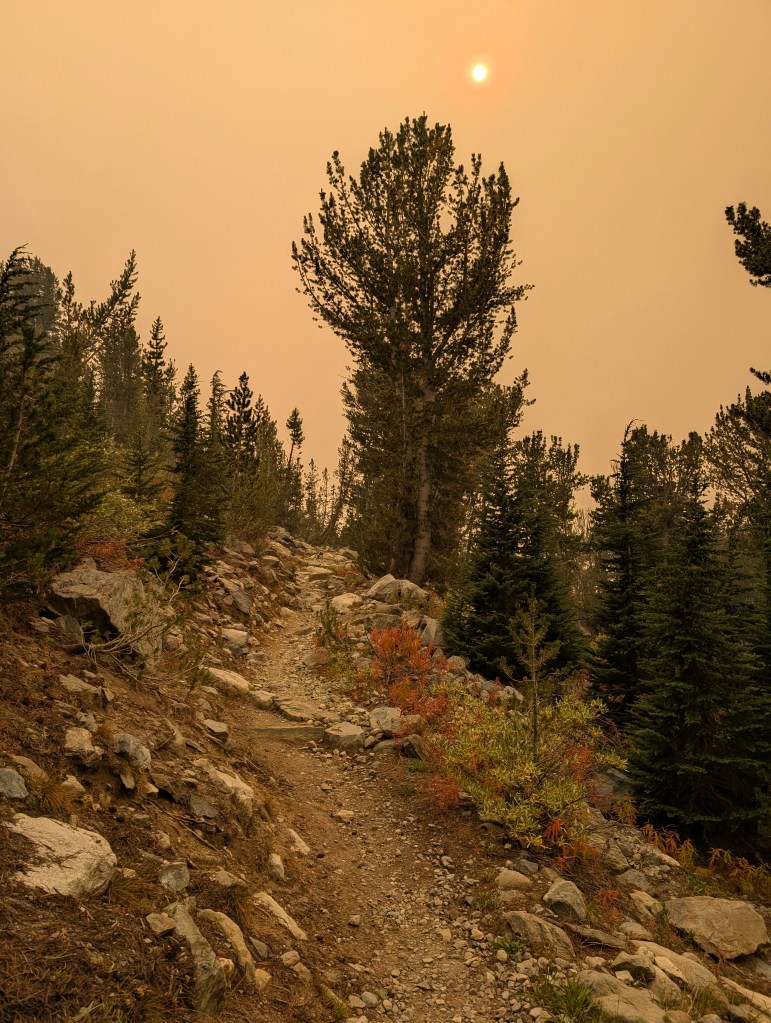
Before the day was out we began to feel the air scratching at the back of our throats. We played hopscotch on the trail with Jamie and Marie, also SOBO on the JMT, and ran into one party of folks heading for a pass. This was a party of three women, one wearing a knee brace, clearly experienced and knowledgeable. The apparent leader — with dark hair, a strong profile, and a confident way of speaking — was wearing an N95 mask, and from what she said, they were heading for an exit to Mammoth, although they did say the mornings were fine, and she spoke of getting up really early — like 4:00 am — as a possible strategy.

Near the Mammoth Cutoff Trail junction, Chris took a break and let me catch up and told me that he was “not thrilled.” He didn’t like the way the air was hitting his throat, and didn’t think he could complete the trail if this continued indefinitely.

I heard that but let him know — I think — then or later that I was resolved to continue, partly because this was the thirtieth anniversary of my first journey on the JMT, and partly because I committed myself to this endeavor, despite my advanced age of seventy years, and would be embarrassed if I fell short.

But I did have second thoughts, I admit, when I saw a Purple Lake outlet smothered thick noxious woodsmoke.

What to do? Still, to get off the trail was unimaginable to me. I privately resolved to make this part of the adventure, come what may, but what I didn’t fully grasp was that Chris was facing a crossroads that very night, or actually earlier, a couple of hours down the trail. For him to go on was to commit to 200 miles. Possibly in smoke. To exit at Vermillion/Mono Hot Springs wasn’t really possible because the ferry and the VVR had unexpectedly closed due to a death. To exit at the next resupply, Muir Trail Ranch, was conceivable, but would mean somehow who knows how going over a hundred miles through the mountains on back roads back to Tuolumne Meadows with little or no public transportation — at least a day’s journey, if not much longer.

Chris got pretty quiet, but went along as I suggested we get up and get going really early, to take advantage of the clean air, and to try and beat the smoke south, away from its drifting pattern. I did have worries. I recalled — or was it Chris who said this? — that Snappy and Ryan were getting off the trail to get away from the smoke, because it was said to be bad down south towards Vermilion. I recalled what a fast-moving duo of guys mentioned they saw down this way — what they described as “a wall of smoke.”

Kind of like this?

[*Chris noted the junction, where a trail could take you in less than a day over Duck Pass to the Mammoth Mountains area, where he happened to have an uncle and friend willing to pick him up and take him to his vehicle at Tuolumne Meadows]

Southbound on the JMT: Gladys Lake to Red’s Meadow

From Gladys Lake to Red’s Meadow is what Muir would call a saunter — a long lovely walk, brisk but as it happens mostly downhill, through a sunny and mostly dry forest. Not especially taxing and pleasant in a cozy sort of way, such as this little trailside pond, which officially is one of the small Trinity chain of lakes scattered along the eastern side of the trail here, a little north of Red’s Meadow.

Well, we sauntered right into Reds Meadow, at which point I apparently completely forgot that my phone also has a camera in it useful for documenting people especially, but also places and even things, so I’ll have to briefly recount what happened in our enjoyable afternoon and evening at Red’s Meadow Resort, near Mammoth, and available by bus line.

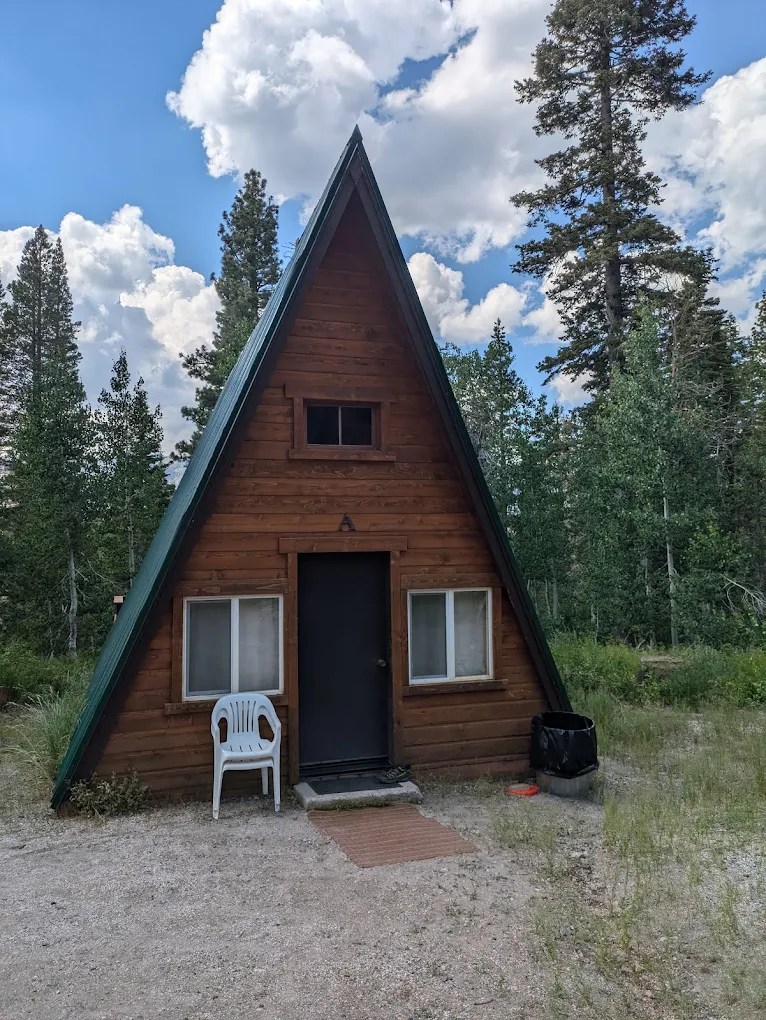
Perhaps I was shy, as sometimes happens when I first hit the trail, but Chris likes town stops, and of his own volition booked a hiker’s cabin at Red’s Meadow, so we had a chance to shower, launder some clothes, and have a couple of generous old-fashioned diner sort of meals — tuna melt, that sort of dish. Teenagers at both the take-out window and the store across the way were stepping up to man the register and the griddle, and seemed eager to please. Enjoyable to see that kids can still be kids, at least some places. Here’s the hiker cabin Chris rented from Red’s Meadow Resort the morning of our arrival on September 6th.

Among the ‘packers at the tables, scarfing down food and waving away the persistent and abundant and carnivorous bees (actually wasps no doubt), were the voluble Beans, a balding middle-aged man with a silver goatee, and two chatty and friendly gay men, who we in time met and hung up with, named Snappy and Ryan, and two 30’s or so women, who in time I came to know as Jamie and Marie.

The universal subject of conversation was smoke from the Garnet Fire, started by lightning, which had been burning for nearly two weeks in remote heavily wooded forest land well to the south, a few miles from Cedar Grove, in Sequoia-Kings Canyon National Park to the southwest. Though a considerable distance from Red’s Meadow, hiker reports and some modeling available online showed a lot of smoke in the midsection of the Range of Light, well south of Yosemite but north of the much bigger and taller mountains to the south, and including famously beautiful waterfall trails such as one passing through Evolution Valley.

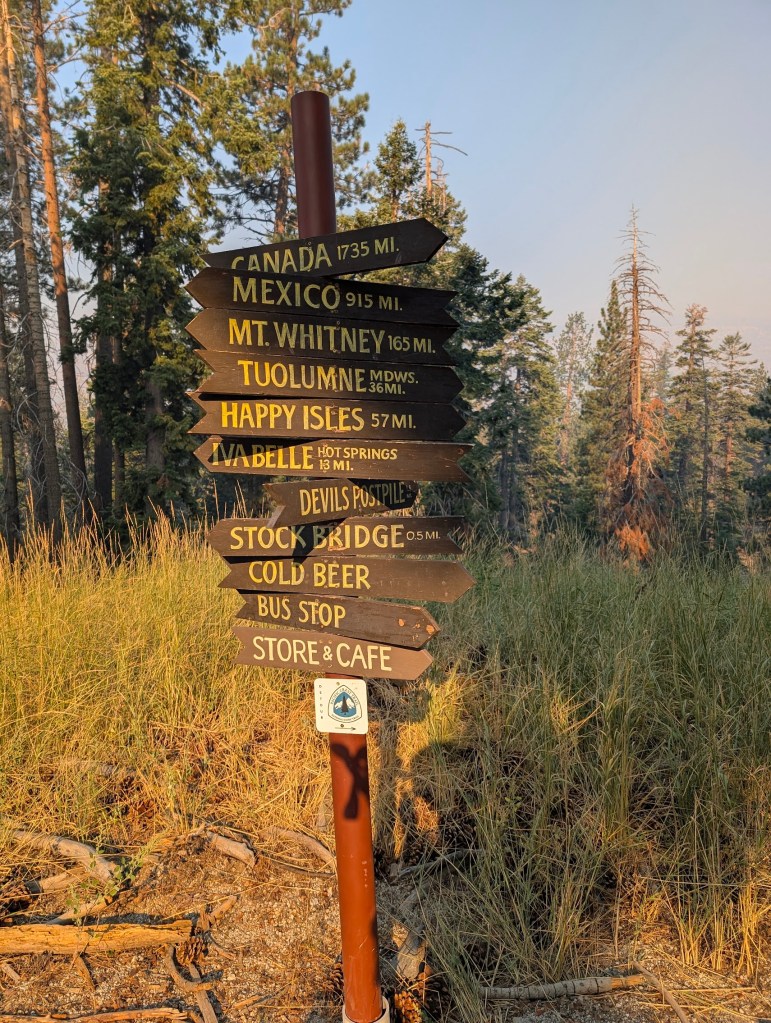
When we woke in the morning and headed out, fairly early, with packs weighty with food for the four days before our last big trail resupply, at Muir Trail Ranch, the smoke hung ominously in the tall pines. A long ways to Whitney, as the sign said.

Southbound on the JMT: Thousand-Island Lake to Gladys Lake

We had a luminous full moon night at a well-known campsite overlooking the famed Thousand Island Lake, this early September night. Though the ground was a flat planteau made mostly of granite, the tentsites were impressively well laid out and groomed completely clear of sharp little rocks or stones by thousands of ‘packers, perhaps). We pitched tents under the soaring majesty of the Ritter-Banner Mountains, half expecting to be joined by others hikers. We were on a small plain of sorts no more than twenty-five feet or so above the trail, but still not much visible from below, with numerous tentsites to spare — perhaps a half dozen.

Once while getting water a pair of young men asked me if there were sites up where we were, and I said yes and said they were welcome to stay, which was true. (I knew Chris would agree.) But they nodded and moved on.

The trail winds its rocky way over ridges and past a couple of little lakes, Emerald and Ruby, before going up and over a ridge and then descending rapidly to sizeable Garnet Lake. It’s worth mentioning that the trail here was as crowded as any Sierra trail for thru hiker types that I’ve ever seen, and a lot of the hikers passing me by (no complaint) didn’t seem to know the rudiments of hiker etiquette. Oh well. I didn’t either, when I started, and who knows what gaffes I may have committed.

I find that the John Muir Trail is frequently used as a means to an end: a sort of self-initiation, a preparation for an entirely new life. For example, when I first walked the trail, in July-August 1995, I fell in with a quietly determined young Asian-American man who was preparing himself to go to law school that fall. We went over Glen Pass in deep snow together as I recall (wish I could remember his name).

My doctor Andrew Mace told me that he walked the trail the summer before he went to med school. In my experience you encounter a lot of people who are testing themselves against it, and with cause: it’s a real effing challenge, some of those passes. I saw a couple of trail runners go up Glen Pass, dancing lightly up the path past me, lithe, a couple in track gear, carrying almost nothing but a little water. Still, Glen Pass is 11,926 feet in elevation above sea level. It’s more manageable than some other passes, because it does employ switchbacks, but a lot of those switchbacks are tight and steep, with big granite steps to negotiate, and even the trail runners slowed to a walk as they maneuvered around and through the stones and boulders of this winding trail, which keeps its summit hidden from view.

In this case the pass over which the intrepid ‘packer must climb, is nowhere near 12,000 feet, but nonetheless a challenging uphill trudge, as can be seen below when the black line of the JMT turns angular and twisty,, such as climbing up out of the Garnet Lake basin, an elevation gain of 400 feet in a half or quarter of a mile. (This is the area just above and to the right of the “No camping within –” warning.)

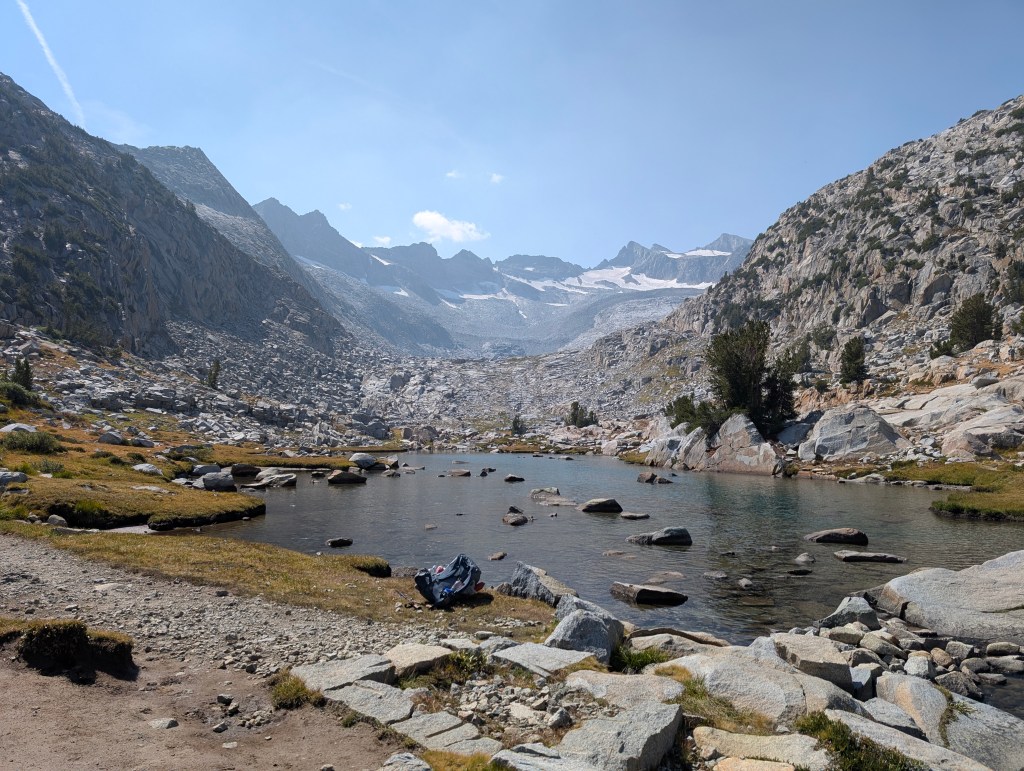
But our reward for going over that pass and continuing on a little later in the day than would be my preference was the discovery of a platonic ideal of a campsite; just off the trail at Gladys Lake, towards the lower end of the JMT in the map above.

A perfect campsite: properly sited more than 100 feet from the friendly circle of Gladys Lake, but not too far — one could fetch water easily. The camp was well off the trail and not visible to passers-by, but still obviously a well-known and well-used camp. Just over the crest of a ridge was a vast canyon, through which Shadow Creek runs. This is the one section where the JMT has split from the PCT. It’s spectacular and at the same time homey as you could want, with a kitchen area all set up, a firepit with some wood left by previous campers, two or three perfectly groomed tentsites. A big ol’ log to rest your back on. Lovely.

I experienced many a gorgeous campsite on this trip, but it’s hard to compete with a “grand show” such as this. The extraordinary cloud formation I believe is the edge of a vast swirling monsoonal system, one that more than once during the course of this journey turned stormy and sometimes even threatening.

Southbound on the JMT September 2025

A good friend and I set out to walk the John Muir Trail SOBO this September, and found ourselves on a journey. Life altering, at least regarding certain factual matters. Such as the fact that I will never go over Mather Pass again. Twice is enough. Never!

Here is a record of sorts of our progress. It’s mostly an excuse to post pictures of the Sierra and my fellow pilgrims.

This grand show is eternal,” as Muir said, and “See how willingly Nature poses herself on photographers’ plates. No earthy chemicals are as sensitive as those of the human soul. All that is required is exposure, and purity of material.” [John O’ the Mountains, 1872]

We launched from the trusty NPS Wilderness Permit office in Tuolumne Meadows, where I turned in a permit I had gotten to leave five days later, after my buddy Chris /Tugboat leapt on an opportunity that came up on the website and got a permit for us to leave on the 3rd (of September). We knew we were carrying too much but we correctly wanted an accurate toll of the damage, and asked if they had a scale and they did, but no hook to hang it on, so we had to awkwardly hold it in the air to get a reading. I was a little over 34 pounds; Chris was a little over 35. Too much. Tugboat cussed at that, half-joking, half-not. We both have an overpacking problem.

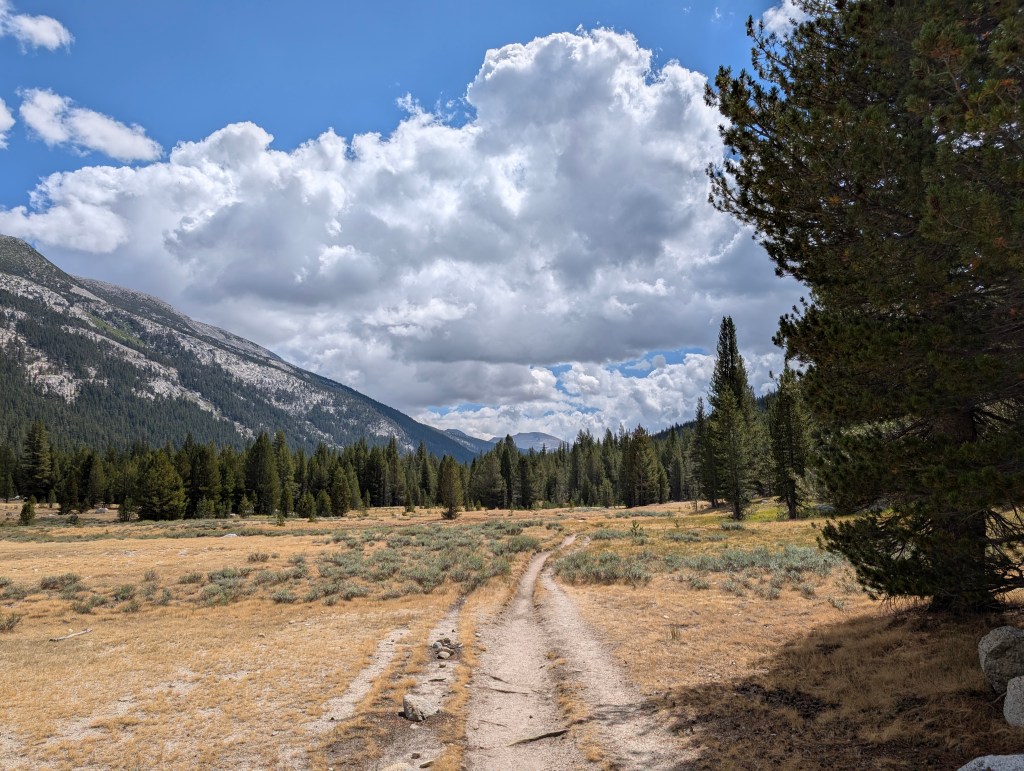
Regardless, we set out promptly at 10:30 on the trail up Lyell Canyon, and soon enough fell under its spell. Countless people have walked this trail for thousands of years, with little doubt — it’s so obviously the way south from Tuolumne Meadows that some today call it the John Muir Freeway.

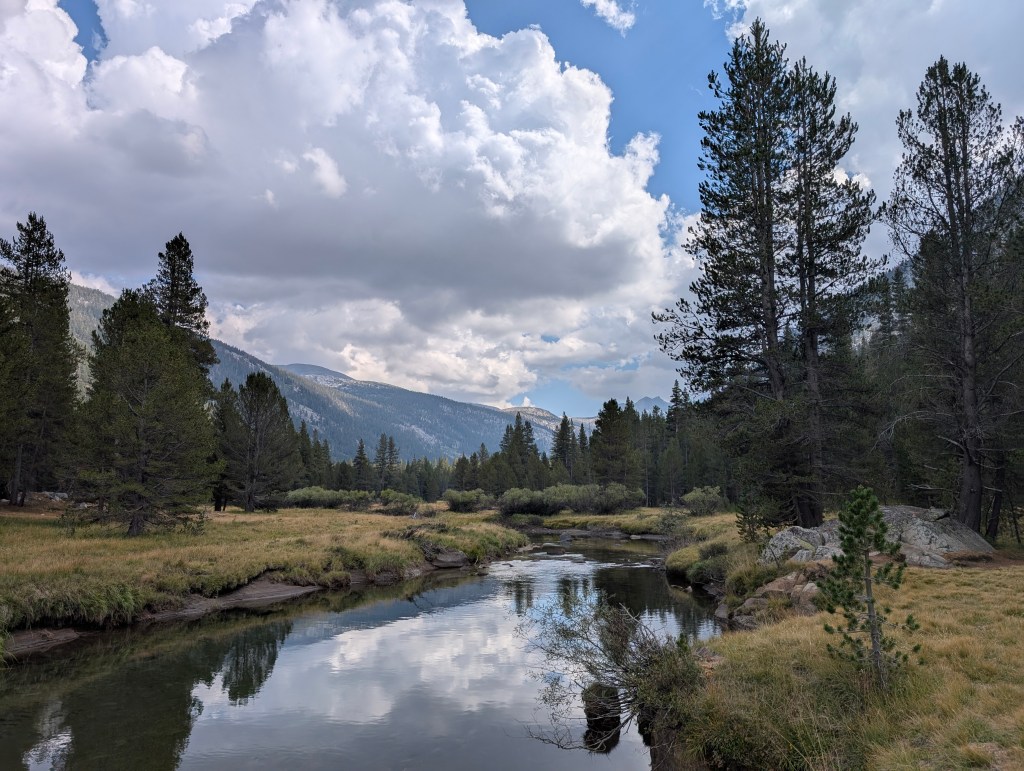
Yet it still entices. One finds startling pictures without hardly trying, as so often seems to be the case with the Sierra.

[Space for graphic profile of the Lyell Canyon part of the JMT heading south out of Tuolumne Meadows and up towards Donohue Pass. ]

Suddenly the trail takes a turn upward and before long one ‘packer after another is panting as the trail switchbacks up a trail that’s increasingly rough, with lots of boulders to maneuver around. Those suffering people included Tugboat and me, Heavy Lit, and countless others, many of them faster than us. We were really hffing and puffing: the trail ascends a little less than a thousand feet, and plateaus briefly before resuming an ascent out of the valley below.

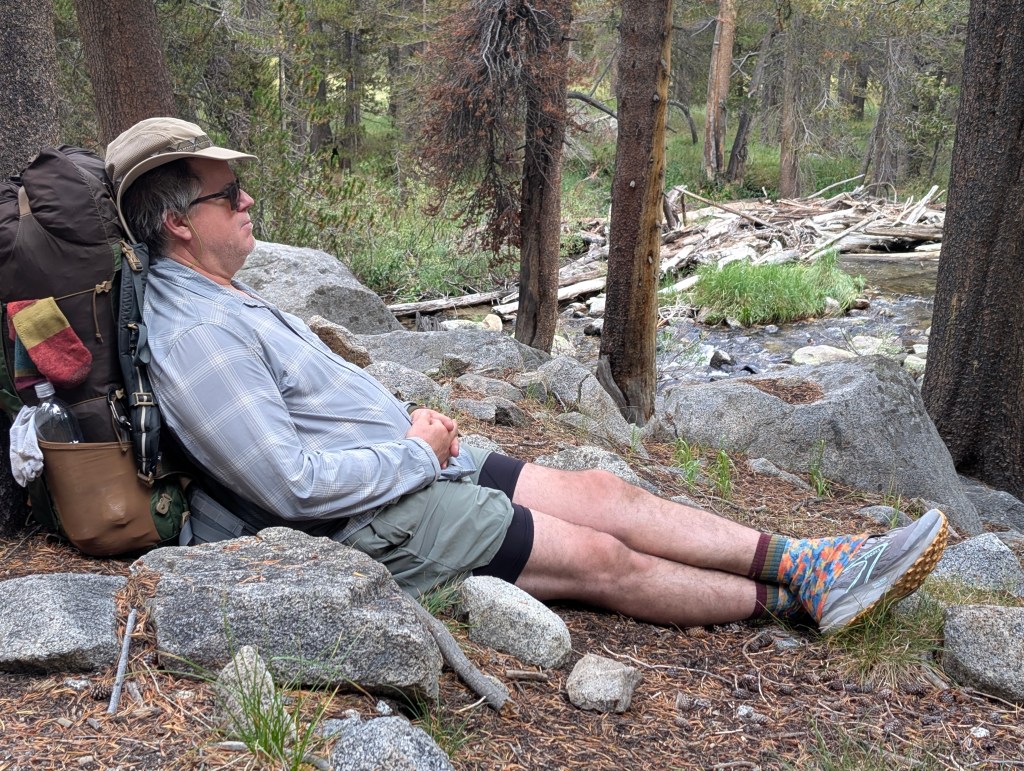
We found a perch to catch our breath and rest up for the final ascent of the day. Despite our late start, we had climbed switchbacking up out of the valley and we felt it. My heartrate was getting into the exhausting territory. “Really kicked my butt,” Tugboat said, before falling into a much-needed recovery nap. I was not fortunate enough to fully sleep, but boy I needed the rest, a break from climbing.

A half an hour later we found a lovely place about 200 feet from Lyell Creek. A designated spot, well below the trail, and private, but well above Lyell Creek, and hygienic. Perfect. Next morning we and at least a hundred others set out for Donohue Pass, leaving on our right, to the southwest, the remains of Lyell Glacier.

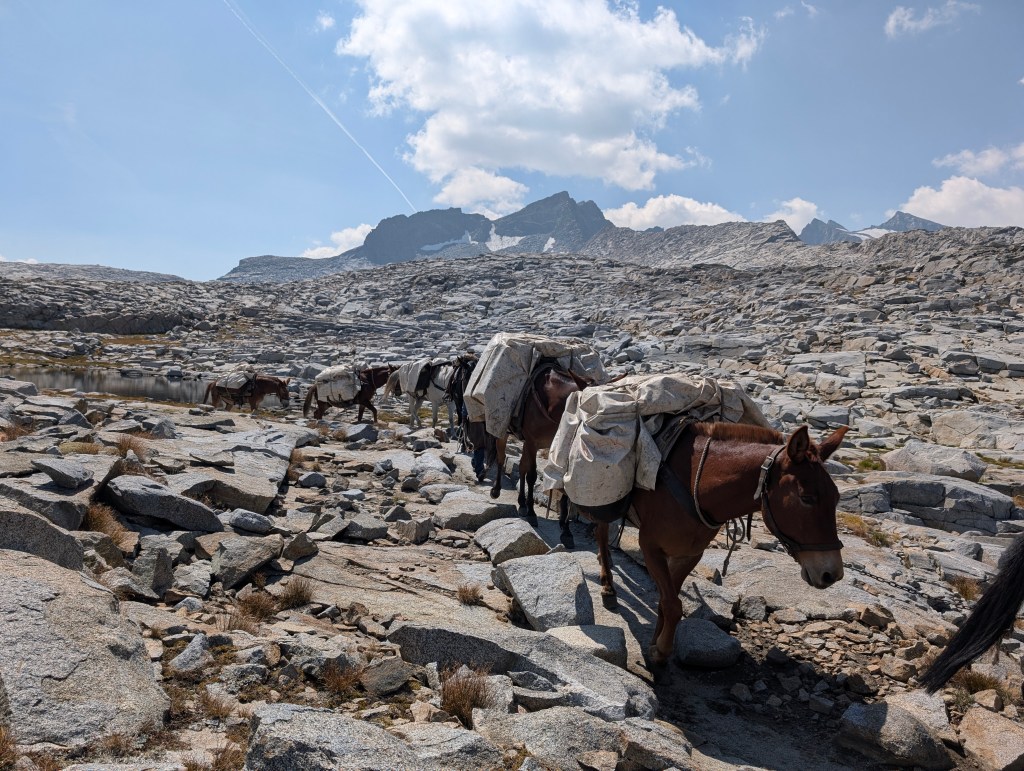
By lunch we were at the pass, at a moderate 11,000 feet, and quite heavily trafficked — including mule trains.

Now we were in the Sierra, with the mountains — such as Banner-Ritter — to prove it.

We camped that night at fabled Thousand-Island Lake, and happened to meet — to our good fortune — the folks who had hired the mule trains. They had a large party camped higher up on the hill, with a fabulous view of these great mountains. The fellow said he used to be a triathlete, and couldn’t carry a pack anymore, but he still loved the mountains, and they hired mule trains to go as a party, and bring a kayak, and kayaked around Thousand-Island Lake! And they gave us each a muffin! Did not expect trail magic well off the trail at the start of the High Sierra.

Come back soon for more JMT in 2025!

Sons of the Second Son; or, origin of the redneck, by James McMurtry

This is a song from the great and often unjustly overlooked Austin-based rocker James McMurtry about — he says as he says introducing this new song — “18th century feudalism and primogeniture and their combined effects on modern-day American redneck culture.”

After playing to countless “rooms full of rednecks” in Texas and other Western states, the hard-bitten and almost menacingly articulate McMurtry started thinking the origin of the redneck as a people, where they came from and where they went. He learned that in the past in Europe if you weren’t the first-born son, you got nothing, basically, from your family, and so why not start over someplace new?

From that demographic fact he draws some pretty interesting conclusions.  Here he is live this year with his fellow road warrior Betty Soo in Northhampton, Mass.

[Note: when I saw him at the Troubadour in L.A. a couple of months ago, he encouraged anybody “good with the intertubes” to post video of this song, because he said he “wanted to get it out there.”]

I introduced this song to some musician friends of mine and they were impressed, especially with McMurtry’s ability to subtly develop and sing out a this-is-who-I-am voice of the redneck. (And the redneck, for good or not good, clearly is a figure central to our culture.)

In the old world when your race was run
It all went to the eldest son
What’s the poor second son to do?
But join up with the common man
Set sail for the promised land
Across the might ocean blue
And they made us who we are
So let’s wave those stripes and stars

[chorus 1]
For the sons of the second son
Products of genocide
Polishing up their guns
Righteous and justified
Sons of the peasantry
Thinkin’ they’re finally free
Sons of the peasantry
Thinkin’ they’re finally free
Sons of the faithful serfs
Salt of the blessed Earth
In search of a master


[Verse 2]

And for a while we did okay
Or lookin’ back it seems that way”
Tried to put our best foot down
We left tracks in the lunar dust
Did away with the meaner stuff
All could ride at the front of the bus now
Didn’t need no Jim Crow car
And we thought we’d come so far

[Chorus 2]

Sons of the second sons
Products of genocide
Polishin’ up our guns
Eating that Southern Fried
Sons of the peasantry
Tellin’ ourselves we’re free
Sons of the faithful serfs
Salt of the blessed Earth
In search of a savior

[Verse 3]

Nowadays we’re feelin’ stressed
It’s all for us and damn the rest
Tellin’ each other have a blessed day
All camoed up and standin’ tall
Building bombs and border walls
As all collective conscience falls away
And they wave those stars and bars
Is that really who we are?

[Chorus 3]

Sons of the second sons
Products of genocide
Polishin’ up our guns
Payin’ on double-wides
Sons of the peasantry
Tellin’ ourselves we’re free
Sons of the loyal serfs
Salt of the blessed Earth
In search of a savior

[Chorus 4]

Sons of the second sons
Products of genocide
Polishin’ up our guns
Livin’ in double-wides
Sons of the peasantry
Tellin’ ourselves we’re free
Sons of the pagan serfs
Salt of the fuckin’ Earth
In search of a Caesar

The Unfurling at Yosemite

Nate Vince, the locksmith at Yosemite National Park until this month, protested the the termination of his and countless other positions at the park by hanging — upside down — an enormous American flag on El Capitan.

It’s a New Yorker story — rooted in a human life, fueled by the energy of the subject and his outrage, but also aware of the inescapable ironies. By Brad Weiners.

Nate Vince

Before a visit to Yosemite National Park, it never hurts to reacquaint yourself with the hazards that can accompany its wild beauty: rockfalls, the swift currents of the Merced River, an encounter with a bear. (Never throw food at one.) A lesser, more recent concern: getting trapped in a park toilet.

Locks that jam, handles that break off, doors that stick owing to swings in temperature—these lavatory failures afforded the Yosemite Valley’s go-to locksmith, Nate Vince, a measure of job security. Or so he thought. On Valentine’s Day, Vince, a forty-two-year-old welder turned park staffer, was among a thousand National Park Service personnel who were terminated via e-mail, a shock that he shared on Instagram: “The people that fired me don’t know who I am, or what I do.” Vince does a great deal more than free tourists from rest rooms. For four years, he shadowed the previous locksmith, getting to know thousands of keys and locks in the park, from gun safes and an on-site federal courtroom to storage lockers for emergency medical supplies.

His time suddenly his own, Vince got an idea to photobomb the park’s annual “firefall” spectacle as a protest. For two weeks in late February every year, the setting sun lends the snowmelt at Horsetail Falls an orange glow, giving it the appearance of molten metal. This fleeting display draws thousands, a ready audience for what Vince had in mind—unfurling an inverted American flag.

“What’s happening is bigger than me,” Vince said by phone from the Zodiac route on the vertical granite of El Capitan, about two thousand feet above the Valley floor. Yes, he needs a new plan for his life, but he also felt a need to speak for those who now feared for their jobs. “I’d say there’s a mild hysteria right now,” he said, adding that the park rangers “have been told not to talk to the media. Now they’ve got this e-mail saying they have to justify what they did last week or it’ll amount to a silent resignation. The people who love our parks need to know what’s happening to those who care for them.”

Inverted flags, a pre-radio, even pre-Morse-code, sign of nautical distress—a visible SOS—became a popular form of protest during the Vietnam War. Last May, supporters of Donald Trump adopted the gesture when he was convicted of falsifying business records. Vince said that he saw the inverted flag as a free-speech symbol that would “disrupt without violence and draw attention to the fact that public lands in the United States are under attack.”

For the visual to register, though, the flag had to be big. Last year, when four climbers placed a banner (“STOP THE GENOCIDE”) on the monumental rock face of El Capitan, “it ended up being sort of a postage-stamp-sized thing, halfway up there,” Miranda Oakley, a Palestinian American climber who hung it with three friends, recalled. “Once people got binocs or a telephoto lens on it, then they got it.”

Vince obtained a thirty-by-fifty-foot flag from Gavin Carpenter, a Yosemite maintenance mechanic who is an Army veteran. He and Carpenter agreed that they’d observe proper flag etiquette. With mild surprise, Vince noted, “One of our climber friends didn’t know you aren’t supposed to let it touch the ground, or that you’re supposed to take it down when it’s not illuminated.”

He had no trouble finding co-conspirators. Although Yosemite rangers and rock climbers have not always been the best of friends, these days they mostly are. Rangers appreciate the annual cleanups led by climbers, and although some older climbers prefer their status as outlaws, even the cranky big-wall pirates muster for mountain rescues. One climber whom Vince tapped to help flew in from New Mexico.

On February 22nd, a crew of six rose at 4 a.m. and headed up the East Ledges, a trail that rock climbers often use to descend from El Capitan after an ascent of its face. On the summit, they used haul bags (for ropes and other gear) to weight the corners of the giant flag before rappelling over the cliff’s edge to unfurl it just off the stone. Wind and thermals—pockets of warmer air on the rise—nearly caused them to abort. Vince recalled a moment that spooked him: “I’m looking over and I see the flag billow and one of our guys floating up like Mary Poppins.”

Two golden eagles surveyed their stunt, one swooping so close that they all stopped to gape. As the sun began to set, the wind relented, and the flag draped down in full. Then, twenty minutes before last light, the team folded it up. “We’d made our point and didn’t want to interfere with people’s experience of firefall,” Vince said. “We brought it up right before the sun lasered the falls. It really had a ceremonial feel. I’ve been down there with the crowd for firefall, too, and the moment builds and everyone just cheers.” 

[from the Monday, March 10, 2025 issue]