Dan Bloom Breaks Through on Polar Cities

Dan Bloom, a climate blogger and reporter working out of Asia, picked up a troubling fact from the great scientist James Lovelock–that soon we will see polar cities–and has worked relentlessly over the last eleven months to make the world pay attention. He’s beginning to make headway: a Chinese blogger picked up images he posted on his site, and he’s about to get a break from some major media here in North America. This has made me wonder: Am I getting too scattershot in my efforts on climate change? I talk about culture, music, science, politics…maybe I’m losing my focus. Feel free to comment. (Or not.)

But for now — congratulations Danny! As long as we think the climate will remain more or less the same, we are not likely to change our lives. Reminding people that polar cities are in our future, unless we make drastic changes, is to force people to pay attention to what needs to be done…now.

Here’s an image he helped bring into being, of a polar city circa 2500…

Polarcity

Global Warming: A Hopeless Case?

The embattled Los Angeles Times has put a tough reporter on the climate change beat: Alan Zarembo, who in his latest missive on the eve of the Bali conference, lays out exactly how ineffective the Kyoto Protocols has been at reducing carbon emissions world-wide.

All true, which gives certain right-wingers great pleasure. In the National Review earlier this year, David Freddoso wrote:

In Western Europe, among the
original EU-15, emissions have risen by almost 3 percent since 1993,
thanks largely to growing economies in Austria, Ireland, Greece, Italy,
Portugal, and Spain. These six relatively small countries have seen
dramatic emissions increases, all greater than 10 percent and in some
cases greater than 20 or even 40 percent. Belgium, Finland, and the
Netherlands all saw emissions increase modestly, while Luxembourg,
Sweden, and Denmark either flatlined on emissions or had insignificant
reductions.

Strange how defeatist these alleged conservatives are when it comes to saving the planet, and how eager they are to spend blood and treasure in the Middle East. Which is the greater threat, really?

According to David King, the science advisor to Tony Blair, climate change is a much more serious threat than Islamic terrorism. In a speech delivered shortly before The Stern Review was released, he warned:

In brief, what [Stern’s] review will demonstrate, in the most detailed
economic analysis that has yet been conducted, and it is a global
economic analysis, that first of all, if no action is taken we will be
faced with an economic downturn of the kind that we haven’t seen since
the great depression and the two world wars.

Sounds urgent, no? Nicholas Stern himself laid out his position on Friday in the Guardian:

The overall targets of 50% reductions in emissions by 2050 (relative to
1990) agreed at the G8 summit in Heiligendamm last June are essential
if we are to have a reasonable chance of keeping temperature increases
below 2C or 3C. While these targets involve strong action, they are not
overambitious relative to the risk of failing to achieve them.

But arguably more interesting is an approach advocated by an advisor to newly-elected Australian Prime Minister Kevin Rudd, known as "contraction and convergence":

That is the inconvenient truth that Howard and Rudd avoided in
their election jousting. In 2004, the US and Australia pumped
roughly 20 tonnes per head of carbon dioxide into the atmosphere.
China produced only 3.6 tonnes per head, Indonesia (excluding
forest fires) 1.4 tonnes, India one tonne and Bangladesh 270
kilograms. If we want an international agreement, that reality has
to be at the centre of it.

[Advisor Ross] Garnaut is attracted to the "contraction and convergence"
approach championed by German Chancellor Angela Merkel: developed
countries should commit to contract their emissions rapidly, while
developing countries would be given some "headroom for emissions
growth", perhaps in the form of "challenging emissions intensity
targets", such as pledging to keep emissions growth to less than
half their growth in GDP.

As their per capita emissions converge with those of
low-emission Western countries (as in Europe or Japan), they too
would then take on emission reduction targets. But be warned: even
for China, that would be 20 years away.

Garnaut’s implied conclusion is that we should not wait for the
world. He says we should move quickly to drive change and not
coddle vested interests — because Australia, as a dry country
with a fragile environment, stands to suffer more from climate
change than any other developed country.

Hmmm. I like the honesty, but obviously, it’s going to be a tough sell.

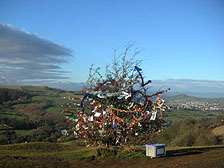
Tree Dressing Day

This past weekend, the first of December, was Tree Dressing Day in England — a new holiday designed to encourage awareness of trees, their local nature, their long lives, and of course their beauty. This idea comes from a particularly impressive and innovative environmental group in England launched many years ago by two women, called Common Ground, which uses art, poetry, maps and other cultural means to encourage the valuation of the particular, the local, and the non-commercial. They anchor their very popular idea of mapping pathways, for instance, on a quote from the great "peasant poet" John Clare:

"Took
a walk in the fields saw an old wood stile taken away from a favourite
spot which it had occupied all my life the posts were overgrown with
ivy and it seemed so akin to nature and the spot where it stood as
though it had taken it on lease for an undisturbed existence it hurt me
to see it was gone for my affections claim a friendship with such
things..
."

(John Clare’s ‘Journal’, Sept 1824)

Hmmm. Could this sort of idea work here in California? A day for decorating trees?

Treedressinginstroud


Global Warming a Communist Plot, Says Talk Show Host

Seriously. Phil Valentine, a talk show host and occasional columnist at the Tennessean writes:

Apparently, I hit a nerve with a column I wrote a
couple of weeks ago on global warming. Many of you took umbrage with my
daring to connect the global warming movement to Marxism. Don’t get me
wrong. I do not believe everyone involved in the global warming
movement subscribes to Karl Marx’s philosophy. However, make no mistake
about it. Those at the epicenter of this movement have ulterior
motives, many of them socialist or even Marxist. What I wrote that
caused such a fuss was that global warming is being used as a template
to rob from the rich nations and give to the poor ones.

I couldn’t resist: I looked up the earlier column and learned this:

There is absolutely no evidence that CO2 has anything to do with any kind of warming.The
Gore Kool-Aid drinkers will point to "all these scientists" but can’t
give you one link between CO2 and any kind of climate change.

Phew. Glad that’s settled. Now where’s my Kool-Aid?

The End of Spend

Great headline (above) from a sidebar in Time on how to survive a recession.

Any time you’re out of work, of course, you’re in a recession (and if you can’t get work, that quickly becomes a depression).

Seriously. In economic terms, a recession is negative growth for two quarters in a row. That’s easily doable without a job.

Yes, yours truly has been exploring the joys of unemployment lately. After no more than a month off for twenty-three years, I am probably due for a break, but it’s still a shock. But I have been doing what the magazine expert suggested, which is the obvious thing, which is paying down my debts. Could be worse. "Don ‘t stop, don’t splurge" said the headline advice.

Easy to remember.

Attempted to apply for unemployment on-line, as the CA state site strongly urged, but that went awry — mysteriously. A week later, after two or three days of intense calling, finally got through to a human and filed a claim. Took about half an hour. He turned out to be a nice guy. Volunteered at a theatre, as yours truly and spouse have done on occasion. Said it had been "crazy" at unemployment, that they had been hiring new people to take claims. That’s a growth industry of today: unemployment.

So, with a little luck, I’ll be on the dole! Does that mean I have become a true blogger?

Australia Wants Emissions Reductions Now

Could the drought have changed Australia’s mind about climate change?

Days after former Prime Minister John Howard and his party were swept from power, a stunning 93% of Australians polled want "the country to reverse its rising greenhouse pollution in five years," according to a survey of almost a 1000 voters.

The European Union‘s ambassador to Australia, Bruno Julien, welcomed Australia’s new position on Kyoto and said he hoped others would follow.

"We would have preferred to have Australia in the beginning, and the United States too, by the way," Bruno Julien said.

"But we greet this news and we are very happy to see that it’s taken at
the highest level because it ensures that negotiations in Bali will be
at a very high level.

"But let’s try to work together to convince the ones who are still not on board."

Hint, hint…here’s an empty Aussie resevoir, captured by Jamie Walhouse:

Dryaustralianresevoir

The Surprise Endings of T.C. Boyle

If there is an American fiction writer better able to surprise us with an ending than T.C. Boyle, I can’t imagine who it might be. Boyle is that rare talent whose work is realistic enough to grip the imagination, creating the possibility of happiness or disaster, and build up real speed towards the finale, allowing for the sudden emotional swerve that hooks a climax into memory. Yet he’s "literary" too, so as not to be constrained into predictability by requirements of any particular genre, which tends to require either a happy ending (as in most movie dramas) or a horrific ending (as in much horror, cf. Stephen King).

Boyle is also rare, if not unique, as a fiction writer for his deep-seated interest in environmental questions, which often emerges in his fiction (for example "A Friend of the Earth," another book I’m overdue to read). This interest in environmental matters and in surprise endings has come out in two recent stories published in two of our best magazines.

A couple of years ago in the New Yorker, Boyle published a harrowing story about the floods of 2005 in SoCal, called La Conchita, which left a powerful (and good) impression on me; last month he published a story about the infamous idea of cloning a beloved dog in Harper’s, called Admiral, which has also stuck with me, although it’s not as potent.

But here’s the point: in both cases, the story builds up towards an apparent disaster — a cataclysm, of some sort. [Warning: those who haven’t read the stories and might want to, go do that now: SPOILER AHEAD!]

The surprise is that despite the 21st settings and the threat of an apocalypse, personal or bigger than that — it works out okay. That’s the true twist ending, these days,. Survival. And it feels so sweet. Here’s a big moment for our lead near the end of the best of these two:

People were crowding around all of a sudden, and there must have been a
dozen or more, wet as rats, looking shell-shocked, the hair glued to
their heads. Their voices ran away like kites blown on the wind.
Somebody had a movie camera. And my cell was ringing, had been ringing
for I don’t know how long. It took me a minute to wipe the scrim of mud
from the face of it, and then I pressed the talk button and held it to
my ear.

Straight out of a movie, isn’t it? That’s the point. True heroism, these days, is to believe in the future.

Black Swan Sighted in Climate Sensitivity

Despite the indefatiguability of denialists, most of the facts of global warming are exceedingly well established. We know that the atmosphere is warming (about 2F, on the average, in the Southwest). We know that six out of seven world oceans are warming (see this colossal study out of Scripps, led by Tim Barnett). We know that the earth is absorbing more heat energy than it emits, which is unequivocal proof of global warming right there. We know that countless species and habitats are shifting in an attitude to survive on a globe whose climate is evolving at alarming speed. We know that Arctic Ice cover is vanishing at a remarkable rate and will be ice-free in the summer within twenty years. We know that fires are becoming more dangerous and heat waves more severe — Phoenix could well become unlivable within our lifetimes, if you consider 122 degrees unlivable, and the mortality risk of heat waves is well-established. And so on and so on.

But despite considerable nervousness on the part of the experts, 82% of whom consider the IPCC’s alarming 4th report to be either fully accurate, or not alarming enough, we still tend to think that things in the future, when it comes to weather, will be like things in the past.

Are we blind? Are we fooling ourselves?

Probably so, argues a "quant"–an  exceedingly well-paid Wall St. statistician who makes a living by mastering stochastic (highly random, often large) changes in the economic weather. In a bestseller called The Black Swan, Nassim Nicholas Taleb makes a strong case for the fact that a single "improbable" change–or disaster–can have a decisive or devastating effect on our lives. Nobody Knows What’s Going On, he titles an early chapter.

Yet although ultimately his argument is mathematical, he begins with a personal story.Taleb grew up in Lebanon, a member of an extremely well-educated, prominent, and successful family. The Lebanon he grew up in was a "paradise." Beirut was known as "the Paris of the Mideast." Then when he was fifteen, a civil war erupted between Christian and Moslem factions in his country.

"I was constantly told by adults that the war, which ended up lasting close to seventeen years, was going to end in "only a matter of days."" writes Taleb in the book.

This devastating experience, among others, forced him to confront the possibility of abrupt change, and especially a change beyond our mind’s ability to absorb. The Black October stock market crash of l987, the rise of the Internet, 9/11 all served to convince of the central importance of these stochastic shifts.

"History and society do not crawl," he argues. "They make jumps. They go from fracture to fracture…yet we (and historians) like to believe in the predictable, small incremental progression."

The book symbolizes this idea with a black swan, because it’s a great example. For centuries the civilized world "knew" that swans were white. Then it discovered southern Australia, where swans are black.   

"One single observation can invalidate a general statement derived from millenia of confirmatory sightings of white swans. All you need is one single (and, I am told, quite ugly) black bird," writes Taleb in his prologue. In the book he alludes in passing to the possibility of a black swan in climate change change, but doesn’t pursue the idea. He is more focused on the possibility of economic disaster (a threat environmentalists certainly should not ignore). Yet the book makes a strong emotional and mathematical argument for considering bigger risks  in climate — an enviro disaster bigger than Katrina.

In mathematical thinking, Taleb disdains the Gaussian — bell curve — model as a means by which to analyze our lives, arguing that the small events of daily life mean little when put up against the huge changes that determine our fate.

"The traditional Gaussian way of looking at the world begins by focusing on the ordinary, and then deals with exceptions or so-called outliers as ancillaries….[which] is like focusing on the grass and missing out on the gigantic trees," he writes.

When it comes to the climate, which already is expected to warm a huge 3 degrees F in the next-twenty five years, this can’t be ruled out. And last month two researchers took a second look at the math of climate sensitiviity–the rising temperatures in years to come that we will experience due to the increased energy already stored in the oceans and the atmosphere. When we have doubled the usual rate of CO2 in the atmosphere, what will we see in terms of global temperatures?

This is a huge question for the IPCC; this year’s Fourth Assessment devotes pages 64-68 to introducing the discussion, and argues that in fact a central advance in this report is the increased precision we can place on the question of how quickly the planet will warm.

Where the last report estimated between 1.5 degrees Centigrade and 4.5 degrees C, the Fourth Assessment, which compares the performance of thirty different climatemodels against various sets of observations, much more confidently projects temperatures between 2 degrees C and 4.5 degrees C, mostly likely on the short side of 3. It admits that "Values higher than 4.5 degrees C cannot be excluded, but agreement with observations is not as good…"

Last month in the most prestigious of American science publications, Science, a study subtly challenged the IPCC on the likelyhood of a moderate sensitivity to increasing greenhouse gas permeation. Gerard  Roe and Marcia Baker took a second crack at the math and concluded that "the probability of large temperature increases are relatively insensitive to decreases in uncertainties associated with the underlying climate processes."

In other words, although we can exclude the possibility that the climate will not warm, the IPCC’s narrowing of the range of sensitivity was not warranted.

For a sympathetic analysis of their argument, you can consult the Three-Toed Sloth (who also usefully includes a link to the complete study). James Annan has doubts; mostly he objects that yes, the possibility of a huge increase cannot be completely rejected, but the IPCC has in fact considered it and concluded that almost certainly it will not happen. RealClimate tends to agree, a little less confidently, but splits the difference by pointing out that we can rule out negligible warming of no consequence, we must "recognize and confront" the possibility of unexpectedly high temps.

But what sticks with me is the comparison of a Gaussian set of possibilities [top diagram] with the long tail of an "outlier" [bottom diagram]. Looks kinda like a black swan…

Gaussiangaindistribution

Stochasticdistribution

  (h/p: Political Animal)

Best Debate Ever: Republicans on YouTube

I’ve been watching Presidential debates since the Carter-Reagan era, and I have never seen a more entertaining or more revealing debate than the Republicans on YouTube. Since the questioners knew this was their one and only shot at a national audience, they asked what they really wanted to know, without undue fawning and with good humor, and elicited genuine and often surprising answers.

My favorite question came from a bright-eyed young fellow named calciumboy. He asked the candidates if they believed every word in the Holy Bible was true. I thought he was joking, but check out his site on the question of matrimony.

He’s not. He tells prospective mates:

If you think I’m "the one", for cryin out loud, don’t wait for me to ask you out; just tell me.  I’ll never have the nerve to ask you.  I figure if a girl doesn’t like me enough to tell me she wants me, then she doesn’t like me enough to be my wife.

Oh and here’s the fun part: after revealing my flaws (ie. social cowardice) and my lack of money and prospects, I have the "nerve" to tell you that I must have a humble, godly wife, who understands that this is not an "equal-partnership", it is a Biblical marriage (you know, the "old-fashioned" kind that everybody patronizes today, where the wife respects and obeys the husband – I know, that’s tough to hear when you’ve been fed feminist propaganda your whole life).  If you have a problem with this, we will never marry…

He then went on to quote a slew of Old Testament prophets: "Wives, submit yourselves unto your husbands, as unto the Lord…" etc.

Scary!

Huckabee jumped in and as a preacher tried to take the Holy Bible question away from Giuliani, who said (in essence) that no, some of the Bible is allegorical, such as Jonah and the whale. Huckabee agreed, but preached it — inspirationally.

Other superb questions: What would Jesus do about the death penalty, and how many guns do you own?

Best answer of the night: McCain on torture. [See below.] Will it help him?

With Republicans, probably not.

Winners: Huckabee, McCain
Losers:   Romney
Agreed Upon-On Also-Ran: Thompson
Questions on Global Warming or Environmental Matters: None

Update: Tom Toles on the same question, candidates.