Feedback Loop of the Week

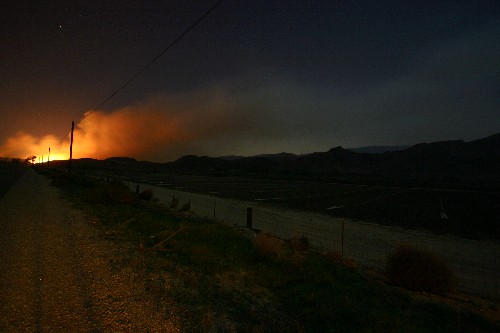
Wish we could report otherwise. Story From the highly-conservative San Diego Union-Tribune (which nonetheless has published a good deal of interesting weather and climate reporting in recent years).

The amount of greenhouse gases emitted by last
week’s blazes in Southern California equal that of roughly 500,000 cars
traveling on the road for one year, according to the state Air
Resources Board.

Wildfire_oct22_497x600

Farm Bill: Bad for Your Health, Bad for the Planet

A tough, funny little ad from a doctor’s group takes a wide stance against the fattening of America at taxpayer’s expense. "Dirty Little Secret," it’s called and it’s worth thirty seconds of your time. 

Hat-tip to McClatchey, which ran the story on the issue (and the Farm Bill, which is a huge bill that deserves far more scrutiny than it has gotten — it’s also going to change the way food is labeled). For better or worse. The story opens with a good, punchy lede:

If you’re feeling fat these days, blame Congress.

One aspect of the bill they didn’t mention — the Dept. of Agriculture also administers pro-beef advertising campaigns, even though the consumption of beef is not good for our health, and the production of beef is bad for the climate.

Nature: Kyoto Is Over, but Crisis Continues

So says Nature. Oxford economist Gwyn Prins and scientist Steve Rayner, writing for the famous English publiciation, call for a post-Kyoto "silver buckshot" approach that sounds a lot like what is happening in England right now:

…labelling of consumer products; market instruments, such as emissions
trading; and market stimuli, such as procurement programmes for clean
technologies; [and] a few command-and-control mechanisms, such as
technology standards11.
The benefit of this approach is that it focuses on what governments,
firms and households actually do to reduce their emissions, in contrast
to the directive target setting that has characterized international
discussions since the late 1980s.

The focus on emission reduction, by hook or by crook, is what I like about this "inelegant" approach. The authors also call for massive funding for energy research, which sounds anything but bottom up, and based on our unhappy experience in the late 70’s in the US, unlikely to make much of a difference.

But on one central point they should be heard loud and clear:

Many climate activists seem to assume that slowing
greenhouse-gas emissions has logical and ethical priority over adapting
to climate impacts. But the ethical issues cut both ways. Current
emissions reductions will mainly benefit future generations, whereas
the momentum already in the climate system drives the near-term. Faced
with imminent warming, adaptation has a faster response time, a closer
coupling with innovation and incentive structures, and thereby confers
more protection more quickly to more people. It is not clear to us that
the interests of millions of people in poorer countries who depend on
marginal ecosystems are best served by an exclusive preoccupation with
mitigation. Indeed, such a narrow focus is likely to be a fatal error.
Mitigation and adaptation must go hand in hand.

This shouldn’t be controversial. Yours truly, and various other Gristians, have been making the same point for years, and scientists such as Gerald Meehl as well. Preserving the climate requires action now, and for decades to come. Given how long it took us to get into this mess, is it really any wonder?

No Impact Man Makes a Splash

This writer sets out to reduce his footprint to near-zero, gets a book deal with FSG. Movie deal in the works. Supports Four Seasons-loving wife in NYC. (Where have I gone wrong?) But he does make sense quoting a "happiness writer" at UC Riverside named Dr. Sonja Lyubomirsky:

"Perhaps the most common error is that we assume that positive events
… will provide much more happiness than they really do. Take
materialism, the pursuit of money and possessions, as an example. Why
is it so hard for us (even myself!) to believe that money really
doesn’t make us happy? Because the truth is that money does
make us happy. But our misunderstanding, as one happiness researcher
eloquently puts it, is that ‘we think money will bring lots of
happiness for a long time, and actually it brings a little happiness
for a short time.’ Meanwhile, in our effortful pursuit of such dead
ends to pleasure, we end up ignoring other, more effective routes to
well-being."

Along similar lines, in The Black Swan, Nassim Nicholas Taleb argues that the nature of humans is much happier with a series of small rewards (such as a monthly salary) than a lump sum of money…even if the amount of money received is the same in the end. He has numerous other arguments — troubling ones.

More on this soon, I hope.

Andy Revkin on The Sixth Extinction

The problem with information and the Internet is, if anything, an oversupply. On any given issue are far too many links, papers, voices, banners; much more than anyone sane could possibly desire.

The problem with information and the radio is the opposite: one is always missing something, hoping for something, overhearing something that might possibly could be checked later (but probably won’t).

But today on Which Way, L.A.?, I heard veteran host Warren Olney, as sharp a questioner as can be found anywhere, talking to veteran New York Times reporter Andy Revkin. Due to static, I could only hear two of Revkin’s responses, but they are, by sheer coincidence, the exact two most worth hearing on the subject of The Sixth Extinction.

For the sixth time on the history of the planet, and the first time since the crash of the dinosaurs sixty-five million years ago, half the species or more on Earth, according to one group of scientists at the University of Arizona, face extinction within the century.

Olney asked Revkin: "Does that figure include our species?"

"Uh, no," said Revkin, in his usual modest, reasonable way, and then for a long time all I could hear was static and a mention of 9 billion people with in 50 years.

Then he said:

"It’s time for everybody to wake up…" (static)

Who could argue with that?