Although fire lines are holding, and Ojai has been declared out of danger, the Zaca fire grew 2700 acres last night, and isn’t expected to be contained for two weeks. But there are compensations: This photo was taken from the air on the fire’s 45th day, a week ago. (Licensed.)
The Green Flash
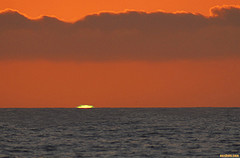
The last of the sunset, just before the top of the sun is about to wink out before being swallowed up by the horizon, that last few seconds in which the light changes — below Brad offers some tips on how to see the famous green flash, and mentions it’s a fairly subtle effect.
Since this is the age of the Internet, naturally we can find whole sites on the subject: here’s one which won an award from Griffith Observatory a few years ago.
And here’s a nice rendition (not too spectacular and/or untrustworthy) from McShots, who has been taking pictures of sunsets near his home in El Segundo for years, and finally captured the fabled green flash.
I think I have had the same reaction to the green flash as did he and many other photographers on Flickr, who asked: Is that it?
A Year After Katrina: Is the Corps Getting a Clue?
We all know that New Orleans is threatened by hurricanes, but less dramatic and less well-known is the fact (as discussed by Time and below) that naturally the Big Muddy would help protect New Orleans by tirelessly constructing wetlands, mud banks, and the like — if only the Army Corps of Engineers didn’t get in the way.
In its latest report card on Hurricane Katrina, a year later, the National Wildlife Federation gives Congress a D+ for failing to reform the Corps while passing a massive bill called the Water Resources Development Act.
Back in March, in an editorial ($) the New York Times made much the same point, and faulted Democrats in the House:
Readers will recall that the Democrats promised to upend the status
quo as soon as they won majority control. But some things, it appears,
are untouchable, among them the Army Corps of Engineers. Presented with
another opportunity to reform the Corps — its weaknesses exposed by
the levee failures in New Orleans and other misjudgments predating
Hurricane Katrina — Democrats on the House transportation committee
took a dive.
The committee approved a huge $40 billion water
resources development bill that is loaded with pork-barrel projects
dear to Congress’s heart but, partly for that reason, is devoid of any
serious reforms to an agency that over the years has inflated the
economic payoffs of its projects while underestimating their potential
damage to the environment. The measure, virtually identical to last
year’s Republican bill, seems assured of passage.
But although Congress did not seriously consider an amendment from Senators Feingold and McCain which would require independent review by experts of any project over $40 million, interestingly the 74th amendment to the bill, proposed by Barbara Boxer and agreed to in the Senate by unanimous consent, does call for a "working group" to be established, including:
(I) independent experts with experience relating to–
(aa) coastal estuaries;
(bb) diversions;
(cc) coastal restoration;
(dd) wetlands protection;
(ee) ecosystem restoration;
(ff) hurricane protection;
(gg) storm damage reduction systems; and
(hh) navigation and ports; and
(II) representatives of–
(aa) the State of Louisiana; and
(bb) local governments in southern Louisiana.
And the National Wildlife Federation does give Congress a B for directing the Corps to find a way to close the notorious Mississippi River Gulf Outlet, or Mr. GO, which experts think substantially worsened the flooding during Katrina. (The Corps disagrees, unsurprisingly.) So although imperfect, there is some reason to think this bill may not be a complete disaster.
What stuns yours truly is the news that this amendment came from Boxer and her frequent sparring partner, Mr. Global-Warming-Is-a-Hoax, James Inhofe, Republican of Oklahoma.
Will ask how in the world this happened…now I’m curious.
Just Saying “No” to China
Well, we tried. Here’s my account of what happened and what I learned, in the Ventura County Reporter.
A Fiery Gift
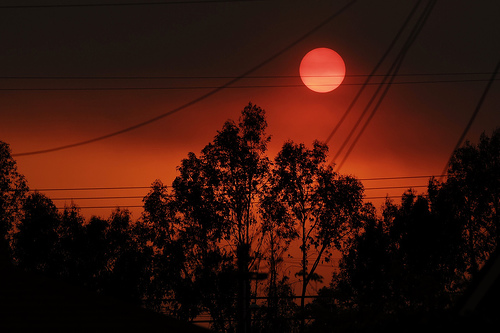
In a nice piece in the Ventura County Star by Zeke Barlow, the oceanographer and climatologist Bill Patzert points out a good aspect of the Zaca Fire: some of the sunsets we’ve been seeing.
He explains why they look the way they do:
The bright color is light bouncing off smoke and ash particles. The
more particles, the more colorful the sky. Friday had 58 micrograms of
particulate matter per cubic meter in Ojai. A moderate level is less
than 40; a normal level is around 15.
The current levels aren’t terribly good for you, but they sure are pretty. Sort of like birthday cake.
Size matters, too. The larger the particle, such as chunks of ash,
the more oranges and reds will scatter across the horizon, because they
have longer wavelengths than other colors, said Bill Patzert, a
climatologist with the Jet Propulsion Laboratory.
Patzert said dynamic sunsets also provide better chances to witness
the elusive green flash, a burst of light just after sunset. The green
wavelengths are bent, coming around the horizon after the sun has sunk,
creating an optical illusion.
Jules Verne wrote about it in "Le Rayon Vert." He said you can peer into someone’s soul when you witness it.
My grandfather Frederick Brooks, a UC Davis engineer and meterologist fascinated with the microclimates of Northern California, also described the "green flash" in longing tones. I think he had seen one; I confess I have not, despite having seen many another sunset.
But how can you peer into someone’s soul, if you’re looking off into the sunset?
Just wondering.
(Here’s a recent local sunset, courtesy of John Mueller via Creative Commons.)
Burying West Virginia
The Bush administration is giving one last gift to the coal industry: permission to bury much of West Virfginia under a pile of coal tailings, aka "excess spoil."
“This is a parting gift to the coal industry from this administration,”
said Joe Lovett, executive director of the Appalachian Center for the
Economy and the Environment in Lewisburg, W.Va. “What is at stake is
the future of Appalachia. This is an attempt to make legal what has
long been illegal.”
From the New York Times, which adds:
Mountaintop mining is the most common strip mining in central
Appalachia, and the most destructive. Ridge tops are flattened with
bulldozers and dynamite, clearing all vegetation and, at times, forcing
residents to move.
The coal seams are scraped with gigantic
machines called draglines. The law requires mining companies to reclaim
and replant the land, but the process always produces excess debris.
Roughly
half the coal in West Virginia is from mountaintop mining, which is
generally cheaper, safer and more efficient than extraction from
underground mines like the Crandall Canyon Mine in Utah, which may have
claimed the lives of nine miners and rescuers, and the Sago Mine in
West Virginia, where 12 miners were killed last year.
The rule,
which would apply to waste from both types of mines, is known as the
stream buffer zone rule. First adopted in 1983, it forbids virtually
all mining within 100 feet of a river or stream.
Also involved, although it’s unclear exactly how, is a convicted felon and former Bush administration official:
The early stages of the revision process were supported by J.
Stephen Griles, a former industry lobbyist who was the deputy interior
secretary from 2001 to 2004. Mr. Griles had been deputy director of the
Office of Surface Mining in the Reagan administration and is
knowledgeable about the issues and generally supports the industry.
In
June, Mr. Griles was sentenced to 10 months in prison and three years’
probation for lying to a Senate committee about his ties to Jack Abramoff, the lobbyist at the heart of a corruption scandal who is now in prison.
Topics for further research…meanwhile, here’s one consequence of mountain-top removal.
This is the town of Lyburn, W. CVa., which was buried in coal sediment from a company residue pond. Taken by Flickr photographer Bob Gates.
From the National Memorial for the Mountains photostream.
The No-B.S. Computer for Cheap Geeks
$100, 8 watts, but with no operating system installed. Guess it’s a geeks-only product. Still — wow. Amazing. I have to see this work. Via Eco-Geek.
We’re Getting Drunk on Ethanol, Says LA Times
The Los Angeles Times is going through probably the worst stretch in its entire history, stretching back well over a hundred years. But despite one setback after another on the news pages, it’s shown encouraging signs of life in its daily editorials, specifically a series called "A Warming World," which has brought great discernment and wisdom to the topics of nukes, a carbon tax, Kyoto, and now, ethanol.
Here’s the open:
‘Gasoline is going — alcohol is coming. And it’s coming to stay, too,
for it’s in unlimited supply. And we might as well get ready for it
now."
Those words might have come from President George W. Bush, or just
about any member of the U.S. Congress, or every major presidential
candidate from both parties. All are euphorically drunk on ethanol (a
fancy name for grain alcohol), seen as the miracle fuel that will
simultaneously solve our global warming problem and end our reliance on
foreign oil. Actually, though, they were uttered by automotive pioneer
Henry Ford nearly a century ago.
Ford might have been a visionary, but he was badly mistaken about ethanol. Unfortunately, so are Bush et al.
Alcohol is best taken in moderation, and that applies to cars as much
as people. Ethanol isn’t all hype — it’s a promising alternative fuel
that could stretch gasoline supplies and cut emissions. But as
politicians try to outdo one another by approving ever-bigger ethanol
subsidies, production mandates and research grants, few are considering
the environmental and economic effects of a massive, rapid rise in
ethanol production. These are so severe that unless the mania ends
soon, they could far outweigh any gains.
The rest is here. A debate on the same subject can be found in the august pages of Foreign Affairs, in which two economists conclude that not only will ethanol raise food prices worldwide, hurting the poor, but the subsidies given to corn in this country will surely discourage far more promising research into switchgrass, according to a summary at the WSJ’s Informed Reader blog.
This brings to mind the bogus push for "clean coal," which as the writers on Grist never fail to point out, would if implemented eliminate coal’s only signficant energy advantage — price.
Will the U.S. ever come up with an energy policy that actually makes sense?
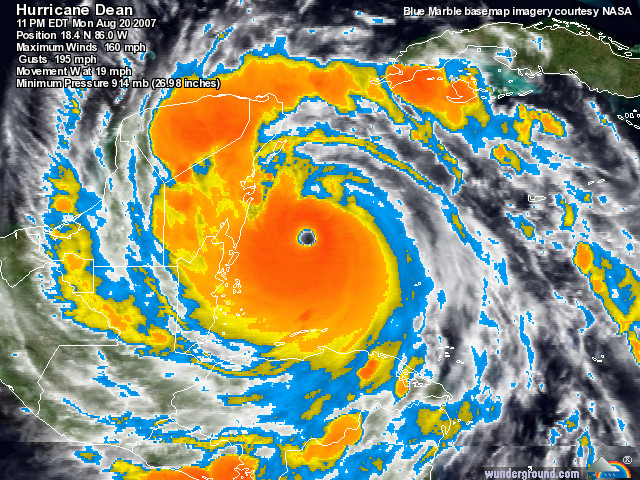
Dean Reaches Category 5
000
WTNT64 KNHC 210034
TCUAT4
HURRICANE DEAN TROPICAL CYCLONE UPDATE
NWS TPC/NATIONAL HURRICANE CENTER MIAMI FL AL042007
835 PM AST MON AUG 20 2007
DATA FROM THE AIR FORCE RESERVE HURRICANE HUNTER AIRCRAFT CURRENTLY
INVESTIGATING HURRICANE DEAN INDICATE THAT MAXIMUM SUSTAINED WINDS
HAVE INCREASED TO 160 MPH...MAKING DEAN A POTENTIALLY CATASTROPHIC
CATEGORY FIVE HURRICANE ON THE SAFFIR-SIMPSON HURRICANE SCALE.
$$
FORECASTER KNABB![]()
(HT: Wunderblog)
In Search of Cheney’s “Virtue”
Nickolas Kristof, unlike an estimated 97% of pundits, actually goes out and researches the topics he writes about, talking to experts, ordinary folks, and traveling to difficult places like Chad and Cambodia to report on harrowing issues such as genocide and child slavery. He’s about to take a leave from his paper, the New York Times, to write a book, but leaves us with a first rate column ($) on the wrongheadedness of Dick Cheney, who Kristof quietly but convincingly shows has totally misled us on energy and energy conservation.
Kristof begins:
Dick Cheney once scoffed that energy conservation can be a “personal virtue” but is no basis for an energy policy.
Growing evidence suggests he had it exactly wrong.
He then talks to a wide range of well-known experts on the issue, and shows that in fact working to conserve energy not only reduces the risks of global warming, but also can substantially help to grow the economy. Then he lowers the boom:
Climate skeptics say that we don’t know how serious climate change
will be, and they’re right. But isn’t it prudent to address threats
even when we’re unsure of them? We don’t expect to be caught in a fire,
but we still believe in fire escapes and fire departments.
Suppose we had political leaders who snorted that fires are nothing
new, that the science of firefighting is unclear, and that we can’t
impose a burden on business by establishing fire departments — while
brightly adding that citizens can extinguish fires on their own out of
“personal virtue.”
Why, we would think those leaders were nuts.
Trying to conserve our traditional climate, this weekend hundreds of protesters surrounded Heathrow Airport in London, and protested plans to expand into a neighboring village. Kim Murphy has a nice news piece about the protests in the Los Angeles Times, and concludes with a droll remark about the plaintive nature of the protest.
The greatest show of force was a midday parade through this village’s
streets — shadowed by Heathrow’s lumbering jets overhead — as
demonstrators carried placards reading, "No Third Runway," "Altitude
Sickness" and one of the catchier slogans of modern protest, "We Are
Armed Only With Peer-Reviewed Science."
It’s true — Nature magazine studies only go so far, no matter how intimidatingly written. Unfortunately. Which is why these sort of protests might, as Al Gore recently said, help focus our attention and our efforts on the issue.
Here’s a picture of the larger issues at stake in these protests from pro Simon Rigglesworth on Flickr.