Nature Poetry Today: Why Is It So Stale?

David Oates has an idea. A new poem, from this quarter’s issue of ISLE:

        Nature poem

nature detail
nature detail
feeling
nature detail

scene setting        [beginners: do this first]
nature detail
feeling
feeling
nature detail
poignant feeling

civilization detail
bad feeling
nature detail
threatened feeling
nature detail
reassured feeling  [advanced: ironic, or, even more
threatened]

Get Yer Stench Here

A genius move for activism on an important issue — environmental, climatological, dietary, pollution, you name it. An interactive factory farm map. Where’s your nearest hog farm? Find out here.

Or, as the New York Times puts it, politely but firmly, in an editorial:

Wherever it appears, factory farming has two notable effects. It
threatens the environment, because of huge concentrations of animal
manure and lax regulation. And it threatens local political control.
Residents who want a say over whether and where factory farms, whose
stench can be overwhelming, can be built find their voices drowned out
by the industry’s cash and lobbying clout.

[cut]

It’s important to read this map not as a static record of farm sites or
a mere inventory of animals. It is really a map of overwhelming change
and conflict. It raises two of the fundamental questions facing
American agriculture. Do we pursue the logic of industrialism to its
limits in a biological landscape? And how badly will doing so harm the
landscape, the people who live in it and the democracy with which they
govern themselves?

Kevin Trenberth: Imitating a Volcano to Avert Global Warming Could Be Disastrous

Kevin Trenberth is not just another boring scientist. He is the head of climate analysis for the National Center for Atmospheric Research, and he’s also unusually outspoken on the subject of global warming. When attacked by notorious denier Fred Singer, a decade ago, he defended himself briskly. He told Congress this spring that the planet was "running a fever," irritating Al Gore haters everywhere, and this past week he published a paper arguing that attempting to reduce global warming by emulating a major earthquake, such as we saw in l991 from Mt. Pinotubo, could be disastrous. The abstract warns:

Following the eruption of Mount Pinatubo in June 1991 there was a
substantial decrease in precipitation over land and a record decrease
in runoff and river discharge into the ocean from October
1991–September 1992. The results suggest that major adverse effects,
including drought, could arise from geoengineering solutions.

(HT: John Fleck)

China Blames Its Flooding on Global Warming

Song Lianchun, head of China’s metereological forecasting service, said last week of the floods that displaced hundreds of thousands of Chinese and killed about 700:

"It should be said that one of the reasons for the weather extremes
this year has been unusual atmospheric circulation bought about by
global warming," Song told a news conference carried live on the
central government Web site (www.gov.cn). "These kind of
extremes will become more frequent, and more obvious. This has already
been borne out by the facts," he said. "I think the impact on our
country will definitely be very large."

Because China is far behind the U.S. in terms of historical emissions of carbon dioxide, it is unwilling to act to reduce emissions unless the U.S. acts first, the Reuters story points out.

The good news in this story is that the Chinese government was able to act to reduce the risk. 100 million Chinese have been affected by the flooding, and up to one million displaced, with thousands of homes destroyed. Still, disaster has been mostly averted, according to a Los Angeles Times story. Would we in this country be able to say the same, if 100 million Americans faced serious flooding?

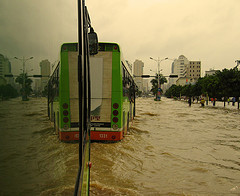
Doubtful. We don’t even have an agency for disaster mitigation, as China does. Here’s a picture of the flooding in Nanning, southern China, near Vietnam, from a Flickr member and resident. The bus plows through the flood as if it were business as usual.

Flooding_in_nanning_china

Britain Under Water (As Predicted by Boring Scientists)

An editorial entitled Britain Under Water, from the Belfast Telegraph, via equaintance Danny Bloom:

Most remarkable of all is the fact that the astonishing picture the nation
  is now witnessing – whole towns cut off, gigantic areas underwater, mass
  evacuations, infrastructure paralyzed and grotesquely swollen rivers, from the Severn and the Thames downwards not even at their peaks yet – has all been caused by a single day’s rainfall. A month’s worth and more in an hour. It is obvious that the Government and the civil powers, from Gordon Brown down to the emergency services, are struggling to cope, not only with the sheer physical scale of the disaster itself, but with the very concept ofit. It is entirely unfamiliar. It is new. Yet it is exactly what has been forecast for the past decade and more.

No one can yet attribute the flood events of the past week, or indeed, those of June, when Yorkshire suffered what Gloucestershire and Worcestershire are suffering now – again from one single day’s rainfall – directly to global warming. All climates have a natural variability which includes exceptional occurrences.

But the catastrophic "extreme rainfall events" of the summer of 2007, on 24 June and 20 July, are entirely consistent with repeated predictions of what climate change will bring.

It is nearly 10 years since the scientists of the UK Climate Impacts Programme first gave their detailed forecast of what global warming had in store for Britain in the 21st century – and high up on the list was rainfall, increasing both in frequency and intensity.

This was thought most likely to happen in winter, with summers predicted to be hotter and dryer. But yesterday Peter Stott of the Met Office’s Hadley Centre for Climate Prediction and Research, an author of a new scientific paper linking increases in rainfall to climate change, commented: "It is possible under climate change that there could be an increase of extreme rainfall even under general drying."

The paper by Dr Stott and other authors, reported in The Independent yesterday, detects for the first time a "human fingerprint" in rainfall increases in recent decades in the mid-latitudes of the Northern Hemisphere – that is, it finds they were partly caused by global warming, itself caused by emissions of greenhouse gases.

The public as a whole appears not to have taken the extreme rainfall predictions on board, thinking of climate change in terms of hotter weather. But the science community has been fully aware of it, and has steadily reinforced the warnings.

One of the most important came from a group of experts commissioned to look at the risks by the Chief Scientific Adviser, Sir David King, under the Government’s Foresight Programme, in 2004. Their report, Future Flooding, said that unless precautions were taken, more severe floods brought about by climate change could massively increase the number of people and the amount of property at risk. Yet once again, this hardly penetrated the public consciousness.

Perhaps now it will. These vast floods were caused by a single day’s rain. When has that ever happened before? Probably never — the previous record-holder in Britain, the floods of l947, were caused by thawing snow, and rain on snow. And if this damage that could be caused by one day’s rain…

Reminds me of the lyrics to Thom Yorke’s climate change song "And It Rained All Night" —


And it rained all night and then all day 
The drops were the size of your hands and face 
The worms come out to see what’s up 
We pull the cars up from the river 

It’s relentless 
Invisible 
Indefatigable 
Indisputable 
Undeniable 

Welcome to the Weather of the 21st Century

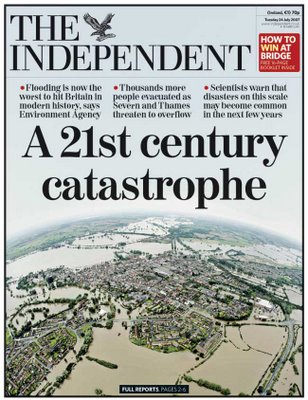
A great anecdote (and cover) from the Independent in Britain:

In April 1989 Margaret Thatcher, then Prime Minister, gave her Cabinet a seminar on global warming at No 10 and one of the speakers was the scientist and green guru James Lovelock. A reporter asked him afterwards what would be the first signs of global warming. He replied:"Surprises." Asked to explain, he said: "The hurricane of October 1987 was a surprise, wasn’t it? There’ll be more."

The floods of 2007 were a surprise as well, and if Dr Lovelock is right, there’ll be more of them too. Welcome to the weather of the 21st century.

What’s scary is that Lovelock has been right in the past, and in his most recent book cogently and scientifically argued that we are facing not just gradual warming, but an abrupt temperature leap that will threaten, yes, civilization as we know it.

From The Revenge of Gaia, in the chapter "Forecasts for the 21st Century:"

Although we have much to learn, it does appear probable that in a few years, when the carbon dioxide abundance passes 500 ppm, we will enter the zone where temperatures will rise to a new steady state, perhaps six to eight degrees hotter than now. We do not know if this new regime will be stable in the long term, and if we are foolish enough to continue trying to farm and pollute the air on the remaining habitable parts of the Earth, a final collapse might happen. Nothing in science is certain, but Gaia theory is now robustly supported by evidence from the Earth and it suggests that we have little time left if we are to avoid the unpleasant changes it forecasts.

21st_century_catastrophe

Optimism: The True American Faith of Today

No doubt I spend too much time on the Internet, but I have to say it has its compensations…such as when a bright guy you’ve never met writes a little essay inspired by a thought from yours truly.

Take a look at postmodern conservative Mr. James Poulos’ thoughts on optimism, which to me (and Rod Dreher as well) is the Achilles Heel of America today.

Environmental Ignorance Threatens New Orleans

That’s according to Time. Remarkably, the cover story leads with the importance of wetlands, as a natural defense against hurricanes (and a natural protector for levees).

The same dynamic, on a much less dramatic scale, can be found in Southern California, where only after trapping rivers in concrete did we slowly come to realize that without estuaries and wetlands and outflows, our local beaches and ocean health are threatened. Beaches need to be replenished with sand, for one, but without wild rivers, where will that sand come from? In Ventura County, we are trying to heal the coast by taking down Matilija Dam. It’s a good idea, but it’s slow work.

On New Orleans, here’s the magazine:

Bigger levees aren’t all bad. New Orleans desperately needs them; one
local slogan is, "Make Levees, Not War." But New Orleans needs its
eroding wetlands just as desperately; another local slogan is, "Fix the
Coast, or We Are Toast!"

[cut]

New Orleans wasn’t always a city in a bowl. The French founded it in
1718 on high ground along the Mississippi, a "natural levee" of
sediment deposited by the river. That’s why tourists in the French
Quarter stayed dry during Katrina. And that’s how all of south
Louisiana was built—by the Mississippi River mutinying its banks and
rambling around its floodplain like an unruly teenager, dropping mud
around its delta and creating roughly 4.5 million acres (1.8 million
hectares) of wetlands between New Orleans and the Gulf. So while the
French built an earthen levee 1 mile long and 3 ft. high (1.6 km long,
1 m high) to block the river’s annual tantrums, they didn’t bother
trying to block the occasional hurricanes that swept up the Gulf. "They
didn’t need hurricane levees," says Kerry St. Pe, a marine biologist
whose ancestors arrived in 1760. "They had wetlands to protect them."
New Orleans wasn’t on the coast, and hurricanes wilt over land.

The Corps ordered communities to imprison the river in a narrow
channel with a strict "levees only" policy, rejecting calls to give the
river room to spread out. So levees rose, and the Corps repeatedly
declared the river floodproof. But the constrained river also rose, and
its jailbreaks repeatedly proved the Corps wrong. In the epic flood of
1927, crevasses shredded the entire valley and nearly destroyed New
Orleans.

Congress rewarded this failure by allowing the Corps to seize
control of the entire river and its tributaries, an unprecedented Big
Government project that foreshadowed the New Deal and established the
Corps as the U.S.’s manipulator of water and manhandler of nature. It
built dams, floodways, revetments and pumped-up levees throughout the
Mississippi basin, caging the beast in its channel, safeguarding
riverfront cities, creating a reliable web of liquid highways. But by
walling off the river, trapping its sediments behind giant dams and
armoring its erosive banks with concrete, the Corps inadvertently
choked off the land-building process. The straitjacketed river now
carries less than half its original sediment load down to Louisiana. So
there’s little new land-building material to offset the natural erosion
of the coast, much less the unnatural rising of the sea fueled by
global warming.

The result is that New Orleans is sinking, and about 30% of the
coast’s wetlands have slipped into the Gulf, jutting Louisiana’s chin
even further into the path of Mother Nature’s fist, endangering the
U.S.’s largest offshore oil and gas fields, a lucrative seafood
industry, a busy network of ports and about 2 million people. If Mexico
had seized all that land, we’d be at war.

Great line, and here’s what I think is a great picture of the St. Louis Cemetary in New Orleans, from a  set on the city today, posted under the disturbing title A Rehearsal for the Apocalypse.

New_orleans_cemetery_under_clouds

European Heat Waves: Now Twice as Long!

That’s according to a study from the University of Bern.

The surprising news is that this study looks at temperature records and concludes that temperatures were overestimated in the past in Europe. This will not please deniers in this country eager to argue that due to the so-called heat island effect, high temperatures are being overestimated now.

The bottom line:

"The researchers suggest that their conclusions contribute to growing
evidence that western Europe’s climate has become more extreme."

In any case, as one of the commentators points out, this dispute over the observational record cannot refute the evidence of global warming that is coming in from countless natural sources: glaciers, butterflies, maple trees, and so on. But that won’t stop the deniers.

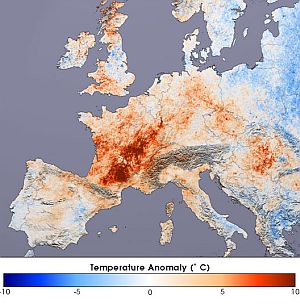
From the study, here’s a map of temperature anomalies in Europe during the 2003 heat wave, via NASA.

(Hat Tip: Sci Guy)

Temperature_anomalies_in_europe_via