Bush Administration on Carbon Emissions: We Don’t Care, and We Don’t Care if You Know We Don’t Care

Ever write something and only realize later what you were really trying to say? Ever write and publish something and then realize what you were trying to say?

This happened to me with the following post. Only after reading the comments (on Grist) did I realize the point. Even if you take the Bush administration at its word on global warming, you quickly see that they have no intention of acting to reduce carbon emissions. They say as much!

Here we go…

On a new blog called Terra Rossa–"Where Conservatives Consider a New Energy Future"–GOP pollster Whit Ayres argues that when President Bush at the G-8 summit declared his willingness to "seriously consider" carbon emission reductions over the next forty years, he took a "major step" in the direction of his environmental critics. Says Ayres: 

I don’t think anyone could argue that conservatives are not trying to compromise on the issue. While many conservative voters, politicians, and business leaders might prefer to take no action to limit carbon emissions, they have heard the call to action and are clearly working toward a cap they can live with.

Ayres claims the President has undergone a "sea-change" on global warming, but ignores these inconvenient facts:

    –No agreement to reduce carbon emissions came out of the G-8 summit, despite much pressure from Germany and Europe.

    –The President talks of "long-term" goals, but has committed to nothing but discussion.                                                                                                                              
    –Shortly after taking office, a White House insider admitted to Andrew Revkin of The New York Times [$] that the Bush administration intended to do as little as possible about global warming:


”There’s a sense in which everybody’s saying the American public doesn’t have the attention span or background to pay attention to this issue,” the official said. ”There’s still a hopeful perception around the White House that this has gone away.”

   –Not only did the President break a reassuring campaign promise regarding carbon emissions, but just this last year told a biographer that he was a "dissenter" on the "theory" of global warming.

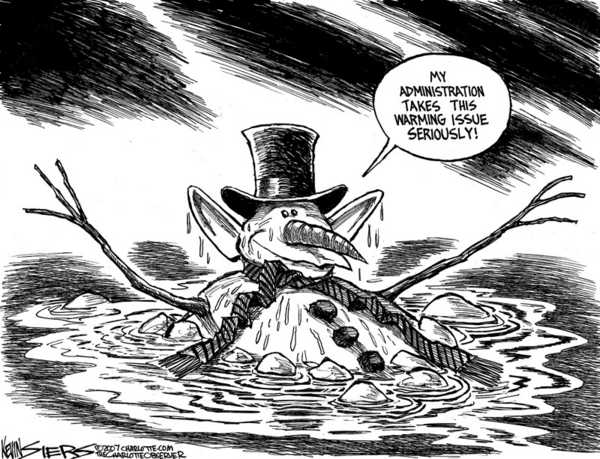
So we have good reason to doubt the sincerity of the Bush adminstration, despite the bland assurances of progress from White House environmental chief Jim Connaughton. And in fact this past week the President himself, in his own words, has let us know exactly how high a priority he gives the issue. Four recent speeches–to a Southern Baptist convention, to a homebuilders convention, at a political fund-raiser, and at a nuclear power plant yesterday were put through a word processor, and the results show what is on the President’s mind, and what is not:

Thinking About Polar Cities — Or Trying To

An interesting journalist named Dan Bloom, now based in Taiwan, has been agitating for consideration of one of James Lovelock’s more alarming ideas — polar cities. (Here’s his site on the subject.)

I don’t have answers for Mr. Bloom’s difficult questions, but while I’m thinking on the subject, I want to quote on this Sunday from his citation of the late great Kurt Vonnegut, and his poem Requiem:

..When the last living thing has died on account of us,

how poetical it would be

if Earth could say,

in a voice floating upwards

from the floor of the Grand Canyon,

"It is done."

People did not like it here.

But some of us do like it here, readers will protest. And no doubt Kurt would say; yes, but — not enough to save the place. And he has a point. What  we say is of little interest to the natural world…

Hasta La Vista, Governor

Shocking news: the "post-partisan" Governor of California, the world-famous Arnold Schwarzenneger, may be moving to my neighborhood. That’s according to a rumor printed in the Ventura County Star.

The Sacramento Bee recently reported that the couple made an offer on a property listed for about $6 million in Upper Ojai. It didn’t name an exact location. That story also cited a similar report in the Pacific Coast Business Times newspaper earlier this month.

Neither the governor’s office nor the real estate company said to be handling the transaction would comment. But the news has been bouncing around town since the power couple rode through three weeks ago.

According to a Realtor in the Santa Ynez Valley, the governor and his family also looked at properties there, but found none to their liking before heading to Ojai.

There goes the neighborhood (the obvious joke). Actually, the neighborhood is already essentially gone for ordinary folks like us. The elementary school population is less than half what it was ten years ago, because ordinary folks–young couples likely to send their kids to public school–can’t afford the area.

But the Guv endeared himself somewhat to me by visiting our colorful outdoor bookstore, Bart’s Books, where every couple of weeks I take a stack of books back, and a couple of books out, and pay nothing — recycling at its best.

When he was in town, the governor dropped into the store and browsed the bookshelves sheltered under the canopy of trees, said [the owner] Dave Ray, who wasn’t in at the time.

"I heard he said, Ah’ll be back,’ " Ray said.

Arnold_schwarzenneger_on_meet_the_p

Spring Comes to the Arctic — Two Weeks Early

In a gently-written article from Greenland, Nature reports that spring is coming two weeks early in the Arctic.

The discovery adds to the litany of changes to ecosystems that are occurring in response to changing climates around the world. But the rate at which changes are occurring in the high Arctic far outstrips that seen elsewhere in the Northern Hemisphere.

"We suddenly realized that the trends are dramatically stronger than elsewhere," says Toke Høye of the University of Aarhus, Denmark, who led the research. Previous worldwide studies of animals and plants have suggested that, globally, the beginning of spring is advancing by around five days per decade.

But in the frozen valleys of Zackenberg, northeastern Greenland, the rate of change is almost triple the world average, Høye’s team has discovered. "This is the first study of its kind in the high Arctic," he says. "It’s quite a surprise to see such a huge difference."

I confess, I love Mr. Hoye’s quiet way of speaking, though I do think this is exactly the sort of dry understatement that has hindered public understanding of the threat of global heating. But that’s the nature of science; facts come first, emotion far behind. For most people, I think, it’s the other way around. Here’s Mr. Hoke’s picture of the thaw…

Spring_thaw_in_arctic_by_toke_t_hoy

The Fires of Life: Colin Fletcher, R.I.P.

When I was twelve or so, I stumbled across Welsh hiker Colin Fletcher’s classic book, The Complete Walker. Its blend of practicality and lyricism helped inspire me to become a somewhat-nervous young backpacker, mostly with friends and family. Later I headed off on my own, which for Fletcher was always the best way to go. (Indeed, he had a certain disdain for those who had to have company.)

A lot of his tips have dated, thanks to the incredible advances in backpacking technology just in the past ten years, but his principles remain as sound as ever, and before going I still like to spread out a tarp and put everything on it and visualize the trip, day by day, which was one of his fundamental ideas. I remember seeing a picture of him with all his gear spread out on the tarp and thinking; jeez, that’s not very much, and no it’s not, and no, you don’t need a lot, really.

The Los Angeles Times has the best obit I’ve seen on this wonderfully cranky individualist, which included with a great line from his book River, about going down the Colorado, from its source to the sea, at age 67. Fletcher wrote:

"I needed something to pare the fat off my soul…. And I knew … there is nothing like a wilderness journey for rekindling the fires of life."

Colin Fletcher, Rest in Peace:

Colin_fletcher


The Standard for Good Fathering Today

Joel Achenbach is a hugely popular blogger and writer for the Washington Post. Nonetheless, sometimes I just can’t resist quoting him:

In generations past, there were many men who did not see their role in society as one that involved the direct nurturing of children. Some vanished into their jobs. Some dedicated their lives to the war against conformity. Collectively they set a standard for "good fathering" that is not hard to meet. And for that we must thank them.

It’s so true. I try to be a good dad, but really, no one expects that much.

To be considered a good father you basically have to be just a tiny bit better than Darth Vader.

Darth_vader_takes_a_nap

James Lovelock: “We Have to Change Our Whole Style of Living”

In an effort to open up important books on climate change to the broader public, and to implant their key points in my mind, I’m going to excerpt crucial passages. Here’s a central point from James Lovelock’s The Revenge of Gaia, published by a Penguin imprint in 2006:

I am not recommending nuclear fission energy as the long-term panacea for our ailing planet or as the answer to all our problems. I see it as the only effective medicine we have now. When one of us develops late-onset diabetes as a consequence of overeating and insufficient exercise, we know that medicine alone is not enough; we have to change our whole style of living. Nuclear energy is merely the medicine that sustains a steady secure source of electricity to keep the lights of civilization burning until clean and everlasting fusion, the energy that powers the sun, and renewable energy are available. We will have to do much more than just rely on nuclear energy if we are to avoid a new Dark Age later this century.

From the first chapter, "The State of the Earth."

Sunday Morning on the Planet: Baby Birds

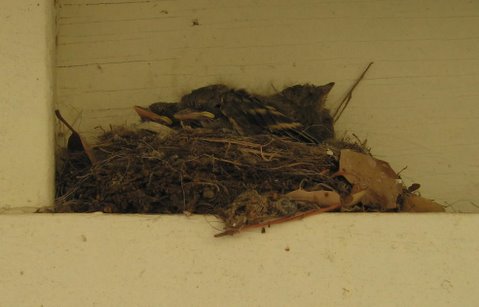
It’s been an unusually good year for birds in our little corner of Southern California. The huge winds of the Christmas season, which tore open our porch, encouraged birds to fly in and out, and one pair (of dark-eyed juncos, I think) moved right in and built a nest. Three little birds charmed us with their twittering for weeks. They’ve moved on, but here’s what they looked like a week and a half ago…

Baby_birds_on_the_porch

Ganges River Seasonal by 2030, UN Warns

On the other side of the coin, the river on which 800 million Hindus depend, both physically and spiritually, may become seasonal by 2030, according to a U.N. study reported by the Washington Post.


recent reports by scientists say the Ganges
[River] is under an even greater threat from global warming [than sewage]. According to a U.N. climate report, the Himalayan glaciers that are the sources of the Ganges could disappear by 2030 as temperatures rise.

Disappear? As in, no more water? How cow

Ganges_river_sunrise_varanasi_by_ja