Not Everyone Liked Reagan

In comparison to the confused blundering of the Current Occupant of the White House, the political skills of his right-wing idol Ronald Reagan look good in hindsight.

When things went badly with troops in the Middle East, Reagan cut and ran. When tax cuts early in his term turned out to be ruinous, he agreed to raise taxes. When his advisers screwed up attempting to fight terrorists, he changed tack and recruited Beltway "wise men" to replace the ideologues.

His common sense in retrospect looks like sheer genius, and countless think pieces in recent years have highlighted his fence-building skills.

No doubt Reagan had charm, but he couldn’t seduce everyone. The President of the Heritage Foundation, Edwin Feuler, writes a piece based on the recently-released "Reagan Diares," using it to attack Reagan’s critics, but along the way he admits that in his time not everyone fell for Reagan.

Reagan occasionally failed. In 1983, he requested a meeting with photographer Ansel Adams. "He has expressed hatred for me because of my supposed stand on the environment." Reagan couldn’t bring Adams around. "I’m afraid I was talking to ears that refused to hear," he wrote.

Way to stand up for your beliefs and the planet, Ansel.

Update: Interestingly, a book on Reagan called "Reagan: A Life in Letters" reports what Adams said after he met the President in l983. In a footnote, the authors quote a letter he wrote to a photographer friend, saying talking to Reagan about the environment was "very discouraging…like confronting a stone wall." He left with "a sinking feeling this country is in very poor hands."

Ansel_adams_l960_by_nancy_newhall

The 2007 Ojai Music Festival

A preview. I liked the way pianist Amy Williams described this year’s music director and principal soloist, Pierre-Laurent Aimard:

“He’s a god. He’s one of those extraordinary musicians whose playing is near-perfect or perfect. I always try to hear his concerts whenever I can, and I’m always surprised and fed musically by what he does.”

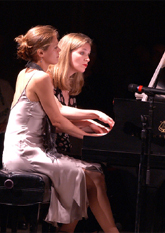
But Amy Williams can play herself, as can her partner Helena Bugallo, seen here at Ojai in 2005.

Bugallowilliams_2

The Inadequacy of Accurate Information

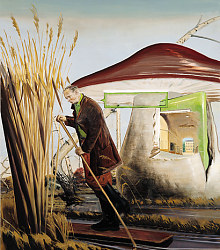
How does The New Yorker do it? They put out a better magazine every week than most publications manage once a month, or once a quarter. I especially love their art critic, the man with the difficult name of Peter Schjeldahl, who recently had a great piece on Hopper, and this past week wrote about the East German artist Neo Rauch.

Rauch’s paintings created a sensation in Montreal last year. Now he has a solo show at the Met. In the midst of a wide-ranging discussion, the critic notes:

Today, we are flooded with accurate information—letting us confidently judge the failures and iniquities of political leaders, for instance—and we naturally feel that such clarity must influence events, but it only amplifies our dismay as the world careers from one readily foreseeable disaster to another.

How insightful! And to see this in a painting — fascinating.

Neo_rauch_moor

File Under: Ulp!

It’s been lovely lately. For three or four days we actually had the perfect average temp: 68 degrees. Even here at Oak Creek, California, elevation about 1468, about ten miles from the coast, the late-night incursion of the marine layer has brought us what my aunt Ruth from back East used to call "coolth."

With luck, this may continue for a few weeks. But late last night I heard a restless wind coming in, possibly from the north, and it’s warmer this morning. NOAA says a La Niña condition is forming in the Pacific, which means the forecasts are likely to stay dry.

This morning in the Los Angeles Times, Bill Patzert told the story:

"With this late developing La Niña, that’s not good for Southern California or the Colorado River Basin. It could be dry next winter as well."

Patzert has been enjoying the early-morning gloom as well early this June, but expects the upcoming summer to be as hot as or hotter than last year’s summer, a record-breaker.

The analogues are especially alarming. File Under: Ulp!

(From NOAA’s soil moisture estimates.)

Temperature_outlook_for_june_07

Ecuador to World: Help Us, and We Won’t Drill in the Rainforest

In response to intense pressure from indigenous and environmental organizations opposed to drilling for oil in an Amazon rainforest, Ecuador has gone to the world and asked for financial help, according to the Environmental News Service.

The oil fields under Yusani National Park are estimated to contain 900 million to 1 billion barrels of oil, about one-quarter of Ecuador’s total reserves. In about a year, international oil companies will be allowed to bid for the right to drill.

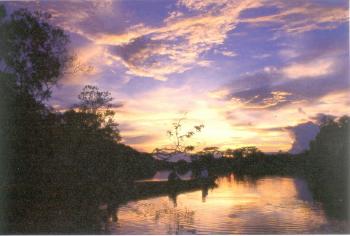
To avoid this fate, Ecuadorian President Rafael Correa is asking the international community for about $350 million a year. For more, please see the rest of the news in Grist. Here’s a picture of the Yasuni:

Yasuni_national_park


There is a Bird We Cannot See

Great new poem from a poet and professor not known to me, Molly Lou Freeman, called There is a Bird We Cannot See. I just have to quote a couple of lines:

She says
                      
                            There is destiny in western sun,
         
             Hopefulness manifest.
                      
                            There are ways of being spoken to
                
                    And indirectly heard.

She says
       
            We live—we choose between—
                                 
                                   Despair and splendor—.

Bush on Climate Change — Translated

A little late, but via Dan Froomkin’s hard-hitting column from the Washington Post, here’s Andrew Gumbel of The Independent translating the Prez’s speech last week on global warming:

"’In recent years, science has deepened our understanding of climate change and opened new possibilities for confronting it."

Translation: In recent years, my refusal to acknowledge the reality and seriousness of global warming has turned me into a laughing-stock and contributed to my record low poll ratings. So now I have to look interested.

"’The United States takes this issue seriously."

Translation: Al Gore takes this issue seriously, his movie was a hit, and it’s causing me no end of grief.

"’By the end of next year, America and other nations will set a long-term goal for reducing greenhouse gases."

Translation: By the end of next year, I’ll be weeks away from the end of my presidency and this can be someone else’s problem.

"’To develop this goal, the United States will convene a series of meetings of nations that produce the most greenhouse gasses, including nations with rapidly growing economies such as India and China."

Translation: We will look as busy as we can without doing anything.

"’The new initiative I am outlining today will contribute to the important dialogue that will take place in Germany."

Translation: The new initiative will put the brakes on the much more robust proposal the Germans are putting forward. As long as dialogue continues, we won’t have to abide by any decisions.

I Am Sorry, Earth. As I Scar You, I Scar Myself: A Q & A with Dancer Monica Favand Campagna

This spring a small-but-innovative dance company in Southern California called TRIP Dance Theatre premiered a production in a Hollywood theater about what poet Gary Snyder calls "the war against nature." The dance was called "Poisoning the Well."

Using delicate Asian-flavored music, played live, the dancers first appeared carrying water and gathering around a well. Slowly the audience could see the grace and beauty of these dancers, four of them women, literally turned upside down by human desperation, greed, and the raw flow of our "effluent society," including elegantly simplified depictions of  "red tides," the vast gyres of plastics in the oceans, and "drunken" trees.

The dance was both gorgeous and upsetting, but called for few words. To better understand, and to introduce TRIP Dance Theatre to a wider audience, Grist asked company founder and choreographer Monica Favand Campagna to talk about her work: 

Gathering_at_the_well