Sunday Morning on the Planet: A Different Kind of Silence

After the devastating Day Fire of last fall, which burned for three weeks in the backcountry around the Sespe (river), consuming about 40 square miles of chaparral in fire, much has changed, but few have been given permission to see the burned areas.

Good friends Lauren and Alisdair Coyne and a few others from Keep the Sespe Wild, after repeated requests, were given permission to hike through the Sespe by the Forest Service. For years they’ve been going in late fall to yank out water-guzzling exotic species at a hot springs along the river.

In their latest newsletter, they wrote about the experience, describing "a different kind of silence."

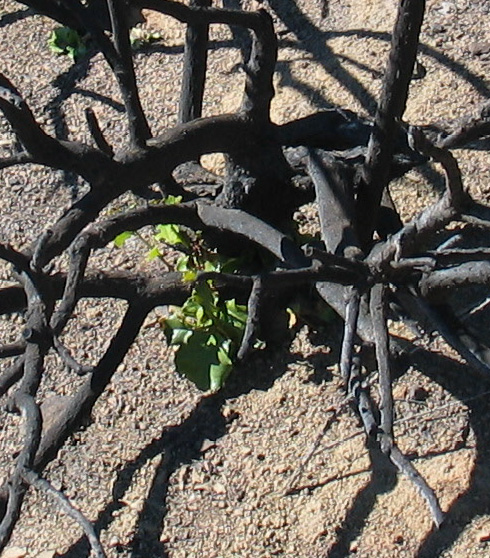
In some places, the soil is burned almost bare, with only tiny stubs of blackened stems, at most an inch or so tall. In others, a magical land of blackened sticks covers hundreds of yards beside the trail, all around six or eight feet tall, the skeleton stems and branches of shrubs burned to a uniform blackness, with the low winter sunlight casting a further black shadow…[and] with almost no vegetation, other life had also disappeared. No birds, no lizards (well, only a couple), no flies.

But they also found new green growth at the base of some of these plants, which have millions of years of experience with wildfire. Of the low shrubs, 80% are expected to return in a year. With them, will come the other life…
Day_fire_new_growth

Bush Administration Muzzles Scientists…Again

That’s according to a first-rate story in the Seattle Post-Intelligencer. The lede:

The Bush administration is ordering federal wildlife officials headed for international meetings on polar bears not to talk about how climate change and melting ice are affecting the imperiled animals.

The ever-reliable Andy Revkin of the NYTimes is also on the case. His lede:

Internal memorandums circulated in the Alaskan division of the Federal Fish and Wildlife Service appear to require government biologists or other employees traveling in countries around the Arctic not to discuss climate change, polar bears or sea ice if they are not designated to do so.

His newspaper was tipped off by a former Interior Department official (under the Clinton administration) who described the memos as a "Soviet-style directive." Lovely.

Or you can listen to Kiernan Suckling, the spokesperson for the trouble-making Center for Biological Diversity, which sued the US government in late 2005 to protect the polar bears’ habitat:

The polar bear has created a 24/7 forum for the U.S. government to be grilled about what its position is on global warming, and it’s really put the Bush administration in a tight, tight corner. It’s crazy to say, ‘The polar bear is endangered but we’re not going to do anything about global warming.

The CBD first contacted the Seattle newspaper’s enviro blog (Dateline Earth) about the muzzling. So maybe they should get the credit for breaking the story? Or Suckling? Not sure, but this much we know–the Bush administration is playing the role of the dim-witted heavy, yet again.

[Hat Tip: Environmental Journalism Now]

Polar_bear_looking_for_ice

The Female John Muir

The LATimes, for all its present woes, still has some wonderful writers, and one of my personal favorites is Susan Salter Reynolds, the lightest and most charming of all book reviewers alive today. Blessedly, she has a great interest in the planet.

Here’s her review of three books on the environment from two Sundays ago, concluding with a quote from Lester Rowntree, who is (apparently) known as the female John Muir. The book in question is "Hardy Californians," a book on Californian plants.

I’ll have to check her out. For now (from Hardy Californians):

These notes of mine were taken in all manner of places in California. In storm-lashed spots and in sheltered corners sweet with the repetitious litanies of bird song; on the hot floor of the glistening desert; on sands and bluffs by the sea; in the fragrant chaparral; in the caves and canyons of lonely islands; within the dnese dark shade of Redwoods; on wind-swept mesas; under the hymn-like music of the mountain conifer forests; and on breath-taking summits."

Hardy_californians

Global Warming Splits Conservatives

When it comes to global warming, conservatism in this country is at a crossroads. Increasing numbers of business leaders, evangelicals, and conservative opinion-leaders are calling for action to reduce the risks associated with climate change, but the best-known conservatives continue to doubt the science of global warming, attack those who would act to reduce emissions, and deride those concerned by the threat to the planet.

To many sympathetic observers, it’s puzzling. As Kerry Emmanuel pointed out in an essay for the Boston Phoenix earlier this year, conservatives didn’t have to react this way:

One can easily imagine conservatives embracing the notion of climate change in support of actions they might like to see anyway. Conservatives have usually been strong supporters of nuclear power, and few can be happy about our current dependence on foreign oil. The United States is renowned for its technological innovation and should be at an advantage in making money from any global sea change in energy-producing technology: consider the prospect of selling new means of powering vehicles and electrical generation to China’s rapidly expanding economy. But none of this has happened.

[For more, plus a very interesting discussion, please see the rest of the post on Grist.]

Good News from Way Down Under

Enviornmentalists are often accused of enjoying "doom and gloom," as if those who care about nature and the planet want to see it destroyed. This makes no sense, if you think about it for a second or two. No one accuses Republicans concerned about Islamic extremism of wanting to see another 9/11. Why should environmentalists be accused of wanting to destroy what is wild and beautiful? 

Nonetheless, this is one of those ideas that seems to have inserted itself inside our body politic, like a tick half-absorbed. Only by going directly at it can enviros hope to dislodge this vicious rumor.

In this spirit let me bring up some remarkably good news from Antartica regarding the stability of the world’s largest floating ice sheet. (Please see this post on Gristmill.)

Or, as Charles Petite said on his Knight Science Journalism site: "Among the sources is Dr. "Abrupt Climate Change" Richard Alley. If Alley is doubtful that the ice is a mere nudge away from calamity, bank on it."

How To Name a Planet-Sucking Gas Guzzler

My comedian friend Cary Odes likes to point out how many monster SUVs are named after the parts of the world they are destroying, such as the Toyota Tundra, or the GMC Yukon Denali.

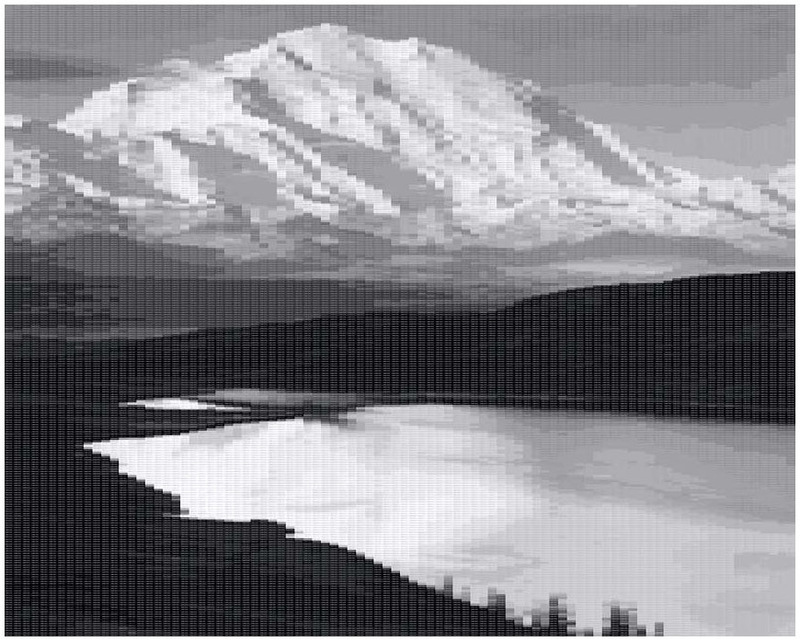
Well, it turns out a Seattle artist named Chris Jordan has also noted that irony, and found a way to visualize it…with a picture of Denali itself, composed of thousands of Yukon logos.

He has lots of other similar work–"running the numbers," as it were–on Orion this month.

The_yukon_denali_in_logos

“We Didn’t Want to Be on the Wrong Side of History”

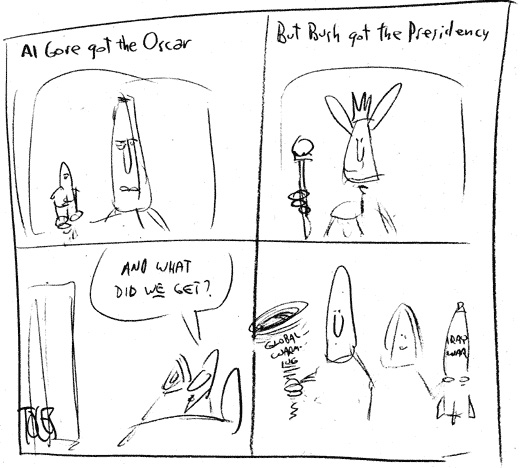
The obvious news on the climate change front is that "An Inconvenient Truth" won the Academy Award for Best Documentary. Given his chance to speak to the fabled billion people live for fifteen seconds, Gore spoke about climate change as a moral issue, not a political issue, and said we have everything we need to get started, except maybe the will to act. (The quotes come from Eli Rabett.)

But the unexpected news is that the largest utility in Texas, the notoriously anti-environmental TXU Corporation, has agreed to a huge buy-out in a deal brokered by a former head of the EPA, William Reilly, a Republican who served under the first President Bush. The deal would cancel eight out of eleven planned new coal plants, and include California-style incentives for conservation, in an effort to reduce emissions to 1990 levels by 2020.

It’s a complicated deal, and according to the LATimes, may face resistance from the Public Utility Commission. But a fascinating NYTimes article about the deal points to what brought the two sides together. Resistance to the deal from Texas mayors and local officials convinced investors that the deal might collapse of its own weight, driving down the TXU stock price, and opening the door to a deal brokered by Goldman Sachs, which has long had a strong interest in reducing emissions.

The crucial quote (from an official who insisted on anonymity):

"We didn’t want to be on the wrong side of history."

That’s the sound of the turning of the tides. Even in Texas, the environment still matters.