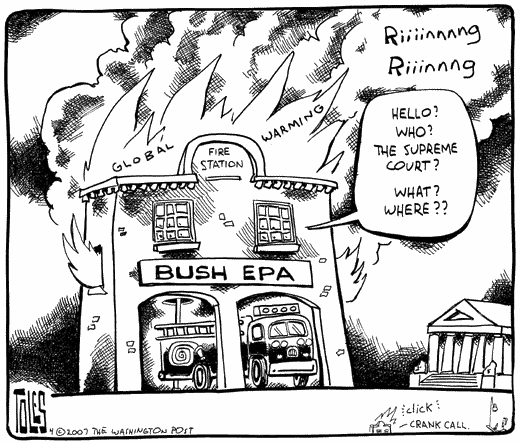
Chief Justice Roberts Loses a Big One

The Supreme Court is not just the highest court in the land, it is also the forum in which our nation’s most pressing issues are debated most rigorously, with precedents, transcripts, questions, and  arguments both oral and written. Congressional hearings, campaign speeches, press conferences and the like all have their time and place, but for truly substantive debate, we must go to the Supremes.

So having taken a look already at the winning argument in the discussion-changing decision of a week ago, let’s take a look at the losing argument. After all, it was a 5-4 decision.

As an unhappy editorial (Jolly Green Justices) in the Wall Street Journal put it: "Someone recently quipped that Justice Stevens considers it his late life’s work to compete for the jump ball that is the jurisprudence of Justice Kennedy, and he seems to be winning most possessions."

It’s true. Both Stevens and Kennedy were nominated to the court by Republicans (Ford and Reagan), and had the EPA lawyers argued their case more cleverly, they might have been able to win this decision on legal grounds. But the "facts on the ground" were against them, and–a little surprisingly–the EPA conceded the seriousness of global warming at the start, and claimed to want to reduce its "harms."

Justice John Paul Stevens, who wrote the majority opinion, seized on this as a concession in his opinion. In oral arguments, he pressed the agency lawyer, Greg Garre, on the matter:

JUSTICE STEVENS: Is there uncertainty on the basic proposition that these greenhouse gases contribute to global warming?

MR. GARRE: Your Honor, the report says that it is likely that there is a — a connection, but that it cannot unequivocally be established.

That weak "unequivocally" did not impress the court. Even Chief Justice Roberts, who wrote a fervent dissent to Stevens’ majority opinion, conceded at the outset Massachusetts’ claim that "Global warming may be a “crisis,” even “the most pressing environmental problem of our time.’"

But Roberts argues that the state of Massachusetts doesn’t have standing–the right–to press a claim against the EPA. Roberts argues passionately, in a blend of Latinisms and blunt English, but it comes down to the claim that because the harm of global warming is "conjecture," that therefore Massachusetts cannot force the EPA to regulate CO2 emissions. This is a stretch. As Stevens pointed out, the state has good reason to protect its coastline, even if it has not yet moved significantly inland.

Roberts is on firmer ground when he points out that regulation is not a remedy:

The [majority] contends that regulating domestic motor vehicle emissions will reduce carbon dioxide in the atmosphere, and therefore redress Massachusetts’s injury. But even if regulation does reduce emissions—to some indeterminate degree, given events elsewhere in the world—the Court never explains why that makes it likely that the injury in fact—the loss of land—will be redressed.

But this is the nature of global warming. We are already committed to decades of warming, even if we stop emitting today. Stevens repeatedly in his majority opinion talks of "reduction of harms," not of redressing particular losses (say, Cape Cod) with particular remedies (say, gas mileage standards). Roberts’ legal argument runs afoul of physical reality. Who claims that regulating emissions will solve the problem? No one I know. The idea is to avoid disaster, not to promise to roll back the clock.

In an analysis for the NYTimes, veteran reporter Linda Greenhouse wrote:

In the majority opinion, Justice John Paul Stevens found five votes for the conclusion that Massachusetts…was also entitled to special deference for its claim to standing because of its status as a sovereign state. Invoking no modern precedent — because there was none — to support this new theory of states’ rights, Justice Stevens deftly turned the court’s federalism revolution, which he has long opposed, on its head and provoked an objection from the chief justice.

This is huge, folks. Enormous. As Juliet Epstein put it in a column for the Washington Post:

Years from now, Massachusetts v. EPA may be seen as akin to the Roe v. Wade ruling on abortion, in which the Supreme Court answered a question that U.S. politicians were unable to resolve.

Justice Scalia seconded Roberts’ dissent, but added one of his own that’s less legal. Essentially, Scalia argues that CO2 is not a matter requiring regulation, in the judgement of the EPA administrator, and that the Court cannot substitute its judgement on that matter. He writes:

…the statute says nothing at all about the reasons for which the Administrator may defer making a judgment.

A more elegant defense for procrastination and non-action is difficult to imagine. But Scalia goes on, quoting the EPA at length on their claim of the "scientific uncertainty" of global warming, and then insisting that CO2 is not an "air pollutant" under the law.

This is a big stretch. Even Scalia admits that the "capacious" phrase from the Clean Air Act describes air pollutants as “any physical, chemical, . . . substance or matter which is emitted into or otherwise enters the ambient air,” including compounds that would affect weather or climatel. Still he insists that CO2 and methane cannot be regulated because they are not "polluting the air." Huh?

In a footnote he snarks at the majority opinion: "It follows that everything airborne, from Frisbees to flatulence, qualifies as an “air pollutant.” This reading of the statute defies common sense."

Scalia seems to have the same difficulty experienced by many others who cannot face the facts of climate. Global warming is complex and can seem contradictory. Drought and floods? Some people can’t seem to wrap their minds around that contradiction, and Scalia can’t seem to contemplate that changing the atmosphere might be harmful even if it doesn’t damage lungs directly.

But note what his narrow definition of air pollution excludes: the harms of global warming. Even the EPA admitted “the global retreat of mountain glaciers, reduction in snow-cover extent, the earlier spring melting of rivers and lakes, [and]the accelerated rate of rise of sea levels during the 20th century relative to the past few thousand years . . . .”

If despite these harms the EPA cannot regulate CO2 emissions, because (according to Roberts) it doesn’t have the right, and because (according to Scalia), greenhouse gases are not air pollution, what is the point of this agency?

And that’s what Buck Parker, of Earthjustice, remarked on in a story by Elizabeth Shogren at NPR:

"I don’t think that there is a very complicated explanation as to what happening. Simply the current administration has violated environmental laws more frequently and probably more egregiously than administrations in the past, and you have environmental law groups like Earthjustice willing to haul them into court."

And the fact that the administration is losing these cases has to be heartening to enviros, although of course under most administrations, the EPA would already be protecting mountains in West Virginia, working to reduce CO2 and methane emissions, and not rewriting the law to encourage mining, logging, and drilling without the oversight or consent of Congress.

But to the right wing of the Supreme Court that’s not important. When James Milkey, representing Massachusetts, addresssed the Court in oral arguments, and said that global warming is only going to get worse, Scalia asked crisply:

"When is the predicted cataclysm?"

And isn’t that the gist of the argument for doing nothing about global warming? As long as we don’t have a specific date when the sky will fall, that there’s no need to act?

Changes in Outlook, Changes in Look

Special thanks to Alberto Berio, of Artillery Unit (see design link below right) for helping with the new look. Comments, complaints, discussion welcome as always.

But now on to more serious topics, treated (I hope) with our customary blend of fact and irreverence.

To wit, here’s a Tom Toles’ sketch on the upcoming hurricane season…and a discussion of the forecast of the agenda-setting forecast from Colorado State University courtesy of Dr. Jeff Masters.

In short, the December and April forecasts from CSU show "negative" skill over the last twelve years, but the June forecast shows substantial skill. Maybe we should wait until June before going to the papers? Just a thought…

Hurricanes_predicted_for_2007

Too Busy for Beauty

Would passers-by notice if one of the greatest violinists in the world today worked the street in Washington, D.C.?

Today the Washington Post magazine runs a fascinating piece by Gene Weingarten called Pearls Before Breakfast to find out.

The answer, essentially, is "no." But there were a couple of exceptions. One was a former violinist:

The cultural hero of the day arrived at L’Enfant Plaza pretty late, in the unprepossessing figure of one John Picarello, a smallish man with a baldish head.

Picarello hit the top of the escalator just after Bell began his final piece, a reprise of "Chaconne." In the video, you see Picarello stop dead in his tracks, locate the source of the music, and then retreat to the other end of the arcade. He takes up a position past the shoeshine stand, across from that lottery line, and he will not budge for the next nine minutes.

People who pay to see Joshua Bell play in a concert hall can pay up to $1000 a ticket. When the editors of the magazine discussed what might happen, they worried about crowd control:

In a demographic as sophisticated as Washington, the thinking went, several people would surely recognize Bell. Nervous "what-if" scenarios abounded. As people gathered, what if others stopped just to see what the attraction was? Word would spread through the crowd. Cameras would flash. More people flock to the scene; rush-hour pedestrian traffic backs up; tempers flare; the National Guard is called; tear gas, rubber bullets, etc.

No such luck. But there was one group who "got" Bell immediately, interestingly:

There was no ethnic or demographic pattern to distinguish the people who stayed to watch Bell, or the ones who gave money, from that vast majority who hurried on past, unheeding. Whites, blacks and Asians, young and old, men and women, were represented in all three groups. But the behavior of one demographic remained absolutely consistent. Every single time a child walked past, he or she tried to stop and watch. And every single time, a parent scooted the kid away.

Interestingly, on his own another great musician–Neil Young–tried a similar experiment a few years ago in Scotland. He had no trouble drawing a crowd, despite wearing the craziest hat you ever did see.

Make of this what you will. Weingarten’s conclusion:

If we can’t take the time out of our lives to stay a moment and listen to one of the best musicians on Earth play some of the best music ever written; if the surge of modern life so overpowers us that we are deaf and blind to something like that — then what else are we missing?

Dueling Drought Stories

The "new normal" in the Southwest is drought, about which we’ll be hearing plenty in the years and decades to come. Even some conservatives, such as the illuminating Rod Dreher, are writing about the fact that Dallas is expected soon to be a Dust Bowl, to the apparent anger and incredulity of most of his readers.

But interestingly, the phenomenon looks different from the coasts. On the left coast, the LATimes runs a "straight" story about the "permanent drought" expected in the Southwest, according to 19 different computer models:

The computer models, on average, found about a 15% decline in surface moisture — which is calculated by subtracting evaporation from precipitation — from 2021 to 2040, as compared with the average from 1950 to 2000.

A 15% drop led to the conditions that caused the Dust Bowl in the Great Plains and the northern Rockies during the 1930s.

The NYTimes begins at the same point–drought in the Southwest–but take a completely different tack, looking at efforts underway to find new sources of water and reallocate existing supplies.

Some $2.5 billion in water projects are planned or under way in four states, the biggest expansion in the West’s quest for water in decades. Among them is a proposed 280-mile pipeline that would direct water to Las Vegas from northern Nevada. A proposed reservoir just north of the California-Mexico border would correct an inefficient water delivery system that allows excess water to pass to Mexico.

The NYTimes version is a little more "optimistic," I suppose, and does take us further down the line of what this news development will mean in the future, but in this case I prefer the simpler, blunter, harder truth. Drought is on its way, as never before, and for many of us, will be with us for the rest of our lives. Why not sit with that a day or two, before we move on to stories about water wars?

[Graphic from Lamont-Doherty lab at Columbia U, which produced the study.]

Drought_in_the_americas

The Jester Asks the Tough Questions

In the 21st century, some of the sharpest questions to politicians and other powerbrokers are coming not from serious-minded reporters, but from edgy comedians, such as Jon Stewart, Stephen Colbert, and Bill Maher.

I don’t know exactly why this is, but I kind of like it.

Last week Maher put Bernie Sanders on the spot regarding a global warming bill, asking the question that no one–left or right–seems ready for in America today: Why can’t we face unpleasant facts?

The Supremes Turn Green: Call for EPA Regulation of CO2 Emissions

The surprisingly firm Supreme Court decision handed down this past Monday on the responsibility of the EPA to regulate CO2 tailpipe emissions is the big news in climate this week and probably this year.

Let me bring you the decision and the links and sit with this ruling (pdf) and you for a minute or two.

As Carl Pope of the Sierra Club said, this is a watershed in the history of global warming.

All the news stories agree. The Supreme Court "rebuked" the Bush administration, according to Businessweek, which went on to point out in their story that many of this nation’s leading corporations agreed with the court. According to the NYTimes, the ruling is "a strong rebuke" to the administration. Henry Payne of the far-right National Review bitterly complains of the Green Supremes.

But before we get into the reverberations, including the administration’s feeble response to this drubbing, let’s listen to what the Supreme Court actually said, both from the majority (composed of three Republican nominees and two Democrats) and the minority (composed entirely of Republicans).

The decision was written by the oldest member of the court, John Paul Stevens, nominated by Gerald Ford in l975. Stevens considers himself a conservative; others consider him a liberal. Regardless, he’s playing a leading role on the court, given that he wrote this shocker as well as Hamden vs. Rumsfeld, which also put the Bush administration back on its heels. I’ll be frank, and confess that after reading his argument, I was awed by its forcefulness, its transparent simplicity, and its logic.

Here’s the opening:

A well-documented rise in global temperatures has coincided with a significant increase in the concentration of carbon dioxide in the atmosphere. Respected scientists believe the two trends are related. For when carbon dioxide is released into the atmosphere, it acts like the ceiling of a greenhouse, trapping solar energy and retarding the escape of reflected heat.

"Coincided"–is it sheer coincidence? Probably not. A plot against life as we know it? Probably not. Just fact. Well put, Mr. Stevens. Note how he next goes on to introduces the seriousness of the issue:

(b) The harms associated with climate change are serious and well recognized. The Government’s own objective assessment of the relevant science and a strong consensus among qualified experts indicate that global warming threatens, inter alia, a precipitate rise in sea levels, severe and irreversible changes to natural ecosystems, a significant reduction in winter snowpack with direct and important economic consequences, and increases in the spread of disease and the ferocity of weather events. That these changes are widely shared does not minimize Massachusetts’ interest in the outcome of this litigation. According to petitioners’ uncontested affidavits, global sea levels rose between 10 and 20 centimeters over the 20th century as a result of global warming and have already begun to swallow Massachusetts’ coastal land. Remediation costs alone, moreover, could reach hundreds of millions of dollars.

He avoids any questions about the data by pointing out that climate change threatens irreversible changes–according to the EPA itself. No need to get into statistics.

Further, he elegantly skewers the argument that because Massachusetts cannot play a decisive role in the worldwide struggle to reduce emissions, that it therefore cannot play any role at all.

That these [climate] changes are widely shared does not minimize Massachusetts’ interest in the outcome of this litigation.

Yes! The global nature of the crisis is not an argument for doing nothing. Many of the objections to reducing emissions aren’t really arguments, but complaints about any sort of change in our lives.  Stevens doesn’t let mental or physical laziness have a vote in this crucial debate.

He extends the decision by again pointing out that the EPA itself does not contest the causality of global warming. The agency admits that CO2 emissions cause global warming, but suggests we should not act,

since predicted increases in emissions from China, India, and other developing nations will likely offset any marginal domestic decrease EPA regulation could bring about. Agencies, like legislatures,do not generally resolve massive problems in one fell swoop…but instead whittle away over time, refining their approach as circumstances change and they develop a more nuanced understanding of how best to proceed.

Collective responsibility does not zero out personal responsibility. Strange how alleged conservatives fail to notice this.

(d) While regulating motor-vehicle emissions may not by itself reverse global warming, it does not follow that the Court lacks jurisdiction to decide whether EPA has a duty to take steps to slow or reduce it. Because of the enormous potential consequences, the fact that a remedy’s effectiveness might be delayed during the (relatively short) time it takes for a new motor-vehicle fleet to replace an older one is essentially irrelevant. Nor is it dispositive that developing countries are poised to substantially increase greenhouse gas emissions: A reduction in domestic emissions would slow the pace of global emissions increases,no matter what happens elsewhere. The Court attaches considerable significance to EPA’s espoused belief that global climate change must be addressed.

Don’t you love that? (My italics, by the way.) The Supreme Court is the first body in America with the power to tell the Bush administration that its lip service is inadequate.

But the majority gets much tougher.

Under the [Clean Air] Act’s clear terms, EPA can avoid promulgating regulations only if it determines that greenhouse gases do not contribute to climate change or if it provides some reasonable explanation as to why it cannot or will not exercise its discretion to determine whether they do. It has refused to do so, offering instead a laundry list of reasons not to regulate, including the existence of voluntary Executive Branch programs providing a response to global warming and im-pairment of the President’s ability to negotiate with developing na-tions to reduce emissions. These policy judgments have nothing to do with whether greenhouse gas emissions contribute to climate change and do not amount to a reasoned justification for declining to form ascientific judgment. Nor can EPA avoid its statutory obligation by noting the uncertainty surrounding various features of climate change and concluding that it would therefore be better not to regulate at this time. If the scientific uncertainty is so profound that it precludes EPA from making a reasoned judgment, it must say so.

Stevens is taking the EPA and the Bush administration to task for not following the law! To the Bush administration, environmental laws are nothing but red tape to be hacked through.

Stevens sees it the other way around: "EPA’s steadfast refusal to regulate greenhouse gas emissions presents a risk of harm to Massachusetts that is both “actual” and “imminent,’" he wrote, and added a little later that while the statute left the central determination to the “judgment” of the agency’s administrator, “the use of the word ‘judgment’ is not a roving license to ignore the statutory text.”

The opinion begins with an elegant introduction to the history of global warming, goes on to make a Federalist argument (that states depend on the Federal government to represent them in this difficulty) and includes a stunning quote from an opinion written by the famous Supreme Court  justice Oliver Wendell Holmes in l907 on the right of the state to regulate for clean air and water:

the State has an interest independent of and behind the titles of its citizens, in all the earth and air within its domain. It has the last word as to whether its mountains shall be stripped of their forests and its inhabitants shall breathe pure air.

When was the last time you read a Supreme Court ruling that sounded as if it had been written by a mountaineer! Holy cow…this is astounding!

Stevens concludes with some backhand shots against the EPA, the Bush administration, and backbiting rival Justice Scalia’s "apparent belief" that the EPA has no right to regulate greenhouse gases, which Stevens calls "irrelevant." Zing!

(Tomorrow: the howls of outrage from the outvoted.)

Supreme_court_justice_john_paul_ste

A Statistical Analysis of the Latest White House Evasions on Global Warming

Everyone who remembers their carbon emission history knows that President Bush promised while on his first campaign for President to regulate emissions, and then welshed on the promise, claiming that the Kyoto Protocols–or any similar effort–would "wreck the economy."

Since then his administration has famously employed oil industry lobbyists to rewrite scientific reports, intimidated scientists from talking to the media, and even sued to prevent states such as California and Massachusetts from acting on their own to reduce emissions.

With this record of duplicity, expecting coherence or sincerity from the White House on global warming is pointless. It’s obvious that the Bush/Cheney/Rove political machine has no intention of acting to reduce emissions (which are rising above 11% a year). It makes more sense to use a sort of scorecard of words to analyse his  words scientifically.

So, from the post-Supreme Court press gaggle, here’s President Bush’s response to a question on the subject of global warming, and here’s a numerical accounting of what he said:

REFERENCES TO GREENHOUSE GASES:                      5
REFERENCES TO SERIOUSNESS OF THE ISSUE:           3
REFERENCES TO AUTOMOBILES:                               3
REFERENCES TO "REMEDY":                                      2
REFERENCES TO "EXPENSIVE":                                   2
REFERENCES TO "NEW TECHNOLOGY":                      2
REFERENCES TO CHINA OR INDIA:                             1
REFERENCES TO REGULATION OR TAX:                     0

Supreme Court to Bush Administration on Global Warming: Deal With It

Huge news: the Supreme Court, on a 5-4 vote, rejects the do-nothing stance towards global warming of the Bush Administration, fully affirms the right of the EPA to regulate greenhouse gases under the Clean Air Act, and in fact demands that the EPA show why they should not do so. The rulling was much more sweeping and decisive than legal analysts expected.

For reaction, see this round-up, courtesy of the Wall Street Journal. Or check out David’s reaction, which can be summarized thusly: YAY!

I like this comment from PolWolf on the WSJ roundup:

THIS COURT DECISION IS AN AFRONT TO EVERY RED BLOODED, PATRIOTIC REPUBLICAN. GREENHOUSE GASES ARE, AND HAVE BEEN, AS EVERY KNOWS, THE FAULT OF BILL CLINTON.

The Venom of Global Warming

A toxic microalgae encouraged by global warming is thriving in tropical reefs and contributing to the poisoning of 50,000 people a year, reports the AP.

The poisonous algae and its effect, which is known as ciguatera, is not new; in fact, among historical celebrities, it’s believed to have poisoned Captain Cook’s men in the South Pacific near Vanatu in 1794. But scientists at the Woods Hole Oceanographic Institute in Massachusetts say that it’s much worse now than it was just twenty or thirty years ago. The director, Donald Anderson, said:

‘We have more toxins, more species of algae producing the toxins and more areas affected around the world."

The scientists blame global warming.

This adds to up to a few facts, some not good news, a little good news, and one potentially new twist:

1)    First, the poison is concentrated as it moves up the food chain. Humans are not poisoned by swallowing the poisonous dinoflagellates. Humans are poisoned by eating predator fish such as barracuda, which consume other fish who filter the microalgae out of the water.   

2)    Consuming the toxic is an extremely painful event, and can send entire families who ate the same poisoned fish together to the hospital, with symptoms similar to those of heavy metal poisoning, such as vomiting and diarrehea, and sometimes convulsions. It can be misdiagnosed as Multiple Sclerosis. 

3)    There is no certain way to tell if the fish has been poisoned or not. The toxin varies from region to region, and is described as "subtle." It cannot be neutralized by cooking or cleaning the fish.

4)    There is no antidote.

5)     But there is good news. Although its symptoms are serious and often result in hospitalization, ciguatera is almost never fatal. and usually–not always–patients recover completely in two weeks.

6)     Despite the risk, governments are reluctant to act, because there is no simple way method or test to distinguish sickening fish from healthy food.

7)     Here’s the new twist: In at least one place where the outbreak just occured, in Ilolio, the Philippines residents have stopped buying barracuda and grouper.

Which raises a question. For these species, this is huge news. According to the story, despite hundreds of casees of ciguatera poisoning a year, in Hong Kong barracuda and grouper remain hugely popular:

Hong Kong diners pay a premium for the risky fish. Rare species like the Napoleon wrasse fetch nearly $50 a pound. The fish are increasingly shipped live from Southeast Asia and as far away as the South Pacific, raising concerns from the World Conservation Union that many species, especially groupers, could be fished out of existence.

So, correct me if I’m wrong, but doesn’t this suggest, on a Darwinian level, that as we warm the planet, we are increasingly driving species to resort to poisoning us to survive?

That we are, in effect, turning other inhabitants of the planet against us?

Average_man_and_giant_barracuda