Moderation Can Be Useful–Even For Republicans

Ventura County in Southern California is represented in the Congress by Elton Gallegly, a Simi Valley Republican who has served for ten terms and will, after some indecision, run again in the fall.

I disagree with Gallegly on many issues, but it’s a fact that he has avoided the worst excesses of the modern-day GOP, as discussed in this long story today in the Ventura County Star. He wisely kept his distance from corrupt and corrupting Tom Delay, and he has always tried to work with others in the county, which has led him to support a number of important local environmentally-minded actions.

These include support for a study on how best to bring down Matilija dam, and support for the construction of an underground reservoir in the Oxnard Plain recommended by local water managers. This reservoir will help keep seawater from contaminating the aquifer. At the same time, it makes possible the safe storage of a great deal of water at a moderate cost, which could be crucial in case of early melting of the Sierra snow pack, which is one of the likely effects of global warming on our state.

Interestingly, he doesn’t trumpet these achievements on his website. He’s a senior member of the House Committee on Resources, chaired by the notorious anti-environmental zealot Richard Pombo. Pombo is now loathed not only by Democrats, but even by Republicans such as legendary former Congressman Pete McCloskey, one of the original sponsors of the Endangered Species Act, who despite being seventy-four years old, is so outraged that he has moved to Tracy and launched a campaign against  Pombo.

Pombo, who was close to Delay, and who has taken substantial funds from Indian tribes, is paying a price for his extremism. According to the Star:

Democratic pollster Ben Tulchin recently conducted a poll in California’s 11th Congressional District in the San Joaquin Valley. The district is represented by six-term Republican Richard Pombo, who also faces a primary challenge this spring. Its political makeup closely mirrors Gallegly’s district.

The poll found 37 percent of voters inclined to re-elect Pombo, 52 percent disinclined.

Having an opponent in the primary can spell problems for an incumbent, Tulchin said. "That’s how incumbents lose typically, when they get challenged in the primary," he said. "It means somebody has already started to make the case against the guy, whether it’s Gallegly, Pombo or (Roseville Republican Rep. John) Doolittle."

Update:    According to a big story on the most vulnerable of incumbent Congressmen in California by Rone Tempest in the LATimes, both Pombo and his fellow Tom Delay crony John Dolittle are not seriously threatened, thanks to "avid supporters" in their "spectacularly gerrymandered" districts. This story discounts the poll mentioned above.

Update 2:    According to a big story by Adam Nagourney on the most vulnerable of incumbent Congressmen nationwide in the NYTimes, the number of Republican seats in play nationwide has jumped to thirty-six, up from twenty-four just a few months ago, and includes Pombo’s district, largely because the Democrats have succeeded in "nationalizing" the election.
Al Gore Speaks: Deniers Freak

The release of Al Gore’s An Inconvenient Truth climate change documentary next week has oil co-funded deniers at the anti-regulation Competitive Enterprise Institute and at FOXNews in full tizzy mode.

According to Kevin Drum and Christina Larson at Political Animal, the "thinktank" is responding with a week-long television advertising campaign in fourteen US cities that concludes with an amazingly dumb tagline:

        CO2:   We call it life.

This obvious absurdity has brought an avalanche of instant joke answers, a few of which will be listed below. Essentially, as Atrios  and David Roberts at Gristmill and numerous others have pointed out in various ways, "If this is all they can come up with, they’re toast."

But it’s obvious how frightened the deniers are, if a movie expected to come in dead last among major releases this summer can elicit such a panicked response.

In something of a surprise, FOXNews claim to be going with the nuanced approach, focusing on the issue  in response to Gore’s movie, but with a special that they say will attempt to "rise above politics on the global warming debate."

Given that last summer FOX actually aired a special on global warming from the Arctic, and accepted its reality for the first time in memory, we’ll cut them some slack, for once, not having yet seen it.

But back to the comedy, with a few alternative taglines:

From Political Animal: CO2: It’s what salad has for lunch.

Or:  C02: We call it life.
       No really–put that plastic bag over your head. 

From Metafilter: Please ignore the environment, it will go away…

And the winner in Drum’s joke contest, from Publius.


The Sound of the Northern Ice

About six months ago I had the bright idea of pulling together resources on climate change for students, who despite a generational interest in the issue, often are daunted by the vastness of the subject.

But it turns out that Andrew Revkin of The New York Times, along with the paper’s Learning Network and the Bank Street College of Education, has already done a thoroughly superb job at this important task. It’s enough to make me want to go back to school, or become a teacher, just to be able to explore these complex and interrelated issues in depth. Check it out.

My favorite bit so far? An interactive audio sample in which Revkin talks to oceanographer Tim Stanton near the North Pole…while in the background we hear the enormous clamor of ice colliding.

Revkin sounds a little nervous; Stanton is blase about the vast forces involved. It’s utterly charming, in a noisy way.

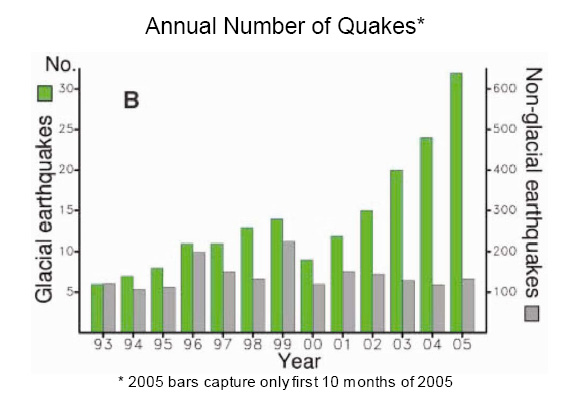
It also reminded me of this visual from James Hansen‘s invaluable site, which comes from a pdf presentation Hansen delivered a few weeks ago to the National Academy of Sciences called "Global Warming: Is There Still Time to Avoid Disastrous Human-Made Change?" Well worth a look.

If the sound of ice colliding is noisy, imagine the sound of a glacial earthquake…

Greenlandglacialearthquakes

Telling the Nation

A couple of weeks ago, David Roberts at Gristmill had the chance to interview climate change hero Al Gore and kindly solicited questions.

My question for him was: Does Al ever feel like saying "I Told You So" to the nation?

Roberts didn’t ask Gore the question, but the thought has crossed Gore’s mind. On "Saturday Night Live" this weekend, thanks to Crooks and Liars, you can see Al Gore say so, live from the Oval Office.

Sort of.

My favorite line:

In the last 6 years we have been able to stop global warming. No one could have predicted the negative results of this. Glaciers that once were melting are now on the attack.

As you know, these renegade glaciers have already captured parts of upper Michigan and northern Maine, but I assure you: we will not let the glaciers win.

Sick? Or Just Burned Out?

"The environment" (God, I hate that word) also includes our lives at work, and in an important column last week in the NYTimes (excerpted below the fold) Paul Krugman discusses a carefully designed study that compared the health of Americans versus the health of Britons. The study finds that despite spending twice as much money, on average, as the Brits, Americans are far sicker.

Malcolm Gladwell, the gifted writer for the New Yorker, discusses the column and solicits comments on his fairly-new blog, and makes the crucial point:


Krugman argues that this is evidence of how much more stressful living in America is than living in England. I think that’s absolutely right. I would simply add that it is one more nail in the coffin of the notion that good health is something that can be purchased through fancy, high-tech drugs and doctors and hospitals. I know the idea that health care is just another consumer good is pretty popular at the moment. But its very hard to read the JAMA study, see what our $5274 actually buys us–and still believe in that notion. Our health is in reality a function of the broader society in which we live–the pressures and conditions and environments in which we find ourselves.

As one of the comments on Gladwell’s post points out, Americans consider themselves lucky to get paid for two or three weeks a year of vacation; in Britain, it’s five or six weeks. This is no small difference; and, I strongly suspect, a big reason why Americans lives are so much more stressful and so much less healthy than the Brits, even though Americans smoke less and drink less.

A solution? My fantasy is that a well-liked candidate runs for President on a platform of providing a month of paid vacation per working American per year. When I mention this people give me the sort of tolerant looks that one turns on crazy people, but why is this deranged? That we should have a tenth or so of our time for ourselves? And not for money? Man, don’t even mention it. That’s crazy…

Our Sick Society

By PAUL KRUGMAN
Published: May 5, 2006

Is being an American bad for your health? That’s the apparent implication of a study just published in The Journal of the American Medical Association.

It’s not news that something is very wrong with the state of America’s health. International comparisons show that the United States has achieved a sort of inverse miracle: we spend much more per person on health care than any other nation, yet we have lower life expectancy and higher infant mortality than Canada, Japan and most of Europe.

But it isn’t clear exactly what causes this stunningly poor performance. How much of America’s poor health is the result of our failure, unique among wealthy nations, to guarantee health insurance to all? How much is the result of racial and class divisions?

How much is the result of other aspects of the American way of life?

The new study, ”Disease and Disadvantage in the United States and in England,” doesn’t resolve all of these questions.

[cut]

Comparing us with the English isn’t a choice designed to highlight American problems: Britain spends only about 40 percent as much per person on health care as the United States, and its health care system is generally considered inferior to those of neighboring countries, especially France. Moreover, England isn’t noted either for healthy eating or for a healthy lifestyle.

Nonetheless, the study concludes that ”Americans are much sicker than the English.” For example, middle-age Americans are twice as likely to suffer from diabetes as their English counterparts. That’s a striking finding in itself.

What’s even more striking is that being American seems to damage your health regardless of your race and social class.

That’s not to say that class is irrelevant. (The researchers excluded racial effects by restricting the study to non-Hispanic whites.)

In fact, there’s a strong correlation within each country between wealth and health. But Americans are so much sicker that the richest third of Americans is in worse health than the poorest third of the English.

So what’s going on? Lack of health insurance is surely a factor in the poor health of lower-income Americans, who are often uninsured, while everyone in England receives health care from the government. But almost all upper-income Americans have insurance.

What about bad habits, which the study calls ”behavioral risk factors”? The stereotypes are true: the English are much more likely to be heavy drinkers, and Americans much more likely to be obese. But a statistical analysis suggests that bad habits are only a fraction of the story.

In the end, the study’s authors seem baffled by the poor health of even relatively well-off Americans. But let me suggest a couple of possible explanations.

One is that having health insurance doesn’t ensure good health care. For example, a New York Times report on diabetes pointed out that insurance companies are generally unwilling to pay for care that might head off the disease, even though they are willing to pay for the extreme measures, like amputations, that become necessary when prevention fails. It’s possible that Britain’s National Health Service, in spite of its limited budget, actually provides better all-around medical care than our system because it takes a broader, longer-term view than private insurance companies.

The other possibility is that Americans work too hard and experience too much stress. Full-time American workers work, on average, about 46 weeks per year; full-time British, French and German workers work only 41 weeks a year.

I’ve pointed out in the past that our workaholic economy is actually more destructive of the ”family values” we claim to honor than the European economies in which regulations and union power have led to shorter working hours.

Maybe overwork, together with the stress of living in an economy with a minimal social safety net, damages our health as well as our families.

[cut]

Andrew Sullivan Stops Scoffing

Most right-wing commentators (such as George Will) still refuse to face the facts on our changing climate, so it’s worth pointing out an exception to the rule.

Andrew Sullivan also happens to be my favorite right-wing commentator, partly for his relative open-mindedness, but mostly for his sheer ability to write. The cold fury with which he described the American torturing at Abu Ghraib and other military installations set a high standard for on-line commentary, I think. Few others could make the public even pay attention to the horror.

And so when–for the first time, as far as I know–Sullivan actually points to some facts on climate change, I want to give him credit. Check out this worthy Quote of the Day, which includes a link to a discussion of climate change…in the Wall Street Journal!

Maybe it’s not too late, after all.

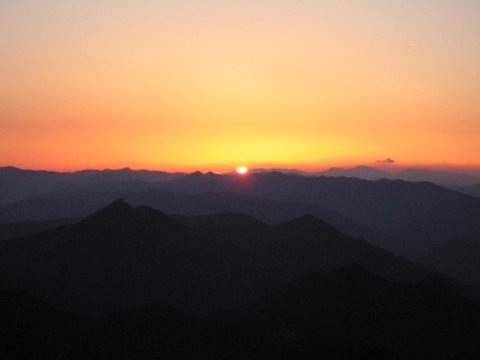
Sunset from the Topa Topas

For my pal Cary’s birthday a week ago we went on a backing trip. Not an easy trip–somehow, the Sespe backcountry’s always tough–but one that left us lots of memories.

Cary had a great time, I can honestly report.

Caryinthesespe

We first went to the top  of the local ridge, the Topa Topas, at about 6500 feet, where we camped.

Trailuptothetopatopas

A tough little mountain, but one with a great view from the top…

Sunsetfromthetopatopas_1

Struggling Through a Bog

Faithful readers know that in recent months yours truly has been troubled by a frustration with the modern nature of time itself. That’s putting it pretentiously, but sometimes one has to reach above the routine to express the sense of a change, and for the moment, it’s the best I can do.

But you might give me a look and suggest that maybe that’s just me.

I don’t think so.

For one, I’m not alone in this conviction; in fact, I’m considerably behind the times.

A couple of months ago I linked to a notable essay by Richard Ford in which he called the pace of life in l998 "morally dangerous" and declared:

Yes, you can say these are just insignificant annoyances and I’m peevish, and the velocity of life and change has increased — that ideas like dollars must flow freely, that the more exchange we have with the unknown the less we fear it, and that life feels full — just the way we always hoped it would. But in an ominous way, these interruptions represent a turf battle over who’s going to say what I have on my mind at any present moment — now, in other words. And this battle seems to contain moral consequence lasting far beyond the moment or the individual interruption. Indeed, at the heart of the contest is an axiological paradox whereby the higher valuation placed on my immediate attention by others — vendors, let’s call them — is accompanied by or perhaps even causes a lower valuation to be placed on it by me, who’s after all losing these moments and having to reconcile their loss. It’s as though I had nows to burn. Except I don’t.

And other voices are making similar claims. In the mail yesterday comes the latest Granta, perhaps the best literary magazine in English.

Being more interested in timelessness than timeliness, they don’t have a big web presence, and allow few links to pieces, especially the great ones. And they always have one or two great ones per issue, sometimes more.

The best I’ve seen so far this issue is by a writer previously unknown to me named Andrew Brown, who is an author and a writer for "The Guardian."

It’s called "In the Clearing" and it’s about going to rural Sweden, where Brown grew up, to work on a book. He found a place as far away from "civilization" as he could that still had electric power. He sat at a desk and looked out at a grey,  mostly featureless landscape speckled with birds.

He writes:

The rain returned next day. I worked. My senses refined. The less there seemed to be to see and hear, the more clearly I could apprehend what there was. At the table in the kitchen I kept typing, looking back to a past that seemed as grey and impenetrable as the clouds clamped over the valley. For days I seemed to be struggling through a bog in my work, measuring progress only in exhaustion. But at least I could attain exhaustion. It seemed to me, from where I sat with nothing to watch but the swallows, that trying to work as I normally do, with a telephone and an Internet connection, was like trying to think in a cloud of mosquitoes.

For and Against Hope

In a hard essay in this month’s Orion, Derrick Jensen argues forcefully against hope.

But no matter what environmentalists do, our best efforts are insufficient. We’re losing badly, on every front. Those in power are hell-bent on destroying the planet, and most people don’t care.

Frankly, I don’t have much hope. But I think that’s a good thing. Hope is what keeps us chained to the system, the conglomerate of people and ideas and ideals that is causing the destruction of the Earth.

This sounds to me like the logic of despair…and violence.

Jensen points out that we don’t hope for what matters most to us–breath, food, family, life itself. We act. When we stop hoping, he figures, we’ll start acting.

When we realize the degree of agency we actually do have, we no longer have to "hope" at all. We simply do the work. We make sure salmon survive. We make sure prairie dogs survive. We make sure grizzlies survive. We do whatever it takes.

But this ducks the central difficulty, which is the gap between the royal environmental "we" and the populace at large. To pretend that "we" enviros can save the grizzlies, or the salmon, or the loveliness of our current climate, without the backing of the larger populace is absurd. That’s why most effective environmentalists I know–such as Alisdair Coyne and Dave White, of Keep the Sespe Wild–remain adamantly focused on public support as a strategy for environmental preservation.

But worse, Jensen’s bitterness hints at what Marxists used to call "direct action," which in practice often meant violent acts. 

Perhaps–to be fair–Jensen is thinking of people like Julia "Butterfly" Hill, who saved an enormous redwood from being logged by the personal risks she took to preserve it. Let’s hope so. But he didn’t specify what sort of actions he had in mind, and with words like "whatever it takes" one can easily imagine more spectacular and less popular actions.

Infinitely more persuasive on this subject is a poem published last month in Poetry by the Nobel-prize winning Wislawa Szymborska. It’s called "Consolation," and it’s about Charles Darwin, of all people.  Szymborska writes at the start:   

     Darwin.
    They say he read novels to relax,
    But only certain kinds:
nothing that ended unhappily.
    If anything like that turned up,
enraged,
    he flung the book into the fire.

   True or not,

    I’m ready to believe it.

    Scanning in his mind so many times and places,

    he’d had enough of dying species,

    the triumphs of the strong over the weak,

    the endless struggles to survive,

    all doomed sooner or later.

    He’d earned the right to happy endings,

    at least in fiction
with its diminutions.

This is the truth. All of us–even Charles Darwin–need hope. We can no more revoke our need for it than we can revoke our desire to breath, to eat, to love.

Hope, like hyperventilation, can lead to giddiness, but it is as essential for our spirits as oxygen for our bodies.

The 3% Solution

From Time magazine, which has been surprisingly feisty lately, a story called The Fix For High Gas Prices  That Congress Won’t Touch. The telling quote:

The cantankerous Republican Senator Chuck Grassley of Iowa has made repeat appearances on CNBC this week to bark out a stern conservation message. "If everyone cut back their driving by 3% we’d have gasoline coming out of our ears!" he told viewers. But he’s one of the few lawmakers willing to publicly encourage cutting back.

It’s not a secret, in D.C. or elsewhere. But Grassley is one of the very few politicians on either side of the aisle willing to be even quoted on the issue. That’s our Congress. Leading the way as always.