"You know, I’ve heard people say, "Oh, you know, he’s just kind of optimistic for the sake of optimism."
President Bush, on March 21st, via PBS.
Or, as Tom Toles Toles puts it:
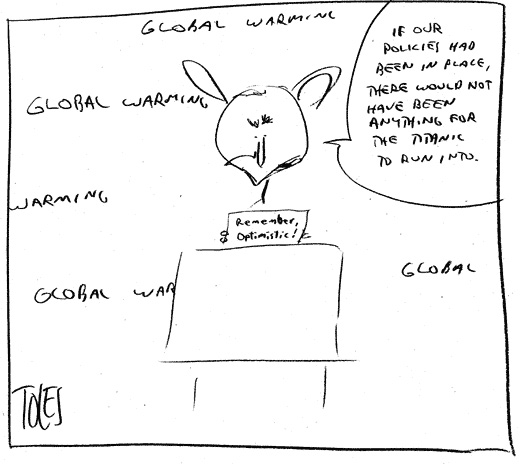
A Change in the Wind
Says Time. I’ll post their excellent story below the fold with one note: Here at last is a mainstream publication willing to say what is obvious to people who have been watching the issue…that yes, cyclones like Larry in Australia, clocked at an unprecedented 180 mph, are a manifestation of global warming. Why is that so difficult for reporters to put down on paper?
Global Warming Heats Up
The climate is crashing, and global warming is to blame. Why the crisis will hit so soon—and what we can do about it
By JEFFREY KLUGER
No one can say exactly what it looks like when a planet takes ill, but it probably looks a lot like Earth.
Never mind what you’ve heard about global warming as a slow-motion emergency that would take decades to play out. Suddenly and unexpectedly, the crisis is upon us.
It certainly looked that way last week as the atmospheric bomb that was Cyclone Larry—a Category 5 storm with wind bursts that reached 180 m.p.h.—exploded through northeastern Australia. It certainly looked that way last year as curtains of fire and dust turned the skies of Indonesia orange, thanks to drought-fueled blazes sweeping the island nation. It certainly looks that way as sections of ice the size of small states calve from the disintegrating Arctic and Antarctic. And it certainly looks that way as the sodden wreckage of New Orleans continues to molder, while the waters of the Atlantic gather themselves for a new hurricane season just two months away. Disasters have always been with us and surely always will be. But when they hit this hard and come this fast—when the emergency becomes commonplace—something has gone grievously wrong. That something is global warming.
The image of Earth as organism—famously dubbed Gaia by environmentalist James Lovelock—has probably been overworked, but that’s not to say the planet can’t behave like a living thing, and these days, it’s a living thing fighting a fever. From heat waves to storms to floods to fires to massive glacial melts, the global climate seems to be crashing around us. Scientists have been calling this shot for decades. This is precisely what they have been warning would happen if we continued pumping greenhouse gases into the atmosphere, trapping the heat that flows in from the sun and raising global temperatures.
Environmentalists and lawmakers spent years shouting at one another about whether the grim forecasts were true, but in the past five years or so, the serious debate has quietly ended. Global warming, even most skeptics have concluded, is the real deal, and human activity has been causing it. If there was any consolation, it was that the glacial pace of nature would give us decades or even centuries to sort out the problem.
But glaciers, it turns out, can move with surprising speed, and so can nature. What few people reckoned on was that global climate systems are booby-trapped with tipping points and feedback loops, thresholds past which the slow creep of environmental decay gives way to sudden and self-perpetuating collapse. Pump enough CO2 into the sky, and that last part per million of greenhouse gas behaves like the 212th degree Fahrenheit that turns a pot of hot water into a plume of billowing steam. Melt enough Greenland ice, and you reach the point at which you’re not simply dripping meltwater into the sea but dumping whole glaciers. By one recent measure, several Greenland ice sheets have doubled their rate of slide, and just last week the journal Science published a study suggesting that by the end of the century, the world could be locked in to an eventual rise in sea levels of as much as 20 ft. Nature, it seems, has finally got a bellyful of us.
"Things are happening a lot faster than anyone predicted," says Bill Chameides, chief scientist for the advocacy group Environmental Defense and a former professor of atmospheric chemistry. "The last 12 months have been alarming." Adds Ruth Curry of the Woods Hole Oceanographic Institution in Massachusetts: "The ripple through the scientific community is palpable."
And it’s not just scientists who are taking notice. Even as nature crosses its tipping points, the public seems to have reached its own. For years, popular skepticism about climatological science stood in the way of addressing the problem, but the naysayers—many of whom were on the payroll of energy companies—have become an increasingly marginalized breed. In a new Time/ ABC News/ Stanford University poll, 85% of respondents agree that global warming probably is happening. Moreover, most respondents say they want some action taken. Of those polled, 87% believe the government should either encourage or require lowering of power-plant emissions, and 85% think something should be done to get cars to use less gasoline. Even Evangelical Christians, once one of the most reliable columns in the conservative base, are demanding action, most notably in February, when 86 Christian leaders formed the Evangelical Climate Initiative, demanding that Congress regulate greenhouse gases.
A collection of new global-warming books is hitting the shelves in response to that awakening interest, followed closely by TV and theatrical documentaries. The most notable of them is An Inconvenient Truth, due out in May, a profile of former Vice President Al Gore and his climate-change work, which is generating a lot of prerelease buzz over an unlikely topic and an equally unlikely star. For all its lack of Hollywood flash, the film compensates by conveying both the hard science of global warming and Gore’s particular passion.
Such public stirrings are at last getting the attention of politicians and business leaders, who may not always respond to science but have a keen nose for where votes and profits lie. State and local lawmakers have started taking action to curb emissions, and major corporations are doing the same. Wal-Mart has begun installing wind turbines on its stores to generate electricity and is talking about putting solar reflectors over its parking lots. HSBC, the world’s second largest bank, has pledged to neutralize its carbon output by investing in wind farms and other green projects. Even President Bush, hardly a favorite of greens, now acknowledges climate change and boasts of the steps he is taking to fight it. Most of those steps, however, involve research and voluntary emissions controls, not exactly the laws with teeth scientists are calling for.
Is it too late to reverse the changes global warming has wrought? That’s still not clear. Reducing our emissions output year to year is hard enough. Getting it low enough so that the atmosphere can heal is a multigenerational commitment. "Ecosystems are usually able to maintain themselves," says Terry Chapin, a biologist and professor of ecology at the University of Alaska, Fairbanks. "But eventually they get pushed to the limit of tolerance."
CO2 AND THE POLES
As a tiny component of our atmosphere, carbon dioxide helped warm Earth to comfort levels we are all used to. But too much of it does an awful lot of damage. The gas represents just a few hundred parts per million (p.p.m.) in the overall air blanket, but they’re powerful parts because they allow sunlight to stream in but prevent much of the heat from radiating back out. During the last ice age, the atmosphere’s CO2 concentration was just 180 p.p.m., putting Earth into a deep freeze. After the glaciers retreated but before the dawn of the modern era, the total had risen to a comfortable 280 p.p.m. In just the past century and a half, we have pushed the level to 381 p.p.m., and we’re feeling the effects. Of the 20 hottest years on record, 19 occurred in the 1980s or later. According to nasa scientists, 2005 was one of the hottest years in more than a century.
It’s at the North and South poles that those steambath conditions are felt particularly acutely, with glaciers and ice caps crumbling to slush. Once the thaw begins, a number of mechanisms kick in to keep it going.
Greenland is a vivid example. Late last year, glaciologist Eric Rignot of the Jet Propulsion Laboratory in Pasadena, Calif., and Pannir Kanagaratnam, a research assistant professor at the University of Kansas, analyzed data from Canadian and European satellites and found that Greenland ice is not just melting but doing so more than twice as fast, with 53 cu. mi. draining away into the sea last year alone, compared with 22 cu. mi. in 1996. A cubic mile of water is about five times the amount Los Angeles uses in a year.
Dumping that much water into the ocean is a very dangerous thing. Icebergs don’t raise sea levels when they melt because they’re floating, which means they have displaced all the water they’re ever going to. But ice on land, like Greenland’s, is a different matter. Pour that into oceans that are already rising (because warm water expands), and you deluge shorelines. By some estimates, the entire Greenland ice sheet would be enough to raise global sea levels 23 ft., swallowing up large parts of coastal Florida and most of Bangladesh. The Antarctic holds enough ice to raise sea levels more than 215 ft.
FEEDBACK LOOPS
One of the reasons the loss of the planet’s ice cover is accelerating is that as the poles’ bright white surface shrinks, it changes the relationship of Earth and the sun. Polar ice is so reflective that 90% of the sunlight that strikes it simply bounces back into space, taking much of its energy with it. Ocean water does just the opposite, absorbing 90% of the energy it receives. The more energy it retains, the warmer it gets, with the result that each mile of ice that melts vanishes faster than the mile that preceded it. That is what scientists call a feedback loop, and it’s a nasty one, since once you uncap the Arctic Ocean, you unleash another beast: the comparatively warm layer of water about 600 ft. deep that circulates in and out of the Atlantic. "Remove the ice," says Woods Hole’s Curry, "and the water starts talking to the atmosphere, releasing its heat. This is not a good thing."
A similar feedback loop is melting permafrost, usually defined as land that has been continuously frozen for two years or more. There’s a lot of earthly real estate that qualifies, and much of it has been frozen much longer than two years—since the end of the last ice age, or at least 8,000 years ago. Sealed inside that cryonic time capsule are layers of partially decayed organic matter, rich in carbon. In high-altitude regions of Alaska, Canada and Siberia, the soil is warming and decomposing, releasing gases that will turn into methane and CO2. That, in turn, could lead to more warming and permafrost thaw, says research scientist David Lawrence of the National Center for Atmospheric Research (ncar) in Boulder, Colo. And how much carbon is socked away in Arctic soils? Lawrence puts the figure at 200 gigatons to 800 gigatons. The total human carbon output is only 7 gigatons a year.
One result of all that is warmer oceans, and a result of warmer oceans can be, paradoxically, colder continents within a hotter globe. Ocean currents running between warm and cold regions serve as natural thermoregulators, distributing heat from the equator toward the poles. The Gulf Stream, carrying warmth up from the tropics, is what keeps Europe’s climate relatively mild. Whenever Europe is cut off from the Gulf Stream, temperatures plummet. At the end of the last ice age, the warm current was temporarily blocked, and temperatures in Europe fell as much as 10(degree)F, locking the continent in glaciers.
What usually keeps the Gulf Stream running is that warm water is lighter than cold water, so it floats on the surface. As it reaches Europe and releases its heat, the current grows denser and sinks, flowing back to the south and crossing under the northbound Gulf Stream until it reaches the tropics and starts to warm again. The cycle works splendidly, provided the water remains salty enough. But if it becomes diluted by freshwater, the salt concentration drops, and the water gets lighter, idling on top and stalling the current.
Last December, researchers associated with Britain’s National Oceanography Center reported that one component of the system that drives the Gulf Stream has slowed about 30% since 1957. It’s the increased release of Arctic and Greenland meltwater that appears to be causing the problem, introducing a gush of freshwater that’s overwhelming the natural cycle. In a global-warming world, it’s unlikely that any amount of cooling that resulted from this would be sufficient to support glaciers, but it could make things awfully uncomfortable.
"The big worry is that the whole climate of Europe will change," says Adrian Luckman, senior lecturer in geography at the University of Wales, Swansea. "We in the U.K. are on the same latitude as Alaska. The reason we can live here is the Gulf Stream."
DROUGHT
As fast as global warming is transforming the oceans and the ice caps, it’s having an even more immediate effect on land. People, animals and plants living in dry, mountainous regions like the western U.S. make it through summer thanks to snowpack that collects on peaks all winter and slowly melts off in warm months. Lately the early arrival of spring and the unusually blistering summers have caused the snowpack to melt too early, so that by the time it’s needed, it’s largely gone. Climatologist Philip Mote of the University of Washington has compared decades of snowpack levels in Washington, Oregon and California and found that they are a fraction of what they were in the 1940s, and some snowpacks have vanished entirely.
Global warming is tipping other regions of the world into drought in different ways. Higher temperatures bake moisture out of soil faster, causing dry regions that live at the margins to cross the line into full-blown crisis. Meanwhile, El Nino events—the warm pooling of Pacific waters that periodically drives worldwide climate patterns and has been occurring more frequently in global-warming years—further inhibit precipitation in dry areas of Africa and East Asia. According to a recent study by ncar, the percentage of Earth’s surface suffering drought has more than doubled since the 1970s.
FLORA AND FAUNA
Hot, dry land can be murder on flora and fauna, and both are taking a bad hit. Wildfires in such regions as Indonesia, the western U.S. and even inland Alaska have been increasing as timberlands and forest floors grow more parched. The blazes create a feedback loop of their own, pouring more carbon into the atmosphere and reducing the number of trees, which inhale CO2 and release oxygen.
Those forests that don’t succumb to fire die in other, slower ways. Connie Millar, a paleoecologist for the U.S. Forest Service, studies the history of vegetation in the Sierra Nevada. Over the past 100 years, she has found, the forests have shifted their tree lines as much as 100 ft. upslope, trying to escape the heat and drought of the lowlands. Such slow-motion evacuation may seem like a sensible strategy, but when you’re on a mountain, you can go only so far before you run out of room. "Sometimes we say the trees are going to heaven because they’re walking off the mountaintops," Millar says.
Across North America, warming-related changes are mowing down other flora too. Manzanita bushes in the West are dying back; some prickly pear cacti have lost their signature green and are instead a sickly pink; pine beetles in western Canada and the U.S. are chewing their way through tens of millions of acres of forest, thanks to warmer winters. The beetles may even breach the once insurmountable Rocky Mountain divide, opening up a path into the rich timbering lands of the American Southeast.
With habitats crashing, animals that live there are succumbing too. Environmental groups can tick off scores of species that have been determined to be at risk as a result of global warming. Last year, researchers in Costa Rica announced that two-thirds of 110 species of colorful harlequin frogs have vanished in the past 30 years, with the severity of each season’s die-off following in lockstep with the severity of that year’s warming.
In Alaska, salmon populations are at risk as melting permafrost pours mud into rivers, burying the gravel the fish need for spawning. Small animals such as bushy-tailed wood rats, alpine chipmunks and pinon mice are being chased upslope by rising temperatures, following the path of the fleeing trees. And with sea ice vanishing, polar bears—prodigious swimmers but not inexhaustible ones—are starting to turn up drowned. "There will be no polar ice by 2060," says Larry Schweiger, president of the National Wildlife Federation. "Somewhere along that path, the polar bear drops out."
WHAT ABOUT US?
It is fitting, perhaps, that as the species causing all the problems, we’re suffering the destruction of our habitat too, and we have experienced that loss in terrible ways. Ocean waters have warmed by a full degree Fahrenheit since 1970, and warmer water is like rocket fuel for typhoons and hurricanes. Two studies last year found that in the past 35 years the number of Category 4 and 5 hurricanes worldwide has doubled while the wind speed and duration of all hurricanes has jumped 50%. Since atmospheric heat is not choosy about the water it warms, tropical storms could start turning up in some decidedly nontropical places."There’s a school of thought that sea surface temperatures are warming up toward Canada," says Greg Holland, senior scientist for ncar in Boulder. "If so, you’re likely to get tropical cyclones there, but we honestly don’t know."
So much environmental collapse happening in so many places at once has at last awakened much of the world, particularly the 141 nations that have ratified the Kyoto treaty to reduce emissions—an imperfect accord, to be sure, but an accord all the same. The U.S., however, which is home to less than 5% of Earth’s population but produces 25% of CO2 emissions, remains intransigent. Many environmentalists declared the Bush Administration hopeless from the start, and while that may have been premature, it’s undeniable that the White House’s environmental record—from the abandonment of Kyoto to the President’s broken campaign pledge to control carbon output to the relaxation of emission standards–has been dismal. George W. Bush’s recent rhetorical nods to America’s oil addiction and his praise of such alternative fuel sources as switchgrass have yet to be followed by real initiatives.
The anger surrounding all that exploded recently when NASA researcher Jim Hansen, director of the Goddard Institute for Space Studies and a longtime leader in climate-change research, complained that he had been harassed by White House appointees as he tried to sound the global-warming alarm. "The way democracy is supposed to work, the presumption is that the public is well informed," he told Time. "They’re trying to deny the science."
Up against such resistance, many environmental groups have resolved simply to wait out this Administration and hope for something better in 2009.
The Republican-dominated Congress has not been much more encouraging. Senators John McCain and Joe Lieberman have twice been unable to get through the Senate even mild measures to limit carbon. Senators Pete Domenici and Jeff Bingaman, both of New Mexico and both ranking members of the chamber’s Energy Committee, have made global warming a high-profile matter. A white paper issued in February will be the subject of an investigatory Senate conference next week. A House delegation recently traveled to Antarctica, Australia and New Zealand to visit researchers studying climate change. "Of the 10 of us, only three were believers," says Representative Sherwood Boehlert of New York. "Every one of the others said this opened their eyes."Boehlert himself has long fought the environmental fight, but if the best that can be said for most lawmakers is that they are finally recognizing the global-warming problem, there’s reason to wonder whether they will have the courage to reverse it.
Increasingly, state and local governments are filling the void. The mayors of more than 200 cities have signed the U.S. Mayors Climate Protection Agreement, pledging, among other things, that they will meet the Kyoto goal of reducing greenhouse-gas emissions in their cities to 1990 levels by 2012. Nine eastern states have established the Regional Greenhouse Gas Initiative for the purpose of developing a cap-and-trade program that would set ceilings on industrial emissions and allow companies that overperform to sell pollution credits to those that underperform—the same smart, incentive-based strategy that got sulfur dioxide under control and reduced acid rain. And California passed the nation’s toughest automobile- emissions law last summer.
"There are a whole series of things that demonstrate that people want to act and want their government to act," says Fred Krupp, president of Environmental Defense. Krupp and others believe that we should probably accept that it’s too late to prevent CO2 concentrations from climbing to 450 p.p.m. (or 70 p.p.m. higher than where they are now). From there, however, we should be able to stabilize them and start to dial them back down.
That goal should be attainable.
Curbing global warming may be an order of magnitude harder than, say, eradicating smallpox or putting a man on the moon. But is it moral not to try? We did not so much march toward the environmental precipice as drunkenly reel there, snapping at the scientific scolds who told us we had a problem. The scolds, however, knew what they were talking about. In a solar system crowded with sister worlds that either emerged stillborn like Mercury and Venus or died in infancy like Mars, we’re finally coming to appreciate the knife-blade margins within which life can thrive. For more than a century we’ve been monkeying with those margins. It’s long past time we set them right.
–With reporting by David Bjerklie and Andrea Dorfman/ New York, Dan Cray/ Los Angeles, Greg Fulton/ Atlanta, Andrea Gerlin/ London, Rita Healy/ Denver and Eric Roston/ Washington
Having complimented DuPont on its impressive work reducing greenhouse gas emissions, I feel honor-bound to report the other side of the story. DuPont still is in big trouble over a carcinogenic gas known as PFOA that is a necessary part of the manufacture of its best-known product, Teflon.
Many, such as the Environmental Working Group, distrust Teflon, and can point to a number of troubling indices suggesting the billion-dollar-a-year product is not safe.
Others, such as Kevin Drum, don’t have the final answer, but do have a solution: Scanpan’s from Denmark, which are made of titanium and emit no gasses at all when heated.
Florida and the East Coast, if the Greenland ice sheet melts:

This from a formidable (but actually, excitingly good) shareholder report put out by the group called CERES, for California Environmental Resource Evaluation System).
Remarkably, in contrast to the head-in-the-sand stance of the Bush administration, it documents how a shocking number of big American corporations have taken on the fact and challenge of climate change, including Chevron, DuPont, and GE, and how these corps are making big changes in their operation and their attitude.
And then there are the "laggards," like the villainous ExxonMobil, Sempra, Phelps Dodge, and ConAgra.
I’ll post and briefly discuss the report below the fold.
Here’s the summary report from March 2006–a big corporation scoreboard on climate risk–by CERES.
Here’s a link to the page where you can find the full report, which I would read and discuss and likely report out, if someone actually paid me to look at this.
Here’s a report from a business ethics group, which reports how disappointingly few mutual funds paid any attention at all to the facts in the report.
And here’s my off-the-cuff reaction: It’s remarkable how much some American corporations have changed in three years. Some examples, quoting from the report:
The first edition of this report, published in 2003, introduced the Climate Change Governance Checklist.
It scored 20 global companies on 14 governance actions that companies should take to proactively address the climate issue. A key finding of that report was that major American companies and industries were largely ignoring or discounting climate change in their governance practices and strategic planning. This is no longer the case. Corporate leaders in many industries have begun to meet the climate challenge.
Consider the following:• In 2003, U.S.-based petroleum companies had virtually a single-minded focus on oil and gas development. In 2004, Chevron formally integrated renewable technologies into its energy portfolio, and now invests more than $100 million per year in low-carbon and carbon-free energy alternatives.
• In 2003, U.S. auto companies relied on sales of big sport utility vehicles with low gas mileage as their main source of profits. In 2004, Ford introduced the first American-built hybrid SUV,
and now plans to increase hybrid vehicle production tenfold, to 250,000 annually, by 2010.• In 2003, few U.S. electric power companies acknowledged the risks related to climate change.
In 2004, American Electric Power announced plans to build the first commercial-scale power plant using coal gasification technology, calling it the “right investment” given foreseeable GHG regulations. Cinergy and many other companies are indicating that GHG regulations are likely and are now advocating for a national climate policy with mandatory controls.• In 2003, American equipment manufacturers were largely silent about their plans to develop GHG-saving technologies. In 2005, General Electric launched its “ecomagination” campaign, a plan to double investments in climate-friendly technologies and reach $20 billion in annual sales by 2010.
Much more could be said–good, bad, and ugly–but the fact that huge companies like DuPont actually are on course to reduce emissions of greenhouse gasses by 65% below 1990 levels should be an inspiration to us all.
Cold and starry have been the nights down here in March 2006, which reminded me of clear Sierra nights and the talented Tom Killion’s woodcut prints.
Killion grew up in my home town, Mill Valley, but has gone on to make quite a name for himself, both as an artist and a scholar. His book of prints, "The High Sierra of California"–which includes unusually good quotes from John Muir, and excerpts from poet Gary Snyder’s mountain diaries–is surely the best Sierran book published this century to date, and it’s a superb advertisement for Killion’s own work. Because he works in prints, much of his art can be had for an amazingly reasonable price.
Here’s an example, an original available for a mere $125. Believe it or don’t…

My favorite Washington reporter is the Washington Post’s Dana Milbank, because he refuses to take anyone too seriously–especially those who take themselves very, very seriously.
Yesterday he reminded me of the great-but-almost-forgotten novelist Thomas Pynchon, who once wrote a brilliant novel–"V"–around the concept of "Wha?" as in "Cafe Wha?"
Except that today, it’s our leaders who are–literally–saying it.
Case in point: Director of Homeland Security Michael Chertoff. Yesterday Milbank went to see Chertoff address the International Association of Fire Fighters, not long after Senator Joe Biden demanded Chertoff’s resignation for his part in a "dangerously incompetent" administration.
Milbank writes:
Chertoff’s problem is not, as Biden suggests, that he’s incompetent. The secretary is highly accomplished. His problem, if anything, is he’s a model technocrat in a position that sometimes demands a commanding leader.
A strikingly thin man with a high-pitched voice, pointy ears and droopy eyelids, Chertoff speaks of "the critical points of triangulation" and calls for a "properly risk-managed approach to critical infrastructure." He talks about the need for "total assets visibility" and favors "an integrated, sensible, systems-based approach." He desires "better information about the constituents of the supply chain." And instead of telling people that he’s protecting them, he says that his department has "done a lot to elevate the general baseline of security in this country."
Relax, America: Your general security baseline is elevated because of a systems-based approach to critical triangulation points.
Unimpressed, the Senator and the fire fighters put a number of questions about Katrina to Chertoff.
He offered a series of explanations for the Katrina problems: "catastrophe of the century . . . a disaster is always an ugly thing . . . Mother Nature can be awfully tough to deal with."
He blended that with his technocratic explanations of DHS ("internal integration into a unified command structure") and attempts at high rhetoric that fell short. Pointing to photos of the Sept. 11, 2001, wreckage, Chertoff said: "You are really part of the war on terror, as well as the war against all hazards."
War Against All Hazards: WAAH?
Readers of this blog or the NY Times already know how much trouble James Hansen has had recently trying to talk in public about global warming under the Bush administration, but last night "60 Minutes" retold the story of James Hansen’s muzzling for a television audience, and well, calling it "Rewriting the Science."
Hansen told reporter Scott Pelley:
"In my more than three decades in the government I’ve never witnessed such restrictions on the ability of scientists to communicate with the public."
Hansen pointed to e-mail he received from NASA in 2004, talking about "a new review process" that would look at all "climate related press releases" before they went out. The story says that NASA "let" Pelley sit down with Hansen, but only with "a NASA representative taping the interview."
"I object to the fact that I’m not able to freely communicate via the media," says Hansen. "National Public Radio wanted to interview me and they were told they would need to interview someone at NASA headquarters and the comment was made that they didn’t want Jim Hansen going on the most liberal media in America. So I don’t think that kind of decision should be made on that kind of basis. I think we should be able to communicate the science."
Hansen spoke out against the deliberate attempt to inflate ambiguity a year and a half ago in a talk at the University of Iowa, saying of the Bush Administration:
"I find a willingness to listen only to those portions of scientific results that fit predetermined inflexible positions. This, I believe, is a recipe for environmental disaster."
This month has seen a flood of alarming news about warming in the Arctic regions, but a report last week revealed a potential silver lining.
Ozone created in the lower atmosphere–the troposphere–as air pollution is now believed to contribute substantially to warming in the Arctic, especially in the winter months. (That’s because ozone is destroyed by higher temps during the summer before it circulates to the northern pole.)
This means that if ozone the air pollutant can be regulated–as it already is by the EPA–as much as a third of Arctic warming could be eased, according to Drew Shindell, the lead author of a recent survey from the GISS (Goddard Institute of Space Studies). Said Shindell:
"We now see that reducing ozone pollution can not only improve air quality but also have the added benefit of easing climate warming, especially in the Arctic."
I’m continuing to research this one…here are different graphs of trophospheric ozone in the Arctic, courtesy of the Earth Observatory:

Hey, enough with the doomy gloom, says my daughter, away at college. And yeah, the wet cold spring makes our creek look lovely…

Today environmentalists got some good news from a Federal Court of Appeals in Washington, which ruled that the Environmental Protection Agency broke the law by allowing utilities to install new equipment without installing new pollution control equipment at the same time, a clear violation of the Clean Air Act. (The change had been stayed since fifteen states, including California and New York, and numerous environmental organizations, sued in 2003.)
The three-judge ruling was unanimous and was written by Janice Rogers Brown, a conservative judge appointed to the panel by the current president.
In truth, it was a "no-brainer," as they say in Hollywood, because the EPA tried to rewrite the English language to claim that "any" physical modification meant something other than the obvious. To wit:
…there is no reason the usual
tools of statutory construction should not apply and hence no
reason why “any” should not mean “any.” Indeed, EPA’s
interpretation would produce a “strange,” if not an
“indeterminate,” result: a law intended to limit increases in air
pollution would allow sources operating below applicable
emission limits to increase significantly the pollution they emit
without government review.
In its ruling, the appeals court literally suggested that the EPA look at Webster’s Dictionary. Industry spokespeople complained this upholding of the law would make things worse by delaying upgrading of old plants. Of course, there is another possibility, which is that utilities might actually make improvements in efficiency or pollution control, or even consider building newer, cleaner power plants to replace dirty old coal plants. Can we imagine change and improvement?
Another right-wing attempt to roll back environmental protection fell down this week when a non-partisan panel or experts appointed by the National Academy of Sciences ruled that California had every right to set higher air pollution standards than the Federal government, if it wished, and pointed out that those higher standards have been highly effective at reducing pollution.
"We’re very pleased," California Air Resources Board spokesman Jerry Martin [told the LATimes]. "Clearly the report justifies our position that we need to have separate standards. Air pollution rates in California in general have plummeted in the last 30 years or so, and that’s largely due to California’s unique emission standards for … all engines that we are allowed to regulate…. Anything we can regulate, we have."

 Kit Stolz