Seeing No Evil–Nor Any Global Warming

It’s one solution to global warming: let our environmental satellites "collapse." From a CNN story:

Scientists warn that the consequences of neglecting Earth-observing satellites could have more than academic consequences. It is possible that when a big volcano starts rumbling in the Pacific Northwest, a swarm of tornadoes sweeps through Oklahoma or a massive hurricane bears down on New Orleans, the people in harm’s way — and those responsible for their safety — will have a lot less information than they’d like about the impending threat.

To be fair, this is not a new issue in observational science. In his autobiography ("Rewards and Penalties of Monitoring the Earth") the man credited with discovering global warming, Charles Keeling, repeatedly describes scrambling desperately for funding. Had the funding been interrupted,  the famous Mauna Kea observatory he helped launch would have had to shut down, with serious, perhaps catastrophic consequences for our understanding of atmospheric chemistry.

But that’s exactly what we’re facing right now:

Landsat, a series of satellites that have provided detailed images of the ground surface for more than 30 years, is in danger of experiencing a gap in service. Landsat 7, launched in April 1999, is scheduled to be replaced by a next-generation satellite in 2011. But if the existing satellite fails before that date and NASA has not developed a contingency plan, scientists, land managers and others who depend on Landsat images could be out of luck.

(Hat Tip to my hometown friend Brad, a metereologist…)

[Correction: Tim Flannery reminds me that it’s Mauna Loa, not Mauna Kea.]

Flying and Emissions: The Good, the Bad, and the Discussion

By fate or design, this past week saw the posting of several different takes on flying.

From the relentless optimists at WorldChanging, a thoughtful post on a new biofuel under development at the University of North Dakota that is believed to be capable of replacing jet fuel and reducing greenhouse gas emissions.

From the confrontational English writer George Monbiot (often published in The Guardian) a grim post on the unhappy facts of flying, entitled "We Are All Killers," about how flying causes 2.7x as much global warming as the mere emission of carbon dioxide.

And from the professors at Environmental Economics, a post on the rationality of ignoring emissions when purchasing an airline ticket…and a terrific discussion in the comments.

What does it all mean? As far as I can tell, that the future is up for grabs at firesale prices.

Sometimes a Headline Is Enough

BIN LADEN TRIED TO WARN BUSH ABOUT KATRINA

In Newly Released Teleconference,
Madman
Expressed Concern About Levees

(see the full story from Andy Borowitz, below the virtual fold)

A newly released video of a teleconference between President George W. Bush and Osama bin Laden that took place in the hours before Hurricane Katrina hit reveals that the al Qaeda terror mastermind attempted to warn the President that the levees in New Orleans could be breached in the event of a powerful storm.

The video, which was broadcast today on the Arabic-language television network Al Jazeera, appears to be the most stunning evidence to date that the President was warned about the vulnerability of the levees but remained unconcerned nevertheless.

During the teleconference, Mr. bin Laden, who appears to be speaking from a cave, warns the President that the full force of Katrina’s fury could breach the levees, adding, “It is important that those levees remain intact, because I would like to breach them myself at a later date.”

Throughout the videotaped session, however, the President seems unconcerned both about Katrina’s potentially catastrophic impact on the levees and Mr. bin Laden’s implied threat to destroy the levees himself.

“What’s most striking about the tape is that Mr. Bush never asks bin Laden any questions, including, where exactly are you calling from?” an Al Jazeera executive said.

At the White House today, Mr. Bush downplayed his contact with Mr. bin Laden, telling reporters that he “barely knew” the al Qaeda madman.

“I know him even less well than I know Jack Abramoff,” the President said.

Elsewhere, in an ominous sign that Iraq may be sliding into civil war, Ken Burns and his camera crew turned up in Baghdad today.

The Heroism of “No”

If you think this planet is worth more than money, sometimes saying "no" is is a kind of heroism, and sometimes the most unlikely creatures–some of them crude, rude, and tattooed–turn out to be the most inspiring of people.

About six months ago, the dimunitive but tough John Densmore, former drummer for the Doors, went to court to win his right not to sell out. Cadillac offered $15 million to the three Doors survivors for the rights to their classic hit, ‘Break on Through (to the Other side)." Apple offered $4 million for an unspecific song. Densmore refused both offers, to the fury of his bandmates. He stood on solid legal ground–in l970 the group agreed specifically that any licensing deal for a song would require unanimous consent within the group–but his bandmates sued him for not selling out.

Last October, he won. Densmore is quoted in a first-rate LATimes story as saying that when his former bandmate Ray Manzarek calls:

"I always ask him, ‘What is it you want to buy?’ "

Now in her Another Green World blog, Judith Lewis finds more examples of rockers turning down big bucks from General Motors, this time from a group much less known than the Doors. Still:

"We figured it was almost like giving music to the Army, or Exxon."

So said Transam guitarist Philip Manley, whose group (which to me sounds like Devo meets punk rock) refused $180,000 to license their song "Total Information Awareness" for Hummer commercials.

To which we can only say: Rock on, dudes!

(Sorry.)


Antarctica Losing Ice at Unexpected Rate

From a story in the Washington Post:

"It looks like the [Antarctic] ice sheets are ahead of schedule" in terms of melting, [glaciologist Richard] Alley said. "That’s a wake-up call. We better figure out what’s going on."

Concise wrap-up from Mark Lynas focuses on the surprise element of the news, and touches on the questions that news raises. Chris Mooney catches the Post writer quoting a denialist from Tech Station Central and wonders:

If [you as a journalist]feel duty-bound to describe a source in such a way as to undermine what the source saying in the eyes of the average reader, then should you really be quoting that source at all?

Idiocy Inaction

President Bush caught in a cover-up lie about Katrina…again.

Will this be his "I am not a crook" moment?

The AP reports–with leaked government videos–that Bush and other top officials in the Bush administration, including Homeland Security Director Michael Chertoff, were thoroughly briefed before the storm about the hazards posed by Hurricane Katrina, including collapsing levees, catastrophic flooding, and a major loss of life.

Bush didn’t ask a single question during the final briefing before Katrina struck on Aug. 29, but he assured soon-to-be-battered state officials: "We are fully prepared."

Or will his Nixonian moment be his statement from after the storm?

We knew it was b.s. at the time, but it’s now revealed to be a bald-faced lie:

    "I don’t think anybody anticipated the breach of the levees."

Nah. Probably it’ll be the picture:

Bushcaughtontape


“Largest Insect Epidemic in North American History”

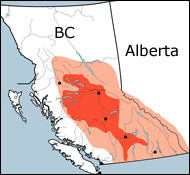
That’s according to the Canadian Forest Service. Hat tip to the Washington Post, for an excellent story about the spread of the Mountain Pine Beetle, a tiny little critter that for eons has been controlled by cold winters…but no longer.

"It’s pretty gut-wrenching," said Allan Carroll, a research scientist at the Pacific Forestry Centre in Victoria, whose studies tracked a lock step between warmer winters and the spread of the beetle. "People say climate change is something for our kids to worry about. No. It’s now."

The Canadian Forest Service estimates that 80% of the pines of British Columbia will be dead within seven years, and fears that the beetle will spread eastward and southward.

Sorry to be so depressing! Believe me, I get no kick from this news. Charles Keeling, the Scripps scientist who more than any other individual discovered global warming, joked in his autobiography that "Perhaps convincing proof will be acknowledged to have arrived when a substantial number of US Congressman are discovered to have secretly purchased real estate in northern Canada."

Along those lines, my wife and I had vague hopes of summering in B.C. in our dotage. Now even that half-fantasy doesn’t look so good now.

Mountainpinebeetlespread_1

FEMA Makes Changes

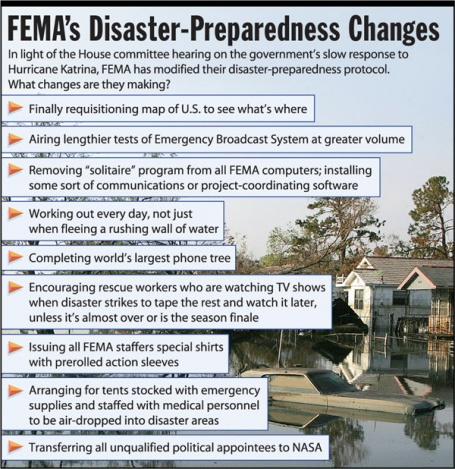
As someone whose property was torn up by the floods of January 05 in California and applied for a loan for repairs from FEMA, I can attest in some small measure to exactly how screwed up this agency is. It’s really worse than a joke. Many months after we gave up hope for the overpriced loan, they called my mother to ask if I was related to her. True story. Still, on the six-month anniversary of Katrina, the time has come to ask the priceless The Onion what sort of changes FEMA has made:

Fema_changes

Another Positive Post

As mentioned a month or so ago, this blog wants to challenge the notion that enviros are inherently doom and gloomsters. Yesterday came an actual rash of semi-good news on the topic of pollutants, which is not what most folks think of when they want to perk up their day. But the fact is, there are simple things we can do to eat well and stay safe, and maybe even mercury can be compensated for:

–In the LATimes (reg. required), a big story about a seafood company that is launching a new division built around the idea of rigorous testing of big predatory fish such as shark, swordfish, and tuna.

–From Newsday, a story about a study from the University of Rochester (reg. required) that surprised researchers by showing that mothers from the Seychelles Islands, where women eat about ten times the amount of mercury as do women in the U.S., bore children who showed no ill effects by the age of sixteen, despite high levels of mercury in the hair samples of mothers.

–From Environmental Health Perspectives, a study showing that children can reduce pesticide loads in the body by has much as fifty percent after just five days of an organic foods diet.

New Orleans to White House: We’ve Just Begun to Fight

In a fairly stunning column for the NYTimes (that I’m not allowed to repost in full) a New Orleans native and novelist named John Biguenet reveals that not only is the ruined city not happy with Federal response to Katrina, but that chances are good it will have legal recourse:

Listen to David Vitter, Louisiana’s Republican senator, who, writing in the Washington Post last week, tried to make clear to President Bush what actually happened here:Most of all, he [the president] has to understand that the great majority of New Orleans’s catastrophic flooding occurred because of breaches in levees that were not overtopped by water but that failed from below because of gross design mistakes made by the U.S. Army Corps of Engineers.” But so far, the president has failed to grasp that an agency of the United States government is responsible for the destruction of a major American city, and, of course, for the deaths of hundreds of citizens.

Mr. Vitter has been described by the National Journal as the most conservative of the Senate’s seven Republican freshmen, so the Bush administration cannot dismiss such an assessment as partisan. Mr. Vitter’s conclusion is supported by a string of forensic engineering studies and documents that confirm that the design failures were identified in 1990 by the Vicksburg office of the U.S. Army Corps of Engineers, but ignored. And it suggests that the country may soon face an extremely expensive day of reckoning.

For New Orleans, this legal recourse may be the only silver lining to Hurricane Katrina, given that charity is fast running out, and that according to Don Powell, appointed coordinator of the Gulf Coast recovery effort last fall, "There are many, many needs that the federal government cannot cover."