Eliza Gilkyson solo for Acoustic Guitar

Eliza Gilkyson, despite having been nominated for a Grammy last year, remains one of our most-overlooked pop stars.

Well, not pop. As a singer, a songwriter, and guitarist, she shines brilliantly from afar, as she demonstrates in a lovely interview and performance for Acoustic Guitar. In her quiet way, she’s fierce.

Acoustic Guitar Sessions Presents Eliza Gilkyson

The above has an especially nice version of her “Roses at the End of Time,” one of her best recent songs.

PCT Section I: Kerrick Canyon (mile 972-986)

Miles 972 to 986 on the PCT offer gorgeous views at the price of real effort. This was one time on the trail that yours truly, age sixty, was passed by folks, both younger and older, from twenty-somethings coming south from Truckee to family groups passing heading north, in both directions. Didn’t manage to capture portraits this day.  Spectacular to see though. Let me feature this image of the lake at the top of the first pass, a sizeable jewel, which had an excellent campsite that appears rarely used — perhaps because it’s at the top of a pass. I wanted to make it here on day three,  but ran out of steam at the end of day two of this part of the trail, section I.

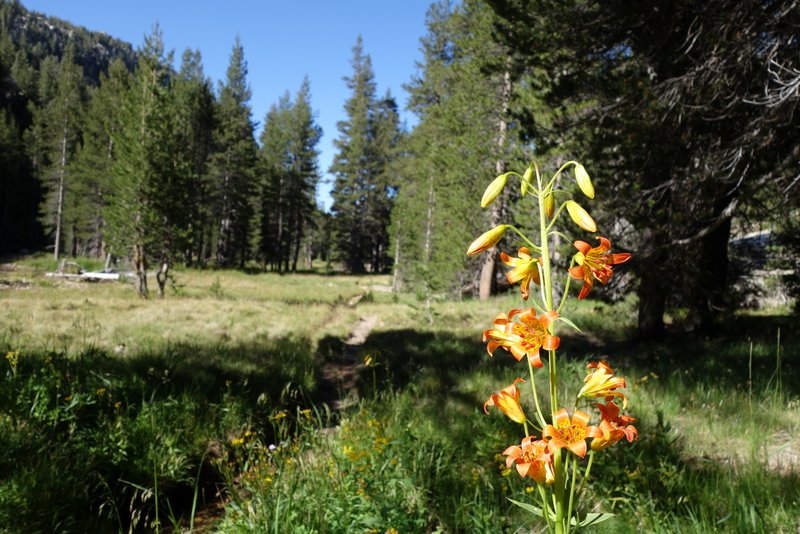
This is what it looks like as you crest the top of the ridge at 9002 feet, headed northbound, at mile 975:

1-DSC03767

Not too shabby, no? I wished I had camped there. For more of this section, featuring yet another paradise called Kerrick Canyon, please see below the fold. Continue reading “PCT Section I: Kerrick Canyon (mile 972-986)”

Homeless man saves a CA beach: The Week

Today the popular news magazine The Week republished the story I wrote for Latterly on Walter Fuller and Ormond Beach that, may I say, changed Walter Fuller’s life. He’s famous now, and his work is better supported than ever before.

So for the record, let me post it again, and this time as a tweet from the magazine.

//platform.twitter.com/widgets.js
This version has been re-edited, and I like the original Ben Wolford version, as was republished in LongReads, better. But this one has its moments, and it’s fascinating to see a story change and morph and live on.

It’s the fourth year of drought in CA. How are we doing?

It’s the fourth year of drought in California. We’re suffering big fires in Northern California, employment drops and spikes of poverty in the Central Valley, and asking for unprecedented conservation in Southern California. We’re also seeing huge impacts on groundwater and to wildlife statewide. We’re hurting.

But is it possible that despite our losses the state as a whole has weathered this slow-motion disaster with some grace, and possibly even shown some leadership?

So argues Charles Fishman in the NYTimes:

For California, there hasn’t ever been a summer quite like the summer of 2015. The state and its 39 million residents are about to enter the fifth year of a drought. It has been the driest four-year period in California history — and the hottest, too.

Yet by almost every measure except precipitation, California is doing fine. Not just fine: California is doing fabulously.

In 2014, the state’s economy grew 27 percent faster than the country’s economy as a whole — the state has grown faster than the nation every year of the drought.

California has won back every job lost in the Great Recession and set new employment records. In the past year, California created 462,000 jobs — nearly 9,000 a week. No other state came close.

The drought has inspired no Dust Bowl-style exodus. California’s population has grown faster even as the drought has deepened.

More than half the fruits and vegetables grown in the United States come from California farms, and last year, the third growing season of the drought, both farm employment and farm revenue increased slightly.

Amid all the nervous news, the most important California drought story is the one we aren’t noticing. California is weathering the drought with remarkable resilience, because the state has been getting ready for this drought for the past 20 years.

Fishman is talking about the changes agencies and farmers in particular have made to adapt to life in our mostly semi-arid environment, and he’s not overlooking what still must be done.

It’s the work of a man with years of experience, and a contrarian, audacious argument to be recommended.

By chance, I expect, today also a noted UC San Diego scientist named Mike Dettinger posted this:

Updated (thru 7/15) Calif “reservoirs” status plot…still 39% more water than in July 1977. http://t.co/mfwKQ1xq2v pic.twitter.com/LMp84kJHtT

//platform.twitter.com/widgets.js

Patzert: El Niño 2015 a potential Godzilla. Maybe.

On a slow news day in August, NOAA’s prediction yesterday that El Niño will continue to strengthen and may well bring big precipitation to the southern half of the country (not just SoCal) made headline news across the nation.

But the focus in the LATimes — and several other news outlets — came not from the official announcement, but from JPL forecaster Bill Patzert, who uses strong language the way other scientists use phrases like “favor” and “preponderance.”

“This definitely has the potential of being the Godzilla El Niño,” said Bill Patzert, a climatologist with NASA’s Jet Propulsion Laboratory in La Cañada Flintridge.

His shop posted an image comparing this El Niño to the epic one of l997-1998. This year’s ocean phenomenon looks even stronger:
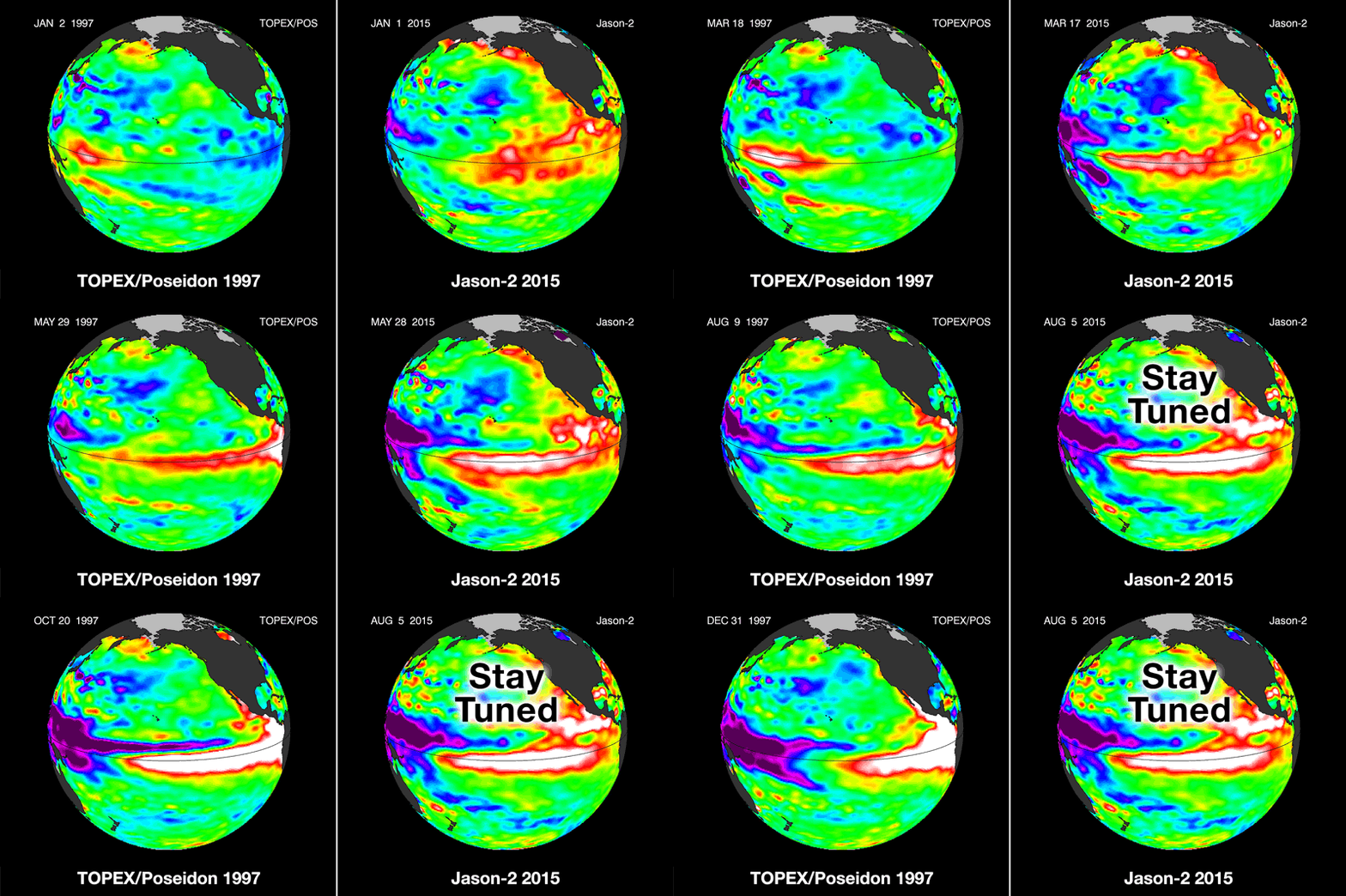
Elnino1997vs2015

Yet to the NYTimes, Patzert was a little more specific — and cautious.

The main missing piece of the current patterns that would ensure an event like 1997, he said, is a relaxation of trade winds in the central and western Pacific, which allows the weather patterns to move eastward. “I’m a little cautious: This could happen, it could not happen,” he said.

In other words, Dr. Patzert said, “Bob Dylan says it all: The answer is blowin’ in the wind.” Without the relaxation of the trade winds, he said, “this will turn out to be a modest El Niño, with a huge sigh of disappointment here in the West.”

NOAA Mike Halpert seemed to agree, saying that we cannot assess “the character of the winter” until about mid-October. He also noted that El Niño doesn’t necessarily mean a great deal of snowfall in Northern California and in the Rockies, from which SoCal gets a great deal of its water — although it can mean that.

In response to a question from yours truly, he directed climate wonks to a post on the agency’s ENSO blog by Dennis Hartman of the U of Washington. Hartmann argues that the drought in the West and the cold winters of recent years (and decades) can be traced to anomalous warmth in the North Pacific. He stresses several times that it’s not yet possible to say if this connected to climate change, natural variability, or other factors.

Although the North Pacific Mode is known to be a product of natural variability associated in some way with ENSO, this mode of variability has become more prominent since 1979.  Whether the enhanced importance of this mode is related to natural variability, global warming, or just changes in observing systems, is, I think, unknown at this point. 

Hmmmm.

Obesity: An Incurable Disease?

George Monbiot writes an environmental column for The Guardian that admirably refuses to be restricted to the obvious topics of climate, wilderness, and waste. This week he challenges the usual medical advice on reducing weight as a useless gesture for people who are obese, pointing to an article in The Lancet that remarks (with a remarkably sharp wit, for a medical journal):

Once obesity is established, however, bodyweight seems to become biologically stamped in and defended. Therefore, the mere recommendation to avoid calorically dense foods might be no more effective for the typical patient seeking weight reduction than would be a recommendation to avoid sharp objects for someone bleeding profusely.

It’s important to distinguish in this conversation between people who are overweight — who can lose weight, and whose health may not suffer — and people who are obese and typically cannot lose weight and often do suffer from the life-threatening complications of obesity, such as heart disease, cancer, and diabetes.

As Monbiot writes:

People who are merely overweight, rather than obese (in other words who have a body mass index of 25 to 30) appear not to suffer from the same biochemical adaptations: their size is not “stamped in”. For them, changes of diet and exercise are likely to be effective. But urging obese people to buck up produces nothing but misery.

The crucial task is to reach children before they succumb to this addiction. As well as help and advice for parents, this surely requires a major change in what scientists call “the obesogenic environment” (high-energy food and drinks and the advertising and packaging that reinforces their attraction). Unless children are steered away from overeating from the beginning, they are likely to be trapped for life.

This dire analysis is not all that controversial in the field, from my experience reporting on the issue. (See for instance Dr. David Katz, editor of the journal Childhood Obesity, in his articles on the topic for the general public.) But it’s not often put that bluntly to the public, especially perhaps in this country.

I raise this question to wonder out loud: Should I try to write about this subject as a health topic? What really got me thinking so was a jaw-dropping data animation, showing how obesity has overwhelmed the nation in the last three decades. (From Max Gilka, charting CDC data.) We take for granted the ruination of so many lives.

obesity-map-usa

How the LAPD fired Ted Rall from the LATimes

Long time readers of this blog may recall my affectionate referencing of some of his ‘toons, on those rare occasions when he turns his attention to climate and environmental topics. (Here’s a 2012 classic of his, sez me, on The Fun of Ignorning Climate Change.)

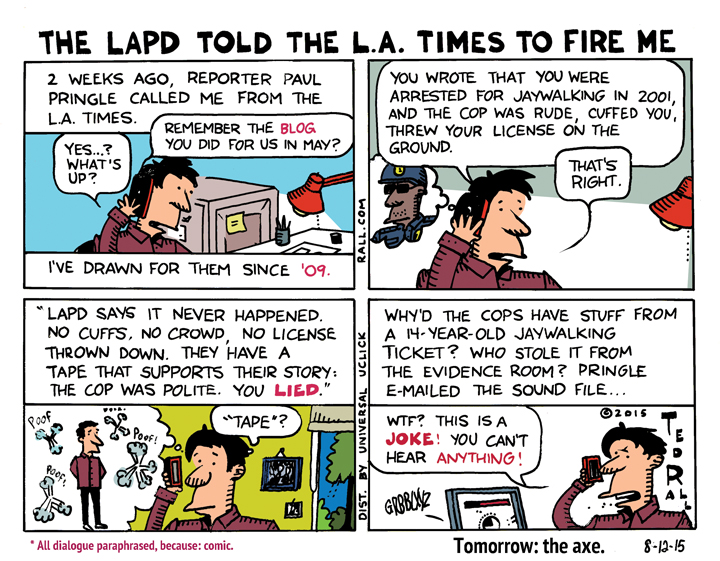
Rall is leftier than I am, and much angrier at Obama, but despite our political differences he’s a reliable witness to fact, in my experience, and so I was genuinely shocked a week ago to hear that my home city paper, the LA Times, fired him from a job posting and blogging on a weekly basis for the op-ed page because he had — allegedly — lied about an arrest for jaywalking.

Fourteen years ago. Jaywalking? Rall lying to his employer? What? 

The story made no sense. At last Rall has drawn it up for us.

On July 27, 2015, the Los Angeles Times fired me as its long-time editorial cartoonist. The reason given was their belief, based on a secret LAPD audiotape of my 2001 arrest for jaywalking, that I lied about my treatment by the police officer in a May 11, 2015 blog for the Times. However, when I had the tape enhanced and cleaned up, it proved I'd told the truth. So why won't the Times comment or admit they were wrong?
On July 27, 2015, the Los Angeles Times fired me as its long-time editorial cartoonist. The reason given was their belief, based on a secret LAPD audiotape of my 2001 arrest for jaywalking, that I lied about my treatment by the police officer in a May 11, 2015 blog for the Times. However, when I had the tape enhanced and cleaned up, it proved I’d told the truth. So why won’t the Times comment or admit they were wrong?

Neolithic Man: As unsustainable as us?

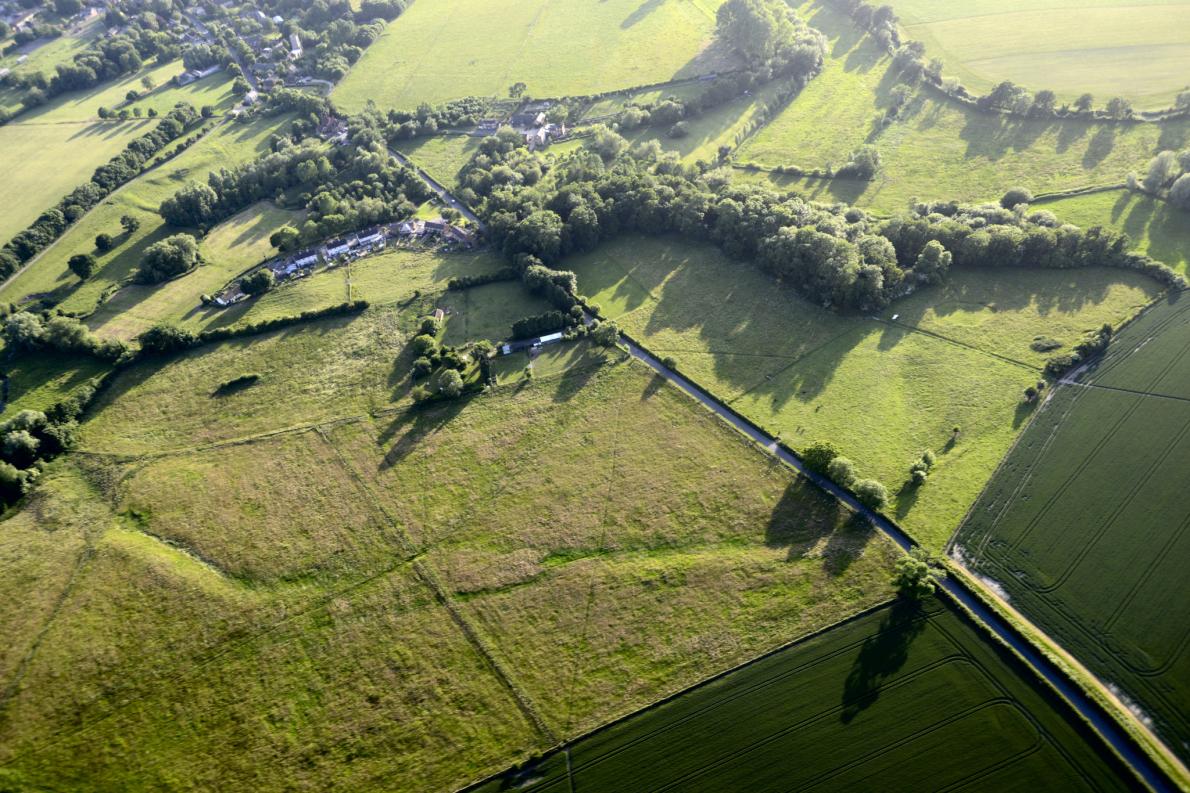
That’s the contention of archaeologist Jim Leary, who leads an excavation of an ancient “henge” (circle) in the UK in the Avebury/Stonehenge region that in its day was ten times the size of Stonehenge, not far away, as quoted in National Geographic.

“It was insane, utterly unsustainable,” says Leary. “We tend to think of people during the Neolithic as somehow being at one with their environment, but they appear to have been just as bad as we are. They were clearing, felling, digging, and consuming their environment at an unsustainable rate in building these huge projects.”

The ripples in the field indicate the line of the original wall. Great story. Raises the question — what should we think of this? The more things change, the more they stay the same?

Or is it a little bit reassuring, to know that each human society becomes as monumental as possible, each in its own way, before the fall?

PCT Section I: From Tuolumne Meadows to Sonora Pass (mile 960-972)

In the last couple of weeks had the opportunity and the great joy to complete two more sections of the PCT, from Tuolumne Meadows in Yosemite NP to the south Lake Tahoe area. Almost exactly 150 miles. In writing up this I’m going to try and follow the advice of a friend who saw a previous trail post and said it was “pretty good, but needed more people!”

So here’s Frog Wild and Laura (Baby Sister) Wild, encountered at about mile 975, roughly ten miles north on the trail at Glen Aulin High Sierra Camp.

Frog Wild and Laura (aka Baby Sister) Wild
Laura (aka Baby Sister) and Frog Wild 

I told them what I was doing, and found out that they were doing something similar — but lengthier — in the other direction, heading south.

“There’s a word for people like us,” Baby Sister said. “We’re LASH — which stands for Long-Assed Section Hiker.”

Continue reading “PCT Section I: From Tuolumne Meadows to Sonora Pass (mile 960-972)”