As trade winds strengthen, more drought for CA?

Much of climate science is settled and doesn't need repeating. We know that injecting increasing amounts of greenhouse gases to the atmosphere leads to warming, for instance.

But how that warming will play out in atmospheric and oceanic circulation patterns, although often discussed, remains to be seen.

Several past studies suggested warming could lead to a weakening of trade winds over the Pacific, but, as Richard Allan of the University of Reading discusses in a fascinating new post on a major new study from Nature Climate Change, that might be all wrong. Maybe warming will lead to a strengthening of these trade winds, as the new study argues, which could feed into exisitng ocean circulation patterns.

Other studies have suggested that the warming expected in the atmosphere has been diverted into the ocean: this study posits a mechanism to explain that. 

It's complicated as this — no doubt simplified — diagram shows:

WalkercirculationEngland

But especially fascinating for us on the West Coast are the implications, which Allan discusses in an offhand style near the end of his post:

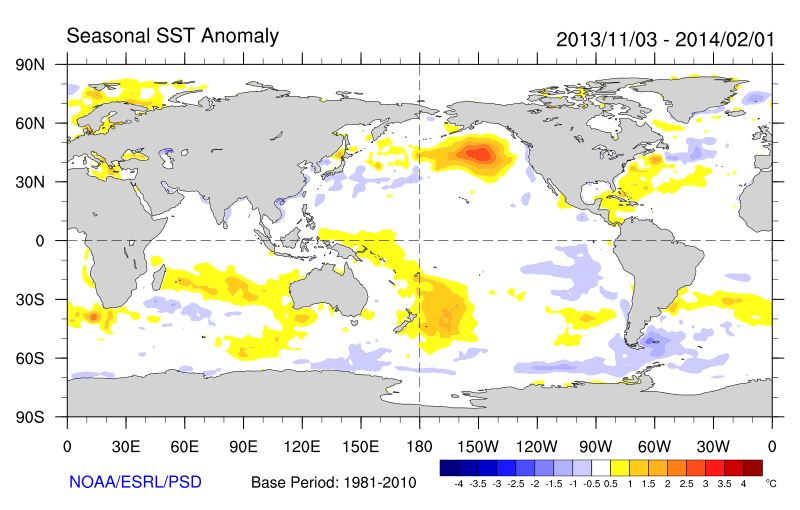
The implications or these changes could be substantial. It would be surprising if these large changes in atmospheric and ocean circulation over the last 2 decades (including also apotentially long-term decline in the Atlantic ocean circulation), have not already disrupted our weather patterns. The map shows this seasons sea surface temperature departures from normal (from NOAA), with a cool East Pacific and unusual patterns over the north Pacific and north Atlantic that are associated with this seasons extreme weather, including drought in California, intense cold in eastern north America and flooding in the UK and Europe. 

"Including drought in California." Hmmm. 

Update: Michael Mann on HuffPost updates with the $64,000 question for California:

Such conditions are basically equivalent to the flip-side of El Niño, known as La Niña. In other words, the slowing of global warming may relate, at least in part, to the tendency for more frequent La Niña-like conditions in recent years. That gives us stronger trade winds in the eastern tropical Pacific, more burial of heat below the ocean surface, colder tropical Pacific sea surface temperatures, and slightly cooler global average temperatures than we might otherwise have seen.

The $64,000 question, then, is whether this increased tendency for La Niña-like conditions over the past decade is entirely natural in origin, or whether it might instead in some way be tied to climate change itself. 

For California, especially Southern California, the 64k question is whether we will be seeing more La Nina conditions, or if this apparent tendency will pass. (As opposed to the question of global temps.) More on this and the Pacific Decadal Oscillation as the news comes in. 

Why winds explain the global warming hiatus
Stronger Pacific winds explain global warming hiatus: study
Pacific winds 'pause' global warming
Patzert: The history of the world is written in droughts

A dirty secret — cauliflower w/pine nuts and anchovies

A couple of years ago Judith Thurman had a great piece in The New Yorker about pine nuts (sadly still not available to non-subscribers). She off-handedly included a great cauliflower recipe with a dirty secret. (Here's Gustiamo's version of that recipe.) She says the dirty secret is pine nuts: I say it's anchovies. 

Regardless — here it is. 

Boil a cauliflower for about seven minutes. Let it cool: heat six tablespoons of olive oil in a cast iron fry pan: add a minced onion, cook until translucent, five or ten minutes. (Start some pasta at this point.)

Add the cooked florets, a little saffron, and — for grittiness — some anchovies. Mash and mix them with the cauliflower and onions. Roast the pine nuts a little first for some extra toastiness, then mix in about one-quarter cup pine nuts and one-quarter cup golden raisins or currents. In a little chicken broth gently simmer the mix, stirring well so the anchovies disappear into the whole. 

Caserecci-

It's a unique recipe — sweet, salty, healthy, inexpensive. Top with toasted breadcrumbs for the grit of appetite, sated. 

Looking to past droughts to foresee CA’s future

The past is never dead. The past is not even past. 

When William Faulkner wrote that, he was thinking of human history, but it's true on here on planet earth as well. Cycles repeat. For that reason, and because they were troubled by the drought they saw in the deep time record, paleoclimatologist B. Lynn Ingram and a fellow researcher at UC Berkeley set out to present the full record of climate extremes in the Southwest to the public in a new book, The West Without Water

In an an introductory op-ed in the LA Times this week, they write

How extreme is this year in California's climate history? To answer this, we need to look back further than the 119 years we have on record, to the geologic past. Based on the growth rings of trees cored throughout the Western United States, AD 1580 stands out as the driest year in the last half a millennium, drier than 1976-77. It was so devastatingly dry in 1580 that the giant sequoias in the Sierra Nevada essentially failed to grow at all; the cores show either extremely thin or absent tree rings. If the current drought continues in California through Oct. 1, this water year will be the driest not only in our modern records but in half a millennium. 

But that's actually a little bit reassuring, because it implies that this sort of drought, when eventually it is over, at least will not return soon. For perhaps as long as 500 years.

But what if it doesn't quit?

In an interview, Ingram gets even scarier:

If you look at the archaeological record, you see that the Native American population in the West expanded in the wet years that preceded those long droughts in the Medieval period. Then during the droughts, they were pretty much wiped out. There was the so-called Anasazi collapse in the Southwest about 800 years ago. In some ways, I see that as an analogy to us today. We’ve had this wetter 150 years and we’ve expanded. Now we’re using up all the available water, yet our population is still growing.

We’re vulnerable just like they were, but on an even larger scale.

[Image of groundwater levels in Central Valley from GRACE, NASA's gravity-measurement satellite. Red line shows groundwater levels from l962 based on USGS measurements — green line shows satellite measurements since 2003] 

GroundwaterinCA

[from Jay Famiglietti at UC Irvine, via National Geographic]


Related articles

Why California's water woes could be just beginning
Drought Politics: How To Use California's Historic Crisis To Score Political Points
In State of the State, Brown asserts no end in sight for drought

The upside of drought in SoCal: Winter sunsets

The lack of rain, which depends on a lack of low clouds and overcast conditions, can make possible some utterly spectacular sunsets. 

Death Valley sunset

This one from Death Valley in late December, courtesy of David Huscher. Here's one I saw on the PCT from a place in the San Gabriel Mountains called Camp Guffy, at about 8200 feet, looking west. 

IMG_5389

The trail that goes under the freeway: Section D of the PCT

The fourth section of the Pacific Crest Trail, Section D, which I walked this past week, begins by passing under Interstate 15 (which goes from Los Angeles to Las Vegas), then turning north along a major rail arterial. It crosses the San Andreas Fault and then (literally) turns and heads for the hills. 

IMG_5196

IMG_5202

IMG_5225

It's a rough start to a tough fire-damaged section.

Death Dust, or, why I’m on the PCT in winter

Dana Goodyear absolutely crushes the story of valley fever in last week's New Yorker. An excerpt:

The regionality of cocci is only partly to blame for the pace of research. In the lab, cocci presents a serious hazard. Early on, laboratory infections were common; a grad student would open a petri dish and, whoosh, millions of spores would go up his nose. (After farm work, lab work was considered to have the greatest occupational risk; at Stanford, a center of valley-fever research, a group of obstetrics students got it, though their classroom was two stories above the cocci lab.) At the county public-health building in Bakersfield, I saw a slide of cocci, recovered from a patient’s sputum and fed agar, potato extract, and sugar. Angled in a test tube to reduce surface area and stored in a bio-safety cabinet (air flow, straight up), the slide was covered with a cloudy gray smear, like a spiral galaxy. “Here he is,” the lab director said. “Just looks like a little bread mold. He’s making arthrospores in there, and if we opened it we’d just get a little invisible cloud of infectious particles.” Cocci researchers typically work in Bio Safety Level 3 labs: hepa-filtered air, seamless floors and ceilings, closed antechamber. Until last year, Cimmitis was listed as a Select Agent. After culturing it, lab technicians had seven days to report to the Department of Homeland Security that it had been destroyed.

In Tucson, Galgiani took me to see the university’s Bio Safety 3 lab. In the corridor, you could hear an autoclave grinding like a hotel icemaker, sterilizing every piece of lab equipment and protective gear that came into contact with the pathogenic agents inside. In addition to cocci, the lab handles monkey pox, mouse pox, West Nile, and chikungunya, a mosquito-borne virus for which there is currently no treatment. On the wall was a group of manometers. Galgiani checked that the pressure in the rooms was lower than that in the hall: a containment strategy.

“In the nineteen-fifties, both the U.S. and the Russians had bio-warfare programs using cocci,” he said. “Generals can’t control agents that rely on air currents to disperse them, and it was difficult to use the vector precisely, so it fell out of favor. But terrorists don’t care about that stuff—all they care about is perception. A single cell can cause disease, and you can genetically modify it to make it more powerful.” He held up his wallet to a sensor by the door, then put his finger on a fingerprint reader. “The atrium is as far as we get,” he said as we stepped inside. “When you work like this, everything slows down, for safety reasons. It’s a harder kind of research to do.”

Because Valley Fever is endemic to the Antelope Valley, and most dangerous in fall, during windy times and after the summer's heat, I'm going to walk Section D of the Pacific Crest Trail in January. (Helps that we're in the midst of a drought, so snow is not a factor.) Will be gone for a week. Wish me luck. 

Deathdust

Ridiculously Resilient Ridge to break down: NWS

Yesterday an exciting pressure chart came my way via the indefatiguable John Fleck of the Albuquerque Journal. Albuquerque, which has had no perceptible precipitation to date this winter, is as interested in the so-called "Ridiculously Resilient Ridge" of high pressure that has been blocking any possible weather from the Pacific as we are here in California.

So it's exciting when that "RRR" shows signs of breaking down. John put up this chart from the National Weather Service (NWS):

Rrrtobreakup
 

Chatted about this with the helpful meteorologist John Sucop at the Oxnard office of the NWS. He said that models (available to the public here at an NCEP site — check out the loops) show the ridge breaking down by the edge of the month as low pressure systems continue to hit it. 

Of course the ridge could reform: that happens all the time. But the anomaly can't last forever. 

In the meanwhile, might as well take advantage of the anomaly and go hike the San Gabriel Mountains in the winter, when it's mild, bugless, and lacking snow. Usually those hiking the Pacific Crest Trail, section D, are told to wait until May until the snow passes — not this year. 

“Ridiculously Resilient Ridge” explains West Coast drought

That's the meteorological explanation: a ridge of high pressure over the West Coast that has been blocking weather from the Pacific, driving it north, leaving the entire West Coast in drought. 

But what explains the so-called "Ridiculously Resilient Ridge?". 

That we really don't know yet and the climatologists are loathe to speculate. One spot of good news: Paul Rodgers for the San Jose Mercury News discusses the Ridiculously Resilient Ridge brilliantly. 

Ridiculouslyresilientridge


The Titanic/global warming analogy takes a dramatic turn

Last week The New Yorker led off with an uncharacteristically labored analogy/editorial from Adam Gopnik, who pointed out that the Titanic had a twin sister, the Olympic, which sailed unharmed through the frozen northern seas for decades and (he suggested) so could we. 

"It reminds us that our imagination of disaster is dangerously more fertile than our imagination of the ordinary. You have certainly heard of the Titanic; you have probably never heard of the Olympic."

Okay, that's sweet, but doesn't it seem rather besides the point? Far more memorably last week a snarky Internet commentator not nearly as famous as Gopnik found a detail from the familiar Titanic story/metaphor that made a far bigger splash on the intertubes, because it briliantly dramatized what has become an all-too-frequent pattern among deniers. Too often the likes of James Inhofe (who wore long underwear to work at the Senate last week, to show that the evidence for global warming is "laughable") will exalt  an ephemeral detail — a cold snap — in an attempt to wave off the facts. This new metaphor fought that mockery with its own mockery.

Take it away, Nerdy Jewish Girl!  

//platform.twitter.com/widgets.js