Here’s a story I wrote recently for the Ojai Valley News about a local self-educated-via-election-to-water-boards citizen named Russ Baggerly, who called out the City of Ventura’s claim to “pueblo water rights.”
I admit to liking Russ, and admiring his bold challenge in Los Angeles Superior Court to the City of Ventura’s attempt to grab rights to all the water in the Ventura River, and, arguably, in the six watersheds that support the river. Russ argues that Ventura has been after this river’s water for over 100 years.
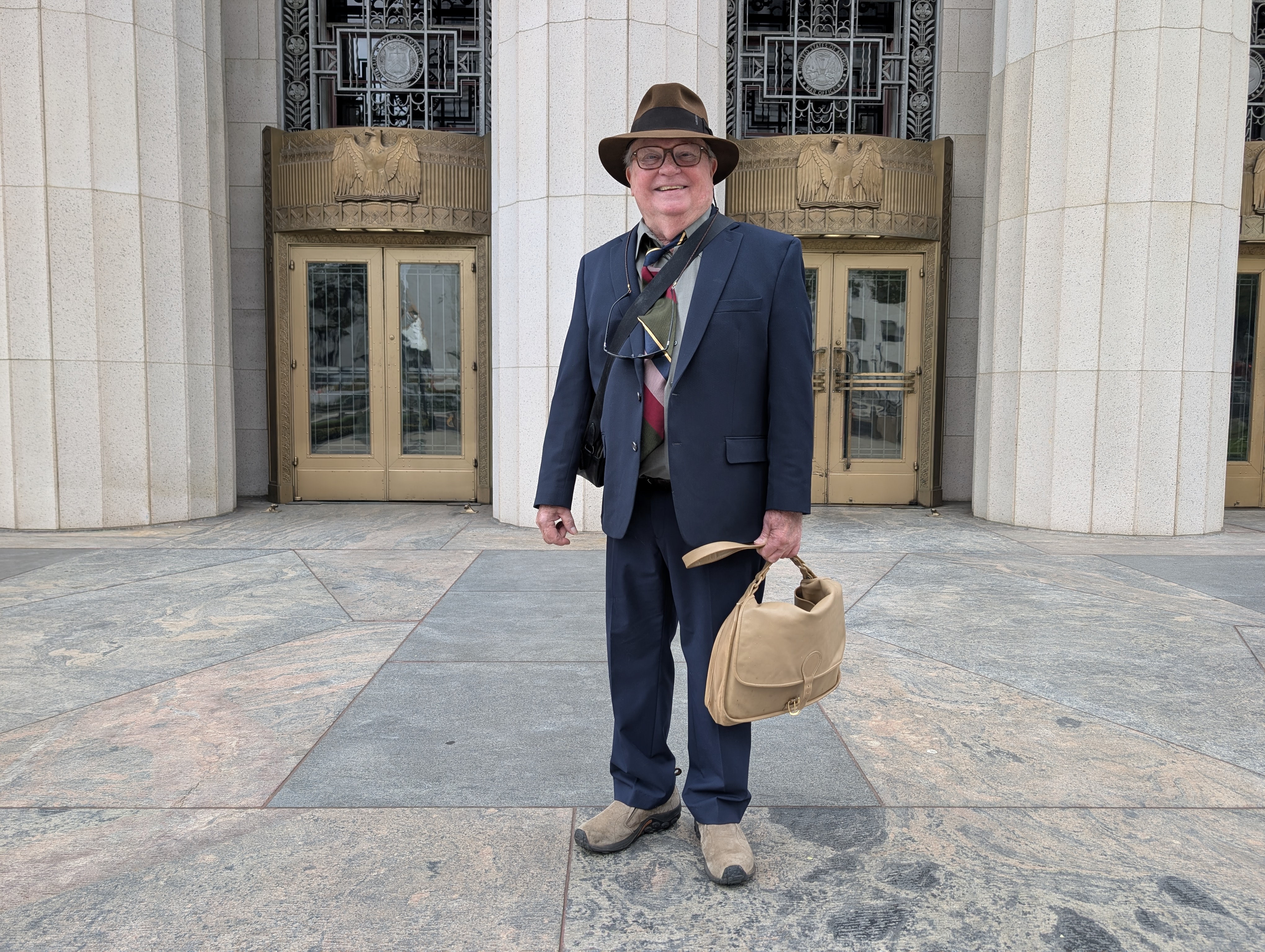
On Monday, October 26, at 10 a.m., in Los Angeles Superior Court in downtown Los Angeles, Russ Baggerly, a decades-long resident of Meiners Oak and self-educated expert on water issues, will hear Judge William Highberger rule on his “motion to strike” 一 excise 一 the underlying legal justification for the hugely unpopular lawsuit filed in 2020 by the City of Ventura against thousands of land owners and well owners in the Ojai basin.
In this controversial “cross-complaint,” in which over 14,000 well owners and land owners in the Ojai basin were subpoenaed, the City of Ventura argued “that it is a successor to the Mission San Buenaventura pueblo right water, which gives it a priority to use sufficient water from the Ventura River Watershed to meet its needs.”
Baggerly begs to differ. Based on historical research, drawing on the results of past official investigations into pueblo water rights quietly commissioned by the City of Ventura decades ago, he argues in motions before the court that the record shows that the City of Ventura never followed the procedures laid out by the Treaty of Guadalupe Hidalgo settlement between the nations in the 1840’s. This settlement governed the issuance of “pueblo water rights” which grant land owners a right to waters, such as the Ventura River, including its tributaries and basins.
Nor did the City of Ventura follow the procedures laid out in the California Land Act passed in 1851 by Congress to establish those claims in US courts, he argued to the court.
After the U.S. won the Mexican-American War and annexed present-day California, those who had received grants of land under Mexican law had to petition the Board of Land Commissioners, appointed by then-President Fillmore, “with specific documents, maps, and witnesses to support their claims within the two-year window delineated by the law,” Baggerly argued in a filing before the court this week.
Baggerly said that the historical record shows that the Board of Land Commissioners heard and approved hundreds of such claims for land and associated water rights, but the City of Ventura never made a claim, was never designated a “pueblo” under Mexican or American law, and thus has no “treaty water rights” under the law. He adds that Ventura wasn’t even incorporated as a city until 1866.
Baggerly is not a lawyer, but after serving as an elected official on the Board of Casitas MWD for sixteen years, from 2004 to 2020, as well as on the Ojai Valley Sanitary District and the Ojai Valley Groundwater Management Agency for many years, he knows water issues, and knows that — like thousands of others in the Ojai Basin who were subpoenaed — he has rights.
“I’m a private citizen,” he said in an interview. “I paid my $400 fee and became a defender in the official lawsuit.”
For decades Baggerly has delved into the intricacies of water use and water law in the Ojai region, taking a sort of delight in its myriad challenges. He ran successfully for office many times, but worked mostly behind the scenes. The fact that he doesn’t have a degree in hydrology or the law deters him not at all.
“I always told everybody that I was uniquely qualified to be an elected official,” he said. “I’m a flamenco guitarist. I have a pulse and I breathe. That’s my qualification.”
While serving on the Casitas Board, when it became apparent that the City of Ventura was contemplating a legal action against Ojai residents and well owners, Baggerly went with fellow Board member Pete Kaiser to plead with the Ventura City Council not to launch such a legal attack.
“Back in 2020, we went — myself as a director, as well as director Baggerly — before the Ventura City Council to try and reason with them as to this whole action,” Kaiser said. “We think it made more sense at that time to look at this question in a reasonable fashion and see what we could with diligence see what we need to do to really come together.”
When it became evident that Ventura would not be deterred, Baggerly plunged into research of the pueblo water rights claim, and dug up reports by the Thomas Stetson engineering firm commissioned to look into water rights for Ventura in 1964. Their deep dive into water rights found little or no evidence to support a pueblo water rights claim, and the Stetson report ultimately counseled Ventura not to pursue it.
Baggerly in his motion makes a historical argument with supporting evidence. Ventura, represented in this matter by Shawn Hagerty for the Best Best and Krieger law firm, stressed that Ventura would only invoke this “treaty right” if it was challenged by another major water user, moved to to exclude or limit Baggerly’s presentation evidence, and responded in a legal argument bristling with case citations, Latin, and difficult legal language.
Baggerly admits that Judge William Highberger may not want to derail a water rights case with thousands of defendants that has been grinding through the courts for over a decade, and which 一 according to public records 一 has cost Ventura at least $9 million in legal fees and $3 million in expert witness testimony. But it’s a fact that the Judge will rule on the motion Monday in court, after hearing arguments this week from both the City of Ventura and Baggerly, and his ruling could radically alter the course of the trial.

Baggerly makes three arguments against Ventura, which he believes has been angling for decades to capture such “treaty water rights.” These rights encompass not just the water in the Ventura River channel, but the streams and tributaries and groundwater that supports it.
Two such “physical solutions” to solve the case have been presented to the court in briefs this year, the first from Casitas MWD and Ventura. This plan would focus primarily on San Antonio Creek, as the best remaining habitat in the watershed for the endangered fish (as long Matilija Dam continues to block passage of the steelhead fish to the ocean). Casitas in this Fish Habitat Enhancement Plan (FHEP) would agree to hire an expert in stream modification, and provide some funding for physical work, such as moving boulders to create refugia for the fish during dry times. The FEHP would cost Casitas about an estimated $300,000 a year, funded by ratepayers.
`Another physical solution was proposed by the State Water Resources Control Board and California Fish and Wildlife, and calls for more ambitious and expensive work, such as physical barrier removal. This physical solution is intended to not just enhance the habitat for the fish, but to restore its population, which all agree is in danger of extinction in the watershed.
According to recent studies from California Fish and Wildlife, the local steelhead population was decimated by the drought of 2012-2017 and the Thomas Fire, killing thousands of trout. The state parties’ physical solution would cost a great deal more than the FHEP, which concerns Mike Flood, the General Manager of Casitas, and Pete Kaiser, the President of its Board of Directors.
Flood said the state parties’ proposal would cost between $10-75 million over time, with no identified source for such funding.
“We have to look at what’s in the best interest of our ratepayers, and how the dollars are being spent,” Kaiser added. “The state seems to think that money falls from trees.”
The cost of the proposed physical solution has been a stumbling block in mediation and the subsequent court-ordered direct negotiations, which stretched for over a year with no settlement. Judge Highberger in court on Monday seemed unsure of how to bridge this gap between the annual costs the local agencies and litigants are willing to take on, and the demands by the larger state parties for a multi-year plan that will ensure the survival of the fish.
In court for a trial status conference on October 19th, Judge Highberger asked the parties to speak to the funding question.
“What powers do I have to force government agencies to spend money?” he asked. Hagerty, representing Ventura, suggested that the answer was embedded in the physical solution proposed by the city. This physical solution does lay out a spending and funding mechanism for San Antonio Creek, although the answer raises other larger questions, such as whether this proposed physical solution with the FHEP will in fact be enough to save the fish from extinction, which falls under the legal rubric of “public trust.”
“Will a trial of the physical solution satisfy the “public trust” doctrine?” the Judge asked. “Or am I wasting my time on a theological debate?”
Baggerly believes that the proposed physical solution as it stands is not enough to ensure the survival of the endangered fish, but he’s long been outraged by what he considers to be an entirely fabricated claim for the water of the Ojai basin by the City of Ventura. He believes he has evidence to prove this.
“I hope I have the Judge’s ear,” he said in an interview, remarking on his concluding point in the motion, which he thinks — from watching court hearings on Zoom, and listening closely — might have caught Judge Highberger’s attention.
If the Judge should not agree with his arguments about “pueblo water rights,” that would mean that the City of Ventura could build its pueblo water right out of the final judgement and physical solution.
If the court should deny his pleading and allow treaty water rights in the physical solution, he argues in the conclusion to his motion that “I would beg the court to say in the Statement of Decision that because the City of Ventura could control all the water in the Ventura River watershed [that]…the City of Ventura shall be held responsible for the total cost and implementation of the Physical Solution and pay all cross-defendants court costs and attorney fees because the City brought this lawsuit to the watershed.”
Such a ruling would cost Ventura many millions of dollars, not just in court costs, but in implementing a “physical solution” intended to give the steelhead trout a chance at survival.
If Judge Highberger was to hand down such a ruling, Baggerly said, “Maybe the Ventura City Council might reconsider their position in this case.”
(In the next week, Judge Highberger denied Baggerly’s claim, but said that his motion raised “a very important question” — which he expects to return in the water rights litigation, when the trial begins in early December.)

