When will we start to see ice sheet disintegration?

James Hansen has published hundreds of scientific papers in his long and distinguished career as “the father of climate change awareness,” as described in The Guardian. With a team he published another one this morning, but this one is different.

For one, although Hansen organized the effort, he is one of a team of 18 experts from around the world, signaling a global consensus around a central scientific idea.

For another, Hansen gave up his tenured post in a government-backed research post in order to lead the effort to reduce greenhouse gas emissions, and to be able to stand outside the government critically.

The idea is that the little-controlled experiment that humanity is conducting on its home planet resembles a period of 120,000 years ago called the Eemian, which was much much warmer than it is today.

The Washington Post reported:

The research invokes collapsing ice sheets, violent megastorms and even the hurling of boulders by giant waves in its quest to suggest that even 2 degrees Celsius of global warming above pre-industrial levels would be far too much. Hansen has called it the most important work he has ever done.

The sweeping paper, 52 pages in length and with 19 authors, draws on evidence from ancient climate change or “paleo-climatology,” as well as climate experiments using computer models and some modern observations. Calling it a “paper” really isn’t quite right — it’s actually a synthesis of a wide range of old, and new, evidence.

“I think almost everybody who’s really familiar with both paleo and modern is now very concerned that we are approaching, if we have not passed, the points at which we have locked in really big changes for young people and future generations,” Hansen said in an interview.

As reporter Chris Mooney noted, to call the warning a “paper” is not quite right. It’s scientific, but it’s also an argument. Hansen argues as he has since at least 1988 in a famous warning delivered to Congress that our present almost uncontrolled release of greenhouse gases is “highly dangerous” to civilization as we know it.

Hansen and team write in an open source European journal called Atmospheric Chemistry and Physics:

If the ocean continues to accumulate heat and increase melting of marine-terminating ice shelves of Antarctica and Greenland, a point will be reached at which it is impossible to avoid large scale ice sheet disintegration with sea level rise of at least several meters. The economic and social cost of losing functionality of all coastal cities is practically incalculable. We suggest that a strategic approach relying on adaptation to such consequences is unacceptable to most of humanity, so it is important to understand this threat as soon as possible.
In the words of the New York Times:
The paper by Dr. Hansen and 18 co-authors dwells on the last time the Earth warmed naturally, about 120,000 years ago, when the temperature reached a level estimated to have been only slightly higher than today. Much of the polar ice disintegrated then, and scientists have established that the sea level rose 20 to 30 feet.
Hansen and colleagues say the world was only about 1 degree Celsius warmer then than it is now. The paper has been controversial, because it was published before undergoing the traditional mostly secret peer review process, and because it posits a mechanism that could bring catastrophic warming in decades, not centuries, which has been the usual view, even among scientists most concerned about risks such as sea level rise.
But as Chris Mooney points out for Wa-Po, the mechanism of ice sheet melting and cold water pooling described by the team of the Eemian era looks quite a bit like what NOAA just found in recent datasets:.

Indeed, shortly before the new paper’s publication, the National Oceanic and Atmospheric Administration released new recent data on the globe’s temperature that certainly bears a resemblance to what Hansen is talking about. For not only was the globe at a record warmth overall over the last three months, but it also showed anomalous cool patches in regions that Hansen suspects are being caused by ice melt – below Greenland, and also off the tip of the Antarctic peninsula.
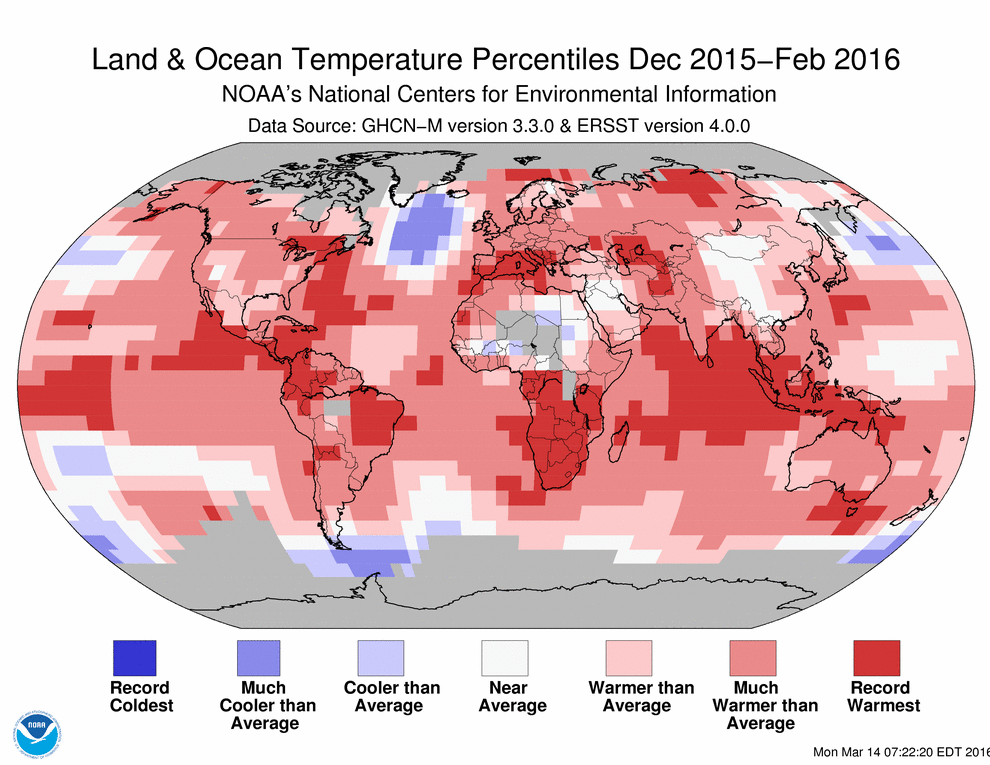
“My interpretation is that this is the beginning,” Hansen says of these cool patches in curious parts of the global ocean. “And it’s one or two decades sooner than in our model.”

Hansen has been sounding the alarm in public since l988 — but he’s been right more often than not. That’s the problem. What if the climate is changing much faster than our ability to bring down greenhouse gas emissions?

After all, it’s been 66,000,000 million years since the earth saw greenhouse gases released as rapidly as they are now — ten times faster than at any point in the planet’s history — according to the World Meteorological Organization.

.
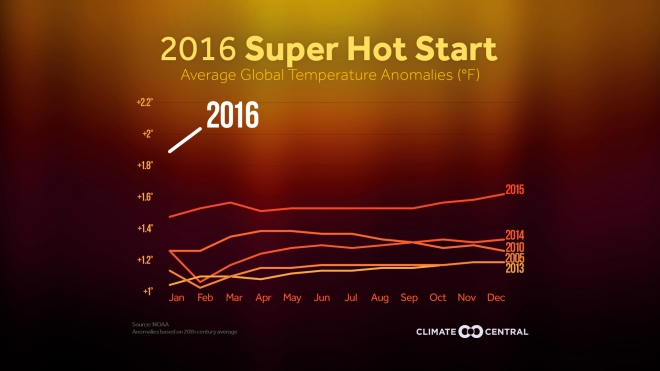
Here comes the super-hot summer of 2016

This year has been off the charts hot. Lots of graphics to that point:

superhotstart2016

The February heat anomaly this year [as charted by NOAA] is scary to me.

february2016anomaly

Already we are in the fifth year of drought, which has only slightly lessened, and not at all in central SoCal.

droughtCAmarch2016

And now models pointed are calling for an especially hot summer on the West Coast. Oh great.

//platform.twitter.com/widgets.js

Thinking about wildness in CA: Daniel Duane

Daniel Duane first came across my media screen last summer with a spectacular essay in the NYTimes Sunday Review — My Dark California Dream — in which he thought through some of the problems that have hit California lately, from wildfire to drought to traffic to the devastation of sea life off our shores.

But it was not a litany of horrors, nor a blaming, it was a wrestling with the issue(s), including the issue of one’s own lost paradise, one’s own inevitable self loss.

Confusing one’s own youth with the youth of the world is a common human affliction, but California has been changing so fast for so long that every new generation gets to experience both a fresh version of the California dream and, typically by late middle-age, its painful death.

Tremendous. Now Duane brings another top of the Sunday Review section essay, a long thoughtful look at what is known, in a somewhat Orwellian way, as “wildlife management.”

Duane puts it more vividly, in the opening of The Unnatural Kingdom:

If you ever have the good fortune to see a Sierra Nevada bighorn sheep, the experience might go like this: On a sunny morning in Yosemite National Park, you walk through alpine meadows and then up a ridge to the summit of Mount Gibbs at 12,764 feet above sea level. You unwrap a chocolate bar amid breathtaking views of mountain and desert and then you notice movement below.

Binoculars reveal three sturdy ewes perched on a wall of rock, accompanied by two lambs and a muscular ram. The sight fills you with awe and also with gratitude for the national parks, forests and, yes, environmental regulations that keep the American dream of wilderness alive.

Unless your binoculars are unusually powerful, you are unlikely to notice that many of those sheep wear collars manufactured by Lotek Wireless of Newmarket, Ontario. You will, therefore, remain unaware that GPS and satellite communications hardware affixed to those collars allows wildlife managers in distant air-conditioned rooms to track every move made by those sheep. Like similar equipment attached to California condors, pronghorn antelope, pythons, fruit bats, African wildebeest, white-tailed eagles, growling grass frogs, feral camels and countless other creatures, those collars are the only visible elements of the backlot infrastructure that now puts and keeps so many animals in the wild.

Phenomenal. Part of a book Duane is working on about the Sierra. That’ll be good…

Theunnaturalkingdom

a rare soupcon of spicy humor

From Kelly Conaboy at The Awl:

What does a bay leaf taste like? Nothing. What does a bay leaf smell like? Nothing. What does a bay leaf look like? A leaf. How does a bay leaf behave? It behaves as a leaf would, if you took a leaf from the tree outside of your apartment building and put it into your soup. People say, “Boil a bay leaf in some water and then taste the water if you want to know what a bay leaf tastes like.”

No.

In search of confirmation, as well as freedom to ignore the bay leaf portion of future recipes I might encounter, I reached out to a number of chefs and asked them, “Are bay leaves bullshit?”

Chef Anna Klinger, of Park Slope’s Al Di La, said: “I like them and use quite a bit.”

Anna Klinger and I are not technically friends so I do not take this lie personally, and I appreciate the way she did not explicitly state on record that bay leaves are not bullshit. Sneaky.

And yes, it goes on that way, adamantly, and it’s pretty hilarious. If a bay leaf can be funny and not bullshit.

Bee-loving in Ojai — for good reason

To report now and again for a small town newspaper means documenting something that happened or is happening in a small town, but sometimes what at first seems purely local turns out to be much bigger — even international in scope.

From the Ojai Valley News:

A move is under way in Ojai to loosen restrictions on keeping a backyard bee hive.

Kit Stolz, Ojai Valley News correspondent

An international organization of scientists, meeting in Malaysia last week, released a two-year study estimating that up to 40 percent of pollinators around the world — such as bees — face extinction. The report attributed this, in large part, due to the perils of living in a world of rapid change and industrial agriculture.

In Ojai, the young, but active, Ojai Valley Bee Club is taking action to save bees by encouraging city officials to consider a measure loosening regulations that prohibit backyard beekeeping. The club, which meets monthly, has approximately 60 members.

Glenn Perry, an award-winning researcher into bee products such as propulis and the use of bee sting therapy to ease arthritis, moved to Ojai in recent years. He said he was surprised to learn from Ventura County’s Department of Agriculture that Ojai and Ventura County discouraged beekeeping at home.

“Unless you have a large ranch of hundreds of acres, or live out in the boonies, it’s basically illegal,” Perry said. “Ojai has a specific law that regulates beekeeping, and in urbanized areas nearby, such as Meiners Oaks, or Oak View, or Casitas Springs, the county regulations prohibit backyard beekeeping.”

(I must confess, looking at that first ‘graph, it feels kind of stuffy, Probably could have done better than its second sentence, which is simultaneously vague and foreboding. Oh well.)

Nonetheless, as I indicated in the story, Mr. Glenn Perry is literally a world-famous expert in bees. It didn’t take more than a few minutes in his presence to realize how much he knew, and how carefully he answered questions, and how focused his efforts were, and why they had such importance.

Perry, who helped start the Bee Club, argues that local bee hives support the health of important pollinators such as bees, are not dangerous, and should be supported by growers and gardeners alike.

Curtis Skene, who helps lead the larger and older Santa Barbara Beekeepers Association, agrees.

“Absolutely backyard beekeeping helps,” he said. “Bees are under pressure and in danger from all kinds of problems and predators and pesticides. Backyard bee-keeping is very important because it helps keep stocks strong,” he said.

Perry and others from the club reached out to Ojai City Councilman William Weirick, who has expressed a willingness to look at revising regulations to encourage backyard beekeeping.

“We know that that there are pressures on the bee population that are poorly understood and we know that these important pollinating species are being put at risk,” Weirick said. “We also know that bee hives have a much higher over-wintering survival rate in urban areas than in rural areas, and, we know that honey-producing activity is much higher in urban areas than rural, and so it appears that urban beekeeping is something of a refuge for the bees, and a help in their continuing survival.”

In fact bee-keeping is on the upswing across the nation, but especially amongst the trend-setters, in places like Santa Barbara, Santa Monica, Los Angeles, and New York.

(Bee-keeping is perfectly legal in New York City in fact, as long as bee-keepers follow a few basic rules and register their hives with the city.)

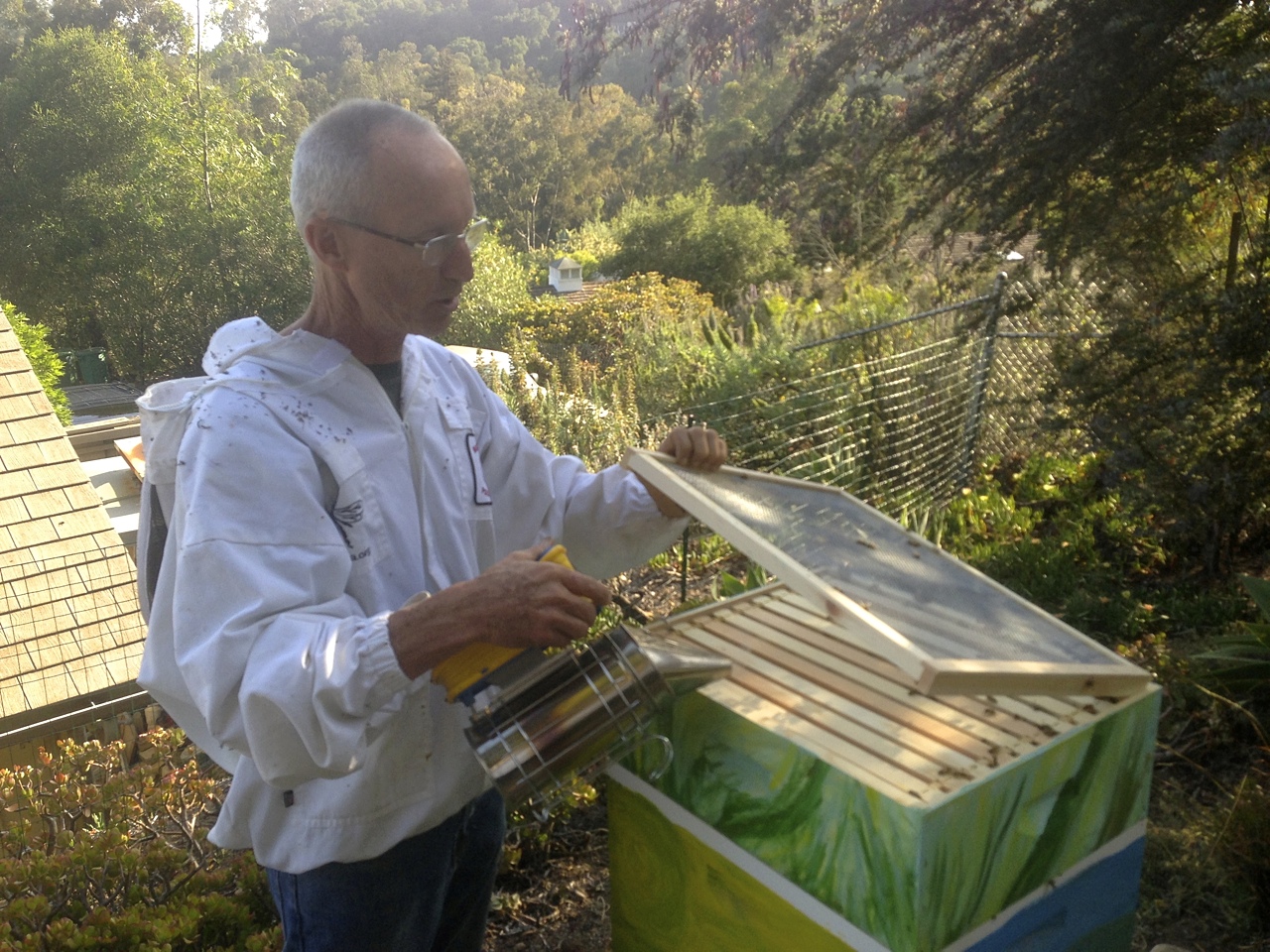
It’s inspiring stuff — local folks making a difference, helping to keep the natural world alive. beekeepersbba

[bee-keeper photo from sbba]

Drought hits city trees too (not just wild forests)

Another excellent story from the Washington Post, on a problem — the fate of urban trees — that seems not as well studied as that of wild forests.

Everywhere he goes, Anthony Ambrose sees the dead and dying.

They haunt this city’s streets, the browning yards of stylish homes, the scenic grounds of the local University of California campus and dry roadway medians. They’re urban trees, thirsty for water as the state enters the fifth year of the worst drought in its history, and thousands are keeling over.

“It’s definitely not a good thing,” said Ambrose, a researcher at the university who studies forest ecosystems. “They’re not as visual, they’re not as pretty. Along the highway you see a lot of dead redwoods. I feel sorry for the trees.”

The story expands beyond that of urban trees to numerous other side effects of the drought, including urban waste water systems that aren’t getting enough use, and the cost of rebates for lawn removal, but it circles back to the heart-tugging of urban trees — which aren’t numbered. Need to ask TreePeople about that.

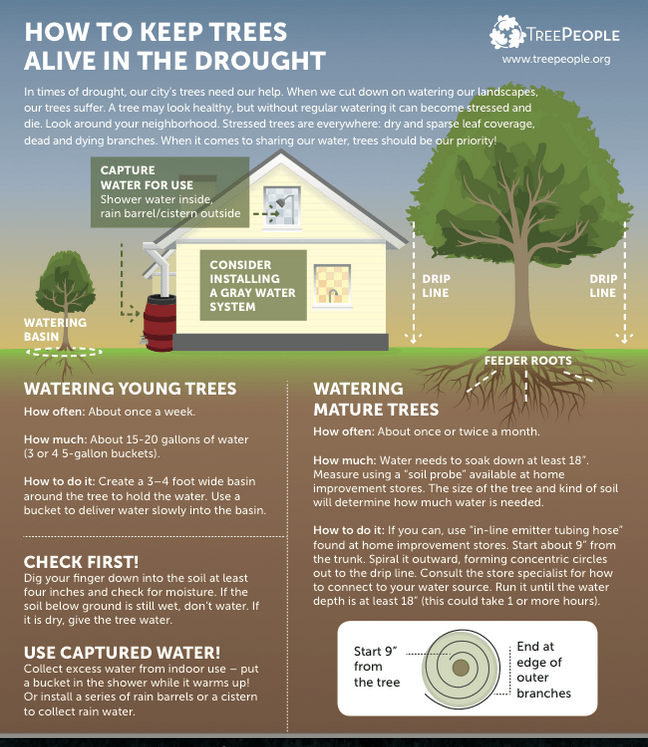
In the meantime:

HowtoKeepTreesAlive

The Revenant: from the bear’s POV

The Revenant, the most spectacularly cinematic contender for Best Picture in years, did not take home that particular Oscar at the Academy Awards presentation this past Sunday,  but it remains a massive world-wide hit, far bigger than “Spotlight,” won three other major awards — best director, best actor, and best cinematographer — and will almost certainly be the best remembered picture of 2015.

And what stands out first in the movie? Of all the early scenes, which one makes the greatest impression?

The bear attack, surely, in which our hero, scouting through the woods for a way across the mountains, hears hoarse breathing, sees a couple of bear cubs, and then out of nowhere is brutally attacked, bitten, and torn open by a bear. He ultimately shoots the bear, as it attacks again, and then stabs it, and finally kills it.

How did they film this? Well, first they did their homework, according to a story in Backpacker:

Glenn Ennis of Vancouver, one of the performers who played the bear, told Backpacker the team prepared by studying videos of wild and captive bears, including several attacks.

Ennis recalls one clip of a man being attacked after entering a zoo enclosure. The footage went on for quite some time, with the bear wandering away mid-attack but then coming back and getting vicious again, he says. The bear in The Revenant behaves similarly.

The bear itself was created with computer effects, but it was superimposed over Ennis and his actual movement. He had to call on his acting background to practice ursine walking and “getting into the headspace of a bear,” he says. When they’re not attacking something, “they have a nonchalance to them.”

Earlier on in the film’s production, a group including director Alejandro González Iñárritu, cinematographer Emmanuel Lubezki and visual effects supervisor Richard McBride met for an informal consultation for the film with Scott McMillion, a Montana-based writer and author of Mark of the Grizzly, a 1998 nonfiction book about bear attacks.

It’s impressive as hell, and from that moment onward the movie takes on a legendary cast, This is the story of a man who survived a bear attack. He is no longer a white man, a fur-trapper, a father — he is the man who survived the bear attack. He has become a myth, though he still has a life to live through.

The bear, quoted in The New Yorker, has a different POV:

There has been a lot in the press about how nightmarishly gruelling the shooting was on “The Revenant.” In fact, it was as difficult as I’ve ever experienced. I’m no diva—I mean, I’m literally a bear, I defecate in the woods—but even I must go on the record to say that there were times during filming when I longed for death.

Read the whole thing.

bearattack

Wishing and Hoping (for El Niño in SoCal)

El Niño has been a no-show in Southern California this year, despite endless fall warnings of a Godzilla event (including those transmitted by yours truly).

So what happened?

Short version, according to a post put up on the Weather West blog by the wise young Daniel Swain of Stanford, is we don’t know — but we have suspicions.

…I’ll reiterate that it’s impossible to discern in real time–and especially within the confines of a blog post–exactly why California has been considerably drier than expectations during the present very strong El Niño event, and why West Coast ridging [high pressure build-up] has been so prominent during recent winters. One thing that is clear is that warming temperatures have already increased the likelihood and severity of drought in California–irrespective of changes in precipitation patterns.

Swain argues that the “subtropical ridging” is not a return of the dreaded Ridiculously Resilient Ridge that created the California drought of the past five years — at least not yet — and reminds us that the winter is not yet over, and suggests the pattern could shift soon:

…there are still tantalizing signs of a potential shift to much wetter conditions by the very end of the month. The GFS and ECMWF ensembles have both been suggesting that the anomalously deep Gulf of Alaska low which has been present so far this winter will shift subtly eastward over the coming 2 weeks, eventually displacing the West Coast ridge far enough to the east to allow the “storm parade” which has been present across the North Pacific for the entire winter to reach California.

That suggestion is shown in this model animation in the early days of March. (Watch the low move into California as the days in the marker at the top pass by.)

96cff75c-c72b-4bfd-b05f-fba85b9ffde6

To the Ventura County Star, local hero Bill Patzert, of JPL/NASA fame, argues that the El Niño this year might have been so big it pulled the subtropical jet stream into NorCal, but likewise suggests that could change:

Forecasts that El Niño would bring a conveyor belt of wet storms have yet to materialize in Southern California.

But experts say it’s not too late. There are still two months to go.

Climatologist Bill Patzert, of NASA’s Jet Propulsion Laboratory in Pasadena, said he’s still counseling patience and optimism.

The El Niño didn’t start to peak until January and February. It might have been too big, pushing the subtropical jet stream farther north. As its intensity decreases, that could change.

There is precedent for that, Patzert said. In 1983, “the big show didn’t really happen until March and April.”

Meanwhile, El Niño storms have boosted the Sierra Nevada snowpack, which provides about one-third of California’s water, including in east Ventura County.

True. But the rainfall numbers this year for Ventura County are little short of dismal:

rainfalltotals


Let us pray.

Scalia passing: Quail react (via Samantha Bee)

Samantha Bee has a new show on the television, called Full Frontal, about which I know nothing, but this post from her on the passing of Antonin Scalia from the perspective of quail in Texas is pretty hilarious.

One example, from a bird labeled simply “Quail.”

Quail

“As a quail, I’m a firm believer in not getting shot out of the sky while transporting leaves to line my nest with. But I’m also a conservative, and I can’t help but think Scalia’s brilliant and ferocious opposition to judicial overreach will not easily be replaced in my lifetime. Especially since that’s like 5 years, tops.”

Whole thing is pretty great.  Especially if you’re a sucker for media reax from non-human species.

A prayer for the earth: Pope Francis

On Valentine’s Day, one can’t overlook (well, one can, but shouldn’t) love for the earth from which we came.

From “Praise Be” from Pope Francis, a prayer for the earth [passage 178]:

A prayer for our earth

All-powerful God, you are present in the whole universe and in the smallest of your creatures.
You embrace with your tenderness all that exists.
Pour out upon us the power of your love,
that we may protect life and beauty.

Fill us with peace, that we may live
as brothers and sisters, harming no one.
O God of the poor,
help us to rescue the abandoned and forgotten of this earth, so precious in your eyes.
Bring healing to our lives,
that we may protect the world and not prey on it,
that we may sow beauty, not pollution and destruction. Touch the hearts
of those who look only for gain
at the expense of the poor and the earth.
Teach us to discover the worth of each thing,
to be filled with awe and contemplation,
to recognize that we are profoundly united
with every creature
as we journey towards your infinite light.
We thank you for being with us each day.
Encourage us, we pray, in our struggle
for justice, love and peace.

h/p: Eric Holthaus

Kennedy Meadows
Kennedy Meadows