The Next Bob Dylan — A Little Late

On the radio show Morning Becomes Eclectic a week or so ago, Steve Earle made an appearance and played some songs live off his new record, Washington Square Serenade. He has visited with Nic Harcourt numerous times over the years, and sounded relaxed and in a good mood. (Earlier this year he also appeared on World Cafe back east, and performed solo for an audience, also a nice performance.) 

Talking with WXPN, he recalls his days in Nashville with Townes Van Zandt and other talents, "We were all folkies," he said. They had a tendency towards long hair, late nights, and other hippieish habits, he added. The powers that were in Nashville didn’t really want to see them become singer-songwriters, but considered them necessary — because they could write good songs. "

They sure could — Earle especially. Still can — and now, at long last, he shows off his folkie side. It’s great. As I said before, I think he’s pretty much the "next Bob Dylan" we’ve been looking for, even though we’ve all given up looking.

"My job was invented where I’m living," he said. "I’m living on the same street where Bob Dylan and his girlfriend Suzie Rotello were photographed for his first record. It’s a pilgrimage of sorts for me. This is a record of love songs for Alison and New York City."

Before this record, I respected Steve Earle (who can play as well as write) but didn’t especially like his work. This record has changed all that for me. I look forward to seeing him play some day, although I’m going to have to wait — he won’t tour until he can hit the road with his wife, Alison Moorer.

Steveearle

Coal: The Addiction and the Hope

An excellent news story by Alan Zarembo in the Los Angeles Times begins with the problem:

Coal, the dirtiest fossil fuel, is the crack cocaine of the developing world.

But along the way, it also mentions the hope — not the promise, but the hope — for a solution.

Another possibility is a process known as integrated gasification,
which converts coal into a cleaner-burning gas, capturing emissions in
the process.

Coal plants in China and India could eventually be retrofitted with such systems.

"We need a bolt-on solution for those existing plants," said
Stanford’s [Michael] Wara. "It’s going to be very difficult to tell those people
to shut down those plants."

File it under topics for further research…

The Host: Best Enviro Movie of the Year

What is an environmental movie? Is it a movie that uses the beauty of wilderness to make us fall in love with the earth, as for example Into the Wild, or Brokeback Mountain? Is it a movie that explicitly tackles an environmental issue, such as Erin Brocovitch, or The China Syndrome?

Or is it a picture that exploits the power of raw film to open up an environmental theme–such as the risk of radiation–with sheer imagination, such as (the original) Godzilla?

It’s a rhetorical question, but one with an inescapable answer: all of the above count as environmental movies, each in its own way, some better than others. And if this is true, as it surely is, than the best environmental movie of the year may turn out to be an unlikely candidate: the mesmerizing–and funny–Korean movie released internationally this year, The Host.

Though essentially a cheesy horror movie, it’s phenomenally well-directed, and to date has been the  best-reviewed foreign film of the year.

Anthony Lane of the New Yorker, hardly known for his raves, gushed that "there will be plenty of
filmgoers who yawned through “Godzilla” in 1998 and swore off large
amphibians for good. All I can say, to tempt them back, is that I have
seen “The Host” twice and have every intention of watching it again." The New York Times compared the director to Steven Spielberg, favorably, likened the humor in the film to Little Miss Sunshine, and explicitly noted the environmental theme:

…the film reminds me less of the usual splatter entertainments that
clutter American movie theaters and more of another recent horror film,
the one in which a newly thawed alien with a giant brain delivers
apocalyptic warnings to humanity about its imminent future. I’m talking
of course about the documentary “An Inconvenient Truth.”

The Village Voice compared the director Bong Joon-ho to Sergei Eisenstein, for crying out loud, and New York magazine called it "one of the greatest monster movies ever made."

Here’s the enviro part: the opening scene, shot in a cool, distant, almost documentary style, shows an American doctor working with a young Korean doctor in a morgue on an American military base in Seoul. The American doctor notices that dust has collected on the morgue’s supply of formaldehyde bottles, and orders the Korean doctor to pour the deadly, mutagenic chemical down the drain, even though the Korean doctor protests that it will go directly to the Han River, and that it’s against regulations. The American doctor sneers: "The Han River is very broad — let us be broad-minded, Mr. Kim." So the Korean pours the toxin down the drain, and the horror begins.

Astonishingly, this is not a fictional scene. Explained the director Joon-ho to Cineaste:

It was a double blessing for me to convey some political commentary in
the film and have it work within a genre. For instance, the opening
scene, when the two scientists are pouring chemicals into the Han River
refers to an actual event that took place six years ago. But at the
same time it’s a very typical monster movie opening.

Now insiders report that the new Frank Darabont/Stephen King movie about to be released, The Mist, is actually a rip-off of this modern classic, and far inferior. What a shock!

A word to the wise: rent the DVD, and see the original, before some overbaked Hollywood imitation ruins it for you. The Host turns a little strange at times, and it’s bizarrely funny, and has a monster that looks like some demented kind of oversized oyster sex, but as David Edelstein wisely noted:

In the end, though, this is a real horror movie. It’s hard to shake off
the first sight of the creature in the far distance, hanging from the
side of a bridge like some kind of pupa, then dropping into the water
and gliding toward shore (to the oohs and ahhhs of the dopes on the
bank, who throw food to it). When Hyun-seo becomes the mother she never
had to a homeless orphan who’s still alive when he’s dumped into the
monster’s bloody pit, The Host leaves the realm of its campy
modern counterparts. But then, despite cartoonish flourishes, it has
never functioned at the level of movies like Tremors or Eight Legged Freaks or even Jurassic Park.
This is a portrait of a country’s deepest anxieties, which just happen
to be distilled into a mandibled squidlike reptile. It has the tang of
social realism.

A word to the wise: on the DVD, choose the subtitled Korean version (that was shown in theaters over here), not the dubbed American version, which sounds as if five actors chosen at random were put in a room to ad lib dialogue in English. But most importantly, if you like good movies — don’t miss it.

(h/t: SFMike)


http://www.hostmovie.com/flash/slideshow.swf

Climate Scientists Right Again — Snore

"I told you so" is so much less interesting than an argument — unfortunately for those of us interested in preserving our traditional climate. A recent story in the San Diego Union-Tribune looked at the predictions of a team of scientists at Oregon State University and found they were right on the money.

The flames that have consumed much of San Diego
County and Southern California “are consistent with what the latest
modeling (studies) show,” said Ronald Neilson, a professor at Oregon
State University and a bioclimatologist for the U.S. Forest Service.

“This is exactly what we’ve been predicting to happen, both in fire forecasts for this year and in longer-term patterns,” Neilson said.

Five years ago, Neilson and other Oregon State
University researchers predicted that periodic increases in rain and
snowfall, combined with higher temperatures and rising levels of carbon
dioxide in the atmosphere, would spur vegetation growth. That would add
to already extensive quantities of fuel caused by decades of fire
suppression, in which blazes are not allowed to burn out of control and
thereby eliminate dead or dying vegetation.

Controversy? Priceless — sure to get headlines. Getting it right? Apparently, that’s boring.

Sigh.

China’s Carbon Emissions: Made for the USA?

Yesterday a D.C. nonprofit, the Center for Global Development, released an inventory of the world’s power plants. Its nifty database shows that on a national level, China trails only the the U.S. in total emissions of greenhouse gases, and not by much.

This will disappoint the global warming proponents at National Review, who have been predicting for months that China will surpass the traditional emissions champ, the United States, this year.

But both the scoffers on the right and the worriers on the left may be overlooking a central question, which was broached this Monday in a news story from the Wall Street Journal.

Simply put: a high percentage of Chinese emissions are produced manufactured for buyers around the world. Shouldn’t that be considered in the emissions accounting?

The vast majority of the world’s MP3 players are made
in China, where the main power source is coal. Manufacturing a single
MP3 player releases about 17 pounds of planet-warming carbon dioxide
into the atmosphere. IPods, along with thousands of other goods churned out
by Chinese factories, from toys to rolled steel, pose a question that
is becoming an issue in the climate-change debate. If a gadget is made
in China by an American company and exported and used by consumers from
Stockholm to São Paulo, Brazil, should the Chinese government be held
responsible for the carbon released in manufacturing it?

The story hints at the complexity of fault-finding when it comes to emissions, which we as a nation and as a species have barely begun to unpack. Not only must we contend with the fact that carbon dioxide is indivisible, and equally warming no matter if emitted in a Communist nation such as China, a capitalist nation such as the US, or a third-world nation such as India, but there is also what The Stern Review calls the "intergenerational" aspect of emissions. Carbon released today may have catastrophic effects thirty years from now, when the original emitters are long dead. Who will the children of today blame then?

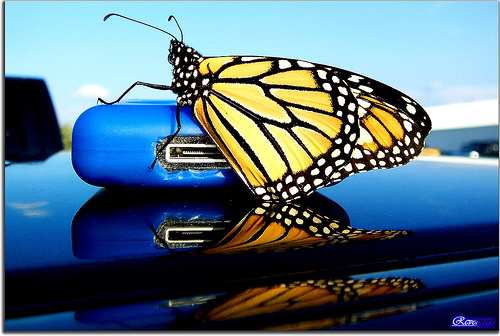
But to continue with Jane Spencer’s thoughtful, probing story…please see the rest on Gristmill. And please don’t take away my iPod…seems everybody loves them.
 

Butterfliipod

Georgia Governor Admits “Wastefulness,” Prays For Rain

A record-breaking drought in the Southwest has been rather inconvenient for traditionalists. John Christy, state climatologist of Alabama and a global warming minimizer, has been forced to insist that the drought has nothng to do with global warming.

"Rainfall patterns by their nature are variable. This is just where (the drought) happens to be this time," he said in July.

And yesterday, Georgia governor Sonny Purdue went outside to pray for rain — and, implicitly, admit fault. As recounted in a thorough piece in the Los Angeles Times (sub. required):

Bowing his head outside the Georgia Capitol on Tuesday, Gov. Sonny
Perdue cut a newly repentant figure as he publicly prayed for rain to
end the region’s historic drought.

"Oh father, we acknowledge our wastefulness," Perdue said.

Purdue was joined by hundreds of Georgians, most of whom saw his repentance as a desire to unify the state. Not all were so forgiving.

Lance Warner, 22, a history student at Georgia State University,
smirked as members of the crowd stretched their arms to the heavens and
cried "Amen!" and "Hallelujah!"

"You couldn’t make this up," he said. "You can’t make up for years of water mismanagement with a prayer session. It’s lunacy!"

"Mismanagement?"

Wait — Lance, are you saying the drought has nothing to do with how a distant bearded father figure in the sky feels about us?

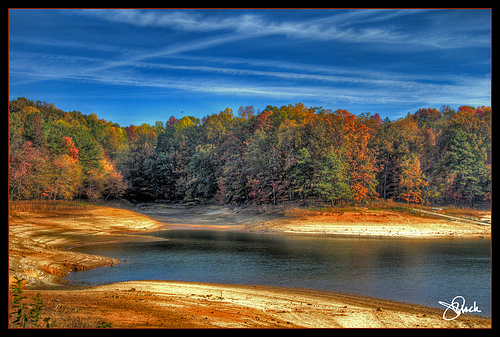
Meanwhile Atlanta’s Lake Sydney Lanier continues to decline — ninety days supply left.

(Thanks to Flickr’s Duckshoot for sharing.)

Lakesydneylanier

Blame Aplenty in SF Oil Spill Disaster

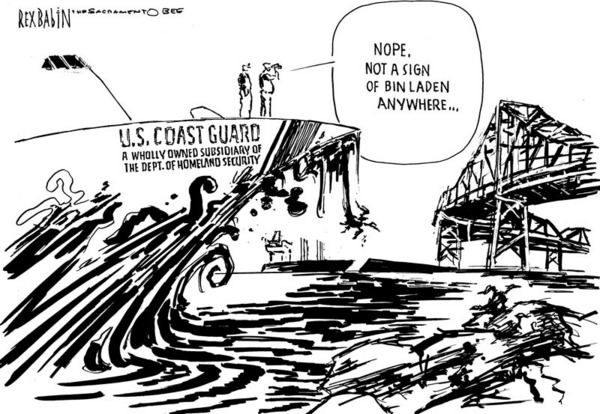
Tomorrow it will have been a week since a hugh container ship cut itself open on the Bay Bridge in the fog and spilled 58,000 gallons of bunker oil into San Francisco Bay. I have yet to see a really good newspaper story about this disaster (although I confess I haven’t been watching the Bay Area papers closely). But NPR’s All Things Considered ran a good story today, featuring an interview with Larry Collins, a crab fisherman who leads an industry group. His opening statement:

It’s ugly. A lot of dead birds, dead crabs floating. It’s in every rip, where the currents come together, the oil’s in the rip. It’s starting to get into the eel grass, it’s fouling all the beaches, the little coves. It’s everywhere.

Over 500 birds have been found dead already, some of them (such as Western Grebes) with only a spot of oil on their feathers. But from afar, the editorial coverage has been good. Daniel Weintraub (sub. required) of the Sacramento Bee opened his column with a great anecdote:

The San Francisco Bay Area has long been a hotbed of civil
disobedience. So it was only appropriate that, even as government
authorities tried their best to keep volunteers from helping with the
cleanup from last week’s big fuel spill, a man from Marin led a group
of monks-in-training on a covert mission to save a beach.

Sigward
Moser was the ringleader, according to an account in the San Francisco
Chronicle. He and about 30 others, including 20 aspiring monks from the
Mill Valley Zen Center, ventured onto Muir Beach on Saturday afternoon.
They scraped up 500 bags of oil-laden sand before The Man – in this
case a National Park ranger – put Moser in handcuffs and led him away.

He
was cited for entering a restricted area and failing to obey an
official order, and then released. No word on the whether the monks
were also detained.

Funny? Sure. You couldn’t make this stuff up if you tried. But the
story also illustrates a serious problem with the government’s response
to last week’s spill of 58,000 gallons of bunker fuel after a ship
slammed into a concrete support under the San Francisco-Oakland Bay
Bridge.

From the Coast Guard on down, it seems as if every
federal and state agency’s first response was to downplay the extent of
the problem, push away offers of help and try to retain control of
their turf, if not the hazardous oil spreading for miles onto some of
the most beautiful coastline in the country.

First, the Coast
Guard failed to notify any local agencies about the spill for more than
four hours after the full magnitude was apparent. Until then, according
to local officials, the guard was saying that only 140 gallons had
spilled, vastly underestimating the extent of the potential problem.

And the Los Angeles Times ran a gutwrenching (literally) column from Daniel Helvarg, author of "50 Ways to Save the Ocean." His opening:

Oil-covered birds look even worse in real life than they do on TV. Not
the dead ones so much, except when a gull has ripped open a floating
grebe and is pulling at its toxic guts.

Hong
Kong-based shipping executives don’t have to use ships that burn heavy
bunker fuel, the dregs of the petroleum process. Of course, cleaner
fuels would prove marginally more expensive, and U.S. consumers would
have to pay a penny extra for their tube socks or Chinese-made
children’s toys.

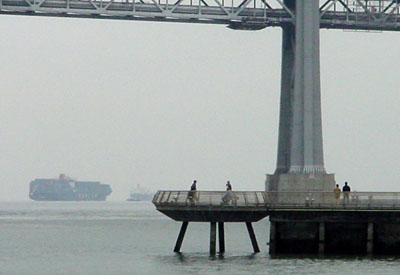
But I must say, my favorite reporting on this incident comes via my equaintance SFMike, who last week posted a nice series of pictures, along with a narration that gives a sense of how the story unfolded.

Best of all is his line and picture about the offending container ship that so stupidly ran into the Bay Bridge. Mike writes:

The
ship, "Cosco Busan" could be seen parked in the bay on Thursday
afternoon (in the photo below), like a naughty child who’s been made
to stand in the playground by himself after bad behavior.

Coscobusan