A Cloudland We Can Only Dream About, and…

–Another midday
cloudland, displaying power and beauty that one never wearies in
beholding, but hopelessly unsketchable and untellable. What can poor
mortals say about clouds? While a description of their huge glowing
domes and ridges, shadowy gulfs and cañons, and feather-edged ravines
is being tried, they vanish, leaving no visible ruins. Nevertheless,
these fleeting sky mountains are as substantial and significant as the
more lasting upheavals of granite beneath them. Both alike are built up
and die, and in God’s calendar difference of duration is nothing. We
can only dream about them in wondering, worshiping admiration, happier
than we dare tell even to friends who see farthest in sympathy, glad to
know that not a crystal or vapor particle of them, hard or soft, is
lost; that they sink and vanish only to rise again and again in higher
and higher beauty.

John Muir, My First Summer in the Sierra, July 23rd, 1872

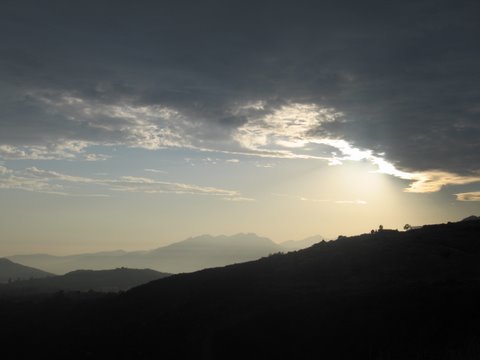
The pic below come from about a week ago, July 18th, here in Ventura County, SoCal., when we had a couple of lovely days of high clouds and cool days.

As the temps begin to climb, I confess I miss those clouds…

End_of_spring_in_cloudland

To Save the Planet, Would You Give Up Tangerines?

That’s the question that came out of the John Edwards campaign, as reported by the New York Times’ refreshingly straightforward op-ed writer Gail Collins. It’s behind the newspapers pay wall, unfortunately, but let me quote a couple of passages:

John Edwards has a plan to cap carbon emissions, while allowing
businesses to buy the right to go over their quotas. Many people regard
this as the most efficient and politically salable way to reduce
greenhouse gases. But they usually acknowledge that it would make some
products — like small orange fruits that have to be transported a long
way to get to market — more expensive.

“I live in North Carolina; I’ll probably never eat a tangerine again,” Elizabeth [Edwards] said.

This created a big stir in the press covering the campaign. Reporters asked:

Was Mr. Edwards prepared to admit that the public might have to
give up tangerines in order to keep the polar bears from drowning in
the Arctic?

“I’d have to think about it,” [Edwards] said during a press conference later that day.

Ever since Jimmy Carter was (politically speaking) burned alive for suggesting that Americans might be wise to conserve energy, politicians have been afraid to go down that road. Can you blame them?

And yet if we cannot conserve energy, we cannot hope to avoid climate chaos. As crunchy conservative Rod Dreher puts it today, writing from the Dallas area:

In north Texas, they’re building McMansions on the sun-baked plain that
will cost a fortune to cool in our punishing summers. And Americans
wouldn’t have it any other way. We’re going to have to crash hard to
change this habit of mind.

Environmental Riots — and Demonstrations

One of punk’s great anthems was one of the Clash’s first great songs:

White riot
I wanna riot
White riot
A riot of my own.

This was a sincere wish on the late Joe Strummer‘s part, and to some extent, his wish came true.

The punk movement was a riot in music. His audiences were uncontrollable and he liked that, mostly. He saw a few riots and wanted more, to get people stirred up, showing their desires, demanding change.

Could the ferment in present-day environmental interest be showing up in spontaneous demonstrations?

I have seen a few examples in the news of what sounds–at least from afar–like environmental riots. 

This kind of demonstration of environmental rage rarely if ever seems to happen in the this country, so perhaps we–including reporters–aren’t primed to expect it and report on it in this country.

But consider (please see the rest of the post on Grist):


The Blob: A Harbinger of Global Warming?

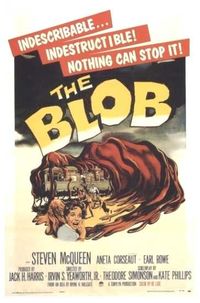
From a story in Slate about a festival (Blob Fest) devoted to the B-movie classic The Blob:

Many Blob Fest attendees suggested the movie was about communism—the
giant red mass slowly growing larger and more menacing, swallowing
communities. I asked [the screenwriter] if that had been on her mind when she was
writing, but she scoffed. "I wasn’t thinking about communism when I
wrote it. I was thinking about good and evil," she said. So much for my
attempts to parse hidden meanings from B movies.

Though [Kate] Phillips might not have intended The Blob to
have a political message, she did accidentally insert an environmental
warning, which was reflected in the Blob Fest’s 2007 theme: "An
Inconvenient Blob." I thought it was just an attempt to ride the green
bandwagon until I finally caught one of the three weekend screenings of
the movie. At the end of the film, the Blob is imprisoned in the
Arctic, where, as the narrator menacingly intones, it would remain as
long as the North Pole stayed cold. Green activists should add the
return of the Blob to the long list of global-warming-related dangers.

[last lines]

Lieutenant Dave:
At least we’ve got it stopped.

Steve Andrews:
Yeah, as long as the Arctic stays cold.

200pxthe_blob_poster

Leader of UK Sees Climate Change in England Floods

According to a story in the BBC, Gordon Brown, the newly-appointed Prime Minister, has with other officials in his government attributed the "extraordinary" flooding in England this year to climate change.

Mr Brown, in his No 10 press briefing, said climate change meant planning had to presume more extreme weather events.

That included boosting urban drainage systems to cope with heavier downpours.

Floods in Gloucestershire, the worst-affected county, have left thousands of people without a supply of drinking water.

The story quotes Brown:

"I think the emergency services have done a great job."

"Obviously like every advanced industrial
country we’re coming to terms with some of the issues surrounding
climate change. "


"It’s pretty clear that some of the 19th Century
structures we’re   dealing with – infrastructure and where they were
sited – that is something we’re going to have to review."

"This has been, if you like, a one in 150 years
set of incidents that has taken place in both Yorkshire and Humberside
and now in Gloucestershire and the Severn."

In the story, refering to climate change, Brown uses the word
"obviously." Obviously! What is obvious in the UK is still all but
unmentionable here in the USA, even in press coverage, which has yet to
mention climate change in reference to the flooding, despite the Prime
Minister’s statement.

Here’s a picture of Oxford’s ancient, great Port Meadow, almost completely flooded. Usually at this time of year the upper Thames would be a sliver of water in a sea of green; now, it’s the opposite. 

Port_meadow_under_water_2

Texas Floods Predicted by Scientists

In Texas, according to two reports compiled by the Union for Concerned Scientists, global warming will mean "more frequent intense rainfall events are expected, with longer dry periods in between."

The EPA agrees: "the amount of precipitation on extreme wet days in summer is likely to increase."

Ho hum. Scientists get it right again: Floods swamp Texas.

They’re so predictable! So boring.

No news here…keep it moving, folks.

(HT: The Daily Green)

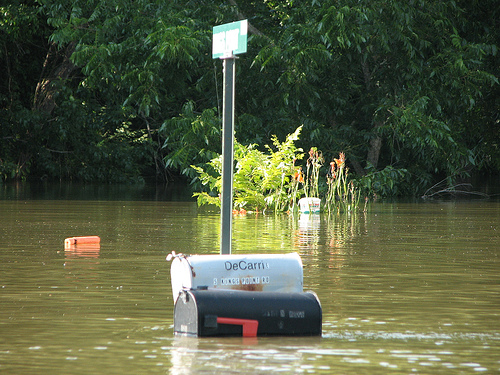
(Photo: No Mail Today)

No_mail_today

James Madison: We Can Scarcely Be Warranted in Supposing…

"Address to the Agricultural Society of Albemarle, Virginia" (1818).

"One of the landmarks of American nature writing, delivered not long after he retired to "Montpelier," his Orange
county estate, James Madison’s "Address to the Agricultural Society of
Albemarle" is an early argument for an "ecological" method of
agriculture in Virginia. In his address, Madison diagnoses seven
"errors in our husbandry" deserving of correction, including the
cultivation of originally poor or recently impoverished land, bad
ploughing techniques, the destruction of woodlands, the neglect of
proper manure, the lack of irrigation, the overuse of horses, and the
keeping of too many cattle."

Hat trip to Verlyn Klinkenborg, for bringing up as philosophic a defense of the planet and its health as I have ever read.

For me this speech brings to mind the famous code of Aldo Leopold: "To keep every cog and wheel, is the first principle of intelligent tinkering."

But the more I think about it, the deeper–less human-centered–Madison’s argument becomes.

Perhaps I should read it again.

Here’s the crux of the matter, as near as I can tell:

Agriculture, once effectually commenced, may proceed of itself, under impulses of its own creation. The mouths fed by it increasing, and the supplies of nature decreasing, necessity becomes a spur to industry; which finds another spur in the advantages incident to the acquisition of property, in the civilized state. And thus a progressive agriculture, and a progressive population ensue.

But although no determinate limit presents itself. to the increase of food, and to a population commensurate with it, other than the limited productiveness of the earth itself, we can scarcely be warranted in supposing that all the productive powers of its surface can be made subservient to the use of man, in exclusion of all the plants and animals not entering into his stock of subsistence; that all the elements and combinations of elements in the earth, the atmosphere, and the water, which now support such various and such numerous descriptions of created beings, animate and inanimate, could be withdrawn from that general destination, and appropriated to the exclusive support and increase of the human part of the creation; so that the whole habitable earth should be as full of people as the spots most crowded now are or might be made, and as destitute as those spots of the plants and animals not used by man.

The supposition cannot well be reconciled with that symmetry in the face of nature, which derives new beauty from every insight that can be gained into it. It is forbidden also by the principles and laws which operate in various departments of her economy, falling within the scope of common observation, as well as within that of philosophic researches.

The earth contains not less than thirty or forty thousand kinds of plants; not less than six or seven hundred of birds; nor less than three or four hundred of quadrupeds; to say nothing of the thousand species of fishes. Of reptiles and insects, there are more than can be numbered. To all these must be added, the swarms and varieties of animalcules and minute vegetables not visible to the natural eye, but whose existence is probably connected with that of visible animals and plants.

On comparing this vast profusion and multiplicity of beings with the few grains and grasses, the few herbs and roots, and the few fowls and quadrupeds, which make up the short list adapted to the wants of man, it is difficult to believe that it lies with him so to remodel the work of nature as it would be remodelled, by a destruction not only of individuals, but of entire species; and not only of a few species, but of every species, with the very few exceptions which he might spare for his own accommodation.

Such a multiplication of the human race, at the expense of the rest of the organized creation, implies that the food of all plants is composed of elements equally and indiscriminately nourishing all, and which, consequently, may be wholly appropriated to the one or few plants best fitted for human use.

Whether the food or constituent matter of vegetables be furnished from the earth, the air, or water; and whether directly, or by either, through the medium of the others, no sufficient ground appears for the inference that the food for all is the same.

Different plants require different soils; some flourishing in sandy, some in clayey, some in moist, some in. dry soils; some in warm, some in cold situations. Many grow only in water, and a few subsist in the atmosphere. The forms, the textures, and the qualities of plants, are still more diversified. That things so various and dissimilar in their organization, their constitutions, and their characters, should be wholly nourished by, and consist of precisely the same elements, requires more proof than has yet been offered.

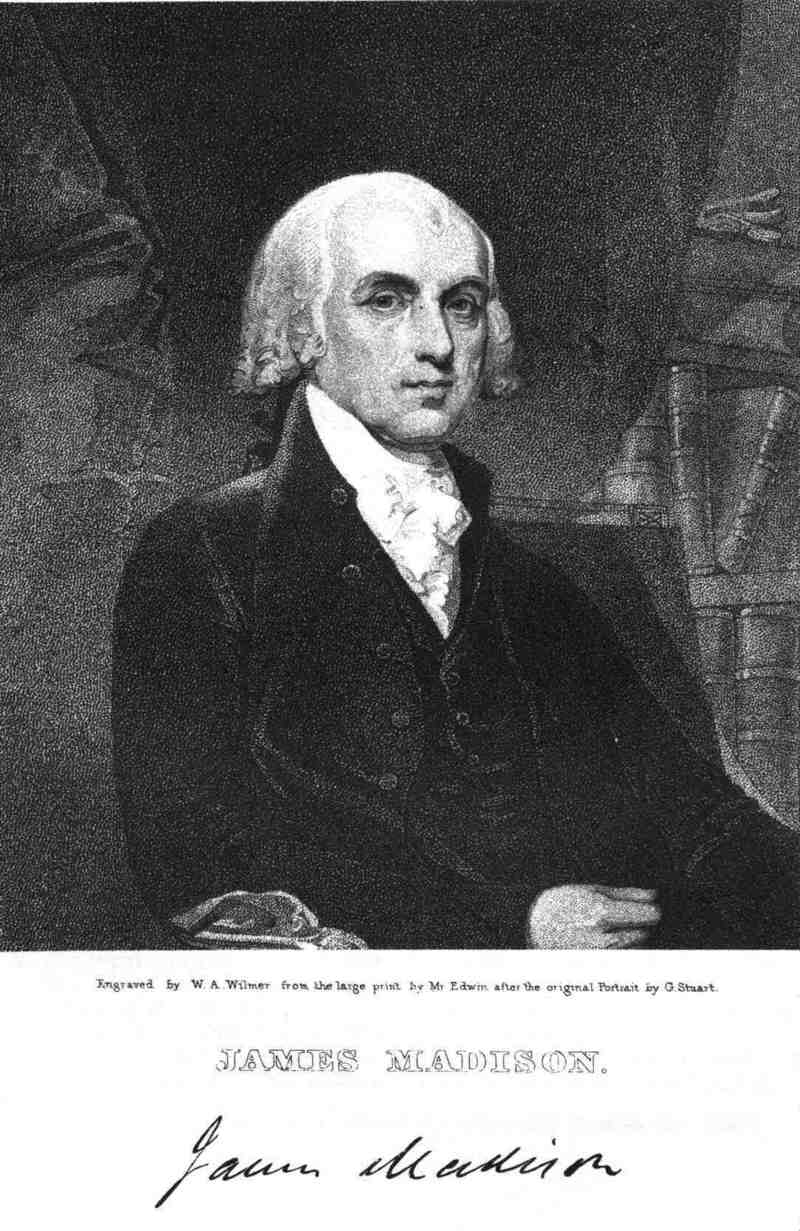
[Ed.  note — is it just me, or for a President, does Madison not look cool?

James_madison_engraving_after_stuar

A Wild-Less California in 2050?

That’s what a New York Times op-ed sees coming — in just 43 years. Verlyn Klinkenborg writes:

In 2007, we remain blindly impervious to the life-claims of almost
all other forms of life — to the moral stipulation that their right to
life is equivalent to ours. How it will be then I do not know, but if
there are indeed 60 million people living in California in 2050, there
will be nothing meaningful to be said on the matter, except as a
subject of nostalgia.

We like to take it for granted that we’re
moving ahead in environmental consciousness. We like to hope that the
curve of our environmental awareness will catch up to the curve of our
economic growth and things will somehow come into balance. But faith in
our progressive enlightenment seems a little misplaced to me,
especially when I remember a speech that James Madison gave to his
local agricultural society nearly 190 years ago.

Madison said,
simply, that we have no reason to suppose that all of Earth’s
resources, which support so much living diversity, can rightfully be
commandeered to support mankind alone. It seems incredible to me, in
2007, that a former president could articulate such an environmentally
sound principle of conscience. But it’s a principle that should move to
the very center of our thinking. It should cause us to re-examine not
just how we shop and what we drive and who we elect but also how our
species reproduces. It should cause us to re-imagine that once and
future California, which lies only 43 years away, and make sure that it
isn’t barren of all but us humans.

I confess, part of me simply cannot face this. When I first read the piece, I mistook Klinkenborg’s reference to a mid-21st century to 2150, and thought, well, that’s a way’s off…but 2050! It’s conceivable I could be alive to see this wildless California…