“Storm World” — Understanding Hurricanes Today

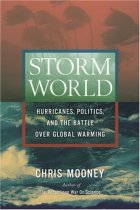
On his site, science writer Chris Mooney recently posted a fascinating pair of graphs, courtesy of collaborator Matt Nisbet, which chart public interest in global warming. As the years march by, the charts show what happens when scientific reports are released, when politics intervene — and when hurricanes strike, as measured by coverage at the Washington Post and the New York Times.

What the graphs show is that in these thoughtful newspapers, political and scientific developments can spur stories, but when hurricanes strike, global warming coverage–and, presumably, public interest–soars.

This is why Mooney’s new book, Storm World, matters — even though the writer takes every possible opportunity to remind readers that we cannot definitively link global warming to any hurricane. The book matters because our fears as a nation do link global warming and hurricanes, and when it comes to modern-day hurricanes the size of Texas, as we saw in 2005, our eyes open wide.

My review continues on Grist…take a look.

Storm_world_2

Just Lookin’

Don’t often talk about the movies in this space, despite my love for them, but for Barbara Stanwyck, born one hundred years ago today, we must make an exception. And must link to a superb essay by Anthony Lane, that ran earlier this year in The New Yorker.

He includes a snatch of dialogue from a l943 movie, "Lady of Burlesque," in which she played a showgirl who had grown up backstage. She described it this way:

I went into show business when
I was seven years old. Two days later the first comic I ever met stole
my piggy bank at a railroad station in Portland. When I was eleven, the
comics were looking at my ankles. When I was fourteen, they were . . .
just lookin’. 

You said it, sister.

Barbara_stanwyck_in_l937


Tracking Glaciers, Now and Then

An excellent front-page story in the New York Times looks at the alarmingly rapid retreat of glaciers in India. This is a disaster in the making: although floods are expected in the next couple of decades, then water supplies will rapidly diminish…for one/sixth of the world’s population.

According to another first-hand account reporting on the main glacier near Mt. Everest, Rongbuk, entire ice formations have vanished already (see picture below).

But today I want to highlight something different. Contrast the scientific reporting of John Muir, in the Sierras in the mid-19th century, with the reporting of an Indian scientists in the Himalayas today.

Here’s Muir, from a letter written on October 8th, 1872:

I planted five stakes in the glacier of Mount McClure which is situated east of Yosemite Valley near the summit of the Range. Four of these stakes were extended across the glacier in a straight line, from the east side to a point near the middle of the glacier. the first stake was planted about twenty-five yards from the east side of the glacier, the second, ninety-four yards, the third, one hundred and fifty-two, and the fourth, two hundred and twenty-five yards. The positions of these stakes were determined by sighting across from bank to bank past a plumb-line made of a stone and a black horsehair.

And here’s the NYTimes report on an Indian scientist, Mr. Dohbal, explaining why estimates of water resources are so spotty and uncertain.

To spend a couple of days with Mr. Dobhal, 44, a glaciologist with
the Wadia Institute for Himalayan Geology, a government-sponsored
research institution based in the North Indian city of Dehradun, is to
understand why there is not more research on these glaciers. It is
lonely, time-consuming work, equally demanding of body and mind.

Mr.
Dobhal’s days begin inside a tent, not particularly well-suited for
such chilly heights, usually around 5:30, with prayers and a cup of hot
tea.

This morning’s journey is just above the base camp, to
about 12,800 feet, where Mr. Dobhal must install a set of crude bamboo
rulers to measure the undulations of the ice. The drilling machine in
this case is a steady hiss of steam that comes out of a steam machine
carried on the back and inserted into the glacier through a long,
narrow pipe. Mr. Dobhal drives it slowly, expertly through the solid
black ice, taking care to drill an absolutely straight 13-foot-long
hole.

When it is done, the bamboo pole slides in effortlessly.
When he is finished, there will be 40 such stakes up and down the
Chorabari, in the upper reaches where the ice accumulates in winter,
all the way down to where the snout spills its meltwaters. Over the
next months, the stakes will record the rise and fall of the ice — in
other words, changes in the glacier’s total mass.

Downstream,
where the glacier’s meltwater becomes what is known as the Mandakini
River, comes another set of crucial measurements. Six times a day, Mr.
Dobhal and his aides, all ethnic gurkhas from Nepal, measure the depth
of the water and the speed at which it flows. It is a remarkably simple
experiment, like one you might do for a high school science fair. A
square wooden paddle, attached to a string, is floated down the
channel. A stopwatch measures how long it takes to travel 23 feet.

“This
will tell me how much water we are getting from one glacier and at
different seasons — how much in summer, how much in winter, how much in
the rainy season,” was Mr. Dobhal’s explanation.

So here’s my question: Was Muir ahead of his time? Or is India behind our time?

In any case, here’s an alarming picture of the disappearing glacier at the foot of Everest:

Rongbuk_glacier_near_everest

Half-Dome: A New Photographic Classic

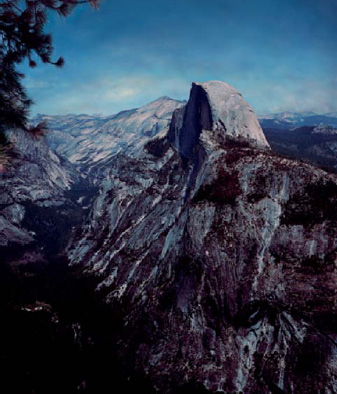
In Aperture magazine can be found a fascinating interview and a great picture of Half-Dome by a young German photographer named Florian Maier-Aichen.

He calls his picture "The Best General View," which is both a reference to a classic photograph from the 19th-century by Carleton Atkins, and also a sly nod to his method, which blends all sorts of manipulation, digital and otherwise, in service of the final image. As he told Aperture:

I do not really care about believability; the ultimate goal is a good picture, no matter how you got there. I am interested in creating a picture beyond the photograph.

But from my perspective, not only has Maier-Aichen succeeded in creating a good picture, but he has  created a fully believable picture, in that the sky as it usually appears above Half-Dome in photographs is not washed out, as is usually the case these days, and the stone has not a shiny flatness, but a darkness suggestive of weight and mass.

Funny how manipulation can be more real than "reality" — at least according to the lens– itself.

As art critic Christopher Knight put it for the Los Angeles Times:

He does for the postmodern world of digital imagery what camera work
attempted in the 19th and early 20th centuries, when various
pictorialists used painting’s strategies and motifs in photographs.
Modern photographic orthodoxy asserts that the world seen directly
through a camera’s lens is richer than imagination in creative
possibility.

Halfdome_by_florian_maieraichen

Sunday Morning on the Planet: Trees

Especially in this heat, we treasure our trees, soaking up the sun, holding back the clamor from the nearby road, keeping us sane. Here’s a favorite poem for many on the subject by the revered W.S. Merwin, courtesy of Garrison Keillor’s lively Writer’s Almanac:

Trees


I am looking at trees
they may be one of the things I will miss
most from the earth
though many of the ones I have seen
already I cannot remember
and though I seldom embrace the ones I see
and have never been able to speak
with one
I listen to them tenderly
their names have never touched them
they have stood round my sleep
and when it was forbidden to climb them
they have carried me in their branches

As Teddy Roosevelt Said (Regarding Climate Change and other Difficult Matters)

"In any moment of decision, the best thing you can do is the right thing. The worst thing you can do is nothing."

As quoted by his great-grandson Theodore Roosevelt IV, a Republican environmental activist, who was on the scene in Florida this week as Arnold Schwarzenneger joined with Charlie Crist to celebrate the passing of a bill to reduce Florida’s carbon emissions to l990 levels by 2025.

Patti Smith Reminds Us: A Parallel World

Patti Smith, one of the great rockers of the last thirty years, is on tour in Europe, and takes the time–via her coffeebreak blog–to remind us of something.

Hearing the people chanting Gloria in Paris when I faltered. Hearing
the people singing like a choir in Oslo to A perfect day. So beautiful
and touching that I stopped singing and wept. Sitting alone in the Zoo
Café in the Berlin train station having a coffee watching the
torrential rain.


What have I found? The people warm and friendly. All ages. All
wondering what will happen in our world. What can one say? Bad things
are happening. We must make other things happen. Good things. Build a
parallel world. Celebrate that even in the worst of times we are alive.

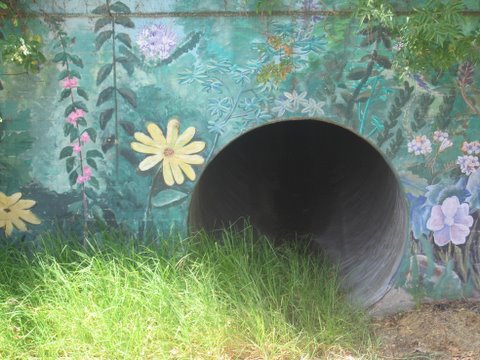
A good example of "building a parallel world" are the folks at Friends of the L.A. River, who have begun resurrecting the river on which a great city was founded, a river later trapped in a straitjacket of concrete. They’re turning back the clock on the present-day ugliness, one drainage pipe at a time, in what the organization’s founder, Lewis MacAdams, likes to call his "forty-year art project."

Near_the_la_river

Leading Republican Calls Most Americans “Wimps”

This is really a ThinkProgress item, but for some reason they haven’t run it, so as ol’ B. Dylan would say, I guess it’s up to me.

Yesterday John Boehner of Ohio, the House Minority (Republican) leader, accused Senators of both parties opposed to escalating the war of being "wimps," according to The Hill.

Since 71% of Americans want out of Iraq by next April, according to the Gallup Poll, and 79% think the so-called surge is either making little difference or making matters worse, Boehner therefore is  attacking most Americans as cowardly.

In his past, Boehner–a man who once handed out checks from tobacco lobbyists to fellow Congressmen on the floor of the House–served six weeks in the Navy before being discharged with a bad back. 

China Fouls Environment; Tolerates Environmentalists

Fasincating story by Cynthia Larson in The Washington Monthly on China called The Green Leap Forward.

Topics for further research: the story came out of a lengthy reporting trip, and has too much content to be reduced to a single point or two, but it has many shocking facts.

For one, it claims that on a bad day, one-quarter of the smog in L.A. "originates in China."

Hmmmm.

It introduces us to an English translation of a jaw-droppingly great Chinese site called China Water Pollution Map, launched by a Chinese activist named Ma Jun, one of the world’s most influential enviros, which charts rivers and streams on the Internet and catalogues the pollution they absorb.

This may not surprise you, but most of the news from China is not good:

Already the costs of environmental cleanup, property damage, and lost
productivity are staggering. China’s State Council, the nation’s
highest administrative body, reported that pollution cost the country
more than $200 billion in 2005, almost 10 percent of the country’s GDP.
Industry releases 2,000 tons of airborne mercury each year, which
settles into the soil, contaminating 12 million tons of grain each year
and threatening food safety, including China’s $31 billion agricultural
export market. (Time reported that only 6 percent of Chinese agricultural products imported to the United States are free from pollution.)

Adopting the adage of the time—“Pollute now, clean up later”—Lanzhou
became northwest China’s primary hub for oil refineries and
petrochemical plants. Today, the city stretches long and narrow between
the Gaolan and White Pagoda mountains, but on many days thick smog
masks their peaks. Just by breathing the city air, Lanzhou’s
3 million residents inhale the equivalent of a pack of cigarettes a
day. Ten percent of the Yellow River near Lanzhou is now sewage, and
last year three industrial spills turned its waters an ominous red.

The World Bank predicts that in the next fifteen years, China’s
shortage of clean water will create 30 million “environmental refugees.”

Here’s a great public picture from a Flickr photographer named +graemetric. He lives in the mostly new city of Dailan, a city of a mere three million or so, largely built around computer work. He has some interesting thoughts about "slavers" and the future.

He says that in China, "all apocalypses are forbidden in the run up to Beijing 2008."

Slavers_in_dailan