Pretty amazing: the adventurous aspect of science. Seeing this, who wouldn’t want to be a "forest canopy scientist?"
Hat Tip: Jim Levett
A Change in the Wind
Pretty amazing: the adventurous aspect of science. Seeing this, who wouldn’t want to be a "forest canopy scientist?"
Hat Tip: Jim Levett
Perhaps I was too kind. The NYTimes editorial today:
Given Mr. Bush’s history of denial and obstructionism when it comes to climate change, there are good reasons to be cynical about this sudden enthusiasm [for action on global warming], coming as it does on the eve of the meeting of the Group of 8 industrialized nations.
The European Union’s chief environmental minister, Stavros Dimas:
The declaration by
President Bush basically restates the U.S. classic line on climate change — no mandatory reductions, no carbon trading and vaguely expressed objectives.
Dana Milbank, on the scene at the White House for the Washington Post, has doubts:
…the plan the White House outlined yesterday listed no concrete targets or dates, no enforcement mechanism and no penalties for noncompliance. It also wouldn’t take effect until four years after Bush leaves office. It was, rather, a call to spend the final 18 months of the Bush presidency forming an aspirational goal.
Matt Yglesias does make the point I was trying to make, albeit more succintly:
Politically, though, it’s always significant when an issue shifts from the category of things Republicans are willing to admit they don’t care about to things they feel compelled to pretend they care about.
But Getty Images catches Bush smirking before his climate change speech.
I’m depressed.
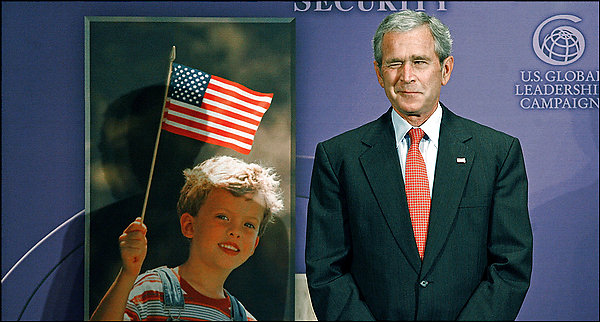
That’s the headline. Crtics have been quick to reject this as a "do-nothing" strategy, pointing out that the U.S. has refused to sign on to Germany’s proposal to reduce emissions sufficient to hold warming to 2 degrees C, which may be necessary to avoid disaster.
They have a strong point. But if this is a do-nothing stance, at least it’s a new do-nothing stance, and one that does call for international efforts to reduce greenhouse gas emissions.
When Vaclav Havel and other dissidents were battling the Soviet Union, he often pointed to laws on the books that gave individuals civil rights. He knew–everyone knew–that these laws weren’t enforced. But asking the powers that be to live up to their promises had a cumulative effect, like the proverbial water on a stone, as his subsequent popular takeover of the Czech Republic proved.
It’s too soon to dismiss this shift on the part of the Bush administration. Calling for action, even if it’s not enough, is not the same as saying action is unnecessary, or pointless, or will "wreck" the economy.
This is a new day, and a new speech. It’s mostly about technology–nuclear and the fabled "clean coal"–but still, given that Bush was a "dissident" on global warming not so long ago, it’s a step.

Following hints that Tony Blair has dropped repeatedly, a White House reporter named Sheryl (perhaps Sheryl Stolberg of the NYTimes) does ask a question about climate change. My mistake. To wit:
Q Scott, Tony Blair, in an interview with the BBC, apparently said that we might see, "the beginnings of action on global warming and climate change at the G8," that he feels the U.S. might sign up to some kind of early action. Any response to that?
MR. STANZEL: I haven’t seen his comments, but certainly as a matter of principle, the President has long understood that global climate change is occurring, humans are having an impact on that. We’ve dedicated over $35 billion of funding to climate research. We just had a report — I believe it was earlier this week — that CO2 emissions in this country have gone down. We’re well on our way to meeting the President’s goal of cutting CO2 emissions — greenhouse gas intensity, that is — by 18 percent by 2012. So we look forward to those talks.
Q But does the President aim to sign an international agreement on global warming at —
MR. STANZEL: You know, we look forward to working with our partners on that important issue; however, it’s important that all parties be addressed when talking about multilateral agreements. And we have had concerns in the past about countries not being involved, and countries that do have a large impact on global climate change.
Q Was Tony Blair wrong?
MR. STANZEL: I haven’t seen his comments, so I trust that your BlackBerry is accurate — (laughter) — but I haven’t seen his comments.
(This is not the first time Tony Blair has tried to pressure the Bush administration on the issue with public statements about his hopes for a deal, but unfortunately, it’s not working. In fact, according to a Financial Times story earlier this month, the U.S. is trying to "water down" a G8 plan to hold global warming to 2 degrees Centrigrade this century with CO2 emissions reductions limits. No real action is expected to come out of negotiations next week, and Germany’s top climate official warns that if no quantifiable limits on emissions are set, the G8 summit "will have failed completely."
Instead of following up Blair’s weak hopes for action, maybe a reporter could follow up on the Germans’ bluntly realistic threats of inaction? Especially since the summit will take place in Germany?)
Despite being under tremendous pressure from their corporate overlords, the denizens of the LATimes continue to put out a remarkably good newspaper. Yesterday they ran the best editorial on reducing carbon emissions this reporter has ever seen, with a terrific lede:
If you have kids, take them to the beach. They should enjoy it while it lasts, because there’s a chance that within their lifetimes California’s beaches will vanish under the waves.
That’s defining the stakes clearly, isn’t it? The editorial went on to explain the options to reduce carbon emissions–"command and control" regulation, "cap-and-trade," and the carbon tax–and showed why a carbon tax is the best and fairest option, even if it’s not yet popular with politicians.
What I like especially is the way the editorial dug into the flaws of a cap-and-trade system. To wit:
Cap-and-trade would also have a nasty effect on consumers’ power bills. Say there’s a very hot summer week in California. Utilities would have to shovel more coal to produce more juice, causing their emissions to rise sharply. To offset the carbon, they would have to buy more credits, and the heavy demand would cause credit prices to skyrocket. The utilities would then pass those costs on to their customers, meaning that power bills might vary sharply from one month to the next.
That kind of price volatility, which has been endemic to both the American and European cap-and-trade systems, doesn’t just hurt consumers. It actually discourages innovation, because in times when power demand is low, power costs are low, and there is little incentive to come up with cleaner technologies.
That’s so clear even I may be able to remember it. Thank you, LATimes…and here’s a picture of a Western coal plant, about which New No. 2 has a plaintive question.

A prominent Eastern poet, Elizabeth Spires, has been writing about the natural world lately. In this poem, published by Ploughshares last year, she identifies with an ancient sea creature, the Coelacanth, which was long thought to be extinct, only to be brought up abruptly from 1500 feet below the surface.
She concludes:
You and I, we live in depths profound and ceaseless,
we swim against cold currents until, nettedand gasping, we are shocked to find out
not what we are,
but what we have never been.
I love her ability to see beyond the obvious, to see a blindness both in our omnipresence and this curious creature’s obscurity.
And here’s an even more interesting poem, just published in The New Criterion.
You have flown to the dangerous country,
how easily you have left this life behind,
this street, this quiet city street,
where letters arrive each day dependably,
where trees make a canopy in summer,
and winter, it is winter now, possesses a cold clarity.But in the place where you are there is heat,
there is hunger, and the trees have been cut down,
and dogs, there must be dogs, slink out of the night’s
blackness, teeth bared, and the sound of drumming penetrates
your sleep even when there are no drums. And slowly,
you begin to forget the words we are used to saying here,
they speak another language there, a language that has no place
for words like snow and safety, a language I will never know
because I have never been to the dangerous country,
and I do not think I will go.
That’s just the start. Sounds kinda like…
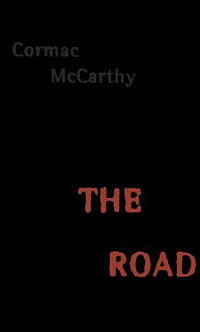
John Dickerson in Slate notes that when his Iraq strategy was questioned in a press conference, the Prez resorted to threatening the children of reporters with al-Qaida:
"They are a threat to your children, David," he said to NBC’s David Gregory . It’s an understandable instinct [writes Dickerson]. To persuade, we try to appeal to common experience. Policy debates can get abstract. Mention someone’s children, though, and they get concrete fast. The president found this such a useful tool that he used it a second time in the same press conference. "I would hope our world hasn’t become so cynical that they don’t take the threats of al-Qaida seriously, because they’re real, and it’s a danger to the American people," he said in response to a question about the war from Jim Rutenberg of the New York Times. "It’s a danger to your children, Jim."
Pardon my obviousness, but if the Prez can sic Osama bin Laden on our children, couldn’t the Washington press corps ask him how he can justify doing nothing about global warming?
As James Lovelock points out in "The Revenge of Gaia:"
Past and present atmospheric pollution with carbon dioxide and methane is similar to the natural release of these gases fifty-five million years ago, when comparable quantities of carbon entered the atmopshere. Then the temperature rose about 8 degrees Centrigrade in the temperate northern regions and 5C in the tropics; the consequences of this heating lasted 200,000 years.
Lovelock foresees this happening within fifty years, baring huge changes made starting now. He’s a little ahead of the climatological consensus, but only by two or three decades, and he’s known for his ability to see the work of life on the planet as a whole.
Give me a choice between a few thousand religious fanatics in robes who want to attack the symbols of our dominance, and an atmosphere shifting to a new mode likely to doom our way of life in these United States, and I’ll take the terrorists. Call me an environmental whacko, but I kinda like our climate as it is.
Sunday was the 100th birthday of Rachel Carson, the science writer who more than anyone else awakened the world to the risk of what the New Yorker once called our "effluent society."
The U.S. Senate was prepared to honor her this year, but that effort was blocked by Oklahoma Senator Tom Coburn, because Carson spoke out against DDT and other pesticides. In a nice post sent in Deborah Byrd of the big and extremely informative Earth and Sky science radio program, Carson’s biographer, Linda Lear, points out on the show’s site that Carson never called for a ban on DDT or any pesticide.
And as the great E. B. White put it, in an appreciation written after Carson’s death in l964:
American justice holds the accused person innocent until proved guilty; somehow this concept has crept over into industry, where it doesn’t belong, and has been applied to products of all kinds. Why should a poison dust or spray, however greatly it may advantage a grower or a housewife in a private project, enjoy immunity while there is any reason to suspect that it may endanger the public health or damage the natural scene? Rachel Carson posed this question and spent years of hard work documenting her thesis. She was not a fanatic or a cultist. She was not against chemicals per se. She was against the indiscriminate use of strong, enduring poisons capable of subtle, long-term damage to plants, animals, and man. No contributor to these pages more effectively combined a warm passion for nature’s mysteries with a cool warning that things can easily go wrong. We take her words seriously, and we’d like to see government departments set aside their jealousies and declare poison guilty until proved innocent.
We might add that for her efforts, Carson was hounded by Monsanto, American Cyanamid, and (according to Time) the whole American chemical industry, and called "probably a Communist" by a former Secretary of Agriculture.
White also includes a lovely quote from Carson, in which she contrasts her perception in "this particular instant of time that is mine" against the overwhelmingly vast sweep of the sea. A true naturalist, her thoughts inevitably go to the bigger picture…

Well, I’m a day late, but my friend Aug sends in a story perfect for my oft-neglected "good news Friday" feature. This one is about Ray Anderson, a highly successful carpet manufacturer based in Georgia.
Back in the 90’s, Anderson came to a sudden realization about his business:
I was running a company that was plundering the earth. I thought, "Damn, some day people like me will be put in jail!" It was a spear in the chest.
Since then he’s completely changed the way his company does business, from the bottom up, but the results have been better than he ever would have guess.
Our costs are down, not up. Our products are the best they have ever been. Our people are motivated by a shared higher purpose — esprit de corps to die for. And the goodwill in the marketplace — it’s just been astonishing.
Read the whole thing, by Cornelia Dean, in the NYTimes. It’s called "Executive on a Mission: Saving the Planet." Anderson now even has a consulting firm, helping other businesses go green. Go Ray!


 Kit Stolz